Table of Contents
Introduction
Trodelvy is the brand name for sacituzumab govitecan, an antibody-drug conjugate (ADC) used for the treatment of certain advanced or metastatic cancers, particularly triple-negative breast cancer (TNBC) and hormone receptor-positive/HER2-negative breast cancer after prior therapies. It combines the targeting capability of a monoclonal antibody with the potent cytotoxic activity of a chemotherapy payload.
Sacituzumab govitecan specifically targets Trophoblast Cell Surface Antigen 2 (Trop-2), a transmembrane glycoprotein that is highly expressed on many epithelial cancers. After binding to Trop-2-expressing tumor cells, the drug delivers SN-38, the active metabolite of irinotecan, directly into cancer cells, resulting in DNA damage and tumor cell death.
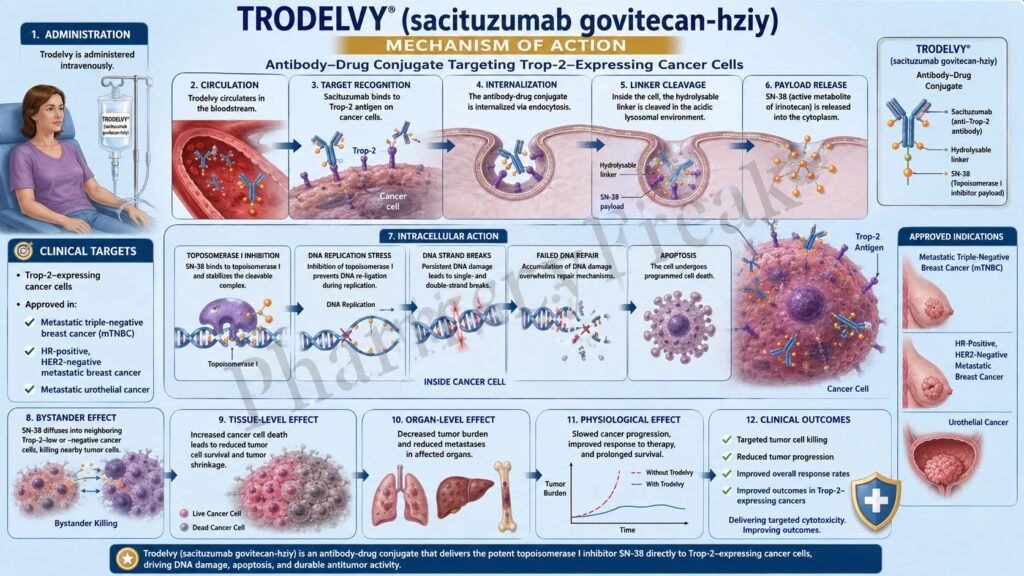
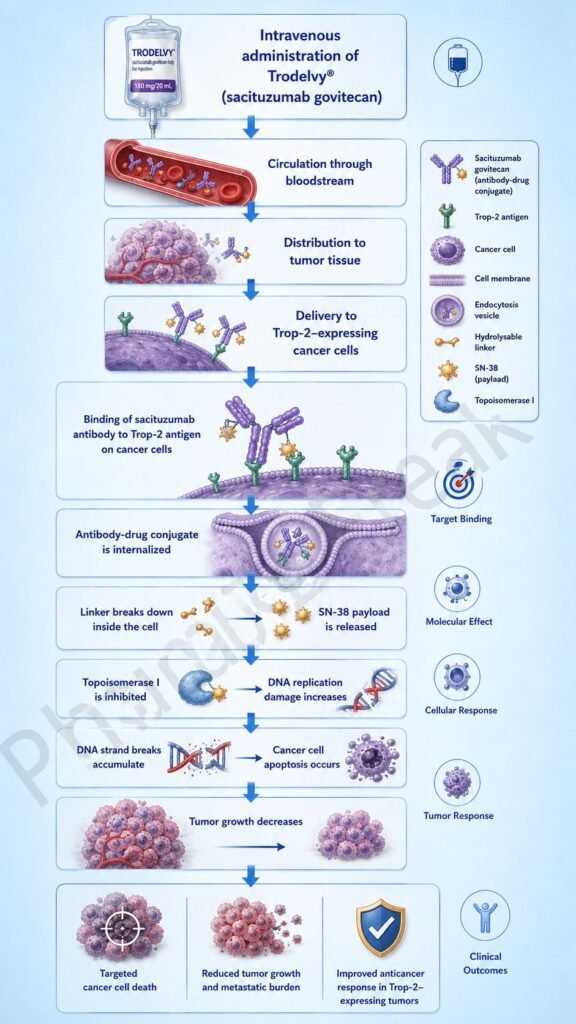
Mechanism of Action (Step-wise)
Sacituzumab govitecan exerts its anticancer effects through targeted delivery of a topoisomerase I inhibitor to Trop-2-expressing tumor cells.
1. Expression of Trop-2 on Tumor Cells
Trop-2 is a cell surface glycoprotein overexpressed in many cancers, including:
- Triple-negative breast cancer
- HR-positive/HER2-negative breast cancer
- Urothelial carcinoma
- Endometrial cancer
- Other epithelial malignancies
High Trop-2 expression is associated with tumor growth, proliferation, invasion, and poor prognosis.
2. Administration and Systemic Circulation
Sacituzumab govitecan is administered by intravenous infusion.
After entering systemic circulation:
- The monoclonal antibody component remains intact.
- It circulates throughout the body.
- It selectively recognizes and binds Trop-2-expressing cancer cells.
3. Binding to Trop-2 Receptors
The antibody portion of sacituzumab govitecan specifically binds to Trop-2 molecules on tumor cell surfaces.
This targeted binding allows:
- Selective delivery of cytotoxic therapy
- Increased drug concentration at tumor sites
- Reduced exposure of normal tissues
4. Internalization of the Antibody-Drug Complex
Following Trop-2 binding:
- The antibody-receptor complex is internalized.
- The complex enters intracellular endosomal and lysosomal compartments.
- Linker degradation occurs within the tumor cell.
5. Release of SN-38
Sacituzumab govitecan contains SN-38 attached through a hydrolyzable linker.
Inside tumor cells:
- SN-38 is released from the antibody.
- Active drug concentrations accumulate intracellularly.
SN-38 is approximately 100–1000 times more potent than irinotecan itself.
6. Inhibition of Topoisomerase I
SN-38 inhibits topoisomerase I, an enzyme responsible for relieving torsional stress during DNA replication and transcription.
Normally, topoisomerase I:
- Creates temporary single-strand DNA breaks.
- Relieves DNA supercoiling.
- Reseals DNA strands after relaxation.
SN-38 stabilizes the topoisomerase I-DNA cleavage complex and prevents DNA religation.
7. DNA Damage and Replication Arrest
Because DNA breaks cannot be repaired properly:
- Single-strand breaks accumulate.
- Replication forks collapse.
- Double-strand DNA breaks develop.
- DNA synthesis is interrupted.
Rapidly proliferating cancer cells are particularly vulnerable to this damage.
8. Induction of Apoptosis
Persistent DNA damage activates:
- DNA damage response pathways
- Cell cycle checkpoints
- Caspase activation
- Apoptotic signaling cascades
The tumor cell ultimately undergoes programmed cell death.
9. Bystander Effect
A unique feature of sacituzumab govitecan is its bystander effect.
Released SN-38 can diffuse into nearby tumor cells that may have lower Trop-2 expression.
This contributes to broader antitumor activity within heterogeneous tumors.
10. Final Therapeutic Effect
The overall effects include:
- Targeted delivery of chemotherapy
- Inhibition of DNA replication
- Tumor cell apoptosis
- Reduction in tumor burden
- Improved disease control in Trop-2-expressing cancers
Thus, Trodelvy acts as a Trop-2-directed antibody-drug conjugate that delivers SN-38 to tumor cells and inhibits topoisomerase I, leading to DNA damage and cancer cell death.
Pharmacokinetics
Sacituzumab govitecan is administered intravenously.
- Given by IV infusion.
- Distributed throughout vascular and tumor compartments.
- Undergoes receptor-mediated cellular uptake.
- Releases SN-38 through linker hydrolysis.
- SN-38 is metabolized primarily by UGT1A1.
- Eliminated through biliary and fecal pathways.
- Terminal half-life of sacituzumab govitecan is approximately 15–20 hours.
- SN-38 half-life is approximately 18–20 hours.
Patients with reduced UGT1A1 activity may experience increased toxicity.
Clinical Uses
Metastatic Triple-Negative Breast Cancer (mTNBC)
Approved for previously treated unresectable or metastatic TNBC.
HR-Positive/HER2-Negative Breast Cancer
Used in advanced disease following prior endocrine and systemic therapies.
Advanced Urothelial Carcinoma
Used in selected patients with previously treated metastatic disease.
Trop-2-Expressing Solid Tumors
Being investigated for additional Trop-2-positive malignancies.
Adverse Effects
Common adverse effects include:
- Nausea
- Vomiting
- Diarrhea
- Fatigue
- Alopecia
- Decreased appetite
Important adverse effects include:
- Severe neutropenia
- Febrile neutropenia
- Severe diarrhea
- Infection
- Anemia
- Hypersensitivity reactions
- Infusion-related reactions
Patients with UGT1A1 polymorphisms may be at increased risk of hematologic toxicity.
Comparative Analysis
| Drug | Target | Payload | Mechanism | Major Indication |
|---|---|---|---|---|
| Sacituzumab Govitecan | Trop-2 | SN-38 | Topoisomerase I inhibition | TNBC, HR+/HER2− breast cancer |
| Trastuzumab Emtansine (T-DM1) | HER2 | DM1 | Microtubule inhibition | HER2-positive breast cancer |
| Trastuzumab Deruxtecan | HER2 | Deruxtecan | Topoisomerase I inhibition | HER2-positive cancers |
| Enfortumab Vedotin | Nectin-4 | MMAE | Microtubule inhibition | Urothelial carcinoma |
| Brentuximab Vedotin | CD30 | MMAE | Microtubule inhibition | Hodgkin lymphoma |
Sacituzumab govitecan differs from other antibody-drug conjugates because it targets Trop-2 and delivers SN-38, a topoisomerase I inhibitor. Unlike ADCs carrying microtubule inhibitors, Trodelvy causes DNA damage through inhibition of DNA repair and replication mechanisms.
MCQs
1. Trodelvy contains which active ingredient?
a) Trastuzumab deruxtecan
b) Sacituzumab govitecan
c) Enfortumab vedotin
d) Brentuximab vedotin
Answer: b) Sacituzumab govitecan
2. Trodelvy targets which tumor antigen?
a) HER2
b) EGFR
c) Trop-2
d) CD20
Answer: c) Trop-2
3. Sacituzumab govitecan belongs to which drug class?
a) Tyrosine kinase inhibitor
b) Antibody-drug conjugate
c) Checkpoint inhibitor
d) Antimetabolite
Answer: b) Antibody-drug conjugate
4. The cytotoxic payload in Trodelvy is:
a) MMAE
b) DM1
c) SN-38
d) Cisplatin
Answer: c) SN-38
5. SN-38 inhibits:
a) Topoisomerase II
b) Topoisomerase I
c) DNA polymerase
d) RNA polymerase
Answer: b) Topoisomerase I
6. Inhibition of topoisomerase I results in:
a) Increased DNA repair
b) DNA strand break accumulation
c) Enhanced protein synthesis
d) Increased angiogenesis
Answer: b) DNA strand break accumulation
7. Trodelvy is approved for:
a) Metastatic triple-negative breast cancer
b) Asthma
c) Hypertension
d) Rheumatoid arthritis
Answer: a) Metastatic triple-negative breast cancer
8. Which enzyme metabolizes SN-38?
a) CYP3A4
b) UGT1A1
c) CYP2D6
d) MAO-A
Answer: b) UGT1A1
9. A major adverse effect of Trodelvy is:
a) Hyperkalemia
b) Severe neutropenia
c) Ototoxicity
d) Hypoglycemia
Answer: b) Severe neutropenia
10. Trodelvy is administered by:
a) Oral route
b) Subcutaneous injection
c) Intravenous infusion
d) Intramuscular injection
Answer: c) Intravenous infusion
11. The bystander effect refers to:
a) Activation of immune cells only
b) Drug diffusion into nearby tumor cells
c) Increased platelet aggregation
d) Enhanced renal clearance
Answer: b) Drug diffusion into nearby tumor cells
12. The final effect of sacituzumab govitecan is:
a) Tumor cell apoptosis
b) Increased tumor growth
c) Enhanced angiogenesis
d) DNA repair activation
Answer: a) Tumor cell apoptosis
FAQs
What is the mechanism of action of Trodelvy?
Trodelvy (sacituzumab govitecan) binds to Trop-2 on cancer cells and delivers SN-38, a topoisomerase I inhibitor, causing DNA damage and tumor cell death.
What type of drug is Trodelvy?
Trodelvy is an antibody-drug conjugate (ADC) consisting of a Trop-2-directed monoclonal antibody linked to SN-38.
What is Trop-2?
Trop-2 is a cell surface glycoprotein commonly overexpressed in several epithelial cancers and serves as the target for Trodelvy.
How does SN-38 kill cancer cells?
SN-38 inhibits topoisomerase I, preventing DNA strand repair and leading to accumulation of DNA damage, replication arrest, and apoptosis.
What cancers is Trodelvy used to treat?
It is approved for metastatic triple-negative breast cancer, HR-positive/HER2-negative breast cancer, and certain cases of advanced urothelial carcinoma.
What are the major adverse effects of Trodelvy?
The most significant adverse effects include severe neutropenia, diarrhea, infection risk, anemia, and infusion-related reactions.
What is the bystander effect of Trodelvy?
Released SN-38 can diffuse into nearby tumor cells, including cells with lower Trop-2 expression, enhancing overall antitumor activity.
References
Goodman & Gilman’s The Pharmacological Basis of Therapeutics
Katzung Basic & Clinical Pharmacology