Table of Contents
Mechanism of Action of Otezla (Apremilast)
Introduction
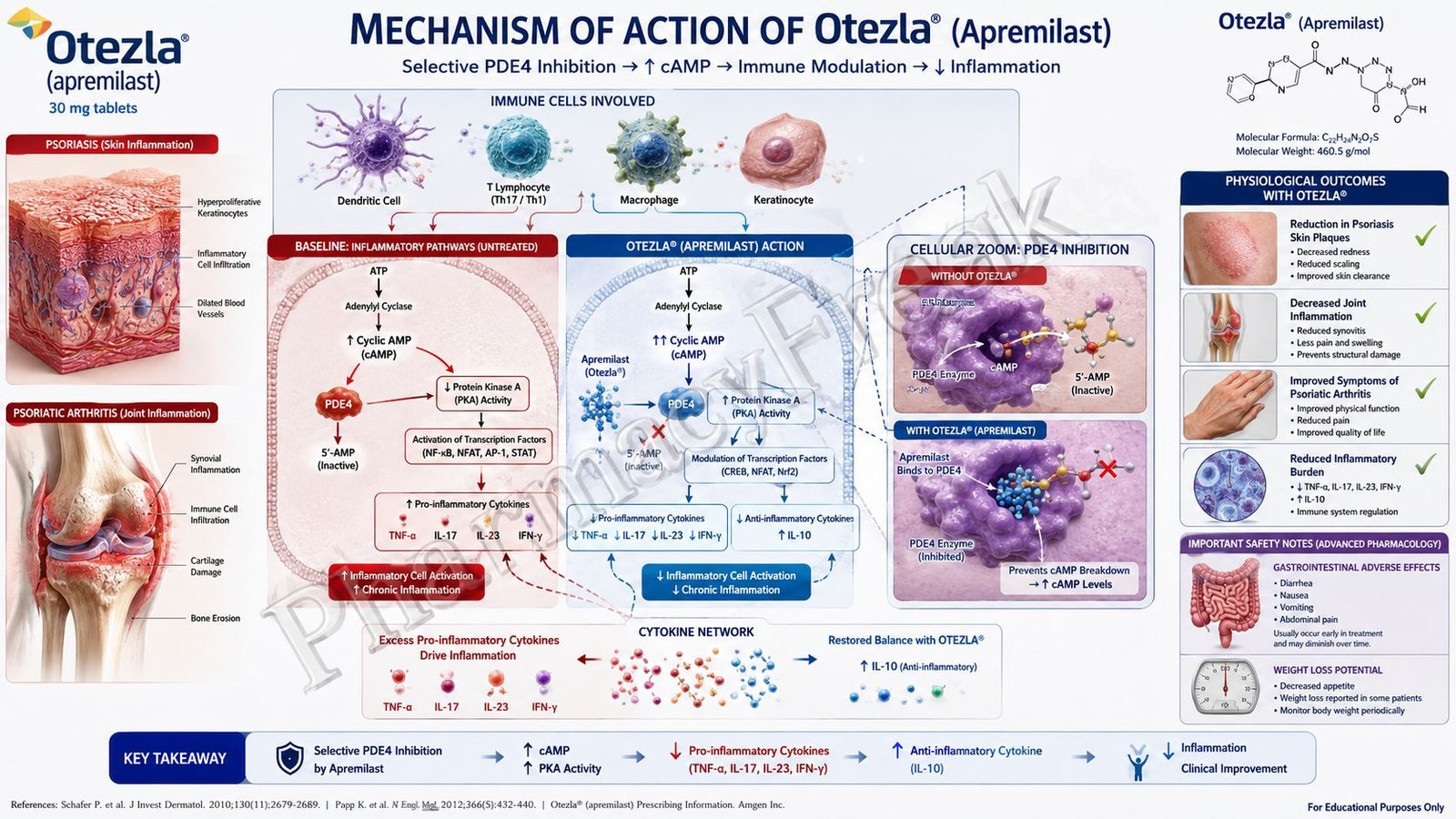
Otezla is the brand name for apremilast, an oral phosphodiesterase-4 (PDE4) inhibitor used for the treatment of plaque psoriasis, psoriatic arthritis, oral ulcers associated with Behçet’s disease, and other inflammatory conditions. Unlike biologic therapies that target specific cytokines, apremilast works intracellularly by modulating inflammatory signaling pathways through cyclic adenosine monophosphate (cAMP).
Inflammatory diseases such as psoriasis and psoriatic arthritis are characterized by excessive production of pro-inflammatory cytokines including tumor necrosis factor-alpha (TNF-α), interleukin-17 (IL-17), interleukin-23 (IL-23), and interferon-gamma (IFN-γ). By inhibiting PDE4, apremilast increases intracellular cAMP levels and helps restore balance between pro-inflammatory and anti-inflammatory mediators.
Mechanism of Action (Step-wise)
Apremilast exerts its anti-inflammatory effects through selective inhibition of phosphodiesterase-4 (PDE4).
1. Role of PDE4 in Immune Cells
Phosphodiesterase-4 is an intracellular enzyme highly expressed in:
- T lymphocytes
- Monocytes
- Macrophages
- Dendritic cells
- Neutrophils
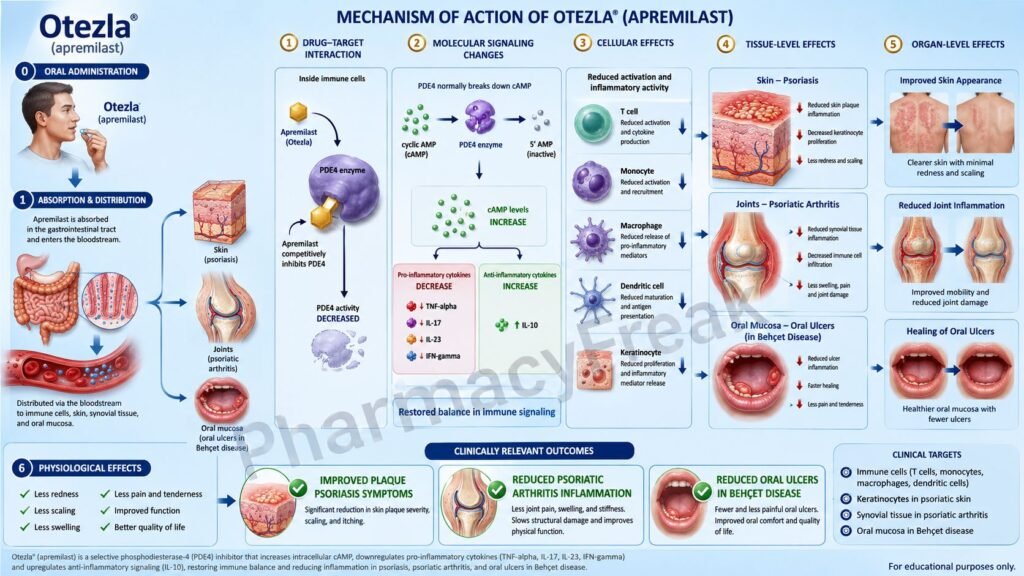
PDE4 is responsible for degrading cyclic adenosine monophosphate (cAMP) into inactive AMP.
Under normal conditions, PDE4 limits intracellular cAMP levels.
2. Oral Administration and Cellular Uptake
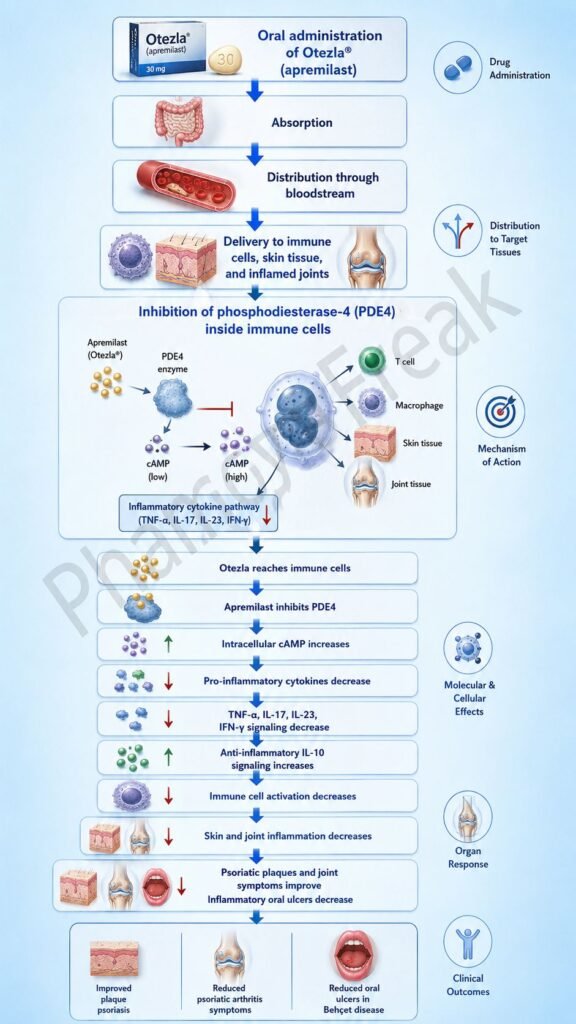
After oral administration, apremilast is absorbed into systemic circulation and distributed throughout the body.
The drug enters immune and inflammatory cells where PDE4 enzymes are located.
3. Selective Inhibition of PDE4
Apremilast selectively inhibits phosphodiesterase-4.
As a result:
- Breakdown of cAMP is reduced.
- Intracellular cAMP concentrations increase.
- Cellular signaling pathways are altered.
This is the primary pharmacological action of apremilast.
4. Activation of cAMP-Dependent Signaling
Elevated cAMP activates protein kinase A (PKA).
PKA subsequently influences several intracellular transcription pathways that regulate inflammatory mediator production.
These pathways affect gene expression within immune cells.
5. Reduction of Pro-Inflammatory Cytokines
Increased cAMP signaling decreases production of multiple inflammatory cytokines, including:
- TNF-α
- IL-17
- IL-23
- IFN-γ
- IL-12
Reduction of these cytokines helps suppress chronic inflammation.
6. Increase in Anti-Inflammatory Cytokines
Apremilast also promotes production of anti-inflammatory mediators such as:
- Interleukin-10 (IL-10)
This helps restore immunologic balance and further suppress inflammatory responses.
7. Suppression of Inflammatory Cell Activity
The combined reduction in inflammatory cytokines leads to:
- Reduced T-cell activation
- Reduced inflammatory cell recruitment
- Decreased keratinocyte activation
- Reduced joint inflammation
- Decreased tissue damage
8. Improvement of Psoriatic Disease
In psoriasis and psoriatic arthritis, reduced cytokine activity results in:
- Decreased skin inflammation
- Reduced plaque formation
- Improved joint symptoms
- Reduced disease progression
9. Final Therapeutic Effect
The overall effects include:
- Reduced inflammation
- Decreased cytokine production
- Improvement in psoriatic lesions
- Reduced joint symptoms
- Better control of chronic inflammatory disease
Thus, apremilast acts as a selective PDE4 inhibitor that increases intracellular cAMP and modulates inflammatory cytokine production.
Pharmacokinetics
Apremilast is administered orally and is well absorbed from the gastrointestinal tract.
- Oral bioavailability is approximately 70–75%.
- Peak plasma concentrations occur within approximately 2–3 hours.
- Widely distributed throughout the body.
- Extensively metabolized in the liver.
- CYP3A4 is the primary metabolic enzyme.
- Additional metabolism occurs through CYP1A2 and CYP2A6.
- Excreted through both urine and feces.
- Elimination half-life is approximately 6–9 hours.
Strong CYP3A4 inducers may reduce the effectiveness of apremilast.
Clinical Uses
Plaque Psoriasis
Used in adults with moderate-to-severe plaque psoriasis.
Psoriatic Arthritis
Reduces joint inflammation and improves physical function.
Oral Ulcers Associated with Behçet’s Disease
Reduces frequency and severity of oral ulcers.
Inflammatory Skin Disorders
May be used in selected inflammatory dermatologic conditions.
Patients Unsuitable for Biologic Therapy
Provides an oral alternative to injectable biologic agents.
Adverse Effects
Common adverse effects include:
- Diarrhea
- Nausea
- Headache
- Upper respiratory tract infections
- Abdominal pain
- Vomiting
Important adverse effects include:
- Weight loss
- Depression
- Mood changes
- Suicidal ideation (rare)
- Severe gastrointestinal intolerance
- Dehydration secondary to diarrhea
Patients should be monitored for significant mood changes and unexplained weight loss.
Comparative Analysis
| Drug | Target | Mechanism | Major Uses | Key Limitation |
|---|---|---|---|---|
| Apremilast | PDE4 | Increases intracellular cAMP | Psoriasis, psoriatic arthritis, Behçet’s disease | GI adverse effects |
| Adalimumab | TNF-α | TNF-α inhibition | Psoriasis, PsA, RA | Injection therapy |
| Secukinumab | IL-17A | IL-17 blockade | Psoriasis, PsA | Injection therapy |
| Ustekinumab | IL-12/23 | IL-12 and IL-23 blockade | Psoriasis, PsA | Injection therapy |
| Methotrexate | Dihydrofolate reductase pathway | Immunosuppression | Psoriasis, PsA, RA | Hepatotoxicity |
Unlike biologic agents that target a single cytokine, apremilast acts intracellularly to broadly modulate multiple inflammatory mediators through PDE4 inhibition. It offers the advantage of oral administration but may be less potent than certain biologic therapies in severe disease.
MCQs
1. Otezla contains which active ingredient?
a) Secukinumab
b) Apremilast
c) Adalimumab
d) Methotrexate
Answer: b) Apremilast
2. Apremilast primarily inhibits:
a) PDE4
b) COX-2
c) TNF-α directly
d) JAK enzymes
Answer: a) PDE4
3. PDE4 normally degrades:
a) ATP
b) cAMP
c) cGMP
d) GTP
Answer: b) cAMP
4. PDE4 inhibition leads to:
a) Reduced cAMP levels
b) Increased cAMP levels
c) Increased calcium influx
d) Reduced ATP production
Answer: b) Increased cAMP levels
5. Elevated cAMP activates:
a) Protein kinase A
b) Protein kinase C
c) Tyrosine kinase receptors
d) JAK enzymes
Answer: a) Protein kinase A
6. Apremilast decreases production of:
a) TNF-α
b) IL-17
c) IL-23
d) All of the above
Answer: d) All of the above
7. Otezla is approved for treatment of:
a) Psoriatic arthritis
b) Hypertension
c) Asthma
d) Tuberculosis
Answer: a) Psoriatic arthritis
8. A common adverse effect of apremilast is:
a) Diarrhea
b) Nephrotoxicity
c) Ototoxicity
d) Hyperkalemia
Answer: a) Diarrhea
9. Which anti-inflammatory cytokine may increase with apremilast therapy?
a) IL-10
b) TNF-α
c) IL-17
d) IL-23
Answer: a) IL-10
10. Apremilast is administered by:
a) Intravenous infusion
b) Subcutaneous injection
c) Oral route
d) Intramuscular injection
Answer: c) Oral route
11. Which enzyme is primarily responsible for apremilast metabolism?
a) CYP2D6
b) CYP3A4
c) CYP2C9
d) CYP2E1
Answer: b) CYP3A4
12. One important monitoring parameter during therapy is:
a) Mood changes and weight loss
b) Thyroid function
c) Visual acuity
d) Bone density
Answer: a) Mood changes and weight loss
FAQs
What is the mechanism of action of Otezla?
Otezla (apremilast) selectively inhibits phosphodiesterase-4 (PDE4), increasing intracellular cAMP levels and reducing production of inflammatory cytokines.
Is apremilast a biologic drug?
No. Apremilast is a small-molecule oral PDE4 inhibitor, not a biologic monoclonal antibody.
How does apremilast help psoriasis?
It reduces inflammatory cytokines such as TNF-α, IL-17, and IL-23 that drive psoriatic skin inflammation and plaque formation.
What conditions is Otezla approved to treat?
Otezla is approved for plaque psoriasis, psoriatic arthritis, and oral ulcers associated with Behçet’s disease.
Why does apremilast cause diarrhea?
PDE4 inhibition can affect gastrointestinal signaling pathways, leading to diarrhea and nausea, especially during initiation of therapy.
Can Otezla cause depression?
Depression and mood changes have been reported in some patients. Monitoring is recommended, particularly in individuals with a history of psychiatric illness.
Is Otezla an immunosuppressant?
It is considered an immunomodulatory agent that regulates inflammatory pathways rather than causing broad immunosuppression like some traditional immunosuppressive drugs.
References
Goodman & Gilman’s The Pharmacological Basis of Therapeutics
Katzung Basic & Clinical Pharmacology