Table of Contents
Introduction
Tricyclic antidepressants (TCAs) are a class of antidepressant drugs used in major depressive disorder, neuropathic pain, migraine prophylaxis, obsessive-compulsive disorder, and certain anxiety disorders. Common TCAs include amitriptyline, nortriptyline, imipramine, desipramine, and clomipramine. Their primary action is inhibition of serotonin and norepinephrine reuptake, leading to increased concentrations of these neurotransmitters in the central nervous system.
Mechanism of Action (Step-wise)
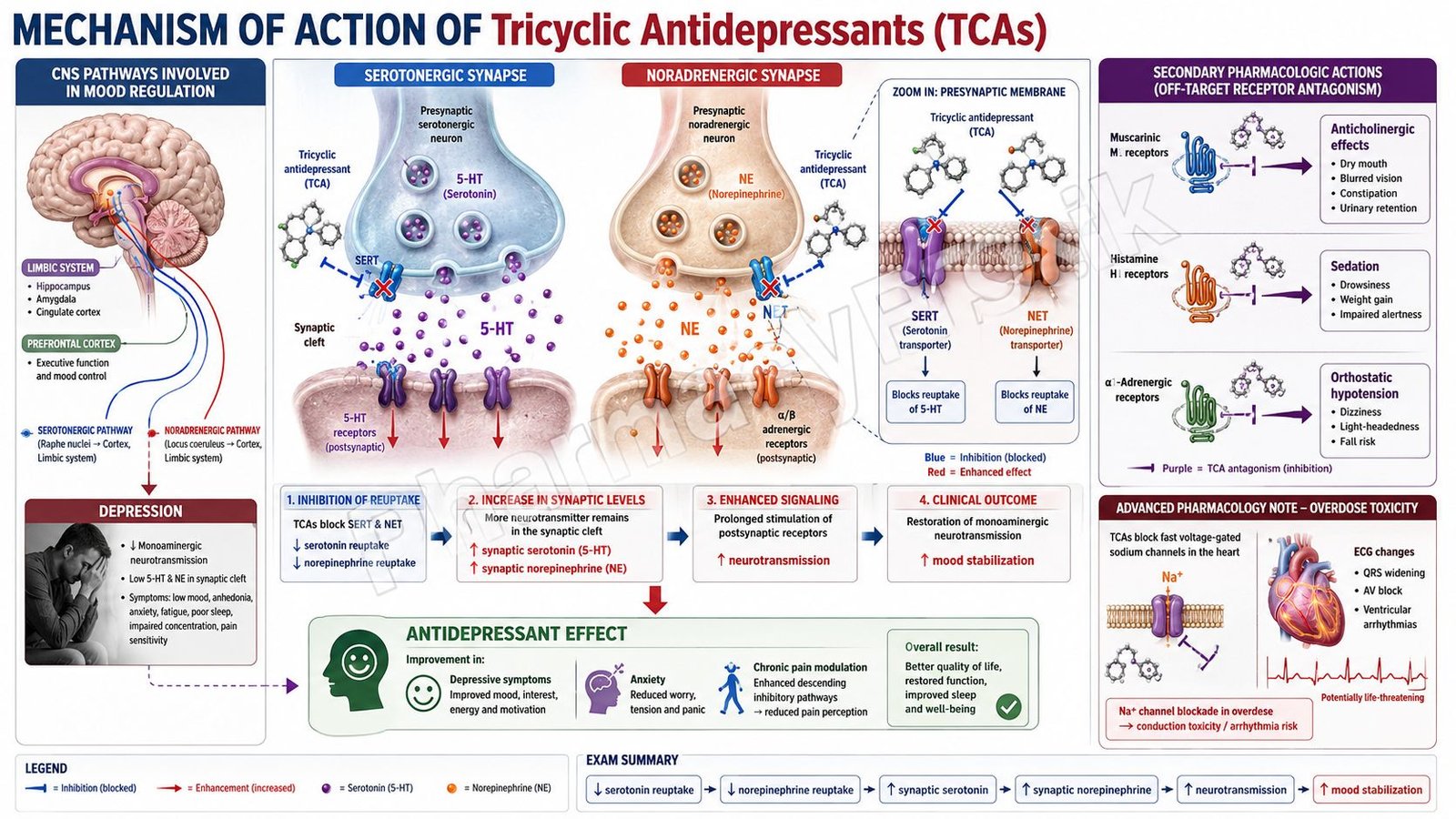
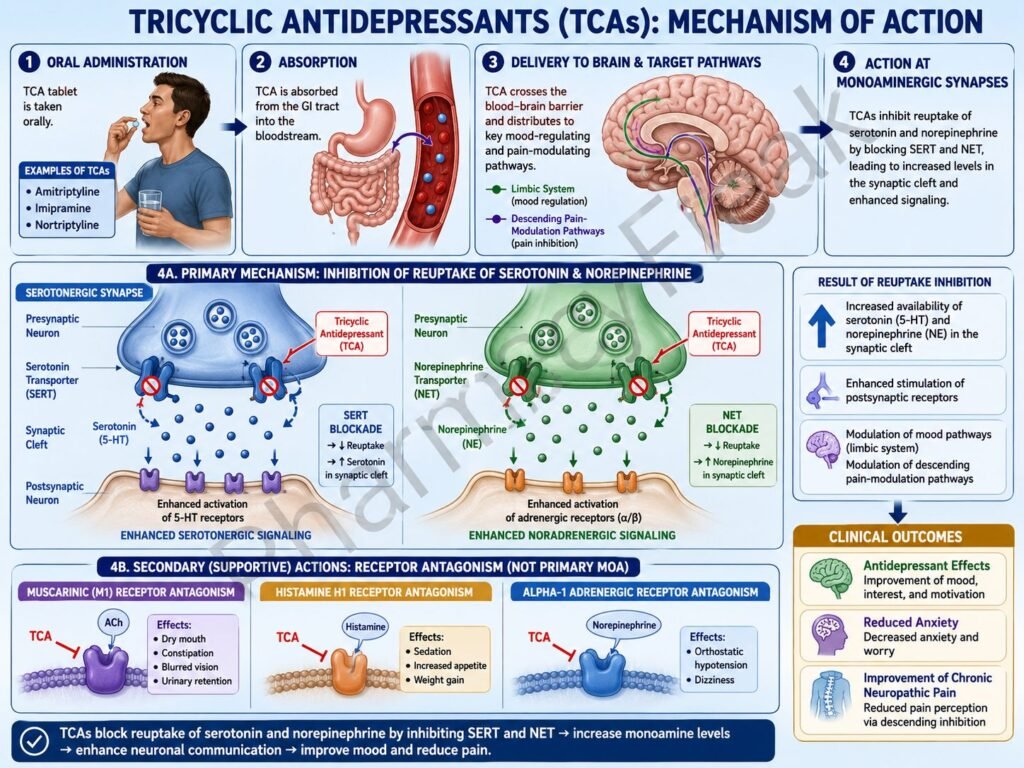
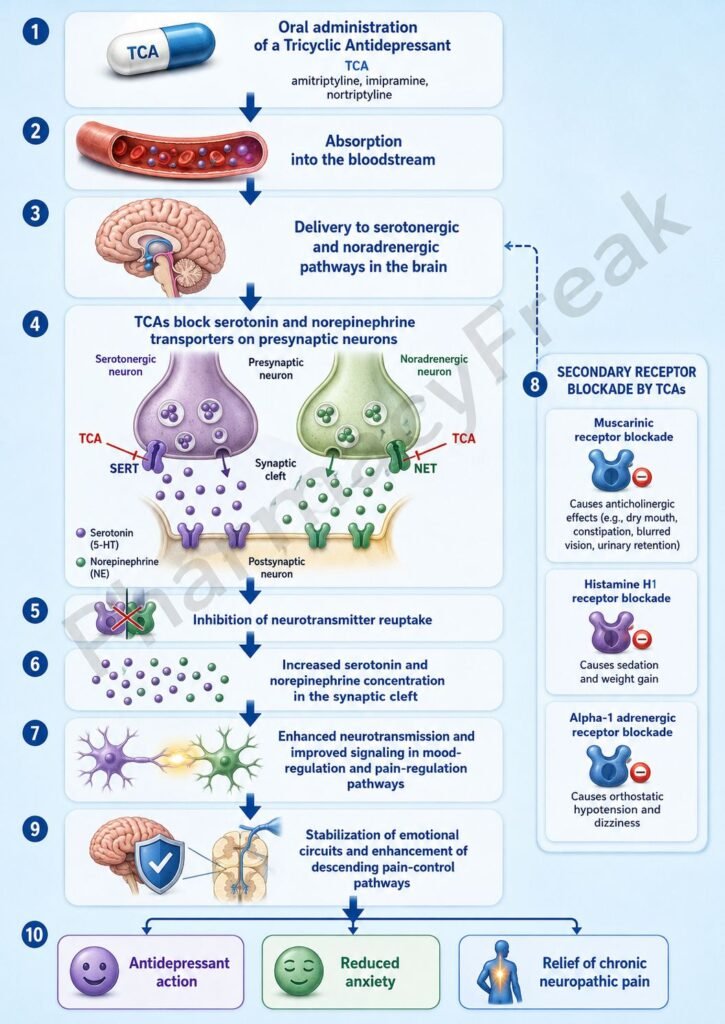
- TCAs enter the central nervous system and act on presynaptic neurons.
- They inhibit the norepinephrine transporter (NET).
- NET normally reuptakes norepinephrine from the synaptic cleft into presynaptic nerve terminals.
- Inhibition of NET increases synaptic norepinephrine concentration.
- TCAs also inhibit the serotonin transporter (SERT).
- SERT normally reuptakes serotonin (5-HT) into presynaptic neurons.
- Inhibition of SERT increases serotonin concentration within the synaptic cleft.
- Increased serotonin and norepinephrine enhance neurotransmission in mood-regulating pathways.
- Chronic treatment produces adaptive changes in receptor sensitivity and neuronal signaling.
- TCAs also block muscarinic cholinergic receptors.
- Histamine H1 receptors are antagonized, contributing to sedation.
- α1-adrenergic receptors are blocked, causing vasodilation and orthostatic hypotension.
- At high concentrations, TCAs block cardiac sodium channels.
- The overall effect is antidepressant activity with additional analgesic and sedative properties.
A key exam point is that TCAs inhibit reuptake of both norepinephrine and serotonin by blocking NET and SERT.
Pharmacokinetics
TCAs are administered orally and are well absorbed. They undergo extensive hepatic metabolism and have relatively long half-lives. Most TCAs are highly protein-bound and eliminated through hepatic metabolism followed by renal excretion of metabolites.
Clinical Uses
TCAs are used in:
- Major depressive disorder
- Neuropathic pain
- Diabetic neuropathy
- Migraine prophylaxis
- Obsessive-compulsive disorder (clomipramine)
- Nocturnal enuresis (imipramine)
- Chronic pain syndromes
Adverse Effects
Common adverse effects include:
- Dry mouth
- Constipation
- Blurred vision
- Urinary retention
- Sedation
- Weight gain
- Orthostatic hypotension
Serious adverse effects include:
- Cardiac arrhythmias
- QT prolongation
- Seizures
- Severe toxicity in overdose
Because of sodium channel blockade, TCA overdose is considered a medical emergency.
Comparative Analysis
| Feature | TCAs | SSRIs | SNRIs |
|---|---|---|---|
| Main neurotransmitters affected | Serotonin + norepinephrine | Serotonin | Serotonin + norepinephrine |
| NET inhibition | Yes | No | Yes |
| SERT inhibition | Yes | Yes | Yes |
| Anticholinergic effects | Strong | Minimal | Mild |
| Sedation | Common | Mild | Mild |
| Overdose toxicity | High | Low | Moderate |
TCAs differ from SSRIs because they affect both norepinephrine and serotonin while also blocking muscarinic, histamine, and α1 receptors. Compared with SNRIs, TCAs generally have more anticholinergic effects and greater overdose toxicity.
MCQs
1. The primary mechanism of TCAs is:
a) MAO inhibition
b) NET and SERT inhibition
c) Dopamine receptor blockade
d) GABA enhancement
Answer: b) NET and SERT inhibition
2. TCAs increase synaptic levels of:
a) Dopamine only
b) Serotonin and norepinephrine
c) Histamine and acetylcholine
d) GABA and glycine
Answer: b) Serotonin and norepinephrine
3. The serotonin transporter is abbreviated as:
a) DAT
b) NET
c) SERT
d) VMAT
Answer: c) SERT
4. TCAs commonly block:
a) Muscarinic receptors
b) Insulin receptors
c) Glucagon receptors
d) Mineralocorticoid receptors
Answer: a) Muscarinic receptors
5. Histamine H1 receptor blockade causes:
a) Hypertension
b) Sedation
c) Bronchospasm
d) Tachycardia
Answer: b) Sedation
6. α1 receptor blockade causes:
a) Orthostatic hypotension
b) Hyperglycemia
c) Hypercalcemia
d) Bronchoconstriction
Answer: a) Orthostatic hypotension
7. TCAs are commonly used for:
a) Neuropathic pain
b) Asthma
c) Hyperthyroidism
d) Tuberculosis
Answer: a) Neuropathic pain
8. A common anticholinergic adverse effect is:
a) Dry mouth
b) Diarrhea
c) Bradycardia
d) Sweating
Answer: a) Dry mouth
9. A major danger in TCA overdose is:
a) Cardiac arrhythmia
b) Hyperthyroidism
c) Hypercalcemia
d) Polycythemia
Answer: a) Cardiac arrhythmia
10. Which of the following is a TCA?
a) Fluoxetine
b) Amitriptyline
c) Sertraline
d) Venlafaxine
Answer: b) Amitriptyline
11. TCAs block cardiac:
a) Potassium channels only
b) Sodium channels
c) Calcium channels only
d) Chloride channels
Answer: b) Sodium channels
12. The antidepressant effect of TCAs is primarily due to increased:
a) Serotonin and norepinephrine neurotransmission
b) Histamine release
c) Dopamine degradation
d) Acetylcholine breakdown
Answer: a) Serotonin and norepinephrine neurotransmission
FAQs
What is the mechanism of action of TCAs?
TCAs inhibit reuptake of serotonin and norepinephrine by blocking SERT and NET transporters.
Why are TCAs effective in neuropathic pain?
Increased norepinephrine and serotonin enhance descending inhibitory pain pathways in the spinal cord.
What are common side effects of TCAs?
Dry mouth, constipation, sedation, urinary retention, and orthostatic hypotension.
Why is TCA overdose dangerous?
Because TCAs block cardiac sodium channels, causing potentially fatal arrhythmias.
How do TCAs differ from SSRIs?
TCAs inhibit both serotonin and norepinephrine reuptake and have significant anticholinergic effects.
Which TCA is commonly used for OCD?
Clomipramine.
References
Goodman & Gilman’s The Pharmacological Basis of Therapeutics
https://accessmedicine.mhmedical.com/book.aspx?bookid=3191
Katzung’s Basic and Clinical Pharmacology
https://accessmedicine.mhmedical.com/content.aspx?bookid=3382
Tripathi KD. Essentials of Medical Pharmacology
https://www.jaypeedigital.com
Harrison’s Principles of Internal Medicine
https://accessmedicine.mhmedical.com