Table of Contents
Introduction
Vitamin K is a fat-soluble vitamin essential for normal blood coagulation and bone metabolism. It acts as a cofactor in the synthesis of several clotting factors and regulatory proteins through a process known as γ-carboxylation. Without adequate vitamin K, the liver cannot produce fully functional coagulation factors, leading to impaired blood clotting and an increased risk of bleeding.
Vitamin K exists in multiple forms, including phylloquinone (vitamin K₁), which is primarily obtained from green leafy vegetables, and menaquinones (vitamin K₂), which are produced by intestinal bacteria and found in certain animal and fermented foods. In clinical practice, vitamin K is used to treat vitamin K deficiency, reverse the effects of warfarin, and prevent hemorrhagic disease of the newborn.
Mechanism of Action (Step-wise)
Vitamin K plays a crucial role in the post-translational modification of clotting factors required for normal hemostasis.
1. Absorption and Transport
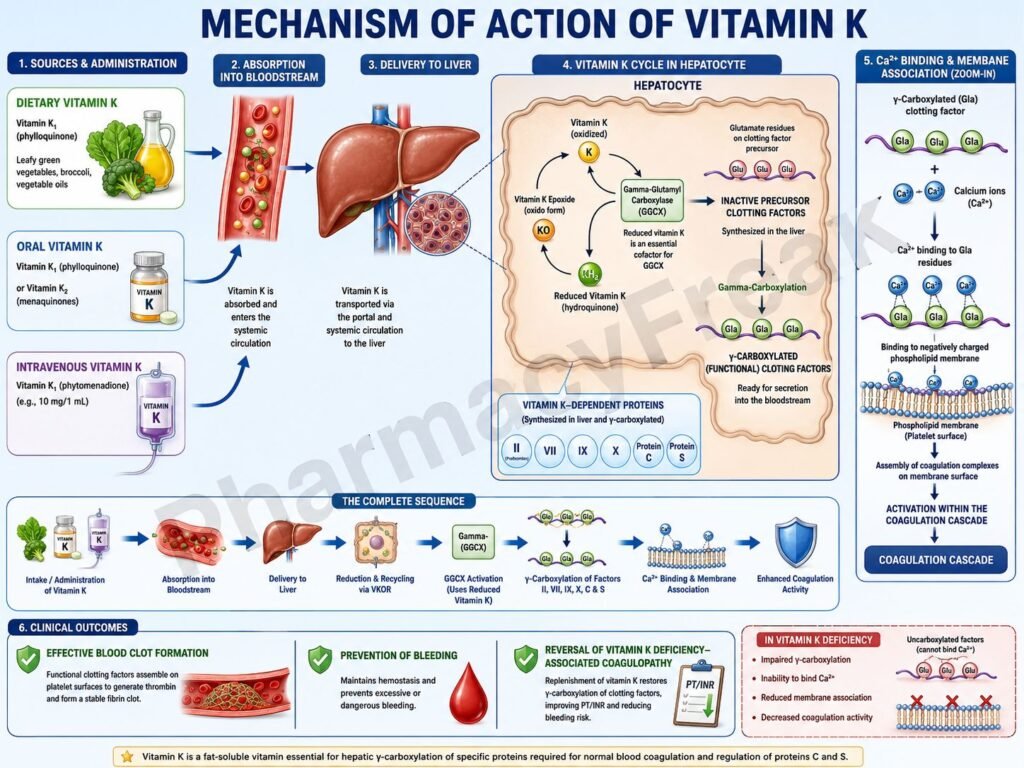
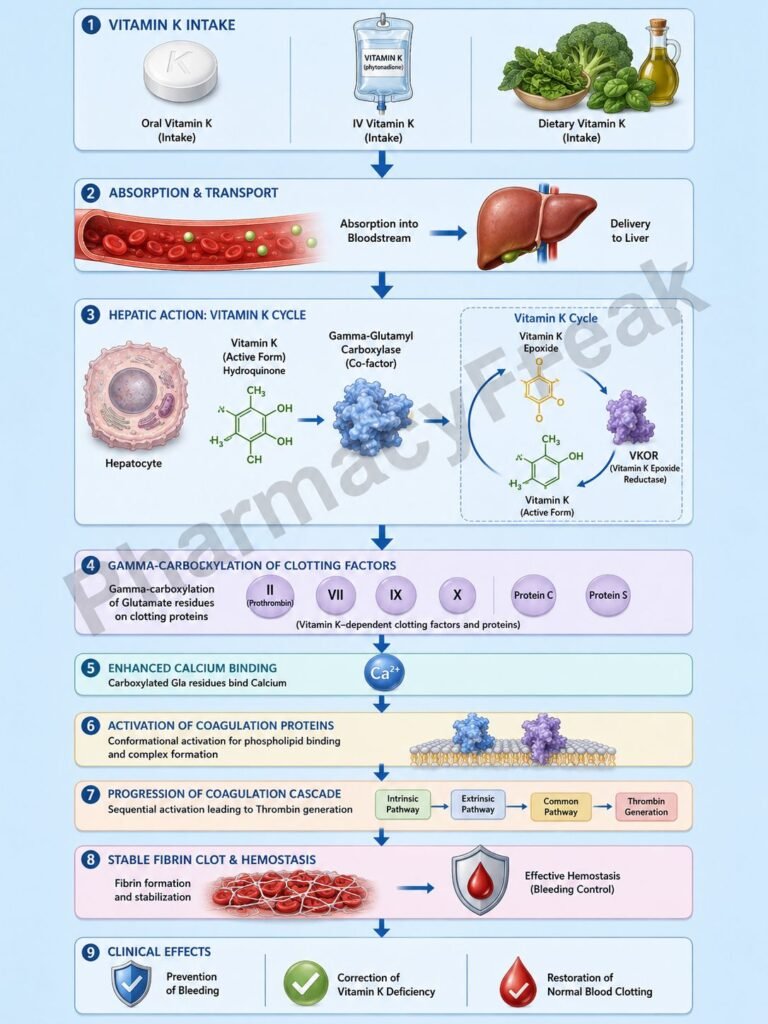
Vitamin K is absorbed from the small intestine along with dietary fats.
Following absorption:
- It is incorporated into chylomicrons.
- Transported through lymphatic circulation.
- Delivered primarily to the liver.
The liver is the major site where vitamin K participates in coagulation factor synthesis.
2. Function as a Cofactor for γ-Glutamyl Carboxylase
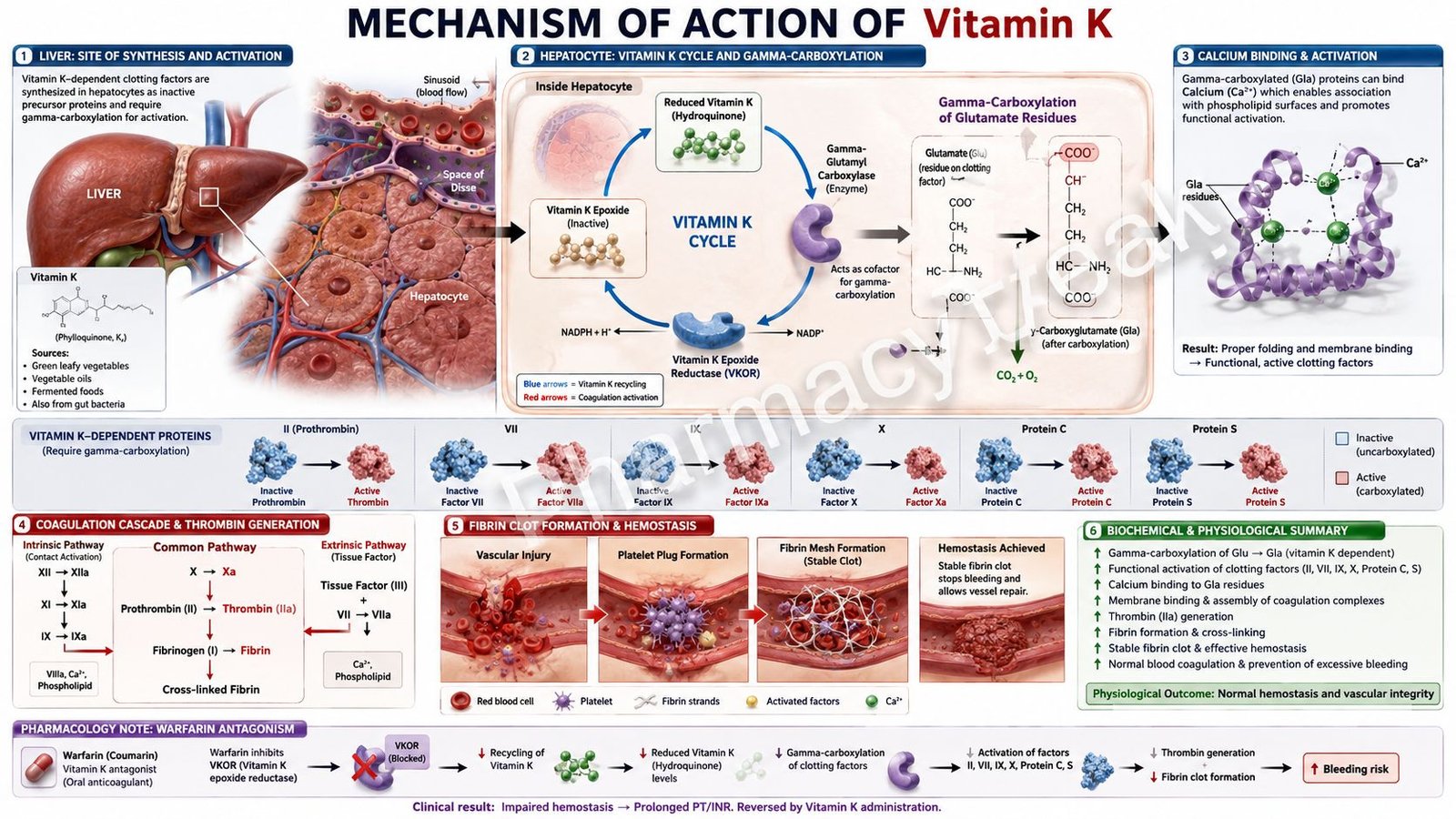
Inside hepatocytes, vitamin K acts as an essential cofactor for the enzyme γ-glutamyl carboxylase.
This enzyme catalyzes the conversion of specific glutamate residues into γ-carboxyglutamate (Gla) residues on clotting proteins.
This modification is critical for biological activity.
3. Activation of Clotting Factors
Vitamin K-dependent γ-carboxylation is required for the synthesis of:
- Clotting Factor II (Prothrombin)
- Factor VII
- Factor IX
- Factor X
- Protein C
- Protein S
- Protein Z
Without γ-carboxylation, these proteins remain biologically inactive.
4. Calcium Binding Capability
The newly formed γ-carboxyglutamate residues allow clotting factors to bind calcium ions.
Calcium binding enables these factors to:
- Attach to phospholipid membranes
- Participate in coagulation complexes
- Promote thrombin generation
This step is essential for effective blood clot formation.
5. Vitamin K Oxidation During the Reaction
During γ-carboxylation, reduced vitamin K (vitamin K hydroquinone) is oxidized to vitamin K epoxide.
As a result, vitamin K must be recycled for continued function.
6. Vitamin K Recycling (Vitamin K Cycle)
The enzyme vitamin K epoxide reductase (VKOR) converts vitamin K epoxide back to its active reduced form.
This recycling process allows repeated use of vitamin K for clotting factor synthesis.
Warfarin exerts its anticoagulant effect by inhibiting VKOR, thereby preventing regeneration of active vitamin K.
7. Role in Bone Metabolism
Vitamin K also promotes γ-carboxylation of bone proteins such as:
- Osteocalcin
- Matrix Gla protein
These proteins contribute to:
- Bone mineralization
- Skeletal health
- Regulation of calcium deposition
8. Final Physiological Effect
The overall effects of vitamin K include:
- Production of functional clotting factors
- Maintenance of normal hemostasis
- Prevention of bleeding
- Support of bone metabolism
- Regulation of calcium utilization
Thus, vitamin K functions primarily as a cofactor required for γ-carboxylation of clotting factors and other calcium-binding proteins.
Pharmacokinetics
Vitamin K is a fat-soluble vitamin with unique absorption and distribution characteristics.
- Absorbed primarily in the small intestine.
- Requires bile salts for optimal absorption.
- Transported in chylomicrons after absorption.
- Stored mainly in the liver in limited quantities.
- Undergoes hepatic metabolism.
- Metabolites are excreted through bile and urine.
- Clinical effects on clotting factor synthesis usually appear within 6–24 hours.
- Full reversal of anticoagulation may require 24–48 hours depending on existing clotting factor levels.
Parenteral formulations are available for rapid correction of deficiency states.
Clinical Uses
Vitamin K Deficiency
Used to correct deficiency resulting from malnutrition, malabsorption, prolonged antibiotic therapy, or liver disease.
Warfarin Reversal
Administered to reverse excessive anticoagulation and elevated INR caused by warfarin therapy.
Hemorrhagic Disease of the Newborn
Given routinely to newborns shortly after birth to prevent vitamin K deficiency bleeding.
Hypoprothrombinemia
Used in patients with reduced production of vitamin K-dependent clotting factors.
Malabsorption Syndromes
Helpful in patients with impaired fat absorption leading to vitamin K deficiency.
Liver-Related Coagulation Disorders
May improve clotting factor synthesis when deficiency contributes to coagulopathy.
Adverse Effects
Vitamin K is generally well tolerated.
Common adverse effects include:
- Injection site pain
- Mild flushing
- Local irritation
Important adverse effects include:
- Hypersensitivity reactions
- Anaphylactoid reactions (rare, especially with rapid IV administration)
- Rash
- Pruritus
- Bronchospasm (rare)
Excessive vitamin K administration may interfere with future anticoagulant therapy but generally does not produce significant toxicity.
Comparative Analysis
| Drug/Vitamin | Mechanism | Primary Effect | Major Clinical Use |
|---|---|---|---|
| Vitamin K | Cofactor for γ-carboxylation | Activates clotting factors | Vitamin K deficiency, warfarin reversal |
| Warfarin | Inhibits VKOR | Reduces active clotting factor synthesis | Anticoagulation |
| Heparin | Activates antithrombin III | Inhibits thrombin and factor Xa | Acute anticoagulation |
| Apixaban | Direct factor Xa inhibitor | Prevents thrombin generation | Anticoagulation |
| Dabigatran | Direct thrombin inhibitor | Prevents fibrin formation | Anticoagulation |
Vitamin K promotes coagulation by enabling synthesis of functional clotting factors, whereas anticoagulants such as warfarin, heparin, apixaban, and dabigatran reduce clot formation through different mechanisms.
MCQs
1. Vitamin K is primarily required for:
a) DNA synthesis
b) Protein digestion
c) γ-Carboxylation of clotting factors
d) Hemoglobin synthesis
Answer: c) γ-Carboxylation of clotting factors
2. Which enzyme uses vitamin K as a cofactor?
a) Cyclooxygenase
b) γ-Glutamyl carboxylase
c) Acetylcholinesterase
d) DNA polymerase
Answer: b) γ-Glutamyl carboxylase
3. Which clotting factor is vitamin K dependent?
a) Factor V
b) Factor VIII
c) Factor IX
d) Factor XII
Answer: c) Factor IX
4. Vitamin K-dependent clotting factors require binding to:
a) Sodium
b) Potassium
c) Calcium
d) Magnesium
Answer: c) Calcium
5. Which anticoagulant inhibits vitamin K recycling?
a) Heparin
b) Aspirin
c) Warfarin
d) Clopidogrel
Answer: c) Warfarin
6. Vitamin K epoxide reductase (VKOR) is responsible for:
a) Clot degradation
b) Recycling active vitamin K
c) Platelet activation
d) Fibrin breakdown
Answer: b) Recycling active vitamin K
7. Which protein is NOT vitamin K dependent?
a) Protein C
b) Protein S
c) Factor X
d) Factor VIII
Answer: d) Factor VIII
8. Vitamin K is routinely administered to:
a) Elderly patients
b) Newborn infants
c) Diabetic patients
d) Hypertensive patients
Answer: b) Newborn infants
9. The active form of vitamin K is required for:
a) Platelet production
b) γ-Carboxylation reactions
c) Fibrinolysis
d) Hemoglobin degradation
Answer: b) γ-Carboxylation reactions
10. A major clinical use of vitamin K is:
a) Reversal of warfarin anticoagulation
b) Treatment of tuberculosis
c) Management of asthma
d) Treatment of epilepsy
Answer: a) Reversal of warfarin anticoagulation
11. Which clotting factor is also vitamin K dependent?
a) Factor II (Prothrombin)
b) Factor V
c) Factor VIII
d) Factor XI
Answer: a) Factor II (Prothrombin)
12. Vitamin K contributes to bone health through activation of:
a) Albumin
b) Osteocalcin
c) Ferritin
d) Myoglobin
Answer: b) Osteocalcin
FAQs
What is the mechanism of action of vitamin K?
Vitamin K acts as a cofactor for γ-glutamyl carboxylase, enabling γ-carboxylation of clotting factors II, VII, IX, X and proteins C and S, which are necessary for normal coagulation.
Why is vitamin K important for blood clotting?
Vitamin K allows clotting factors to bind calcium and participate effectively in the coagulation cascade.
Which clotting factors depend on vitamin K?
Factors II, VII, IX, X and proteins C, S, and Z are vitamin K dependent.
How does warfarin affect vitamin K?
Warfarin inhibits vitamin K epoxide reductase, preventing regeneration of active vitamin K and reducing functional clotting factor synthesis.
Why are newborns given vitamin K?
Newborns have low vitamin K stores and limited intestinal bacterial production, increasing their risk of bleeding. Vitamin K prophylaxis prevents hemorrhagic disease of the newborn.
Does vitamin K reverse warfarin?
Yes. Vitamin K is used to reverse excessive warfarin anticoagulation and restore normal clotting factor synthesis.
Is vitamin K involved in bone health?
Yes. Vitamin K activates osteocalcin and other bone proteins involved in bone mineralization and calcium regulation.
References
Goodman & Gilman’s The Pharmacological Basis of Therapeutics
Katzung Basic & Clinical Pharmacology