Table of Contents
Introduction
Vincristine is a vinca alkaloid antineoplastic agent widely used in the treatment of hematological malignancies and certain solid tumors. It is derived from the Madagascar periwinkle plant, Catharanthus roseus, and acts by disrupting microtubule formation during cell division. Vincristine is a cell cycle-specific chemotherapeutic drug that primarily acts during the M phase (mitosis).
Because rapidly dividing cancer cells rely heavily on proper mitotic spindle formation for chromosome segregation, vincristine effectively inhibits tumor cell proliferation. It is an important component of combination chemotherapy regimens used for acute lymphoblastic leukemia (ALL), Hodgkin lymphoma, non-Hodgkin lymphoma, neuroblastoma, Wilms tumor, and various pediatric cancers.
Mechanism of Action (Step-wise)
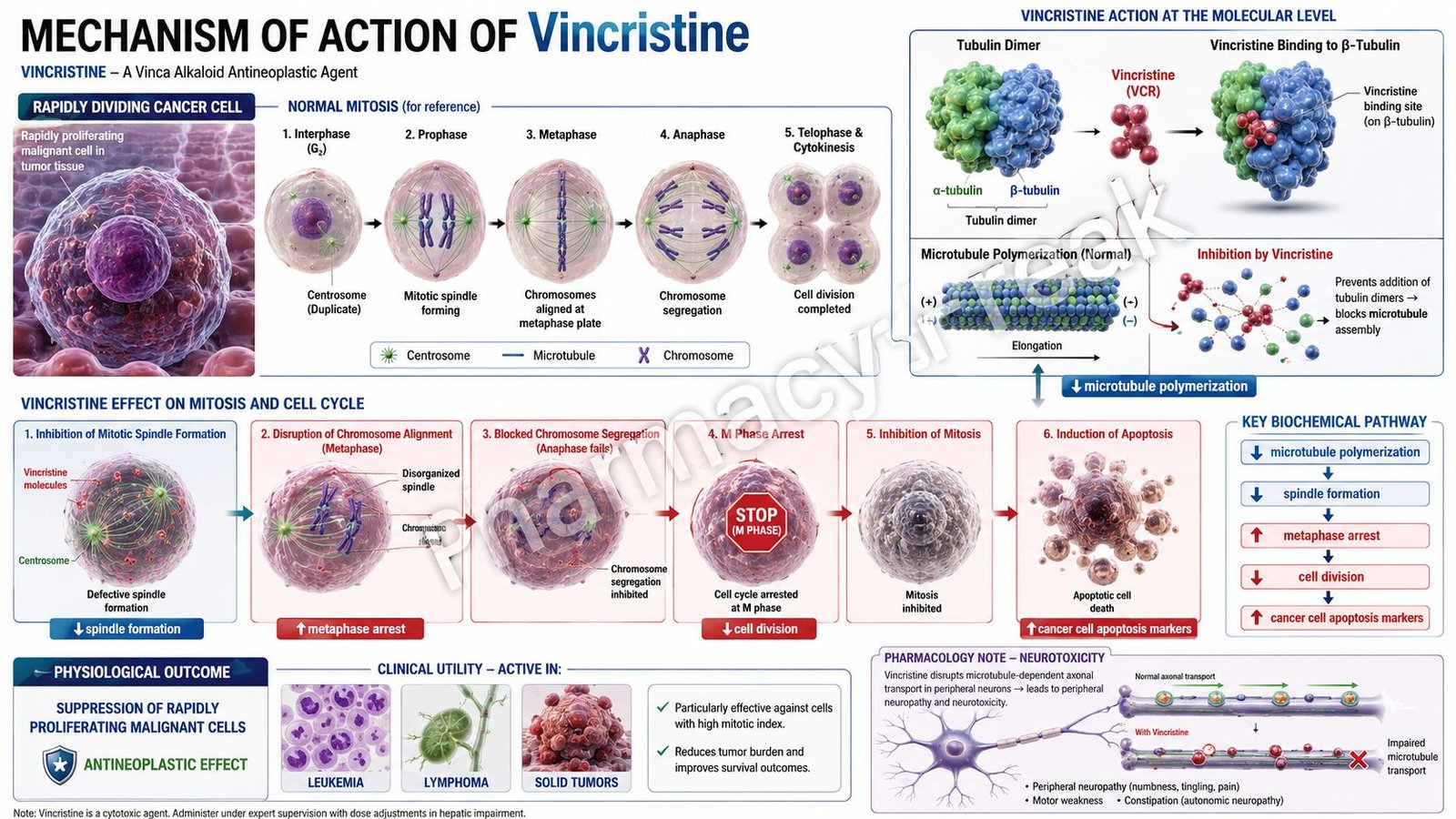
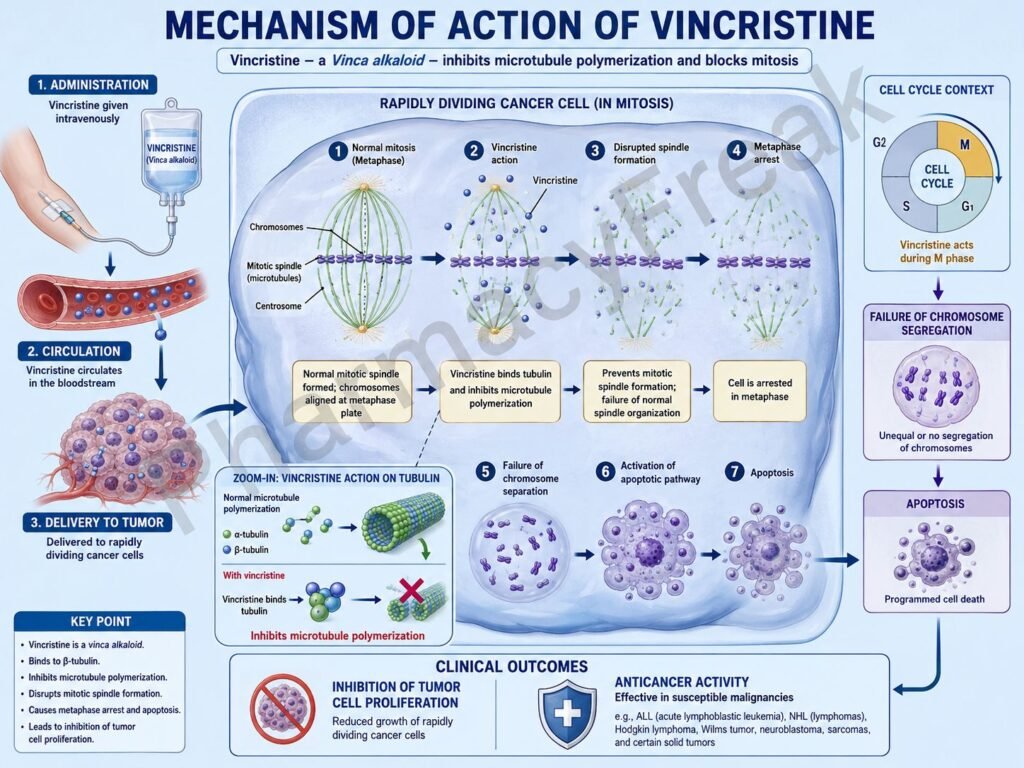
Vincristine exerts its anticancer effects by inhibiting microtubule assembly and preventing mitotic spindle formation.
1. Administration and Cellular Uptake
Following intravenous administration, vincristine enters systemic circulation and is distributed to tissues containing rapidly proliferating cells.
The drug enters cancer cells and targets intracellular tubulin proteins.
2. Binding to β-Tubulin
Microtubules are composed of α-tubulin and β-tubulin heterodimers.
Vincristine specifically binds to β-tubulin molecules.
This binding prevents tubulin polymerization and inhibits the formation of microtubules.
3. Inhibition of Microtubule Assembly
Normally, tubulin dimers assemble into microtubules that form the mitotic spindle.
Vincristine disrupts this process by preventing microtubule polymerization.
As a result:
- Mitotic spindle formation is impaired.
- Chromosome separation cannot occur normally.
- Cell division is halted.
4. Arrest of Cells in Metaphase
The mitotic spindle is essential for movement of chromosomes during mitosis.
Without a functional spindle apparatus:
- Chromosomes fail to align properly.
- Cells become arrested in metaphase.
- Progression through mitosis is prevented.
This effect is particularly pronounced in rapidly dividing malignant cells.
5. Activation of Apoptotic Pathways
Prolonged mitotic arrest triggers cellular stress responses.
These responses activate:
- Cell cycle checkpoints
- Pro-apoptotic signaling pathways
- Caspase-mediated apoptosis
The affected cancer cell ultimately undergoes programmed cell death.
6. Effects on Cellular Transport
Microtubules also function in intracellular transport systems.
Disruption of microtubules interferes with:
- Organelle movement
- Vesicle transport
- Axonal transport in neurons
Interference with neuronal microtubules contributes to the characteristic neurotoxicity associated with vincristine.
7. Final Therapeutic Effect
The overall effects include:
- Inhibition of mitosis
- Prevention of cancer cell proliferation
- Induction of apoptosis
- Reduction in tumor burden
Thus, vincristine acts as an antimitotic agent by preventing microtubule formation and arresting cells during metaphase.
Pharmacokinetics
Vincristine is administered intravenously because oral absorption is unreliable.
- Given exclusively by IV injection or infusion.
- Widely distributed into tissues.
- Limited penetration into the central nervous system.
- Highly protein bound.
- Extensively metabolized in the liver.
- CYP3A4 is the primary metabolic enzyme.
- Excreted mainly through bile and feces.
- Terminal half-life is approximately 19–155 hours due to extensive tissue distribution.
Dose adjustments may be required in patients with significant hepatic impairment.
Important: Intrathecal administration of vincristine is fatal and must never occur.
Clinical Uses
Acute Lymphoblastic Leukemia (ALL)
Vincristine is a key component of induction and maintenance chemotherapy regimens.
Hodgkin Lymphoma
Used in multidrug chemotherapy protocols.
Non-Hodgkin Lymphoma
Frequently included in combination regimens such as CHOP-related protocols.
Neuroblastoma
Commonly used in pediatric oncology treatment protocols.
Wilms Tumor
Part of standard chemotherapy regimens for nephroblastoma.
Rhabdomyosarcoma
Used in combination chemotherapy approaches.
Multiple Myeloma
Occasionally incorporated into selected chemotherapy regimens.
Other Pediatric Malignancies
Used in several childhood cancers because of its effectiveness against rapidly dividing cells.
Adverse Effects
Common adverse effects include:
- Peripheral neuropathy
- Constipation
- Abdominal pain
- Nausea
- Vomiting
- Fatigue
- Hair loss (alopecia)
Important adverse effects include:
- Severe peripheral neuropathy
- Loss of deep tendon reflexes
- Foot drop
- Motor weakness
- Cranial nerve dysfunction
- Paralytic ileus
- SIADH (syndrome of inappropriate antidiuretic hormone secretion)
- Autonomic neuropathy
- Jaw pain
- Neurotoxicity
Unlike many other anticancer drugs, vincristine produces relatively little bone marrow suppression.
Comparative Analysis
| Drug | Drug Class | Primary Target | Effect on Microtubules | Major Toxicity |
|---|---|---|---|---|
| Vincristine | Vinca alkaloid | β-Tubulin | Prevents polymerization | Neurotoxicity |
| Vinblastine | Vinca alkaloid | β-Tubulin | Prevents polymerization | Bone marrow suppression |
| Paclitaxel | Taxane | β-Tubulin | Stabilizes microtubules | Neuropathy |
| Docetaxel | Taxane | β-Tubulin | Stabilizes microtubules | Myelosuppression |
| Etoposide | Topoisomerase inhibitor | Topoisomerase II | DNA strand break accumulation | Myelosuppression |
Vincristine differs from taxanes because it prevents microtubule assembly, whereas taxanes stabilize existing microtubules and prevent their disassembly. Compared with vinblastine, vincristine causes significantly greater neurotoxicity but less bone marrow suppression.
MCQs
1. Vincristine belongs to which class of anticancer drugs?
a) Anthracyclines
b) Taxanes
c) Vinca alkaloids
d) Alkylating agents
Answer: c) Vinca alkaloids
2. Vincristine primarily binds to:
a) DNA polymerase
b) β-Tubulin
c) Topoisomerase II
d) RNA polymerase
Answer: b) β-Tubulin
3. The primary mechanism of vincristine is:
a) DNA alkylation
b) Inhibition of microtubule polymerization
c) Topoisomerase inhibition
d) Antimetabolite activity
Answer: b) Inhibition of microtubule polymerization
4. Vincristine arrests cells in which phase of the cell cycle?
a) G1 phase
b) S phase
c) G2 phase
d) M phase (metaphase)
Answer: d) M phase (metaphase)
5. Which structure is directly disrupted by vincristine?
a) Ribosomes
b) Mitochondria
c) Mitotic spindle
d) Lysosomes
Answer: c) Mitotic spindle
6. The most characteristic toxicity of vincristine is:
a) Hepatotoxicity
b) Nephrotoxicity
c) Peripheral neuropathy
d) Cardiotoxicity
Answer: c) Peripheral neuropathy
7. Vincristine is primarily metabolized by:
a) CYP2D6
b) CYP3A4
c) CYP1A2
d) CYP2C9
Answer: b) CYP3A4
8. Which route of administration is fatal for vincristine?
a) Intravenous
b) Intramuscular
c) Subcutaneous
d) Intrathecal
Answer: d) Intrathecal
9. Vincristine is commonly used in:
a) Acute lymphoblastic leukemia
b) Hypertension
c) Parkinson disease
d) Tuberculosis
Answer: a) Acute lymphoblastic leukemia
10. Compared with vinblastine, vincristine causes:
a) Greater bone marrow suppression
b) Greater neurotoxicity
c) Greater nephrotoxicity
d) Greater cardiotoxicity
Answer: b) Greater neurotoxicity
11. Vincristine prevents:
a) DNA replication
b) Protein synthesis
c) Microtubule polymerization
d) RNA transcription
Answer: c) Microtubule polymerization
12. The final result of vincristine-induced mitotic arrest is:
a) Enhanced cell growth
b) Apoptosis
c) Increased angiogenesis
d) Cellular differentiation
Answer: b) Apoptosis
FAQs
What is the mechanism of action of vincristine?
Vincristine binds to β-tubulin and inhibits microtubule polymerization, preventing mitotic spindle formation and arresting cells in metaphase.
Is vincristine cell cycle specific?
Yes. Vincristine is a cell cycle-specific drug that primarily acts during the M phase of the cell cycle.
Why does vincristine cause neuropathy?
Microtubules are essential for axonal transport in neurons. Disruption of neuronal microtubules leads to peripheral neuropathy and other neurologic adverse effects.
What cancers are treated with vincristine?
Vincristine is commonly used for acute lymphoblastic leukemia, Hodgkin lymphoma, non-Hodgkin lymphoma, neuroblastoma, Wilms tumor, and rhabdomyosarcoma.
How is vincristine different from paclitaxel?
Vincristine prevents microtubule assembly, whereas paclitaxel stabilizes microtubules and prevents their disassembly.
Does vincristine cause severe bone marrow suppression?
Compared with vinblastine and many other chemotherapy agents, vincristine causes relatively little bone marrow suppression.
Why is intrathecal vincristine contraindicated?
Intrathecal administration causes severe neurotoxicity and is almost universally fatal.
References
Goodman & Gilman’s The Pharmacological Basis of Therapeutics
Katzung Basic & Clinical Pharmacology