Table of Contents
Introduction
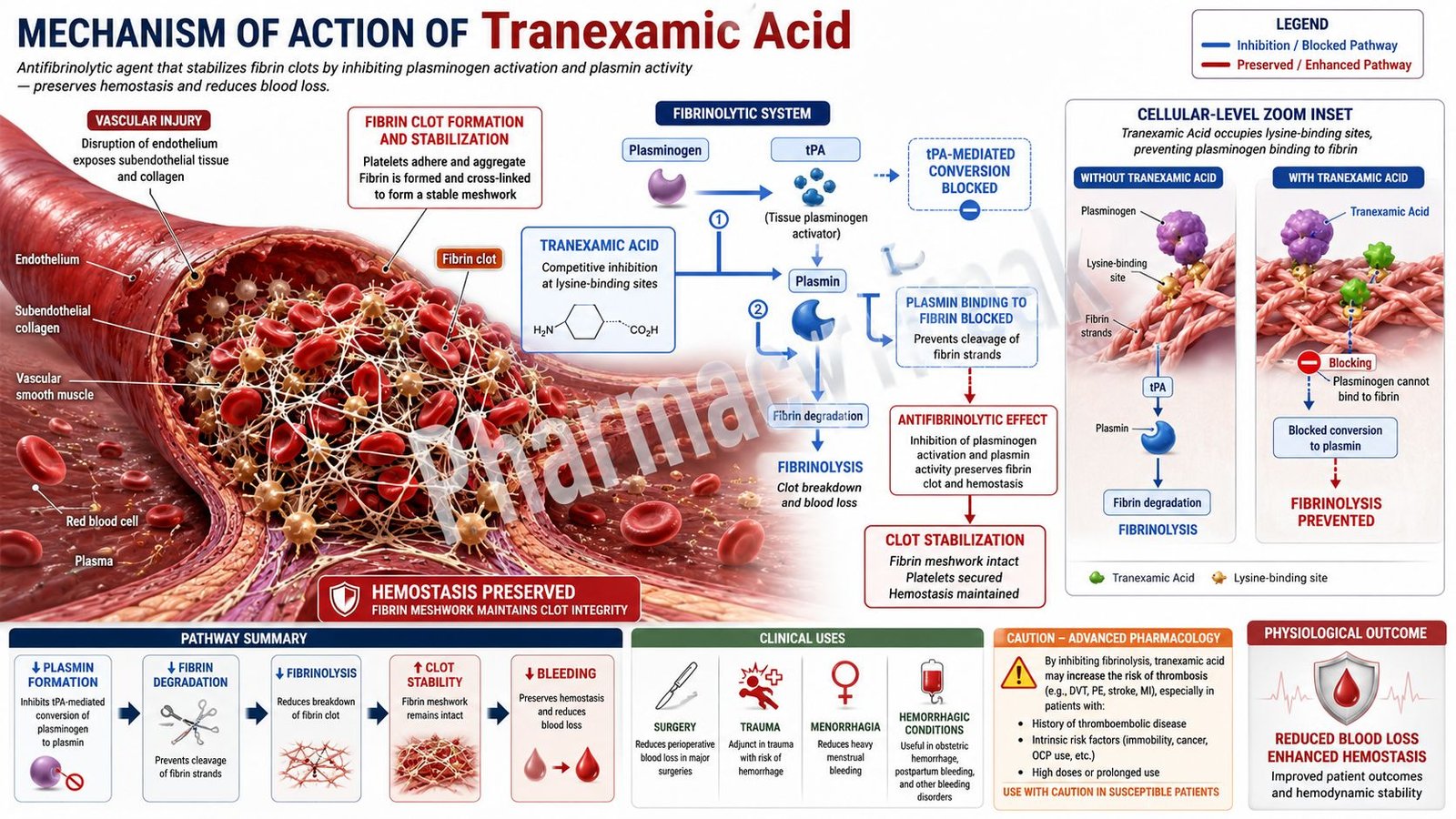
Tranexamic acid is an antifibrinolytic (hemostatic) agent used to prevent and control bleeding. It is a synthetic lysine analog that inhibits fibrinolysis by preventing the breakdown of fibrin clots. Tranexamic acid is widely used in trauma, surgery, postpartum hemorrhage, heavy menstrual bleeding, epistaxis, and various bleeding disorders.
Mechanism of Action (Step-wise)
- During normal hemostasis, fibrin forms a stable meshwork that helps stop bleeding.
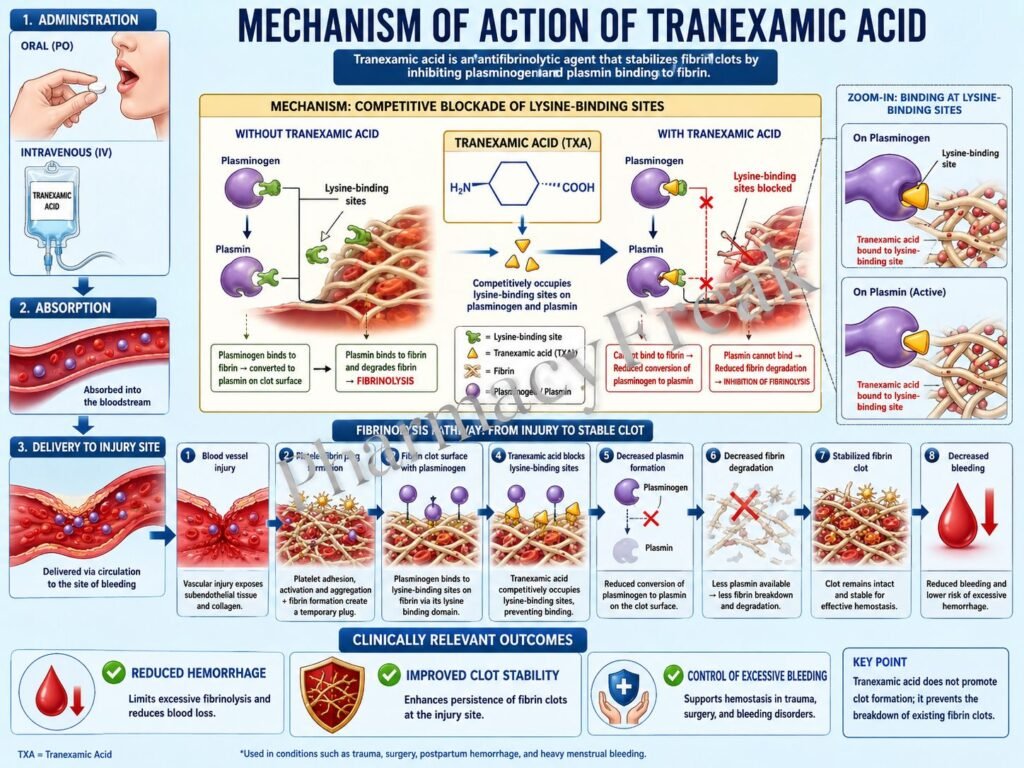
- Plasminogen binds to lysine-binding sites on fibrin within the clot.
- Tissue plasminogen activator (tPA) converts plasminogen into plasmin.
- Plasmin is the primary enzyme responsible for fibrin degradation.
- Tranexamic acid is a synthetic analog of the amino acid lysine.
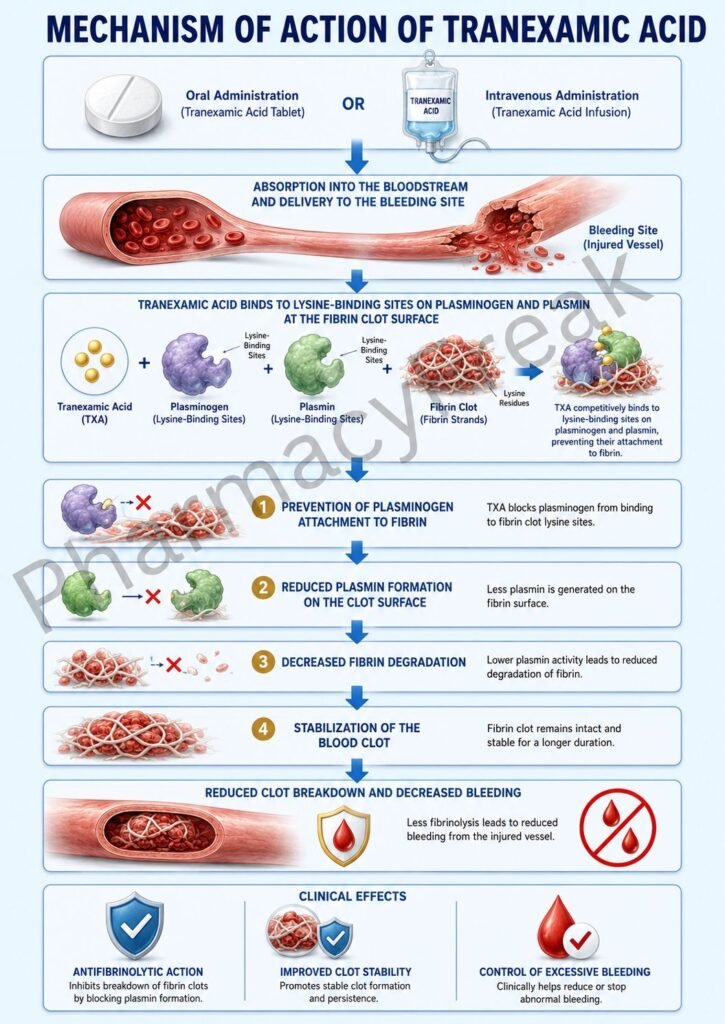
- It competitively binds to lysine-binding sites on plasminogen.
- Binding of plasminogen to fibrin is prevented.
- Conversion of plasminogen to plasmin decreases.
- Existing plasmin activity is also inhibited at higher concentrations.
- Fibrin degradation slows significantly.
- Fibrin clots become more stable and resistant to breakdown.
- Blood loss decreases and hemostasis is maintained.
- The overall effect is inhibition of fibrinolysis and prevention of excessive bleeding.
A key exam point is that tranexamic acid blocks lysine-binding sites on plasminogen, preventing conversion to plasmin and inhibiting fibrin clot breakdown.
Pharmacokinetics
Tranexamic acid can be administered orally, intravenously, or topically. It is rapidly absorbed and widely distributed throughout body tissues. The drug undergoes minimal metabolism and is excreted primarily unchanged by the kidneys. Dose adjustment is required in renal impairment.
Clinical Uses
Tranexamic acid is used in:
- Postpartum hemorrhage
- Trauma-associated bleeding
- Surgical bleeding prevention
- Heavy menstrual bleeding (menorrhagia)
- Epistaxis
- Dental procedures in hemophilia patients
- Hereditary angioedema (selected cases)
Adverse Effects
Common adverse effects include:
- Nausea
- Vomiting
- Diarrhea
- Abdominal discomfort
Serious adverse effects may include:
- Thromboembolic events (rare)
- Seizures (especially with high intravenous doses)
- Visual disturbances
- Hypotension with rapid IV administration
Comparative Analysis
| Feature | Tranexamic Acid | Aminocaproic Acid | Heparin |
|---|---|---|---|
| Drug class | Antifibrinolytic | Antifibrinolytic | Anticoagulant |
| Main target | Plasminogen | Plasminogen | Antithrombin III |
| Fibrin clot breakdown | Inhibited | Inhibited | Promoted indirectly |
| Clinical effect | Reduces bleeding | Reduces bleeding | Prevents clot formation |
| Trauma use | Common | Less common | Not used for bleeding control |
| Menorrhagia use | Common | Less common | No |
Tranexamic acid differs from anticoagulants such as heparin because it promotes clot stability rather than preventing clot formation. Compared with aminocaproic acid, tranexamic acid is more potent and commonly preferred in modern clinical practice.
MCQs
1. Tranexamic acid belongs to which drug class?
a) Anticoagulants
b) Antiplatelet agents
c) Antifibrinolytics
d) Thrombolytics
Answer: c) Antifibrinolytics
2. Tranexamic acid is a synthetic analog of:
a) Glycine
b) Lysine
c) Alanine
d) Tyrosine
Answer: b) Lysine
3. Tranexamic acid primarily acts on:
a) Fibrinogen
b) Plasminogen
c) Thrombin
d) Factor VIII
Answer: b) Plasminogen
4. Tranexamic acid prevents formation of:
a) Fibrin
b) Platelets
c) Plasmin
d) Thromboxane A2
Answer: c) Plasmin
5. Plasmin normally:
a) Forms fibrin clots
b) Degrades fibrin clots
c) Activates platelets
d) Produces thrombin
Answer: b) Degrades fibrin clots
6. Tranexamic acid is commonly used in:
a) Postpartum hemorrhage
b) Hypertension
c) Asthma
d) Parkinson disease
Answer: a) Postpartum hemorrhage
7. The primary effect of tranexamic acid is:
a) Increased fibrinolysis
b) Reduced fibrinolysis
c) Platelet destruction
d) Vasodilation
Answer: b) Reduced fibrinolysis
8. A common adverse effect is:
a) Nausea
b) Hypercalcemia
c) Polycythemia
d) Hyperthyroidism
Answer: a) Nausea
9. High-dose intravenous therapy may cause:
a) Seizures
b) Cataracts
c) Hypoglycemia
d) Hypernatremia
Answer: a) Seizures
10. Tranexamic acid is primarily eliminated through:
a) Lungs
b) Liver metabolism
c) Kidneys
d) Skin
Answer: c) Kidneys
11. Compared with heparin, tranexamic acid:
a) Increases clot stability
b) Prevents clot formation
c) Inhibits thrombin directly
d) Blocks factor Xa
Answer: a) Increases clot stability
12. The main therapeutic action of tranexamic acid is:
a) Prevention of fibrin clot breakdown
b) Dissolution of blood clots
c) Platelet inhibition
d) Vasoconstriction
Answer: a) Prevention of fibrin clot breakdown
FAQs
What is the mechanism of action of tranexamic acid?
Tranexamic acid binds to plasminogen and prevents its conversion to plasmin, thereby inhibiting fibrin clot degradation.
Why is tranexamic acid used in bleeding disorders?
Because it stabilizes fibrin clots and reduces excessive blood loss.
Is tranexamic acid an anticoagulant?
No. It is an antifibrinolytic agent that promotes clot stability.
What are common side effects of tranexamic acid?
Nausea, vomiting, diarrhea, and abdominal discomfort.
Can tranexamic acid be used in postpartum hemorrhage?
Yes, it is widely used to reduce mortality and bleeding in postpartum hemorrhage.
How does tranexamic acid differ from thrombolytic drugs?
Tranexamic acid prevents clot breakdown, whereas thrombolytics actively dissolve clots.
References
Goodman & Gilman’s The Pharmacological Basis of Therapeutics
https://accessmedicine.mhmedical.com/book.aspx?bookid=3191
Katzung’s Basic and Clinical Pharmacology
https://accessmedicine.mhmedical.com/content.aspx?bookid=3382
Tripathi KD. Essentials of Medical Pharmacology
https://www.jaypeedigital.com
Harrison’s Principles of Internal Medicine
https://accessmedicine.mhmedical.com