Table of Contents
Introduction
Terbinafine is an allylamine antifungal agent used for the treatment of dermatophyte infections such as tinea pedis, tinea corporis, tinea cruris, and onychomycosis. It exerts a fungicidal effect by inhibiting ergosterol synthesis in fungal cell membranes. The drug is particularly effective against dermatophytes and is one of the most commonly prescribed oral antifungal medications for nail infections.
Mechanism of Action (Step-wise)
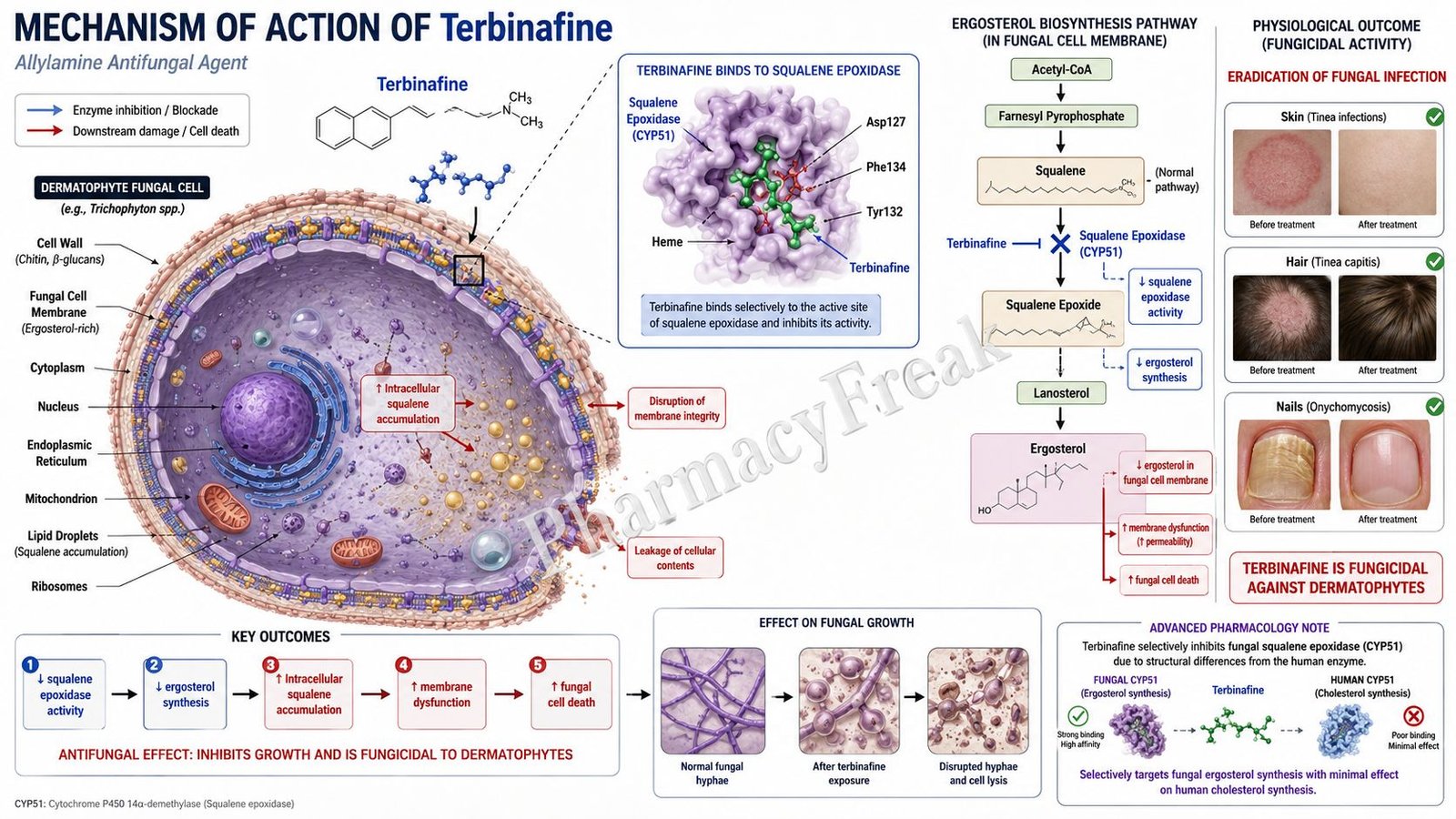
- Fungal cell membranes require ergosterol for structural integrity and normal cellular function.
- Ergosterol synthesis occurs through a multistep biochemical pathway.
- One of the early steps involves conversion of squalene into squalene epoxide.
- This reaction is catalyzed by the enzyme squalene epoxidase.
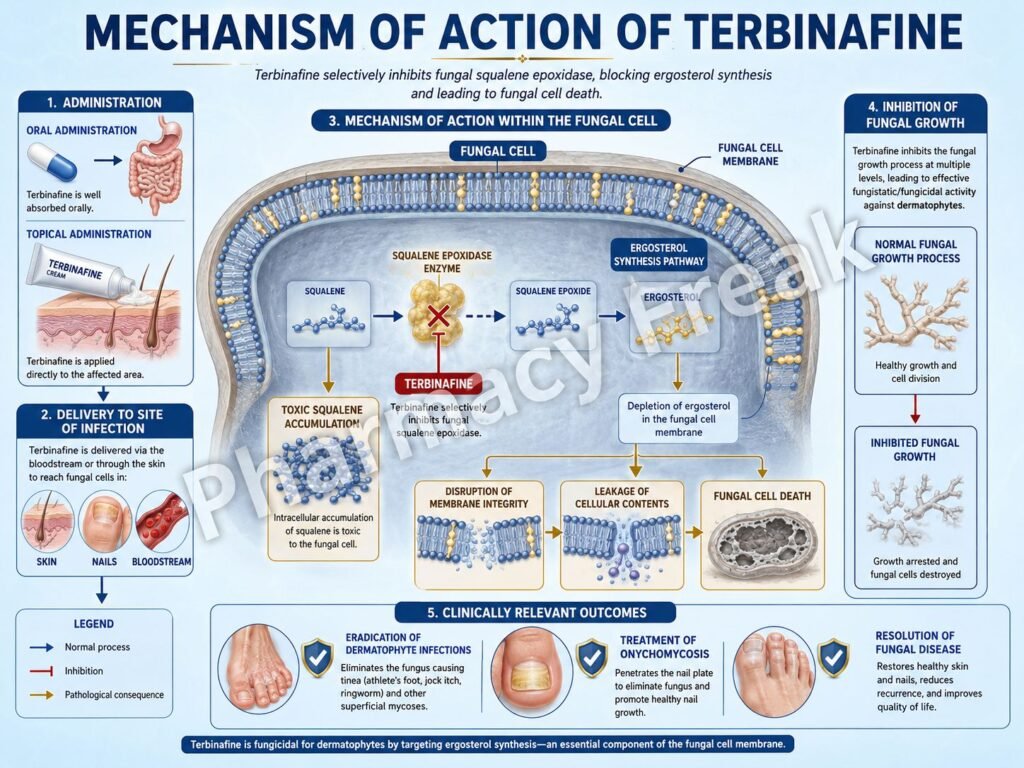
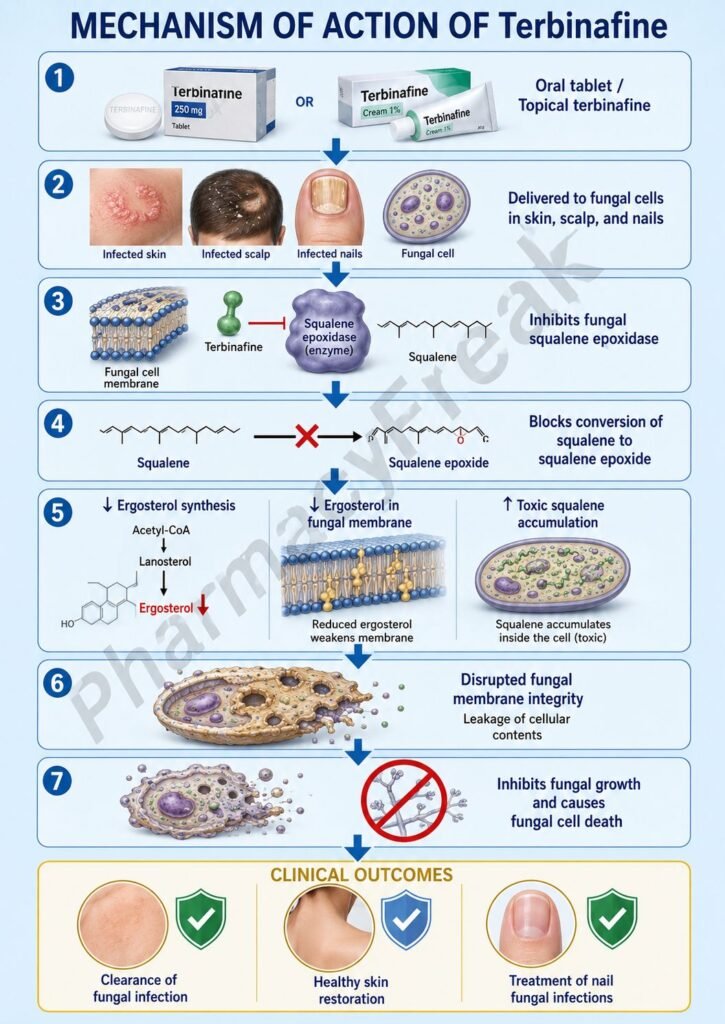
- Terbinafine selectively inhibits fungal squalene epoxidase.
- Inhibition of this enzyme blocks ergosterol synthesis.
- Ergosterol concentration within the fungal cell membrane decreases.
- Cell membrane structure and function become impaired.
- Simultaneously, intracellular squalene accumulates.
- Excess squalene becomes toxic to fungal cells.
- Membrane permeability and cellular metabolism are disrupted.
- Fungal cell death occurs, producing a fungicidal effect against dermatophytes.
- The overall effect is eradication of susceptible fungal infections.
A key exam point is that terbinafine inhibits squalene epoxidase, causing ergosterol depletion and toxic accumulation of squalene in fungal cells.
Pharmacokinetics
Terbinafine can be administered orally or topically. Oral terbinafine is well absorbed and extensively distributed into skin, hair, and nails. It undergoes hepatic metabolism and is eliminated primarily through urine. Because of its accumulation in keratinized tissues, therapeutic effects persist even after treatment cessation.
Clinical Uses
Terbinafine is used in:
- Onychomycosis
- Tinea pedis (athlete’s foot)
- Tinea corporis
- Tinea cruris
- Tinea capitis
- Dermatophyte infections
Adverse Effects
Common adverse effects include:
- Headache
- Nausea
- Diarrhea
- Abdominal discomfort
- Rash
Serious adverse effects may include:
- Hepatotoxicity
- Severe skin reactions
- Taste disturbances
- Rare neutropenia
Liver function monitoring may be recommended during prolonged oral therapy.
Comparative Analysis
| Feature | Terbinafine | Fluconazole | Ketoconazole |
|---|---|---|---|
| Drug class | Allylamine | Azole | Azole |
| Main target | Squalene epoxidase | 14-α demethylase | 14-α demethylase |
| Ergosterol synthesis inhibition | Yes | Yes | Yes |
| Squalene accumulation | Yes | No | No |
| Activity against dermatophytes | Excellent | Moderate | Moderate |
| Onychomycosis treatment | First-line | Alternative | Rarely used |
Terbinafine differs from azole antifungals because it inhibits squalene epoxidase rather than fungal cytochrome P450-dependent 14-α demethylase. This leads to toxic accumulation of squalene in fungal cells and a fungicidal effect.
MCQs
1. Terbinafine belongs to which antifungal class?
a) Azoles
b) Polyenes
c) Allylamines
d) Echinocandins
Answer: c) Allylamines
2. Terbinafine inhibits:
a) β-glucan synthase
b) Squalene epoxidase
c) DNA gyrase
d) Chitin synthase
Answer: b) Squalene epoxidase
3. Squalene epoxidase is involved in synthesis of:
a) Ergosterol
b) Cholesterol
c) Histamine
d) Peptidoglycan
Answer: a) Ergosterol
4. Terbinafine causes accumulation of:
a) Ergosterol
b) Squalene
c) Cholesterol
d) Acetylcholine
Answer: b) Squalene
5. Ergosterol is an important component of:
a) Bacterial cell walls
b) Fungal cell membranes
c) Human red blood cells
d) Viral envelopes
Answer: b) Fungal cell membranes
6. Terbinafine is commonly used for:
a) Onychomycosis
b) Malaria
c) Tuberculosis
d) Influenza
Answer: a) Onychomycosis
7. The effect of terbinafine against dermatophytes is generally:
a) Fungistatic
b) Fungicidal
c) Bactericidal
d) Virucidal
Answer: b) Fungicidal
8. A common adverse effect is:
a) Headache
b) Hypercalcemia
c) Bradycardia
d) Cataracts
Answer: a) Headache
9. A serious adverse effect is:
a) Hepatotoxicity
b) Hypernatremia
c) Polycythemia
d) Hyperthyroidism
Answer: a) Hepatotoxicity
10. Terbinafine accumulates particularly in:
a) Bone marrow
b) Keratinized tissues
c) Cerebrospinal fluid
d) Skeletal muscle
Answer: b) Keratinized tissues
11. Compared with azoles, terbinafine targets:
a) 14-α demethylase
b) Squalene epoxidase
c) DNA polymerase
d) β-tubulin
Answer: b) Squalene epoxidase
12. The antifungal activity of terbinafine results mainly from:
a) Ergosterol depletion and squalene accumulation
b) Cell wall synthesis stimulation
c) Protein synthesis inhibition
d) DNA replication enhancement
Answer: a) Ergosterol depletion and squalene accumulation
FAQs
What is the mechanism of action of terbinafine?
Terbinafine inhibits squalene epoxidase, leading to decreased ergosterol synthesis and toxic accumulation of squalene in fungal cells.
Why is terbinafine effective against dermatophytes?
It produces a fungicidal effect by disrupting fungal cell membrane integrity and causing fungal cell death.
What is the primary target enzyme of terbinafine?
Squalene epoxidase.
What are common side effects of terbinafine?
Headache, nausea, diarrhea, abdominal discomfort, and rash.
Why is terbinafine commonly used for onychomycosis?
Because it accumulates in nails and remains effective against dermatophytes for prolonged periods.
How does terbinafine differ from azole antifungals?
Terbinafine inhibits squalene epoxidase, whereas azoles inhibit fungal 14-α demethylase.
References
Goodman & Gilman’s The Pharmacological Basis of Therapeutics
https://accessmedicine.mhmedical.com/book.aspx?bookid=3191
Katzung’s Basic and Clinical Pharmacology
https://accessmedicine.mhmedical.com/content.aspx?bookid=3382
Tripathi KD. Essentials of Medical Pharmacology
https://www.jaypeedigital.com
Harrison’s Principles of Internal Medicine
https://accessmedicine.mhmedical.com