Table of Contents
Introduction
Sodium bicarbonate is a systemic alkalinizing agent used in metabolic acidosis, cardiac arrest, hyperkalemia, urinary alkalinization, and certain drug toxicities. It acts by increasing plasma bicarbonate concentration, buffering excess hydrogen ions, and raising blood pH. Sodium bicarbonate also alkalinizes urine and can enhance elimination of certain toxins.
Mechanism of Action (Step-wise)
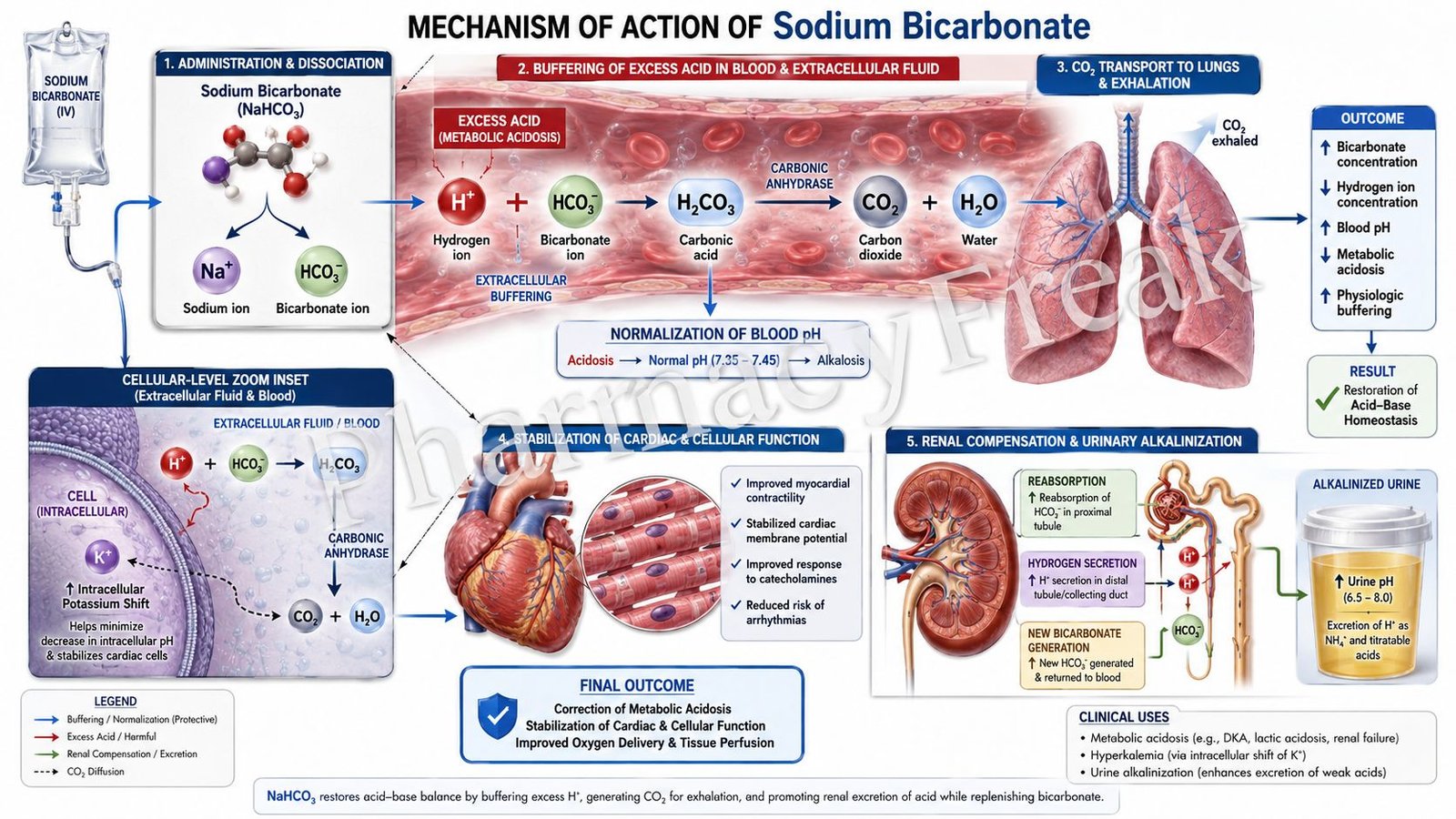
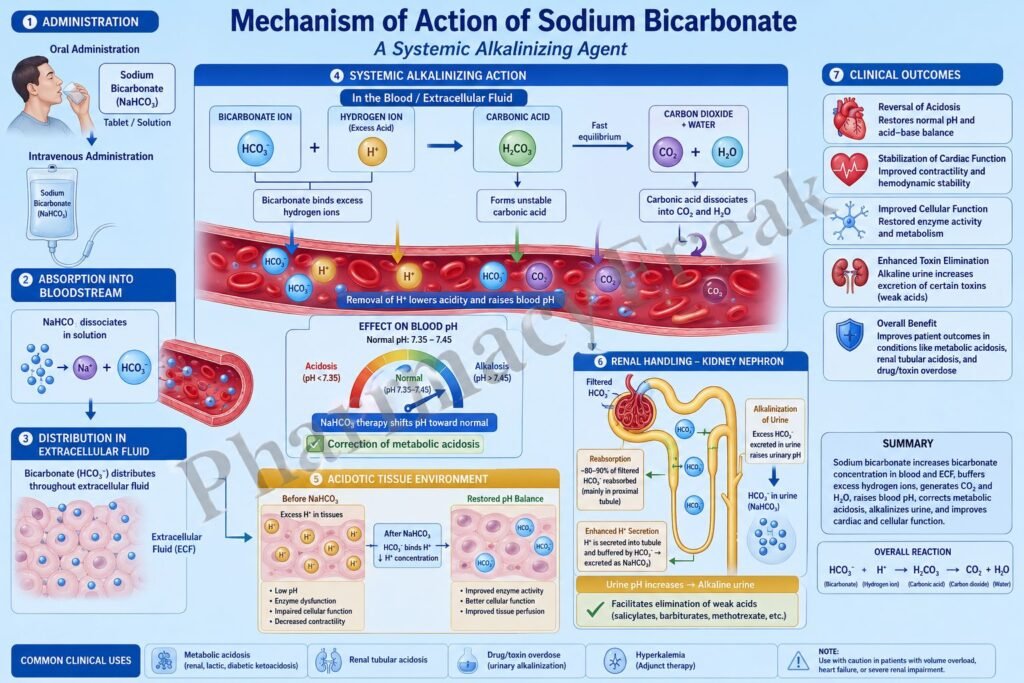
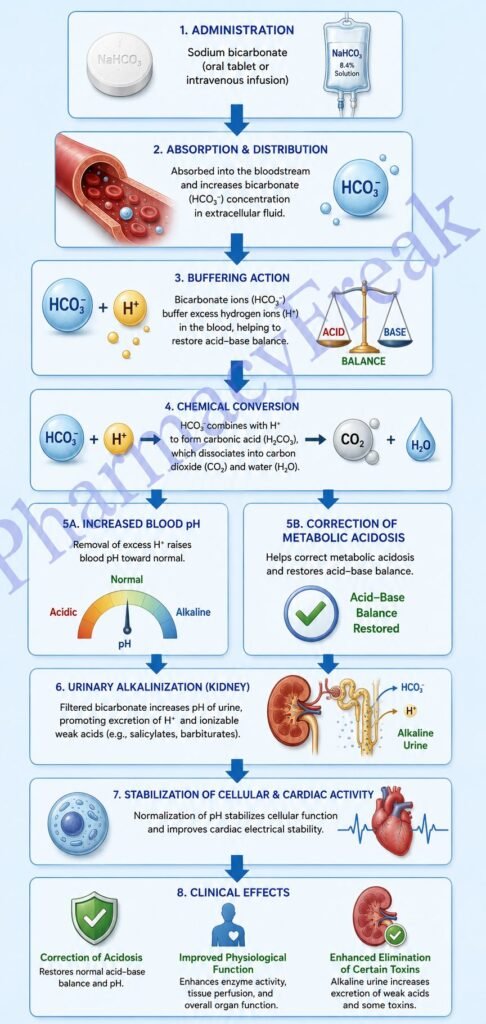
- Sodium bicarbonate dissociates into sodium ions (Na⁺) and bicarbonate ions (HCO₃⁻) after administration.
- Bicarbonate acts as a physiological buffer in extracellular fluid.
- Excess hydrogen ions (H⁺) in acidic conditions combine with bicarbonate.
- This reaction forms carbonic acid (H₂CO₃).
- Carbonic acid is rapidly converted into carbon dioxide (CO₂) and water (H₂O) by carbonic anhydrase.
- Carbon dioxide is exhaled through the lungs.
- Removal of hydrogen ions increases blood pH and corrects metabolic acidosis.
- Increased plasma bicarbonate also promotes intracellular potassium shift, helping reduce serum potassium levels in hyperkalemia.
- In the kidneys, bicarbonate alkalinizes urine.
- Alkaline urine reduces reabsorption of weak acids such as salicylates and phenobarbital, increasing toxin elimination.
- During sodium channel blocker toxicity, sodium bicarbonate also increases extracellular sodium concentration and helps overcome sodium channel blockade.
- The overall effect is correction of acidosis, stabilization of cellular function, and enhanced toxin elimination.
A key exam point is that sodium bicarbonate buffers excess hydrogen ions, increasing blood pH and correcting metabolic acidosis.
Pharmacokinetics
Sodium bicarbonate may be administered orally or intravenously. Intravenous administration produces rapid alkalinization. Excess bicarbonate is filtered and regulated by the kidneys. Carbon dioxide generated from buffering reactions is eliminated through the lungs.
Clinical Uses
Sodium bicarbonate is used in metabolic acidosis, severe hyperkalemia, tricyclic antidepressant overdose, salicylate poisoning, cardiac arrest in selected situations, and urinary alkalinization.
Adverse Effects
Common adverse effects include metabolic alkalosis, hypernatremia, fluid overload, hypokalemia, and increased carbon dioxide production. Rapid administration may worsen intracellular acidosis in some situations.
Comparative Analysis
| Feature | Sodium Bicarbonate | Calcium Gluconate | Acetazolamide |
|---|---|---|---|
| Main action | Systemic alkalinization | Membrane stabilization | Carbonic anhydrase inhibition |
| Main use | Metabolic acidosis | Hyperkalemia cardioprotection | Metabolic alkalosis, glaucoma |
| Effect on pH | Increases pH | Minimal direct effect | Decreases bicarbonate |
| Urine alkalinization | Yes | No | Mild |
| Potassium shift | Intracellular shift | No shift | Potassium loss |
| Sodium load | Present | Minimal | Minimal |
Sodium bicarbonate differs from calcium gluconate because it corrects acidosis and shifts potassium intracellularly rather than directly stabilizing cardiac membranes. Compared with acetazolamide, sodium bicarbonate increases systemic bicarbonate levels instead of reducing them.
MCQs
- Sodium bicarbonate primarily acts as a:
a) Vasodilator
b) Buffering agent
c) Calcium channel blocker
d) Diuretic
Answer: b) Buffering agent
- Sodium bicarbonate increases blood:
a) Potassium
b) pH
c) Calcium
d) Histamine
Answer: b) pH
- Bicarbonate combines with hydrogen ions to form:
a) Sulfuric acid
b) Carbonic acid
c) Hydrochloric acid
d) Nitric oxide
Answer: b) Carbonic acid
- Carbonic acid is converted into:
a) Potassium and sodium
b) Carbon dioxide and water
c) Calcium and phosphate
d) Histamine and serotonin
Answer: b) Carbon dioxide and water
- Sodium bicarbonate is commonly used in:
a) Metabolic acidosis
b) Hyperthyroidism
c) Asthma
d) Parkinson disease
Answer: a) Metabolic acidosis
- Sodium bicarbonate helps reduce serum potassium by:
a) Increasing renal potassium excretion only
b) Shifting potassium into cells
c) Blocking potassium channels
d) Decreasing aldosterone
Answer: b) Shifting potassium into cells
- Sodium bicarbonate alkalinizes:
a) Gastric acid only
b) Urine
c) Cerebrospinal fluid only
d) Synovial fluid only
Answer: b) Urine
- Urinary alkalinization enhances elimination of:
a) Weak acids
b) Weak bases only
c) Cholesterol
d) Calcium salts
Answer: a) Weak acids
- A common adverse effect is:
a) Metabolic alkalosis
b) Severe hypoglycemia
c) Cataracts
d) Bradycardia
Answer: a) Metabolic alkalosis
- Sodium bicarbonate may be used in overdose of:
a) Tricyclic antidepressants
b) Penicillin only
c) Insulin
d) Digoxin only
Answer: a) Tricyclic antidepressants
- Excessive sodium bicarbonate administration may cause:
a) Hypernatremia
b) Hypercalcemia
c) Hypoglycemia
d) Polycythemia
Answer: a) Hypernatremia
- The buffering action of sodium bicarbonate mainly removes excess:
a) Chloride ions
b) Hydrogen ions
c) Calcium ions
d) Histamine
Answer: b) Hydrogen ions
FAQs
What is the mechanism of action of sodium bicarbonate?
Sodium bicarbonate buffers excess hydrogen ions, increasing blood pH and correcting metabolic acidosis.
Why is sodium bicarbonate used in hyperkalemia?
Because alkalinization shifts potassium into cells and lowers serum potassium levels.
How does sodium bicarbonate help in salicylate poisoning?
It alkalinizes urine, increasing excretion of weak acidic toxins.
What are common side effects of sodium bicarbonate?
Metabolic alkalosis, hypernatremia, and fluid overload.
Why can sodium bicarbonate help in tricyclic antidepressant overdose?
Because increased sodium concentration and alkalinization reduce sodium channel blockade.
How is carbon dioxide removed after bicarbonate buffering?
Through exhalation by the lungs.
References
Goodman & Gilman’s The Pharmacological Basis of Therapeutics – Acid-Base Disorders and Electrolyte Pharmacology
https://accessmedicine.mhmedical.com/book.aspx?bookid=3191
Katzung: Basic and Clinical Pharmacology – Drugs Affecting Acid-Base Balance
https://accessmedicine.mhmedical.com/content.aspx?bookid=3382
Tripathi: Essentials of Medical Pharmacology – Electrolyte and Acid-Base Therapy
https://www.jaypeedigital.com
Harrison’s Principles of Internal Medicine – Metabolic Acidosis and Electrolyte Disorders
https://accessmedicine.mhmedical.com