Table of Contents
Introduction
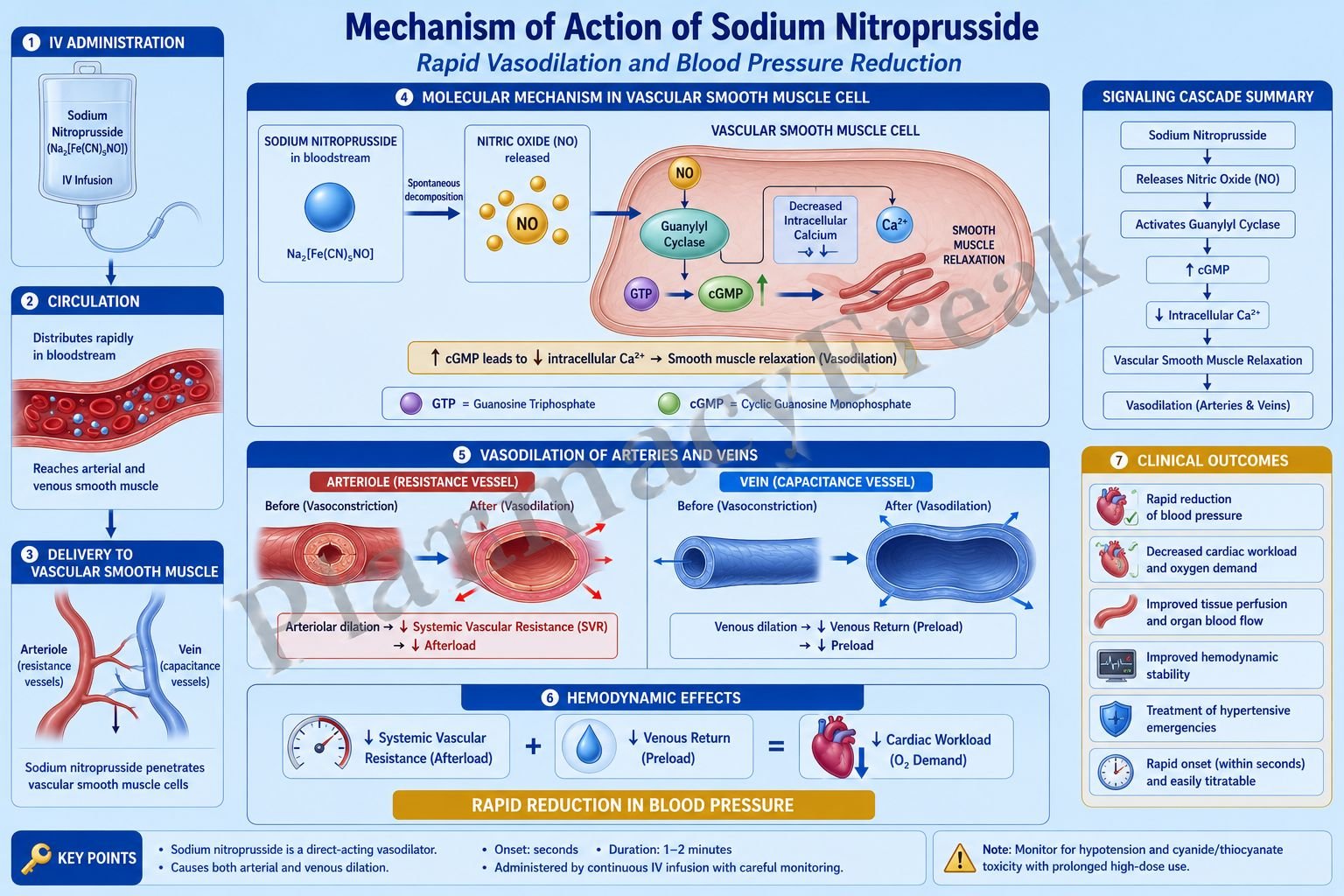
Sodium nitroprusside is a potent intravenous vasodilator used mainly in hypertensive emergencies and acute heart failure. It rapidly reduces both preload and afterload through release of nitric oxide (NO), causing relaxation of vascular smooth muscle. Because of its rapid onset and short duration, it is commonly used in intensive care settings with continuous blood pressure monitoring.
Mechanism of Action (Step-wise)
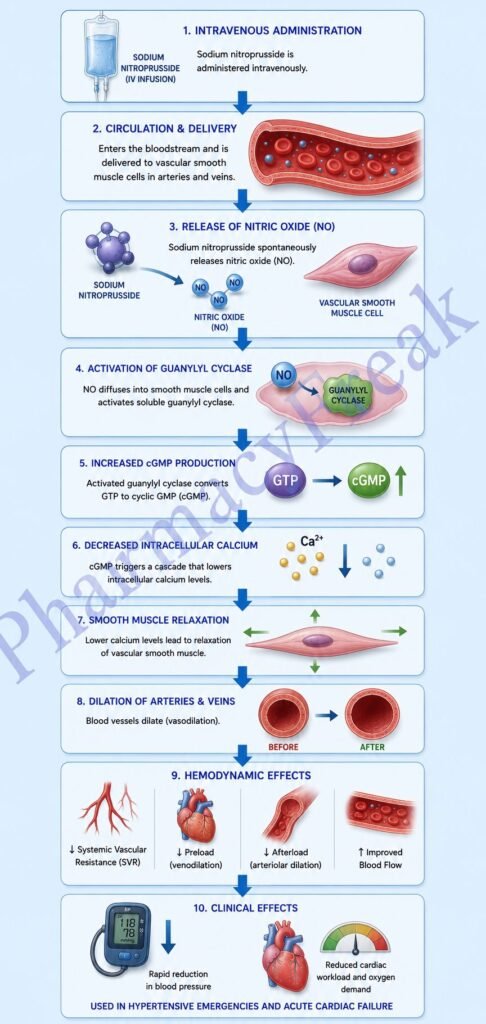
- Sodium nitroprusside enters the bloodstream after intravenous administration.
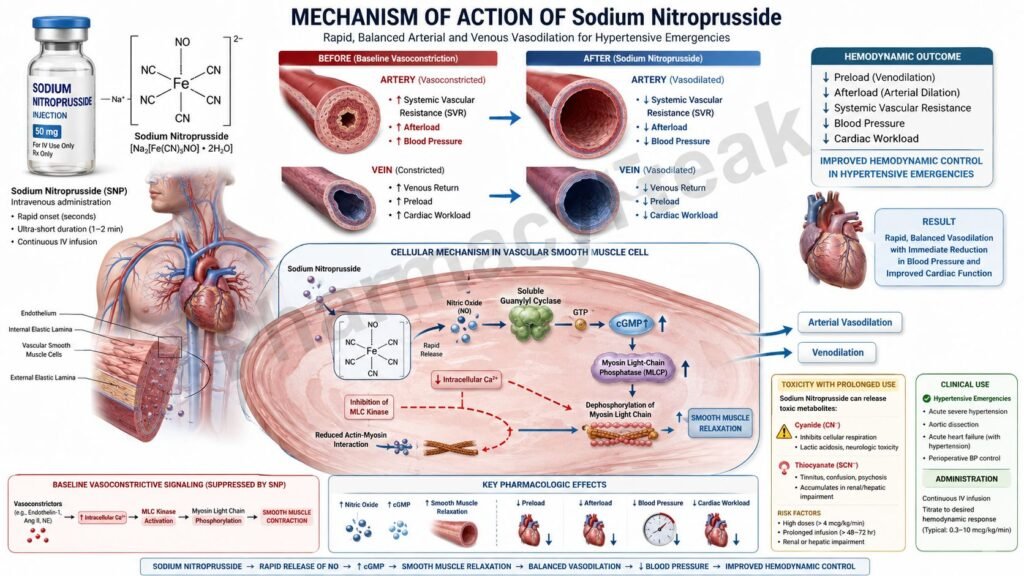
- It spontaneously releases nitric oxide (NO) in vascular smooth muscle cells.
- Nitric oxide activates soluble guanylyl cyclase.
- Activated guanylyl cyclase converts GTP into cyclic guanosine monophosphate (cGMP).
- Increased intracellular cGMP activates protein kinase pathways.
- cGMP-mediated signaling decreases intracellular calcium concentration in smooth muscle.
- Reduced intracellular calcium causes relaxation of vascular smooth muscle.
- Both arterioles and veins undergo vasodilation.
- Venodilation decreases venous return and reduces preload.
- Arteriolar dilation decreases systemic vascular resistance and reduces afterload.
- Cardiac workload and myocardial oxygen demand decrease.
- Blood pressure falls rapidly.
- The overall effect is rapid and controlled reduction of blood pressure with improved cardiac output in selected conditions.
A key exam point is that sodium nitroprusside releases nitric oxide, increasing cGMP and causing potent arterial and venous vasodilation.
Pharmacokinetics
Sodium nitroprusside is administered only by continuous intravenous infusion. It has an immediate onset and a very short duration of action lasting only minutes after discontinuation. Metabolism releases cyanide ions, which are converted in the liver to thiocyanate and excreted through the kidneys.
Clinical Uses
Sodium nitroprusside is used in hypertensive emergencies, acute decompensated heart failure, controlled hypotension during surgery, and severe acute hypertension with end-organ damage.
Adverse Effects
Common adverse effects include excessive hypotension, reflex tachycardia, dizziness, and nausea. Serious toxicities include cyanide toxicity and thiocyanate toxicity, especially with prolonged infusion or renal impairment.
Comparative Analysis
| Feature | Sodium Nitroprusside | Nitroglycerin | Hydralazine |
|---|---|---|---|
| Main mechanism | NO release → ↑ cGMP | NO release → ↑ cGMP | Direct arteriolar dilation |
| Vessels affected | Arteries + veins | Mainly veins | Mainly arteries |
| Route | IV infusion | Sublingual/IV/oral | Oral/IV |
| Main use | Hypertensive emergency | Angina | Hypertension |
| Onset | Immediate | Rapid | Moderate |
| Cyanide toxicity risk | Present | Absent | Absent |
Sodium nitroprusside differs from nitroglycerin because it dilates both arteries and veins equally. Compared with hydralazine, it has much faster onset and more potent blood pressure reduction.
MCQs
- Sodium nitroprusside primarily acts by releasing:
a) Dopamine
b) Nitric oxide
c) Histamine
d) Serotonin
Answer: b) Nitric oxide
- Nitric oxide activates which enzyme?
a) Cyclooxygenase
b) Guanylyl cyclase
c) Acetylcholinesterase
d) MAO
Answer: b) Guanylyl cyclase
- Activation of guanylyl cyclase increases:
a) cAMP
b) cGMP
c) ATP
d) Histamine
Answer: b) cGMP
- Increased cGMP causes:
a) Smooth muscle contraction
b) Smooth muscle relaxation
c) Platelet activation
d) Calcium influx
Answer: b) Smooth muscle relaxation
- Sodium nitroprusside dilates:
a) Veins only
b) Arteries only
c) Both arteries and veins
d) Coronary arteries only
Answer: c) Both arteries and veins
- Venodilation mainly reduces:
a) Afterload
b) Preload
c) Heart rate
d) Oxygen saturation
Answer: b) Preload
- Arteriolar dilation mainly reduces:
a) Venous return
b) Systemic vascular resistance
c) Histamine release
d) Calcium absorption
Answer: b) Systemic vascular resistance
- Sodium nitroprusside is mainly used in:
a) Asthma
b) Hypertensive emergencies
c) Diabetes mellitus
d) Parkinson disease
Answer: b) Hypertensive emergencies
- Sodium nitroprusside is administered by:
a) Oral route
b) Intravenous infusion
c) Intramuscular injection
d) Sublingual route
Answer: b) Intravenous infusion
- A serious toxicity associated with sodium nitroprusside is:
a) Cyanide toxicity
b) Hypercalcemia
c) Cataracts
d) Hypoglycemia
Answer: a) Cyanide toxicity
- Compared with nitroglycerin, sodium nitroprusside causes greater:
a) Arteriolar dilation
b) Histamine release
c) Dopamine blockade
d) Anticholinergic effects
Answer: a) Arteriolar dilation
- Sodium nitroprusside lowers blood pressure mainly by decreasing:
a) Vascular tone
b) Blood glucose
c) Calcium absorption
d) Renal filtration only
Answer: a) Vascular tone
FAQs
What is the mechanism of action of sodium nitroprusside?
Sodium nitroprusside releases nitric oxide, increasing cGMP and causing vascular smooth muscle relaxation.
Why is sodium nitroprusside used in hypertensive emergencies?
Because it rapidly lowers blood pressure through potent arterial and venous vasodilation.
How does sodium nitroprusside reduce cardiac workload?
By decreasing both preload and afterload.
What is a major toxicity of sodium nitroprusside?
Cyanide toxicity.
Why must sodium nitroprusside be carefully monitored?
Because it can cause rapid severe hypotension.
How does sodium nitroprusside differ from nitroglycerin?
It dilates both arteries and veins equally, while nitroglycerin mainly dilates veins.
References
Goodman & Gilman’s The Pharmacological Basis of Therapeutics – Vasodilator Drugs
https://accessmedicine.mhmedical.com/book.aspx?bookid=3191
Katzung: Basic and Clinical Pharmacology – Drugs Used in Hypertension and Heart Failure
https://accessmedicine.mhmedical.com/content.aspx?bookid=3382
Tripathi: Essentials of Medical Pharmacology – Antihypertensive Drugs
https://www.jaypeedigital.com
Harrison’s Principles of Internal Medicine – Hypertensive Emergencies and Heart Failure
https://accessmedicine.mhmedical.com