Table of Contents
Introduction
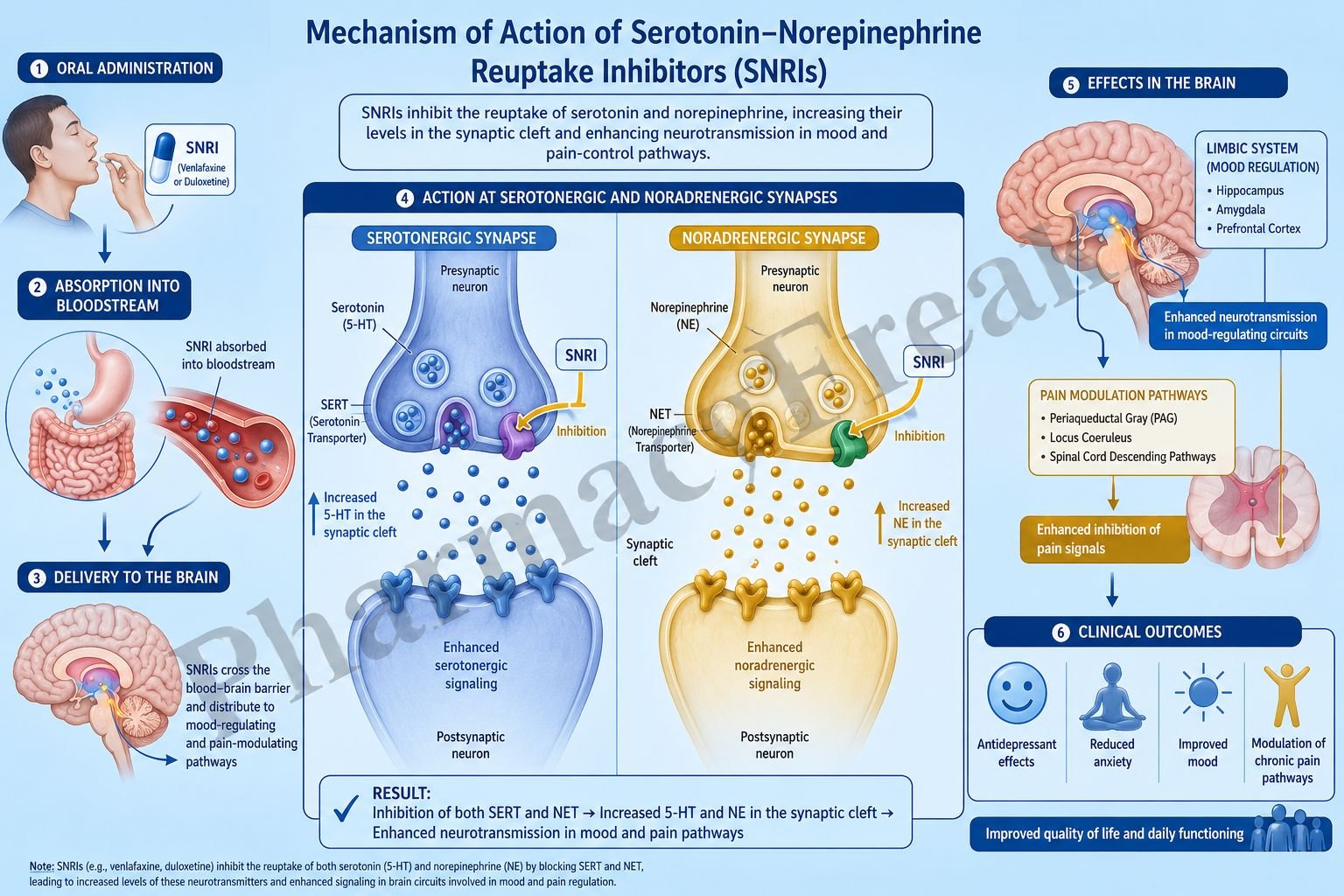
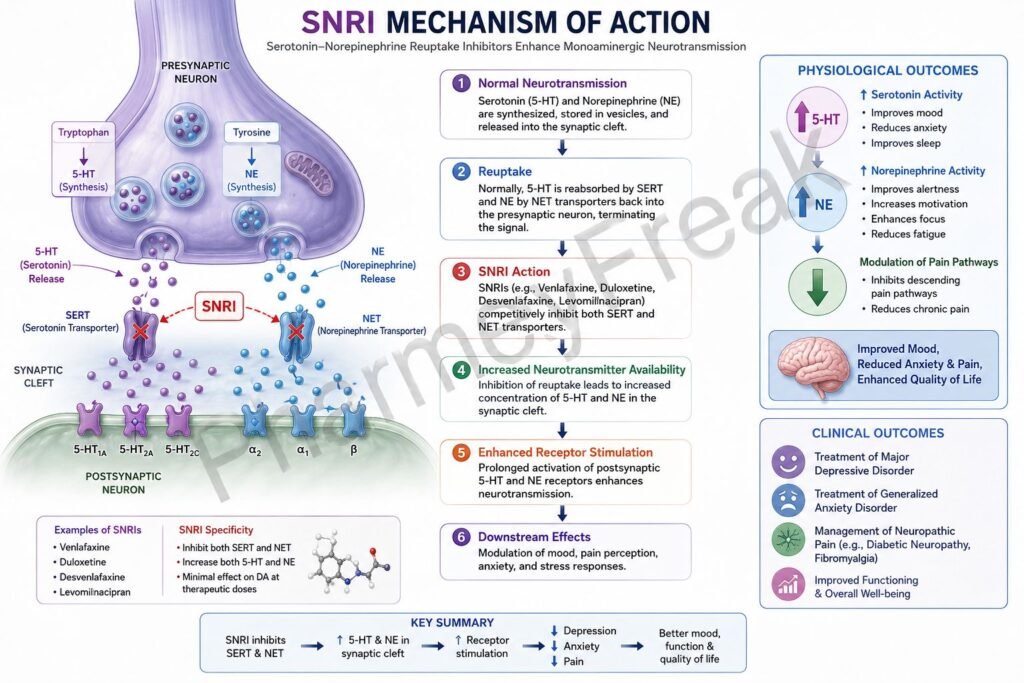
Serotonin-norepinephrine reuptake inhibitors (SNRIs) are antidepressant drugs used in major depressive disorder, anxiety disorders, neuropathic pain, fibromyalgia, and other conditions. They enhance serotonergic and noradrenergic neurotransmission by inhibiting reuptake of serotonin and norepinephrine in the central nervous system. Common SNRIs include venlafaxine, desvenlafaxine, duloxetine, and levomilnacipran.
Mechanism of Action (Step-wise)
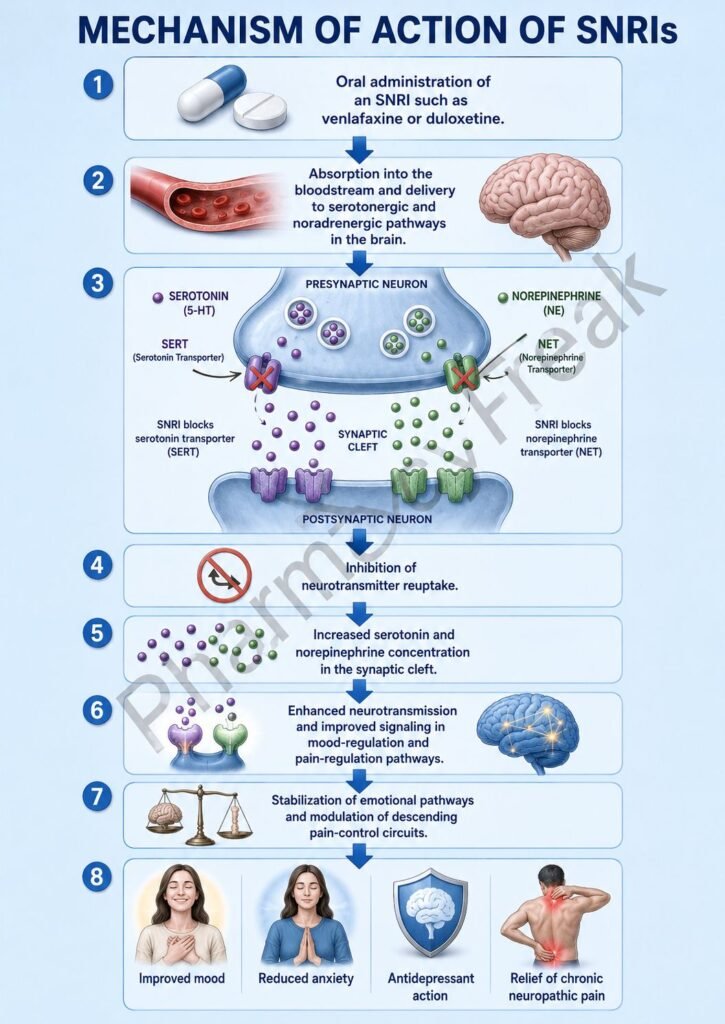
- SNRIs act on presynaptic neurons in the central nervous system.
- They inhibit the serotonin transporter (SERT).
- SERT normally reuptakes serotonin (5-HT) from the synaptic cleft into presynaptic neurons.
- Inhibition of SERT increases serotonin concentration in synaptic spaces.
- SNRIs also inhibit the norepinephrine transporter (NET).
- NET normally reuptakes norepinephrine into presynaptic neurons.
- NET inhibition increases synaptic norepinephrine levels.
- Increased serotonin improves mood, anxiety control, and emotional regulation.
- Increased norepinephrine enhances alertness, concentration, and descending pain inhibition pathways.
- Chronic use produces adaptive receptor and signaling changes in the CNS.
- The overall effect is antidepressant, anxiolytic, and analgesic activity.
A key exam point is that SNRIs inhibit reuptake of both serotonin and norepinephrine by blocking SERT and NET transporters.
Pharmacokinetics
Most SNRIs are administered orally and are well absorbed. They undergo hepatic metabolism through CYP450 enzymes and are eliminated through urine. Many SNRIs are available in extended-release formulations for once-daily dosing.
Clinical Uses
SNRIs are used in major depressive disorder, generalized anxiety disorder, panic disorder, social anxiety disorder, diabetic neuropathy, fibromyalgia, chronic musculoskeletal pain, and neuropathic pain syndromes.
Adverse Effects
Common adverse effects include nausea, insomnia, dry mouth, sweating, headache, dizziness, sexual dysfunction, and increased blood pressure. Serotonin syndrome may occur with excessive serotonergic activity or drug interactions.
Comparative Analysis
| Feature | SNRIs | SSRIs | Tricyclic Antidepressants |
|---|---|---|---|
| Main neurotransmitters affected | Serotonin + norepinephrine | Serotonin mainly | Serotonin + norepinephrine |
| Main mechanism | SERT + NET inhibition | SERT inhibition | Reuptake inhibition with receptor blockade |
| Anticholinergic effects | Mild | Minimal | Strong |
| Blood pressure increase | Possible | Rare | Possible |
| Neuropathic pain use | Strong | Limited | Strong |
| Overdose safety | Safer | Safer | Less safe |
SNRIs differ from SSRIs because they increase both serotonin and norepinephrine levels. Compared with tricyclic antidepressants, SNRIs produce fewer anticholinergic and cardiovascular side effects.
MCQs
- SNRIs inhibit reuptake of which neurotransmitters?
a) Dopamine and acetylcholine
b) Serotonin and norepinephrine
c) Histamine and GABA
d) Dopamine and histamine
Answer: b) Serotonin and norepinephrine
- SNRIs block which serotonin transporter?
a) DAT
b) SERT
c) NET
d) VMAT
Answer: b) SERT
- SNRIs also inhibit which transporter?
a) Dopamine transporter
b) Norepinephrine transporter
c) GABA transporter
d) Histamine transporter
Answer: b) Norepinephrine transporter
- Increased serotonin mainly improves:
a) Mood and anxiety
b) Bone density
c) Calcium excretion
d) Blood glucose
Answer: a) Mood and anxiety
- Increased norepinephrine contributes to:
a) Sedation only
b) Improved alertness and pain control
c) Histamine release
d) Muscle paralysis
Answer: b) Improved alertness and pain control
- SNRIs are commonly used in:
a) Depression
b) Hyperthyroidism
c) Tuberculosis
d) Peptic ulcer disease
Answer: a) Depression
- SNRIs are useful in treatment of:
a) Neuropathic pain
b) Asthma
c) Hypercalcemia
d) Cataracts
Answer: a) Neuropathic pain
- A common adverse effect is:
a) Nausea
b) Severe hypoglycemia
c) Bradycardia
d) Hypernatremia
Answer: a) Nausea
- SNRIs may increase:
a) Blood pressure
b) Calcium absorption
c) Potassium loss only
d) Histamine degradation
Answer: a) Blood pressure
- Compared with SSRIs, SNRIs additionally increase:
a) Dopamine
b) Norepinephrine
c) Acetylcholine
d) Histamine
Answer: b) Norepinephrine
- A potentially serious complication of SNRIs is:
a) Serotonin syndrome
b) Cataracts
c) Hypercalcemia
d) Polycythemia
Answer: a) Serotonin syndrome
- Compared with tricyclic antidepressants, SNRIs generally have:
a) More anticholinergic effects
b) Fewer cardiovascular side effects
c) Greater sodium channel blockade
d) More sedation
Answer: b) Fewer cardiovascular side effects
FAQs
What is the mechanism of action of SNRIs?
SNRIs inhibit serotonin and norepinephrine reuptake by blocking SERT and NET transporters.
What conditions are treated with SNRIs?
Depression, anxiety disorders, neuropathic pain, and fibromyalgia.
How do SNRIs differ from SSRIs?
SNRIs increase both serotonin and norepinephrine, while SSRIs mainly increase serotonin.
Why are SNRIs useful in neuropathic pain?
Because norepinephrine enhances descending pain inhibitory pathways.
What are common side effects of SNRIs?
Nausea, insomnia, dry mouth, sweating, and increased blood pressure.
What is serotonin syndrome?
A potentially dangerous condition caused by excessive serotonergic activity.
References
Goodman & Gilman’s The Pharmacological Basis of Therapeutics – Antidepressant Agents
https://accessmedicine.mhmedical.com/book.aspx?bookid=3191
Katzung: Basic and Clinical Pharmacology – Antidepressant Drugs
https://accessmedicine.mhmedical.com/content.aspx?bookid=3382
Tripathi: Essentials of Medical Pharmacology – Antidepressant Drugs
https://www.jaypeedigital.com
Harrison’s Principles of Internal Medicine – Depressive and Anxiety Disorders
https://accessmedicine.mhmedical.com