Table of Contents
Introduction
Riociguat is an oral pulmonary vasodilator used in selected forms of pulmonary hypertension. It is marketed under the brand name Adempas. Pharmacologically, riociguat belongs to the soluble guanylate cyclase stimulator class, commonly abbreviated as sGC stimulators.
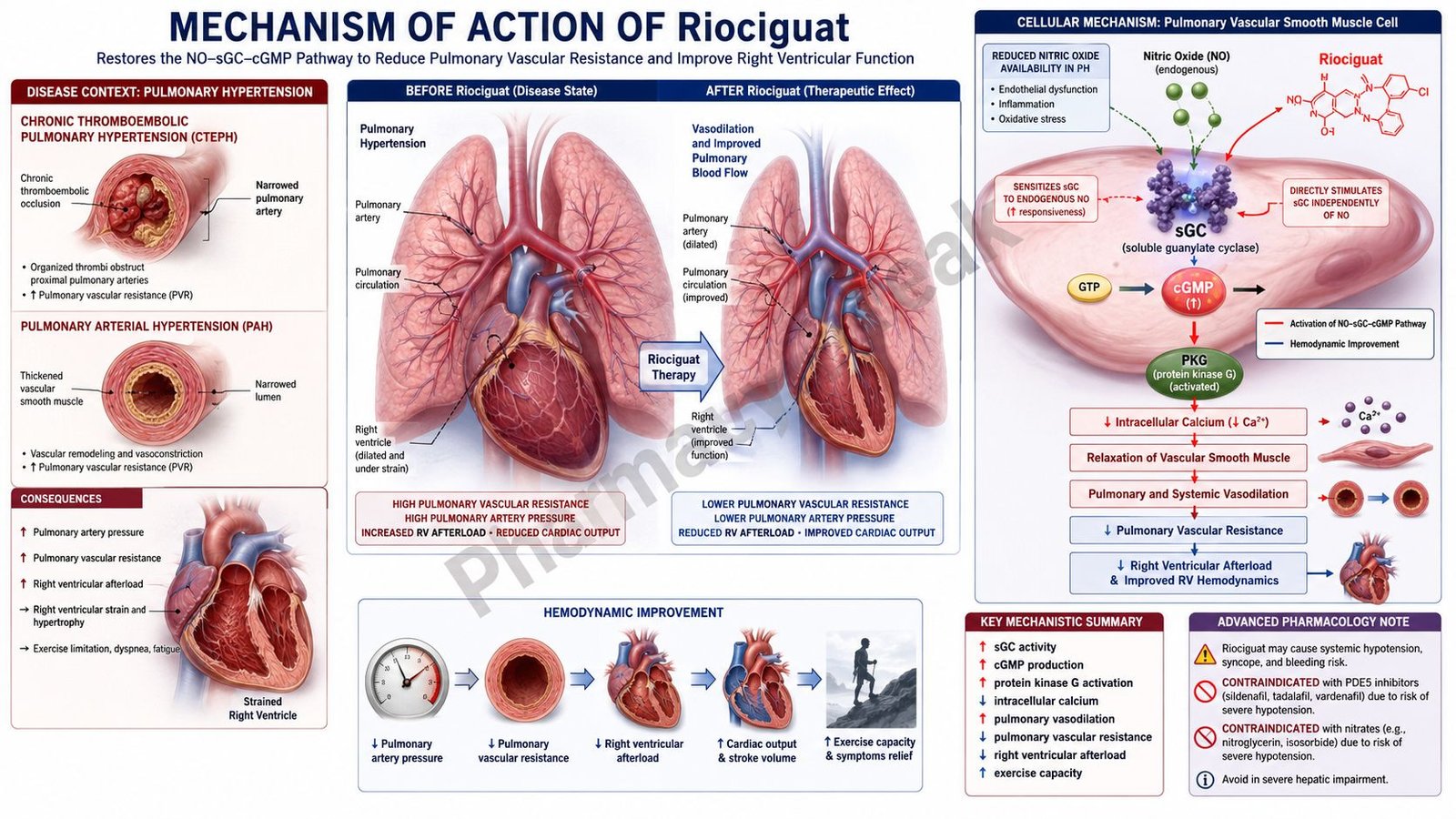
Pulmonary hypertension is a condition in which pressure within the pulmonary arterial circulation becomes abnormally high. This increases the workload of the right ventricle and can eventually lead to right-sided heart failure. In pulmonary arterial hypertension and chronic thromboembolic pulmonary hypertension, impaired nitric oxide signaling, endothelial dysfunction, vascular remodeling, vasoconstriction, and thrombosis-related obstruction contribute to increased pulmonary vascular resistance.
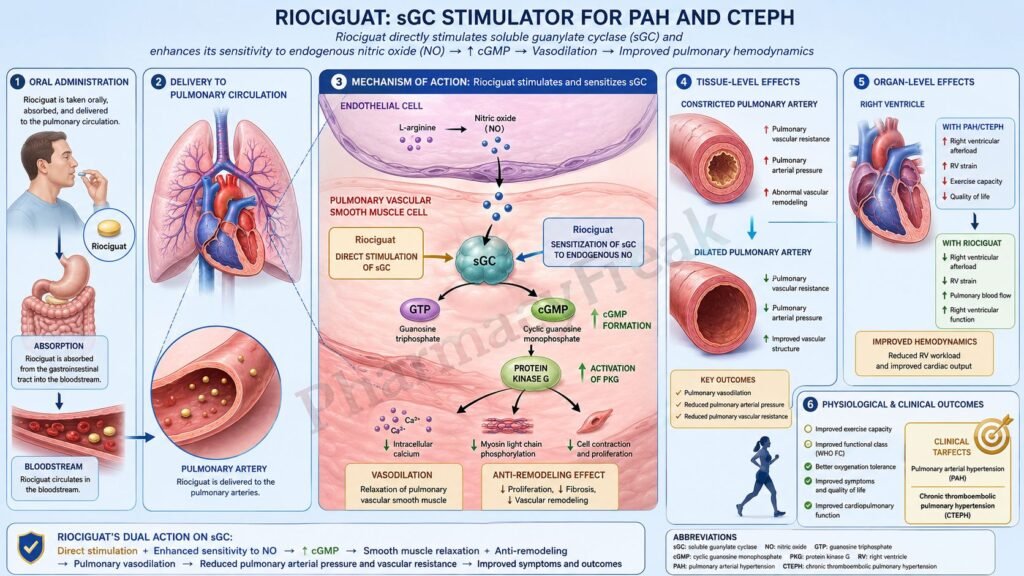
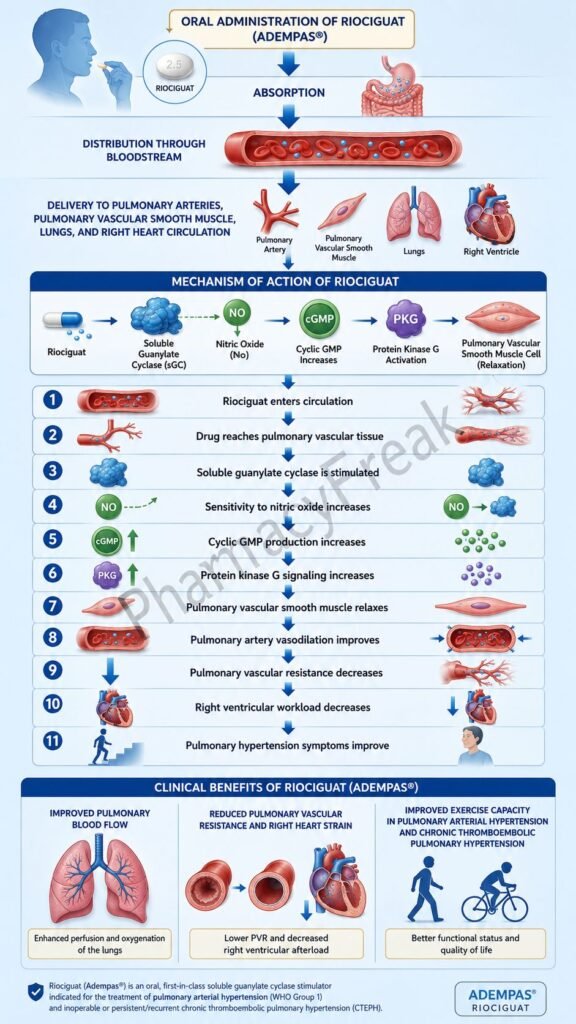
Riociguat works by stimulating soluble guanylate cyclase, the receptor enzyme for nitric oxide. This increases cyclic guanosine monophosphate, or cGMP, leading to relaxation of pulmonary vascular smooth muscle and reduction in pulmonary vascular resistance. It also has antiproliferative and antifibrotic effects in the pulmonary vasculature, which may help counter vascular remodeling.
Adempas is indicated for adults with persistent or recurrent chronic thromboembolic pulmonary hypertension after surgical treatment, or inoperable CTEPH, to improve exercise capacity and WHO functional class. It is also indicated for adults with pulmonary arterial hypertension to improve exercise capacity, improve WHO functional class, and delay clinical worsening.
For exam purposes, riociguat should be remembered as an oral soluble guanylate cyclase stimulator that enhances the nitric oxide-sGC-cGMP pathway and is used in CTEPH and PAH. It has an important boxed warning for embryo-fetal toxicity and is contraindicated in pregnancy.
Mechanism of Action (Step-wise)
Step 1: Nitric oxide normally regulates pulmonary vascular tone
In healthy pulmonary vessels, endothelial cells produce nitric oxide, commonly called NO. Nitric oxide diffuses into adjacent vascular smooth muscle cells and activates soluble guanylate cyclase. This pathway is essential for maintaining normal vascular relaxation and low pulmonary vascular resistance.
Step 2: Soluble guanylate cyclase converts GTP into cGMP
Soluble guanylate cyclase is an intracellular enzyme that acts as the receptor for nitric oxide. When activated, it converts guanosine triphosphate, or GTP, into cyclic guanosine monophosphate, or cGMP.
Step 3: cGMP promotes vascular smooth muscle relaxation
cGMP activates protein kinase G and other downstream signaling mechanisms. These reduce intracellular calcium availability and decrease smooth muscle contraction. The final result is relaxation of vascular smooth muscle.
Step 4: Pulmonary hypertension involves impaired NO-sGC-cGMP signaling
In pulmonary hypertension, endothelial dysfunction reduces nitric oxide bioavailability. Less nitric oxide means reduced stimulation of soluble guanylate cyclase, lower cGMP production, increased pulmonary vasoconstriction, and higher pulmonary vascular resistance.
Step 5: Riociguat directly stimulates soluble guanylate cyclase
Riociguat directly stimulates soluble guanylate cyclase, even when nitric oxide levels are reduced. This is important because pulmonary hypertension often involves reduced nitric oxide signaling. Riociguat therefore helps restore cGMP production despite endothelial dysfunction.
Step 6: Riociguat also sensitizes sGC to nitric oxide
Riociguat has a dual mechanism. It not only directly stimulates sGC but also increases the sensitivity of sGC to endogenous nitric oxide. This means that available nitric oxide becomes more effective at activating the enzyme.
Step 7: cGMP levels increase
By stimulating sGC, riociguat increases intracellular cGMP in pulmonary vascular smooth muscle cells. Increased cGMP is the central second-messenger effect responsible for pulmonary vasodilation.
Step 8: Pulmonary vascular smooth muscle relaxes
Higher cGMP levels reduce intracellular calcium-mediated contraction. This causes relaxation of pulmonary arterial smooth muscle, widening of pulmonary vessels, and reduction in pulmonary vascular tone.
Step 9: Pulmonary vascular resistance decreases
As pulmonary arteries relax, pulmonary vascular resistance decreases. This reduces the pressure load on the right ventricle and improves blood flow through the lungs.
Step 10: Exercise capacity improves
Improved pulmonary blood flow and reduced right ventricular workload help improve exercise capacity. This is commonly measured clinically by the 6-minute walk distance in pulmonary hypertension trials and follow-up.
Step 11: Vascular remodeling may be reduced
The cGMP pathway also has antiproliferative and antifibrotic effects in vascular smooth muscle and related cells. By increasing cGMP signaling, riociguat may help counter abnormal pulmonary vascular remodeling, although its immediate clinical effect is mainly pulmonary vasodilation.
Step 12: Final therapeutic outcome depends on disease type
In chronic thromboembolic pulmonary hypertension, riociguat improves exercise capacity and WHO functional class in patients with inoperable disease or persistent/recurrent disease after surgery. In pulmonary arterial hypertension, it improves exercise capacity, WHO functional class, and delays clinical worsening.
Pharmacokinetics
Riociguat is administered orally as tablets, usually three times daily. The usual starting dose is 1 mg three times daily. In patients who may not tolerate hypotensive effects, a lower starting dose of 0.5 mg three times daily may be considered. Dose titration is individualized, usually increasing by 0.5 mg three times daily at intervals of at least 2 weeks, based on blood pressure and tolerability.
Riociguat may be taken with or without food. However, patients prone to hypotension may experience improved tolerability when taking it with food. Tablets should be taken consistently as prescribed and not combined with contraindicated vasodilators.
After oral administration, riociguat is absorbed systemically. It has relatively high oral bioavailability and reaches peak plasma concentration within a few hours. It is distributed in plasma and is protein bound.
Riociguat is metabolized mainly by CYP1A1, CYP3A4, CYP2C8, and CYP2J2. It is also affected by transporter systems such as P-glycoprotein and breast cancer resistance protein. Drugs that strongly inhibit these pathways may increase riociguat exposure and increase the risk of hypotension.
Smoking is clinically relevant because polycyclic aromatic hydrocarbons in cigarette smoke induce CYP1A1. This can reduce riociguat exposure and may reduce therapeutic effect. If a patient stops smoking during therapy, riociguat exposure may increase, so blood pressure and tolerability should be reassessed.
Riociguat is eliminated through both renal and fecal pathways as metabolites and unchanged drug. It is not recommended in some severe renal or hepatic impairment situations depending on product-specific labeling and clinical context.
Antacids containing aluminum hydroxide or magnesium hydroxide can reduce riociguat absorption. They should generally be separated from riociguat dosing according to prescribing guidance.
Clinical Uses
Riociguat is used in adults with chronic thromboembolic pulmonary hypertension, also called CTEPH. CTEPH occurs when organized blood clots obstruct pulmonary arteries and cause persistent pulmonary hypertension. Pulmonary endarterectomy is the treatment of choice for operable CTEPH, but some patients are inoperable or have persistent or recurrent disease after surgery.
In CTEPH, riociguat is used to improve exercise capacity and WHO functional class in adults with persistent or recurrent CTEPH after surgical treatment or inoperable CTEPH.
Riociguat is also used in adults with pulmonary arterial hypertension, or PAH, classified as WHO Group 1 pulmonary hypertension. PAH involves remodeling and narrowing of small pulmonary arteries, leading to increased pulmonary vascular resistance and right ventricular strain.
In PAH, riociguat improves exercise capacity, improves WHO functional class, and delays clinical worsening.
Riociguat is not used for all types of pulmonary hypertension. It is contraindicated in pulmonary hypertension associated with idiopathic interstitial pneumonias because clinical studies showed unfavorable outcomes in that population. It is also not a general drug for systemic hypertension, heart failure without pulmonary hypertension, asthma, COPD alone, or acute pulmonary embolism.
Adverse Effects
The most important safety warning of riociguat is embryo-fetal toxicity. Riociguat can cause fetal harm and is contraindicated during pregnancy. Females of reproductive potential require pregnancy testing and reliable contraception according to product guidance. In the United States, Adempas is available to females through a REMS program because of this risk.
Hypotension is a major adverse effect. Because riociguat increases cGMP and causes vasodilation, it can lower systemic blood pressure. Symptoms may include dizziness, lightheadedness, syncope, weakness, blurred vision, or falls.
Riociguat must not be used with nitrates or nitric oxide donors because the combination can cause severe hypotension. It is also contraindicated with phosphodiesterase-5 inhibitors such as sildenafil, tadalafil, or vardenafil, because both drug classes increase cGMP signaling and can produce dangerous blood pressure reduction.
Common adverse effects include headache, dizziness, dyspepsia or gastritis, nausea, diarrhea, vomiting, hypotension, anemia, peripheral edema, and palpitations.
Bleeding is an important warning. Serious bleeding events, including hemoptysis and pulmonary hemorrhage, have been reported. Patients with pulmonary hypertension may already have increased bleeding risk, and concomitant anticoagulation may further increase clinical concern.
Riociguat may cause anemia. Monitoring may be needed if symptoms such as fatigue, pallor, shortness of breath, or reduced exercise tolerance worsen.
It should not be used in pregnancy, with nitrates, with PDE-5 inhibitors, or with other soluble guanylate cyclase stimulators. It is also contraindicated in pulmonary hypertension associated with idiopathic interstitial pneumonias.
Comparative Analysis
Riociguat is commonly compared with phosphodiesterase-5 inhibitors such as sildenafil and tadalafil. Both drug classes increase cGMP signaling, but they do so differently. Sildenafil and tadalafil inhibit PDE-5, the enzyme that breaks down cGMP. Riociguat directly stimulates soluble guanylate cyclase and increases cGMP production.
Because riociguat and PDE-5 inhibitors both increase cGMP, they must not be used together. The combination can cause severe hypotension and is contraindicated.
Compared with nitrates, riociguat also acts on the nitric oxide-cGMP pathway, but it does not work by donating nitric oxide. Nitrates release nitric oxide, which activates sGC. Riociguat directly stimulates sGC and sensitizes it to endogenous nitric oxide. However, nitrates and riociguat are contraindicated together because of excessive vasodilation and hypotension risk.
Compared with endothelin receptor antagonists such as bosentan, ambrisentan, and macitentan, riociguat targets the nitric oxide-sGC-cGMP pathway rather than the endothelin pathway. Endothelin receptor antagonists block endothelin-mediated vasoconstriction and proliferation.
Compared with prostacyclin pathway drugs such as epoprostenol, treprostinil, iloprost, and selexipag, riociguat acts through cGMP rather than cyclic AMP. Prostacyclin drugs increase cAMP signaling and produce vasodilatory, antiproliferative, and antiplatelet effects.
Compared with anticoagulation in CTEPH, riociguat does not dissolve clots. Anticoagulation prevents new thrombus formation, while riociguat reduces pulmonary vascular resistance and improves hemodynamics. In CTEPH, anticoagulation and procedural evaluation remain essential.
Compared with pulmonary endarterectomy, riociguat is medical therapy. Pulmonary endarterectomy can be potentially curative in operable CTEPH, while riociguat is used when CTEPH is inoperable or persistent/recurrent after surgery.
MCQs
- Riociguat belongs to which pharmacological class?
a) Soluble guanylate cyclase stimulator
b) Phosphodiesterase-5 inhibitor
c) Endothelin receptor antagonist
d) Calcium channel blocker
Answer: a) Soluble guanylate cyclase stimulator
- The brand name of riociguat is:
a) Adempas
b) Revatio
c) Tracleer
d) Opsumit
Answer: a) Adempas
- Riociguat mainly increases which intracellular second messenger?
a) cGMP
b) cAMP only
c) IP3 only
d) Diacylglycerol only
Answer: a) cGMP
- Riociguat acts by stimulating:
a) Soluble guanylate cyclase
b) Phosphodiesterase-5
c) Cyclooxygenase-1
d) Angiotensin-converting enzyme
Answer: a) Soluble guanylate cyclase
- The normal endogenous activator of soluble guanylate cyclase is:
a) Nitric oxide
b) Histamine
c) Acetylcholine at nicotinic receptors
d) Dopamine
Answer: a) Nitric oxide
- Increased cGMP in pulmonary vascular smooth muscle causes:
a) Vasodilation
b) Vasoconstriction
c) Platelet aggregation only
d) Bronchoconstriction only
Answer: a) Vasodilation
- Riociguat is approved for adults with:
a) Inoperable or persistent/recurrent CTEPH
b) Essential hypertension only
c) Acute asthma attack
d) Acute pulmonary embolism only
Answer: a) Inoperable or persistent/recurrent CTEPH
- Riociguat is also used in adults with:
a) Pulmonary arterial hypertension
b) Type 1 diabetes mellitus
c) Acute bacterial pneumonia
d) Rheumatoid arthritis
Answer: a) Pulmonary arterial hypertension
- Which drug class is contraindicated with riociguat?
a) Phosphodiesterase-5 inhibitors
b) Proton pump inhibitors
c) Inhaled corticosteroids
d) Beta-lactam antibiotics
Answer: a) Phosphodiesterase-5 inhibitors
- Riociguat must not be used with nitrates because of risk of:
a) Severe hypotension
b) Severe hypertension
c) Hypoglycemia
d) Ototoxicity
Answer: a) Severe hypotension
- The boxed warning of riociguat is related to:
a) Embryo-fetal toxicity
b) Severe neutropenia
c) Irreversible hearing loss
d) Pancreatitis only
Answer: a) Embryo-fetal toxicity
- Which adverse effect is commonly associated with riociguat?
a) Headache
b) Gingival hyperplasia
c) Severe hypoglycemia
d) Tendon rupture
Answer: a) Headache
- Smoking may reduce riociguat exposure mainly by inducing:
a) CYP1A1
b) Acetylcholinesterase
c) Cyclooxygenase-2
d) Monoamine oxidase-B
Answer: a) CYP1A1
- Riociguat is contraindicated in pulmonary hypertension associated with:
a) Idiopathic interstitial pneumonias
b) WHO Group 1 PAH
c) Inoperable CTEPH
d) Persistent CTEPH after surgery
Answer: a) Idiopathic interstitial pneumonias
- Which statement best describes riociguat?
a) It directly stimulates sGC and sensitizes it to nitric oxide
b) It blocks beta-1 receptors in the heart
c) It inhibits DNA synthesis in cancer cells
d) It blocks dopamine D2 receptors
Answer: a) It directly stimulates sGC and sensitizes it to nitric oxide
FAQs
What is the mechanism of action of riociguat?
Riociguat stimulates soluble guanylate cyclase and sensitizes it to endogenous nitric oxide. This increases cGMP levels, relaxes pulmonary vascular smooth muscle, reduces pulmonary vascular resistance, and improves pulmonary hypertension symptoms.
What is the brand name of riociguat?
The brand name of riociguat is Adempas.
What is riociguat used for?
Riociguat is used in adults with inoperable or persistent/recurrent chronic thromboembolic pulmonary hypertension and in adults with pulmonary arterial hypertension.
How is riociguat different from sildenafil?
Riociguat stimulates soluble guanylate cyclase to increase cGMP production. Sildenafil inhibits PDE-5, which prevents cGMP breakdown. Both increase cGMP, so they must not be used together because of severe hypotension risk.
Why is riociguat contraindicated in pregnancy?
Riociguat can cause fetal harm and is contraindicated during pregnancy. Females of reproductive potential require pregnancy testing and effective contraception according to product guidance.
What is the most important adverse effect of riociguat?
Hypotension is one of the most important pharmacological adverse effects. Embryo-fetal toxicity is the boxed warning, and bleeding including hemoptysis or pulmonary hemorrhage is also clinically important.
Can riociguat be used with nitrates?
No. Riociguat must not be used with nitrates or nitric oxide donors because the combination can produce dangerous hypotension.
Does riociguat dissolve blood clots in CTEPH?
No. Riociguat does not dissolve thromboembolic clots. It reduces pulmonary vascular resistance through the sGC-cGMP pathway. Anticoagulation and surgical or interventional assessment remain important in CTEPH management.
References
Goodman & Gilman’s The Pharmacological Basis of Therapeutics
Katzung Basic & Clinical Pharmacology