Table of Contents
Introduction
Nucala is the brand name for mepolizumab, a humanized monoclonal antibody that targets interleukin-5 (IL-5). It is used for the treatment of severe eosinophilic asthma, eosinophilic granulomatosis with polyangiitis (EGPA), hypereosinophilic syndrome (HES), and chronic rhinosinusitis with nasal polyps.
Eosinophils play a major role in eosinophilic inflammatory diseases by releasing inflammatory mediators that damage tissues and promote chronic inflammation. Interleukin-5 is the key cytokine responsible for eosinophil growth, activation, recruitment, and survival. By specifically targeting IL-5, mepolizumab reduces eosinophil-mediated inflammation and improves disease control.
Mechanism of Action (Step-wise)
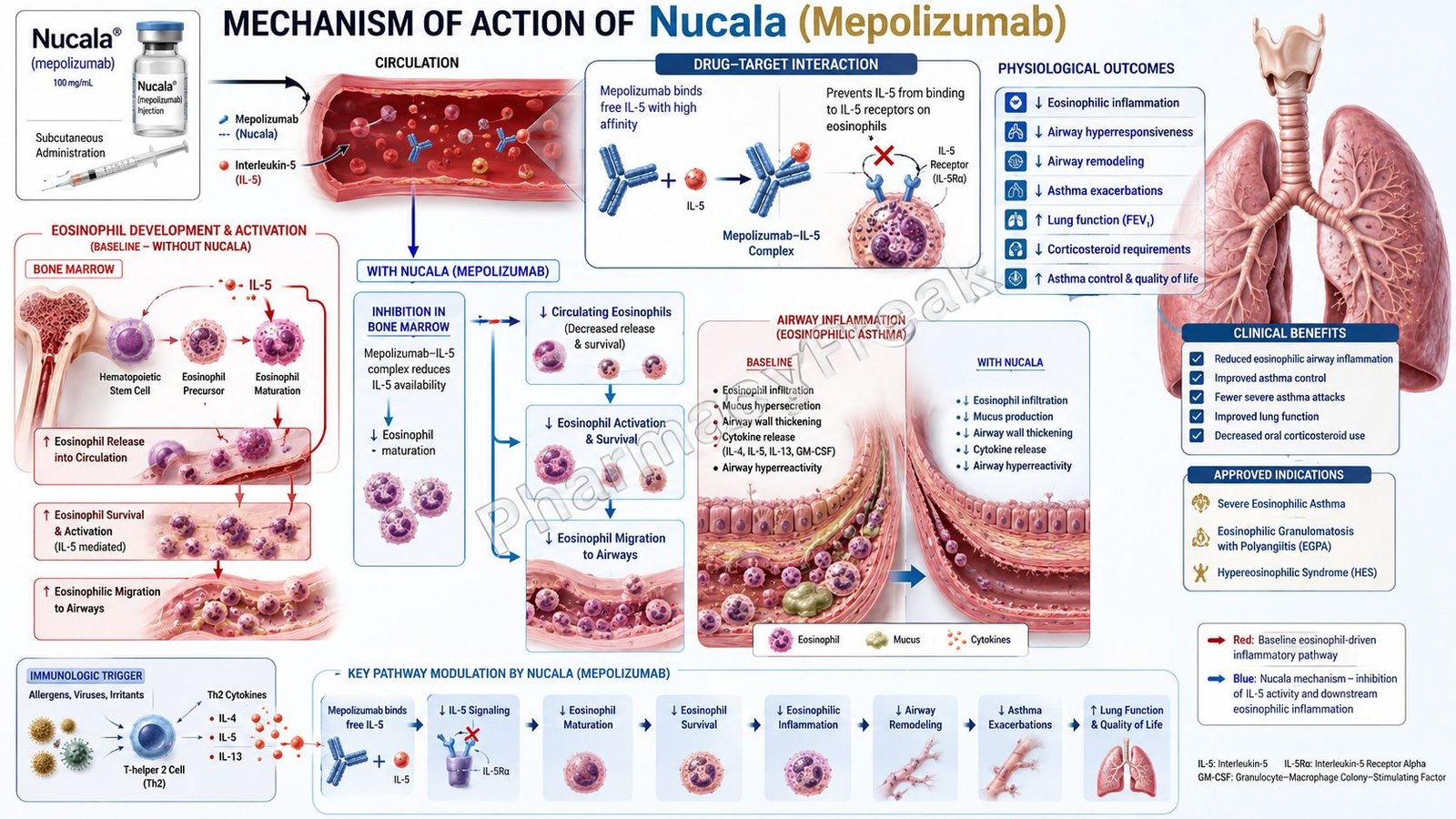
Mepolizumab acts by neutralizing interleukin-5 and suppressing eosinophilic inflammation.
1. Role of Interleukin-5 in Eosinophilic Diseases
Interleukin-5 (IL-5) is primarily produced by:
- Type 2 helper T cells (Th2 cells)
- Group 2 innate lymphoid cells (ILC2s)
- Mast cells
- Eosinophils
IL-5 is the principal cytokine responsible for:
- Eosinophil production in bone marrow
- Eosinophil maturation
- Eosinophil activation
- Eosinophil survival
- Recruitment of eosinophils to tissues
In eosinophilic disorders, excessive IL-5 signaling leads to persistent inflammation and tissue damage.
2. Administration and Systemic Distribution
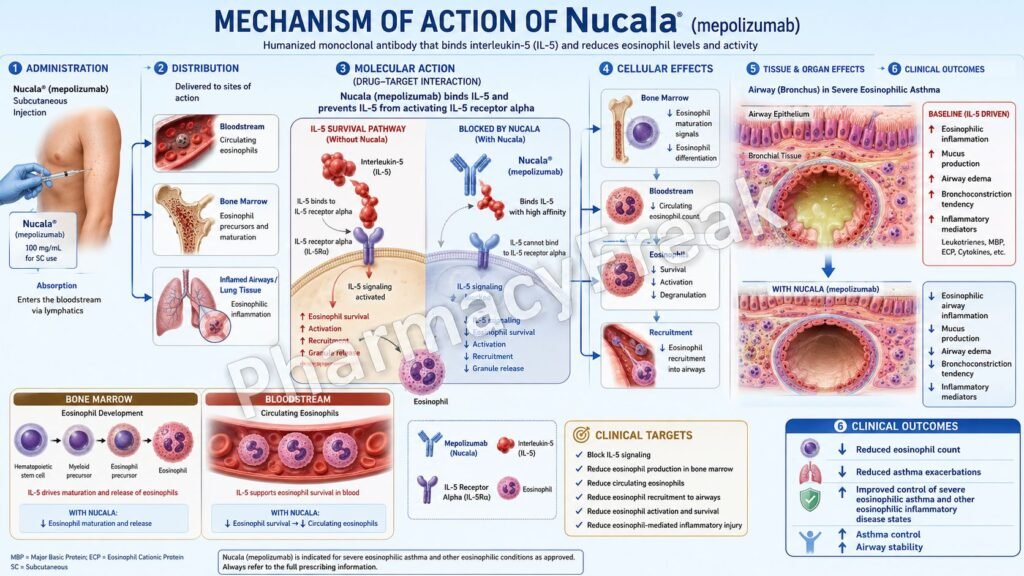
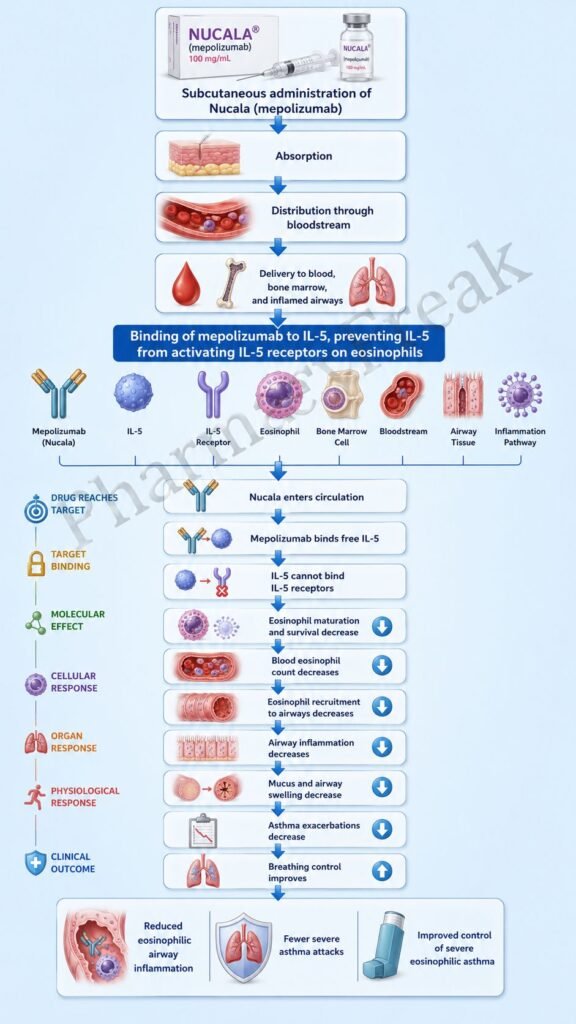
Mepolizumab is administered by subcutaneous injection.
After absorption, the monoclonal antibody enters systemic circulation and distributes throughout the body.
It encounters circulating IL-5 molecules within blood and tissues.
3. Binding to Interleukin-5
Mepolizumab specifically binds to free IL-5 with high affinity.
By binding IL-5:
- IL-5 is neutralized.
- IL-5 cannot bind to IL-5 receptors on eosinophils.
- Downstream signaling is blocked.
This is the primary pharmacologic action of mepolizumab.
4. Prevention of IL-5 Receptor Activation
Normally, IL-5 binds to IL-5 receptors located on eosinophils and eosinophil precursors.
Activation of these receptors stimulates:
- Eosinophil proliferation
- Differentiation
- Survival
- Migration
Mepolizumab prevents receptor activation by removing free IL-5 from circulation.
5. Reduction in Eosinophil Production
Without IL-5 signaling:
- Bone marrow eosinophil production decreases.
- Eosinophil maturation declines.
- New eosinophil generation is reduced.
This lowers the number of circulating eosinophils.
6. Reduction in Eosinophil Survival
IL-5 normally protects eosinophils from apoptosis.
Blocking IL-5 removes this survival signal.
As a result:
- Existing eosinophils undergo apoptosis more readily.
- Blood eosinophil counts decrease significantly.
7. Reduction in Tissue Eosinophilic Inflammation
Lower eosinophil levels lead to:
- Reduced airway inflammation
- Reduced tissue infiltration
- Less release of inflammatory mediators
- Decreased tissue injury
This effect is particularly important in severe eosinophilic asthma and EGPA.
8. Final Therapeutic Effects
The overall effects of mepolizumab include:
- Reduced eosinophil counts
- Reduced eosinophilic inflammation
- Fewer asthma exacerbations
- Improved lung function
- Reduced corticosteroid requirements
- Better disease control in eosinophilic disorders
Thus, mepolizumab acts as an anti-IL-5 monoclonal antibody that suppresses eosinophil-mediated inflammation.
Pharmacokinetics
Mepolizumab is administered as a subcutaneous injection.
- Slowly absorbed after injection.
- Bioavailability is approximately 70–80%.
- Peak plasma concentrations occur within several days.
- Distributed primarily within vascular and interstitial compartments.
- Metabolized through normal protein degradation pathways.
- Not metabolized by cytochrome P450 enzymes.
- Eliminated through proteolytic catabolism.
- Elimination half-life is approximately 16–22 days.
The long half-life allows administration once every four weeks.
Clinical Uses
Severe Eosinophilic Asthma
Mepolizumab is indicated as add-on maintenance therapy for severe eosinophilic asthma.
Eosinophilic Granulomatosis with Polyangiitis (EGPA)
Reduces disease activity and helps maintain remission.
Hypereosinophilic Syndrome (HES)
Used to reduce eosinophil counts and disease manifestations.
Chronic Rhinosinusitis with Nasal Polyps
Helps reduce polyp burden and improve symptoms.
Corticosteroid-Sparing Therapy
Allows reduction of long-term systemic corticosteroid use in selected patients.
Adverse Effects
Common adverse effects include:
- Headache
- Injection site reactions
- Fatigue
- Back pain
- Arthralgia
Important adverse effects include:
- Hypersensitivity reactions
- Anaphylaxis (rare)
- Herpes zoster infections
- Opportunistic infections (uncommon)
- Immune-mediated reactions
Most adverse effects are generally mild to moderate in severity.
Comparative Analysis
| Drug | Target | Mechanism | Main Indications | Key Limitation |
|---|---|---|---|---|
| Mepolizumab | IL-5 | Neutralizes IL-5 | Eosinophilic asthma, EGPA, HES | Injection therapy |
| Benralizumab | IL-5 receptor α | Eosinophil depletion via ADCC | Severe eosinophilic asthma | Injection therapy |
| Reslizumab | IL-5 | Neutralizes IL-5 | Eosinophilic asthma | IV administration |
| Omalizumab | IgE | Anti-IgE antibody | Allergic asthma | Requires IgE criteria |
| Dupilumab | IL-4Rα | Blocks IL-4 and IL-13 signaling | Asthma, atopic dermatitis, CRSwNP | Injection therapy |
Mepolizumab and reslizumab directly neutralize IL-5, whereas benralizumab targets the IL-5 receptor and causes near-complete eosinophil depletion through antibody-dependent cellular cytotoxicity. Omalizumab targets IgE-mediated disease, while dupilumab blocks IL-4 and IL-13 pathways involved in type 2 inflammation.
MCQs
1. Nucala contains which active ingredient?
a) Omalizumab
b) Benralizumab
c) Mepolizumab
d) Dupilumab
Answer: c) Mepolizumab
2. Mepolizumab primarily targets:
a) IgE
b) IL-5
c) TNF-α
d) IL-17
Answer: b) IL-5
3. Interleukin-5 primarily regulates:
a) Neutrophils
b) Platelets
c) Eosinophils
d) Erythrocytes
Answer: c) Eosinophils
4. Mepolizumab belongs to which class?
a) Small molecule inhibitor
b) Monoclonal antibody
c) Corticosteroid
d) Leukotriene antagonist
Answer: b) Monoclonal antibody
5. Blocking IL-5 results in:
a) Increased eosinophil survival
b) Reduced eosinophil production and survival
c) Increased neutrophil activation
d) Increased platelet aggregation
Answer: b) Reduced eosinophil production and survival
6. Nucala is primarily used in:
a) Eosinophilic asthma
b) Tuberculosis
c) Hypertension
d) Diabetes mellitus
Answer: a) Eosinophilic asthma
7. Mepolizumab is administered by:
a) Oral route
b) Intranasal route
c) Subcutaneous injection
d) Topical route
Answer: c) Subcutaneous injection
8. Which disease is approved for treatment with mepolizumab?
a) EGPA
b) Parkinson disease
c) Epilepsy
d) Osteoporosis
Answer: a) EGPA
9. A common adverse effect of mepolizumab is:
a) Headache
b) Nephrotoxicity
c) Ototoxicity
d) Hyperglycemia
Answer: a) Headache
10. Mepolizumab reduces:
a) Blood glucose levels
b) Eosinophilic inflammation
c) Platelet function
d) Thyroid hormone production
Answer: b) Eosinophilic inflammation
11. IL-5 receptor activation normally promotes:
a) Eosinophil survival
b) Bone resorption
c) Platelet aggregation
d) Dopamine release
Answer: a) Eosinophil survival
12. The elimination half-life of mepolizumab is approximately:
a) 1–2 hours
b) 6–8 hours
c) 16–22 days
d) 2 months
Answer: c) 16–22 days
FAQs
What is the mechanism of action of Nucala?
Nucala (mepolizumab) binds to and neutralizes interleukin-5 (IL-5), preventing activation of eosinophils and reducing eosinophilic inflammation.
Is mepolizumab a monoclonal antibody?
Yes. Mepolizumab is a humanized monoclonal antibody directed against IL-5.
How does mepolizumab reduce eosinophil counts?
By blocking IL-5, it prevents eosinophil production, maturation, activation, and survival, resulting in lower eosinophil levels.
What conditions is Nucala used to treat?
It is used for severe eosinophilic asthma, eosinophilic granulomatosis with polyangiitis (EGPA), hypereosinophilic syndrome (HES), and chronic rhinosinusitis with nasal polyps.
How often is mepolizumab administered?
It is typically administered once every four weeks as a subcutaneous injection.
What is the most common adverse effect of Nucala?
Headache and injection-site reactions are among the most commonly reported adverse effects.
How is mepolizumab different from benralizumab?
Mepolizumab neutralizes IL-5 itself, whereas benralizumab targets the IL-5 receptor and directly depletes eosinophils through antibody-dependent cellular cytotoxicity.
References
Goodman & Gilman’s The Pharmacological Basis of Therapeutics
Katzung Basic & Clinical Pharmacology