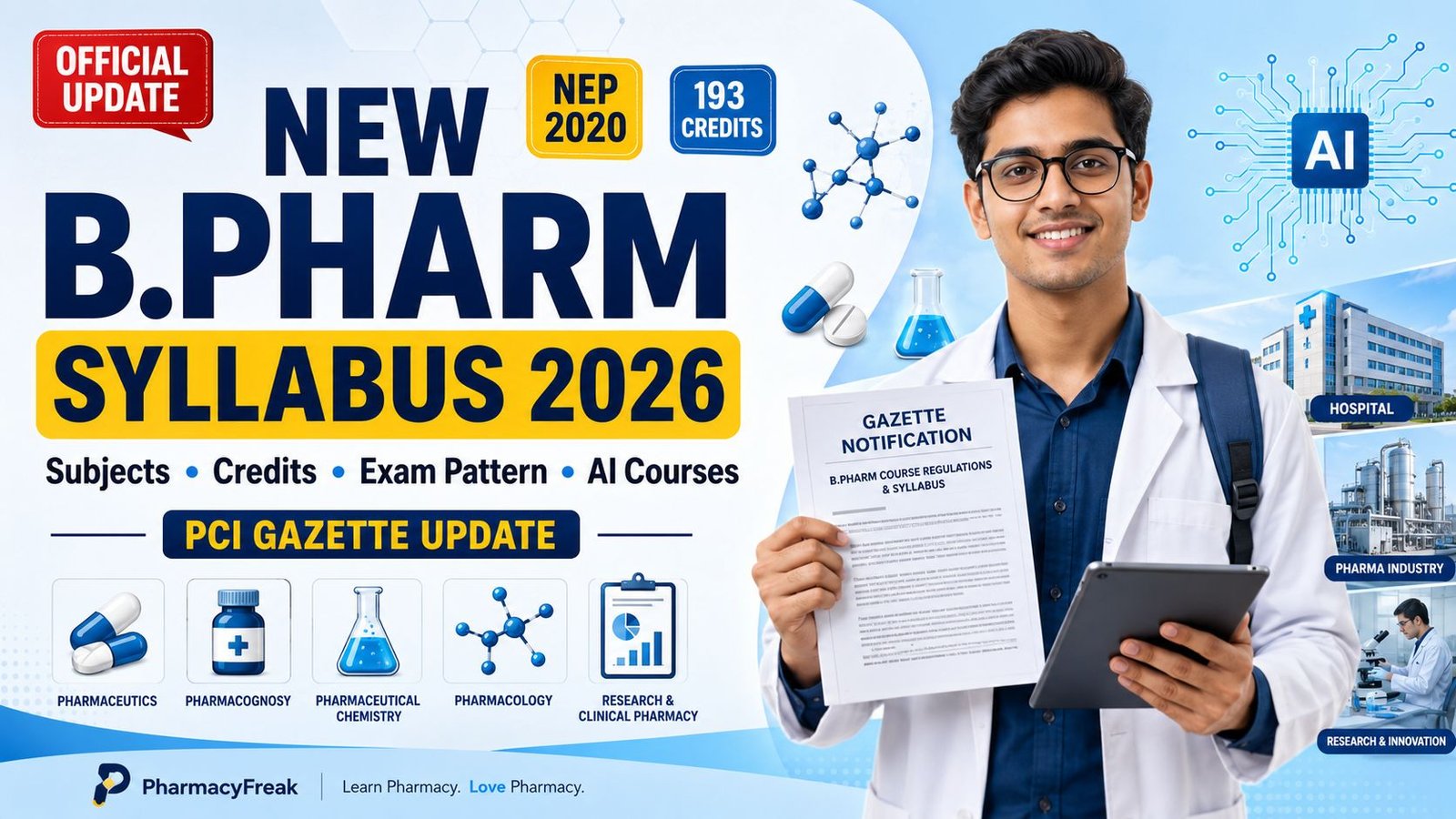
The Pharmacy Council of India (PCI) has notified a new Bachelor of Pharmacy (B.Pharm) syllabus for 2026, aligned with the National Education Policy (NEP) 2020. The new curriculum introduces Python programming, pharmaceutical data analytics, machine learning, multiple AI-focused courses, startup education, skill-based electives, two internships, research projects, industry exposure and a revised credit-based examination system.
The official notification is dated 9 June 2026. It appears in The Gazette of India, Extraordinary, Part III, Section 4, No. 392, whose issue heading is dated 10 June 2026. The notification states that the syllabus comes into force from the date of publication in the Official Gazette. The introductory message in the syllabus says it is proposed for implementation from the 2026–27 academic year.
This PharmacyFreak guide explains the notification in student-friendly language and includes the complete semester-wise course structure, eligibility, duration, credits, electives, attendance, examination pattern, passing rules, internships, research work, grading system and the most important changes from the earlier PCI syllabus.
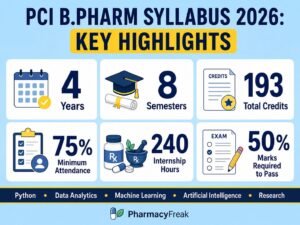
Quick answer: The new PCI B.Pharm programme remains a four-year, eight-semester degree. It requires 193 credits, a minimum of 75% attendance in each theory and practical course separately, 240 hours of internship, research projects in Semesters VII and VIII, and a minimum of 50% total marks in each course to pass. It adds Python, data analytics, machine learning and AI throughout the programme.
New PCI B.Pharm Syllabus 2026: Key Highlights
| Particular | Official provision in the 2026 syllabus |
|---|---|
| Regulating body | Pharmacy Council of India (PCI) |
| Official title | Pharmacy Council of India Syllabus for Bachelor of Pharmacy (B.Pharm) (2026), as per NEP 2020 |
| Notification number | No. 14-154/2025-PCI |
| Notification date | 9 June 2026 |
| Gazette | The Gazette of India, Extraordinary, Part III, Section 4, No. 392 |
| Gazette issue date shown | 10 June 2026 |
| Proposed academic implementation | Academic year 2026–27 |
| Regular duration | 4 academic years or 8 semesters |
| Lateral-entry duration | 3 academic years or 6 semesters, beginning in Semester III |
| Total degree credits | 193 |
| Medium | English for instruction and examinations |
| Minimum attendance | 75% in every individual course; theory and practical attendance counted separately |
| Minimum working days | 90 working days in each semester |
| Semester break | At least 7 days between semesters |
| Pass requirement | At least 50% in each course, including internal and end-semester assessment |
| Internship | Minimum 240 hours across two semesters |
| Research project | 6 credits in Semester VII and 6 credits in Semester VIII |
| Technology focus | Python, data analytics, machine learning, AI, automation, AR/VR and digital pharmacy tools |
| Credit records | Academic Bank of Credits (ABC) and National Academic Depository (NAD) |
Is the New B.Pharm Syllabus Official and When Will It Apply?
Yes. The syllabus has been notified by PCI through the Gazette of India using the powers available under Regulation 8 of the Bachelor of Pharmacy Course Regulations, 2014.
Students should understand the dates carefully:
- The PCI notification is dated 9 June 2026.
- The Gazette issue heading is dated 10 June 2026.
- The notification says the syllabus comes into force on its publication in the Official Gazette.
- The introductory message says implementation is proposed from the 2026–27 academic year.
Universities generally need to issue their own implementation scheme, academic calendar, examination instructions and transitional directions for affiliated colleges. Therefore, newly admitted students should check the notice issued by their university or institution, especially if there is any doubt about the batch from which a revised course code or examination scheme will be used.
Current students should not assume that their subject codes will change in the middle of the programme unless their university issues a formal transition or equivalence order.
Why Has PCI Revised the B.Pharm Curriculum?
The syllabus is designed to make pharmacy education more closely connected with modern healthcare, pharmaceutical manufacturing, research, regulation and digital technology. It combines traditional pharmaceutical sciences with data-driven and experiential learning.
The main priorities visible in the Gazette are:
- Stronger foundations in pharmaceutical, biomedical and clinical sciences.
- More laboratory, project, internship and field-based learning.
- Early exposure to Python, statistics, data analytics and machine learning.
- Responsible use of artificial intelligence in drug discovery, manufacturing, pharmacokinetics and pharmacy practice.
- Improved patient communication, public-health orientation and professional ethics.
- Greater academic choice through AEC, SEC and VAC electives.
- Research, scientific writing, intellectual property and innovation skills.
- Industry readiness through internships, visits, cGMP, automation, facility design, quality systems and regulatory affairs.
- Entrepreneurship through startup, management and marketing courses.
- Environmental responsibility, green pharmacy and sustainability.
Eligibility for B.Pharm Admission Under the 2026 Syllabus
Admission to First-Year B.Pharm
A candidate must have passed a 10+2 examination conducted by a State or Central Government authority, or an equivalent examination recognized by bodies such as the Association of Indian Universities (AIU) or the Council of Boards of School Education in India (COBSE), including systems such as IGNOU and NIOS.
The candidate must have:
- English as one of the subjects;
- Physics and Chemistry as compulsory subjects; and
- Mathematics or Biology as the third qualifying science subject.
PCI may also approve another qualification as equivalent.
B.Pharm Lateral Entry
A candidate may enter directly into Semester III after passing a D.Pharm course from an institution approved by PCI under Section 12 of the Pharmacy Act.
The regular B.Pharm route is eight semesters, while the lateral-entry route is six semesters.
Special Credit Rules for D.Pharm Lateral-Entry Students
The Gazette provides a specific credit arrangement for lateral-entry students.
They must study these additional courses:
- Semester III: Healthcare Psychology and Communication Skills – Theory
- Semester III: Healthcare Psychology and Communication Skills – Practical
- Semester III: Basics of Python Programming for Pharmaceutical Sciences – Theory
- Semester IV: Applied Biostatistics and Data Analytics for Pharmaceutical Sciences – Theory
After successful completion of these additional courses, lateral-entry students are to receive 47 credits connected with their earlier D.Pharm study and the bridging requirements:
- 41 credits are accounted for from the D.Pharm programme.
- 6 credits are awarded for the additional B.Pharm courses listed above.
- The 41 D.Pharm-accounted credits are to be recorded in the Semester III marks sheet.
B.Pharm Course Duration, Calendar and Medium
The programme duration remains:
- Regular entry: four academic years or eight semesters.
- Lateral entry: three academic years or six semesters.
Each semester must contain at least 90 working days. Odd semesters are normally conducted from June/July to November/December, and even semesters from December/January to May/June. A break of at least seven days must be provided between semesters.
The medium of teaching and examinations is English.
B.Pharm Credit System Under NEP 2020
The curriculum uses a Choice Based Credit System (CBCS). Credits represent the expected academic workload.
- One lecture hour per week is assigned one credit.
- Two practical or laboratory hours per week are assigned one credit.
- Every 30 hours of internship or project activity equals one credit.
- If a calculated credit fraction is 0.5 or less, the lower integer is assigned.
A student must earn 193 credits for the B.Pharm degree. A university or institution may offer additional courses or approved MOOC credits, but those do not remove the requirement to complete the prescribed 193 credits.
Semester-Wise Credit Distribution
The detailed semester tables and Table IX in the Gazette give the following distribution:
| Semester | Credits |
|---|---|
| Semester I | 21 |
| Semester II | 26 |
| Semester III | 25 |
| Semester IV | 23 |
| Semester V | 22 |
| Semester VI | 26 |
| Semester VII | 26 |
| Semester VIII | 24 |
| Grand Total | 193 |
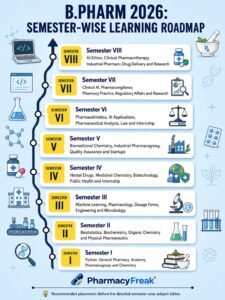
PCI B.Pharm Syllabus 2026: Semester-Wise Subjects and Credits
The following tables reproduce the complete course structure from the detailed semester tables in the Gazette. “T” indicates theory, “P” practical, “I” internship and “RP” research project.
B.Pharm Semester I Subjects
Semester I builds a foundation in pharmacy, anatomy, physiology, pathophysiology, pharmacognosy, chemistry, patient communication and programming.
| Code | Course | Weekly hours | Credits |
|---|---|---|---|
| BP101T | Basics of Python Programming for Pharmaceutical Sciences – Theory | 2 | 2 |
| BP102T | General Pharmacy – Theory | 3 | 3 |
| BP103T | Healthcare Psychology and Communication Skills – Theory | 1 | 1 |
| BP104T | Human Anatomy, Physiology and Pathophysiology I – Theory | 4 | 4 |
| BP105T | Introduction to Pharmacognosy – Theory | 3 | 3 |
| BP106T | Pharmaceutical Inorganic and Analytical Chemistry – Theory | 3 | 3 |
| BP107P | General Pharmacy – Practical | 3 | 1 |
| BP108P | Healthcare Psychology and Communication Skills – Practical | 2 | 1 |
| BP109P | Human Anatomy, Physiology and Pathophysiology I – Practical | 3 | 1 |
| BP110P | Introduction to Pharmacognosy – Practical | 3 | 1 |
| BP111P | Pharmaceutical Inorganic and Analytical Chemistry – Practical | 3 | 1 |
| Total | 30 | 21 |
What Students Will Notice in Semester I
Python is introduced from the first semester rather than being treated as a late or optional computer topic. The course is designed around pharmaceutical datasets, data handling, NumPy, Pandas and visualization, helping students prepare for later analytics, machine-learning and AI courses.
B.Pharm Semester II Subjects
Semester II advances the biomedical, chemical and formulation-science foundation and adds pharmaceutical statistics and data analytics.
| Code | Course | Weekly hours | Credits |
|---|---|---|---|
| BP201T | Applied Biostatistics and Data Analytics for Pharmaceutical Sciences – Theory | 2 | 2 |
| BP202T | Biochemistry – Theory | 3 | 3 |
| BP203T | Human Anatomy, Physiology and Pathophysiology II – Theory | 4 | 4 |
| BP204T | Pharmaceutical Organic Chemistry – Theory | 4 | 4 |
| BP205T | Pharmacognosy and Phytochemistry – Theory | 4 | 4 |
| BP206T | Physical Pharmaceutics – Theory | 3 | 3 |
| BP207P | Biochemistry – Practical | 3 | 1 |
| BP208P | Human Anatomy, Physiology and Pathophysiology II – Practical | 3 | 1 |
| BP209P | Pharmaceutical Organic Chemistry – Practical | 3 | 1 |
| BP210P | Pharmacognosy and Phytochemistry – Practical | 3 | 1 |
| BP211P | Physical Pharmaceutics – Practical | 3 | 1 |
| BP212P | SEC Elective 1 – Practical | 2 | 1 |
| Total | 37 | 26 |
Students select one Semester II SEC practical from Communication Skills; Mental Well-Being, Stress and Conflict Management; or Fundamentals of Computer Operations.
B.Pharm Semester III Subjects
Semester III introduces machine learning while developing pharmacology, dosage-form, engineering, microbiology and medicinal-chemistry foundations.
| Code | Course | Weekly hours | Credits |
|---|---|---|---|
| BP301T | Introduction to Machine Learning in Pharmaceutical Sciences – Theory | 2 | 2 |
| BP302T | Environmental Sciences – Theory | 1 | 1 |
| BP303T | Ethics and Universal Human Values – Theory | 1 | 1 |
| BP304T | General Pharmacology – Theory | 3 | 3 |
| BP305T | Heterocyclic Compounds and Stereochemistry – Theory | 3 | 3 |
| BP306T | Pharmaceutical Dosage Forms I – Theory | 3 | 3 |
| BP307T | Pharmaceutical Engineering – Theory | 3 | 3 |
| BP308T | Pharmaceutical Microbiology – Theory | 3 | 3 |
| BP309P | General Pharmacology – Practical | 4 | 2 |
| BP310P | Heterocyclic Compounds and Stereochemistry – Practical | 4 | 2 |
| BP311P | Pharmaceutical Dosage Forms I – Practical | 3 | 1 |
| BP312P | AEC Elective 2 – Practical | 2 | 1 |
| Total | 32 | 25 |
Students select one AEC practical from Nutraceuticals and Functional Foods; Food Analysis; or Yoga and Life Sciences.
B.Pharm Semester IV Subjects
Semester IV combines herbal drug technology, medicinal chemistry, biotechnology, public health and systemic pharmacology. It also contains the first mandatory internship.
| Code | Course | Weekly hours | Credits |
|---|---|---|---|
| BP401T | Herbal Drug Technology – Theory | 3 | 3 |
| BP402T | Medicinal Chemistry – Theory | 3 | 3 |
| BP403T | Pharmaceutical Biotechnology – Theory | 3 | 3 |
| BP404T | Social Pharmacy and Public Health – Theory | 2 | 2 |
| BP405T | Systemic Pharmacology I – Theory | 3 | 3 |
| BP406P | Herbal Drug Technology – Practical | 3 | 1 |
| BP407P | Medicinal Chemistry – Practical | 3 | 1 |
| BP408P | Pharmaceutical Biotechnology – Practical | 3 | 1 |
| BP409P | Social Pharmacy and Public Health – Practical | 2 | 1 |
| BP410P | Systemic Pharmacology I – Practical | 3 | 1 |
| BP411I | Internship – Mandatory | 8 | 4 |
| Total | 28 | 23 |
B.Pharm Semester V Subjects
Semester V develops industry, quality, formulation, pharmacognosy, pharmacology and entrepreneurship competencies.
| Code | Course | Weekly hours | Credits |
|---|---|---|---|
| BP501T | Biomedicinal Chemistry – Theory | 3 | 3 |
| BP502T | Industrial Pharmacognosy – Theory | 3 | 3 |
| BP503T | Innovation and Startup Ecosystem – Theory | 2 | 2 |
| BP504T | Pharmaceutical Dosage Forms II – Theory | 2 | 2 |
| BP505T | Pharmaceutical Quality Assurance – Theory | 3 | 3 |
| BP506T | Systemic Pharmacology II – Theory | 3 | 3 |
| BP507P | Biomedicinal Chemistry – Practical | 4 | 2 |
| BP508P | Industrial Pharmacognosy – Practical | 3 | 1 |
| BP509P | Pharmaceutical Dosage Forms II – Practical | 3 | 1 |
| BP510P | Systemic Pharmacology II – Practical | 4 | 2 |
| Total | 30 | 22 |
The Innovation and Startup Ecosystem course covers ideation, opportunity identification, minimum viable products, business models, operations, scaling and participation in the startup ecosystem.
B.Pharm Semester VI Subjects
Semester VI is strongly industry- and skill-oriented. It includes AI applications, pharmaceutical law, analysis, IPR, three elective slots and the second mandatory internship.
| Code | Course | Weekly hours | Credits |
|---|---|---|---|
| BP601T | Advanced Pharmacognosy – Theory | 3 | 3 |
| BP602T | Biopharmaceutics and Pharmacokinetics – Theory | 3 | 3 |
| BP603T | Intellectual Property Rights – Theory | 2 | 2 |
| BP604T | AI Applications in Pharmaceutical Sciences – Theory | 2 | 2 |
| BP605T | Pharmaceutical Analysis – Theory | 3 | 3 |
| BP606T | Pharmaceutical Jurisprudence – Theory | 3 | 3 |
| BP607T | AEC Elective 3 – Theory | 1 | 1 |
| BP608P | Biopharmaceutics and Pharmacokinetics – Practical | 3 | 1 |
| BP609P | Pharmaceutical Analysis – Practical | 4 | 2 |
| BP610P | SEC Elective 4 – Practical | 2 | 1 |
| BP611P | VAC Elective 5 – Practical | 2 | 1 |
| BP612I | Internship – Mandatory | 8 | 4 |
| Total | 28 | 26 |
Semester VI elective choices are listed in the complete elective section below.
B.Pharm Semester VII Subjects
Semester VII concentrates on research, clinical AI, pharmacovigilance, pharmacy practice, regulation, analytical techniques and cosmetics.
| Code | Course | Weekly hours | Credits |
|---|---|---|---|
| BP701T | Biostatistics and Research Methodology – Theory | 3 | 3 |
| BP702T | Cosmetics and Cosmeceuticals – Theory | 2 | 2 |
| BP703T | AI in Clinical Applications – Theory | 2 | 2 |
| BP704T | Modern Analytical Techniques – Theory | 3 | 3 |
| BP705T | Pharmacovigilance – Theory | 3 | 3 |
| BP706T | Pharmacy Practice – Theory | 3 | 3 |
| BP707T | Regulatory Affairs – Theory | 2 | 2 |
| BP708T | AEC Elective 6 – Theory | 1 | 1 |
| BP709P | Modern Analytical Techniques – Practical | 3 | 1 |
| BP710RP | Research Project | Not fixed weekly | 6 |
| Total | 22 | 26 |
B.Pharm Semester VIII Subjects
The final semester combines advanced manufacturing, clinical pharmacotherapy, pharmaceutical management, sterile products, novel drug delivery, AI ethics and translational applications, marketing skills and research.
| Code | Course | Weekly hours | Credits |
|---|---|---|---|
| BP801T | Ethical Considerations and Translational Applications of AI in Pharmacy – Theory | 2 | 2 |
| BP802T | Clinical Pharmacotherapeutics – Theory | 2 | 2 |
| BP803T | Industrial Pharmacy and Facility Design – Theory | 3 | 3 |
| BP804T | Pharmaceutical Management – Theory | 2 | 2 |
| BP805T | Sterile Dosage Forms and Novel Drug Delivery System – Theory | 3 | 3 |
| BP806T | AEC Elective 7 – Theory | 2 | 2 |
| BP807P | Pharmaceutical Marketing Skills – Practical | 2 | 1 |
| BP808P | Sterile Dosage Forms and Novel Drug Delivery System – Practical | 4 | 2 |
| BP809P | VAC Elective 8 – Practical | 2 | 1 |
| BP810RP | Research Project | Not fixed weekly | 6 |
| Total | 22 | 24 |
Complete List of B.Pharm Electives in the 2026 Syllabus
Students do not take every course in each elective group. They select one course from the options offered for the relevant elective slot. Actual availability may depend on the university, higher education institution, faculty and facilities.
| Semester | Slot and category | Options |
|---|---|---|
| II | Elective 1 – SEC Practical | Communication Skills; Mental Well-Being, Stress and Conflict Management; Fundamentals of Computer Operations |
| III | Elective 2 – AEC Practical | Nutraceuticals and Functional Foods; Food Analysis; Yoga and Life Sciences |
| VI | Elective 3 – AEC Theory | Green Chemistry; Materiovigilance and Hemovigilance; Scientific Writing; Drug Store and Business Management; Career Building in Cultivation of Medicinal Plants; Active Pharmaceutical Ingredients and Excipient Sciences |
| VI | Elective 4 – SEC Practical | Computer-Aided Drug Design; Analytical Method Development and Validation; Principles of Preclinical Studies |
| VI | Elective 5 – VAC Practical | Professional Skills; Process Analytical Technology and QbD in Formulation Science |
| VII | Elective 6 – AEC Theory | Current Good Manufacturing Practices; Pharmaceutical Automation; Modern Techniques in Cellular Biology; Medical Devices; Transformation of Food Waste into Medicinal Products; Biosimilars, Vaccines and Macromolecules; Precision Medicine* |
| VIII | Elective 7 – AEC Theory | Pharmaceutical Packaging; Supply Chain Management; Industrial Safety and Waste Management; Traditional Healing Practices of India; Futuristic Pharma through AR/VR: Pharma 4.0; Herbal Cosmetics for Industry Perspective |
| VIII | Elective 8 – VAC Practical | Cleaning Validation; Basic Training in Aseptic Handling Techniques; Impurity Profiling |
AEC means Ability Enhancement Course, SEC means Skill Enhancement Course and VAC means Value Added Course.
*The appendix lists Precision Medicine as a seventh Semester VII option, although it is not shown in the earlier Semester VII course-table list. Students should follow the final option list communicated by their university.
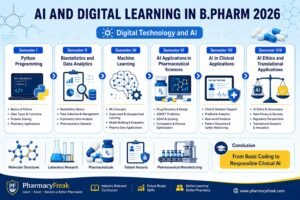
Digital Technology and AI in the New B.Pharm Syllabus
Digital education is not limited to a single “computer applications” paper. It develops across the programme:
- Semester I: Basics of Python Programming for Pharmaceutical Sciences.
- Semester II: Applied Biostatistics and Data Analytics for Pharmaceutical Sciences.
- Semester III: Introduction to Machine Learning in Pharmaceutical Sciences.
- Semester VI: AI Applications in Pharmaceutical Sciences.
- Semester VII: AI in Clinical Applications.
- Semester VIII: Ethical Considerations and Translational Applications of AI in Pharmacy.
Additional elective exposure can include computer-aided drug design, analytical method development, pharmaceutical automation, precision medicine, Process Analytical Technology, Quality by Design and AR/VR-based Pharma 4.0.
The programme outcomes also require students to recognize the limitations and ethical implications of AI, machine learning, digital and computational tools. This is important: the curriculum treats AI as a professional tool that requires scientific validation, data quality, accountability and responsible use, not as a substitute for pharmaceutical judgment.
Internship Rules: 240 Hours of Practical Training
Every B.Pharm student must complete at least 240 hours of practical training across two semesters. The course tables place mandatory internships in Semesters IV and VI, with four credits assigned to each internship.
Training may be completed in an appropriate setting such as:
- Pharmaceutical industry;
- Cosmetics industry;
- Medical-device industry;
- Food industry;
- Hospital pharmacy;
- Community pharmacy; or
- Another relevant field allowed by the prescribed course content.
Students must submit two internship reports, which are evaluated separately.
The stated evaluation pattern is:
| Component | Marks |
|---|---|
| Certificate and report submission | 75 |
| Presentation and discussion | 25 |
| Total | 100 |
Research Project in Semesters VII and VIII
Research has a much larger place in the new scheme. Students receive six project credits in Semester VII and another six in Semester VIII.
Important project rules include:
- Every student must undertake a project under a teacher’s supervision.
- An external mentor from industry, a hospital, an NABL laboratory, a CDSCO-approved laboratory or an allied/interdisciplinary field is preferred.
- A project group may contain no more than three students.
- The report must be typed, bound, submitted in triplicate and contain at least 25 pages.
- Internal and external examiners appointed by the university evaluate the project.
- Students may choose a continuous research theme that begins in Semester VII and continues into Semester VIII.
- If a continuous theme is used, the milestones completed by the end of Semester VII are formally evaluated in that semester.
Project Evaluation
The dissertation book carries 60 marks:
| Criterion | Marks |
|---|---|
| Objectives | 10 |
| Methodology | 20 |
| Results and discussion | 20 |
| Conclusion and outcome | 10 |
| Total | 60 |
The presentation carries 90 marks:
| Criterion | Marks |
|---|---|
| Presentation of work | 40 |
| Communication skills | 20 |
| Question-and-answer skills | 30 |
| Total | 90 |
The dissertation-book score is common to the group, while presentation marks are based on each student’s individual performance.
Compulsory Industry Visits, Institutional MoUs and Community Service
The Gazette goes beyond classroom teaching and places clear responsibilities on colleges.
At Least One Non-Repeated Visit Every Year
Every student must undertake at least one industrial or field visit in each academic year. Possible sites include:
- API manufacturing facilities;
- Excipient manufacturing facilities;
- Pharmaceutical formulation plants;
- Medical-device facilities;
- Food or cosmetics facilities;
- Government- or NABL-approved drug and medical-device testing laboratories; and
- NABH-accredited hospitals.
The facility selected for a particular year should not be repeated in another year. Students must submit individual reports, which are assessed through continuous evaluation as part of a core course decided by the Programme Committee.
Minimum 10 Institutional MoUs
Each pharmacy institution must maintain at least 10 formal, legally valid Memoranda of Understanding with eligible industries, government/NABL laboratories or NABH-accredited hospitals. At least five MoUs must be with pharmaceutical industries.
Adoption of a Village or Urban Ward
Every pharmacy institution must adopt a village or a ward of a panchayat or municipal corporation and conduct community-service activities. Examples include prescription surveys, awareness of rational medicine use and patient-counselling services.
New B.Pharm Examination and Assessment Pattern
The end-semester theory and practical examinations from Semesters I to VIII are to be conducted by the university.
Marks are assigned according to course credits:
| Course credit | Maximum marks | Internal assessment | End-semester assessment |
|---|---|---|---|
| 4 credits | 100 | 40 | 60 |
| 3 credits | 75 | 30 | 45 |
| 2 or 1 credit | 50 | 20 | 30 |
Internal Assessment for Theory Courses
The internal score combines attendance/student-teacher interaction, academic activities and sessional examinations.
| Course credit | Attendance and interaction | Academic activities | Average of two sessionals | Internal total |
|---|---|---|---|---|
| 4 credits | 10 | 10 | 20 | 40 |
| 3 credits | 7.5 | 7.5 | 15 | 30 |
| 2 or 1 credit | 5 | 5 | 10 | 20 |
Academic activities may include any three of the following: quiz, assignment, open-book test, fieldwork, group discussion, seminar or a similar approved activity.
Internal Assessment for Practical Courses
A one- or two-credit practical carrying 50 marks has 20 internal marks:
- Attendance and student-teacher interaction: 5 marks;
- Practical records, regular viva voce and related work: 5 marks; and
- Average of two sessional practical examinations: 10 marks.
Attendance Marks
Attendance is converted into internal marks using the bands specified in the Gazette. For example, 90–100% attendance receives the highest attendance score, while attendance below 75% receives zero attendance marks and also fails the basic eligibility requirement to appear in the examination.
| Attendance | 4-credit theory | 3-credit theory | 2/1-credit theory | Practical |
|---|---|---|---|---|
| 90–100% | 4 | 3.5 | 2 | 2 |
| 85–89% | 3 | 2.5 | 1.5 | 1.5 |
| 75–84% | 2 | 1.5 | 1 | 1 |
| Below 75% | 0 | 0 | 0 | 0 |
Sessional Examinations
Two sessional examinations must be conducted for every theory and practical course. The average of both sessionals is used for internal assessment.
For theory sessionals, the question paper contains objective questions or MCQs, short-answer questions and long-answer questions. The total and long-answer weight vary with the course credit.
End-Semester Theory Paper Pattern
| Course credit | MCQ/objective section | Short-answer section | Long-answer section | Total | Duration |
|---|---|---|---|---|---|
| 4 credits | 20 marks | 20 marks | 20 marks | 60 | 3 hours |
| 3 credits | 10 marks | 20 marks | 15 marks | 45 | 2 hours |
| 2 or 1 credit | 10 marks | 10 marks | 10 marks | 30 | 1.5 hours |
For a four-credit paper, the objective section may be 20 one-mark questions or 10 two-mark questions. The detailed choice pattern is prescribed in the Gazette.
End-Semester Practical Pattern
A one- or two-credit practical end-semester examination carries 30 marks:
| Component | Marks |
|---|---|
| Synopsis | 7.5 |
| Major experiment | 10 |
| Minor experiment | 5 |
| Viva voce | 7.5 |
| Total | 30 |
Practical courses scheduled for four hours per week have four-hour sessional and end-semester practical examinations. Practical courses scheduled for fewer than four hours per week have three-hour examinations.
Passing Marks, Supplementary Exams and Academic Progression
Minimum Passing Marks
A student must obtain at least 50% marks in each individual course, including internal assessment and the applicable end-semester examination. For a 100-mark course, this means a minimum overall score of 50.
The wording in the Gazette sets the pass condition on the total course score, including internal marks. Students should still follow any additional university examination ordinance that is validly issued for implementation.
Grace marks and moderation may be provided according to the applicable university norms, with emphasis on learner progression.
Carry-Forward of Internal Marks
If a student fails a theory or practical course, the student reappears for the end-semester examination. Existing internal-assessment marks are carried forward.
One Chance to Improve Sessional Marks
A student may improve the sessional-examination component of internal assessment once. The repeat sessional must be completed within the same semester. Continuous-assessment marks are not changed through this process.
Supplementary Examination Timeline
The supplementary examination should be completed within two months of publication of the regular end-semester result.
Regular odd-semester examinations are tentatively scheduled for November/December and even-semester examinations for May/June.
Promotion to the Next Semester
Students may progress to the next semester even after failing a course. However:
- A regular-entry student must pass every course up to Semester VII before appearing in the Semester VIII end-semester examination.
- A lateral-entry student must pass every course from Semester III to Semester VII before appearing in the Semester VIII end-semester examination.
- Final CGPA is awarded only after all prescribed courses are completed within the permitted maximum duration.
B.Pharm Grading System, SGPA, CGPA and Class
| Percentage | Letter grade | Grade point | Performance |
|---|---|---|---|
| 90.00–100 | O | 10 | Outstanding |
| 80.00–89.99 | A | 9 | Excellent |
| 70.00–79.99 | B | 8 | Good |
| 60.00–69.99 | C | 7 | Fair |
| 50.00–59.99 | D | 6 | Average |
| Below 50 | F | 0 | Fail |
| Absent | AB | 0 | Fail |
SGPA is the credit-weighted average of grade points earned during a semester. CGPA is calculated using all eight semester SGPAs and their credit weights. Both are calculated to two decimal places.
The examining authority must show marks and SGPA and/or CGPA on marksheets. The uniform conversion prescribed is:
Percentage = CGPA × 10
Degree classification is:
- First Class with Distinction: CGPA 7.50 and above;
- First Class: CGPA 6.00–7.49; and
- Second Class: CGPA 5.00–5.99.
Fail and absent grades are included when the semester SGPA is calculated.
Academic Bank of Credits and Digital Records
The examining authority is responsible for creating and verifying each student’s Academic Bank of Credits ID and maintaining semester-wise credits, grades and awards in the Academic Bank of Credits and National Academic Depository.
This is intended to support verified digital academic records and credit transfer or redemption in accordance with the rules of the relevant statutory bodies. The Gazette does not, however, separately prescribe a first-year certificate, second-year diploma or named multiple-exit award within this B.Pharm syllabus. Students should not assume that an intermediate exit award exists unless PCI or the university issues an applicable regulation.
Maximum Time to Complete B.Pharm and Break-of-Study Rule
The maximum permitted period is twice the prescribed duration:
- A regular four-year student must normally complete the programme within a maximum of eight years.
- A three-year lateral-entry student must normally complete it within a maximum of six years.
A student who does not finish within the maximum period must discontinue the course.
For readmission after a break, the student must obtain university approval and pay the prescribed condonation fee. Condonation is not granted if the break exceeds two years or if completion within the maximum N×2 duration is no longer possible.
Award of Rank and Degree
Ranks and medals are based on final CGPA. A student who has failed one or more courses during the B.Pharm programme is not eligible for a rank. The candidate must also complete the programme in the minimum prescribed period of four years for the award of rank.
Students who satisfy all programme requirements become eligible for award of the B.Pharm degree at the ensuing convocation.
Graduate Attributes and Programme Outcomes
The new syllabus identifies ten graduate attributes expected across pharmacy education:
- Pharmaceutical knowledge proficiency;
- Scientific and analytical thinking;
- Ethical and professional integrity;
- Patient-centred orientation;
- Industry and practice readiness;
- Digital and technological awareness;
- Effective communication skills;
- Teamwork and leadership skills;
- Innovation and problem-solving mindset; and
- Lifelong-learning orientation.
The B.Pharm programme also defines eleven outcomes covering pharmacy knowledge; problem analysis and evidence-based decisions; pharmaceutical skills and practice; modern tools, AI and digital competence; research and innovation; professional ethics and human values; communication; leadership, management and entrepreneurship; responsibility to society; environment and sustainability; and lifelong learning.
Together, these outcomes show that the new curriculum is intended to prepare graduates for pharmaceutical industry, hospitals, community pharmacy, research, regulation, public health, entrepreneurship and technology-enabled roles.
Academic Oversight and Student Representation
Each institution must maintain a B.Pharm Programme Committee and an Internal Examination Committee.
The Programme Committee is constituted annually and includes the Principal or Head of Institution as chairperson, a B.Pharm coordinator, one teacher from every department offering B.Pharm courses and four student representatives – one from each academic year. It must meet at least twice per semester to review class progress, attendance, curriculum issues, course and programme outcomes, learning resources and teaching methods.
The Internal Examination Committee plans the internal-assessment calendar and is responsible for fairness, transparency, question-paper moderation, assessment records and student grievances. Its work covers theory, practical, internship and project assessment. These provisions give students an institutional channel through which genuine internal-assessment concerns can be examined.
Professional Ethics and the Pharmacist’s Oath
The syllabus retains the Pharmacist’s Oath as a statement of professional responsibility. It emphasizes compliance with professional laws and standards, continuous improvement of knowledge, pharmaceutical care, patient counselling, quality medicines, confidentiality and contribution to public health and the pharmacy profession.
Major Changes From the Previous PCI B.Pharm Syllabus
The comparison below uses the earlier official PCI Final Scheme and Syllabus implemented from the 2016–17 academic session and the new 2026 Gazette.
| Area | Earlier PCI scheme | PCI B.Pharm syllabus 2026 |
|---|---|---|
| Policy framework | CBCS under the 2014 regulations | CBCS explicitly aligned with NEP 2020 |
| Minimum working days | 100 per semester | 90 per semester plus at least a 7-day break |
| Minimum attendance | 80% in each course, theory and practical separately | 75% in each course, theory and practical separately |
| Minimum credits stated in regulation | 208 | 193 |
| Digital study | Computer Applications in Pharmacy | Python, data analytics, machine learning and several AI courses across the programme |
| Early curriculum | Traditional core subjects and remedial biology/mathematics where applicable | Python, healthcare psychology and integrated anatomy-physiology-pathophysiology from Semester I; remedial biology/mathematics are not listed in the new semester table |
| Industry exposure | 150-hour Practice School in Semester VII | 240-hour internship across Semesters IV and VI, plus annual visits and institutional MoUs |
| Research project | Six-credit project in Semester VIII | Six-credit project in Semester VII and another six credits in Semester VIII, with an option for a continuous theme |
| Elective placement | Mainly concentrated in the final semester | AEC, SEC and VAC choices distributed across Semesters II, III, VI, VII and VIII |
| Entrepreneurship | Limited standalone emphasis | Innovation and Startup Ecosystem plus management and marketing components |
| Modern industry topics | Present mainly in conventional industrial courses/electives | AI, automation, medical devices, PAT, QbD, precision medicine, supply chains, facility design and Pharma 4.0 options |
| Examination structure | Most major theory courses followed a 25 internal + 75 external structure | Credit-based 40:60, 30:45 or 20:30 internal/external distribution |
| Credit records | Conventional university credit records | Explicit ABC and NAD responsibilities |
The changes do not remove the traditional pillars of B.Pharm. Pharmaceutics, pharmaceutical chemistry, pharmacology, pharmacognosy, analysis, biotechnology, jurisprudence, quality assurance, pharmacy practice and public health remain central. The major shift is that these subjects are now connected with digital tools, research, patient care, industry exposure and professional skills throughout the course.
Important Gazette Discrepancies Students and Colleges Should Know
The official PDF contains a few internal differences that should be clarified through PCI or university implementation directions.
1. Semester-Wise Credit Distribution Differs Between Two Parts of the Gazette
The detailed Semester I–VIII course tables and Table IX give:
21, 26, 25, 23, 22, 26, 26 and 24 credits = 193 credits.
A later graphic titled “Curricular Structure” displays:
21, 23, 23, 25, 25, 26, 26 and 24 credits = 193 credits.
Both add to 193, but the Semester II–V distribution is different. This article uses the detailed course tables and Table IX because their individual course credits add up to those totals.
2. Precision Medicine Appears in the Elective Appendix
The Semester VII table lists six named BP708T AEC options, while the appendix includes a seventh option, BP708T AEC7 Precision Medicine.
What Students Should Do
Do not calculate registration, promotion or examination eligibility from an unofficial social-media chart. Follow the course-registration and examination scheme formally issued by your university. Colleges should seek written clarification where necessary and preserve the notified course codes and credits in student records.
These differences do not change the stated grand total of 193 credits.
How the New Syllabus May Help B.Pharm Students
The revised curriculum can improve career preparation in several ways:
- Python and data analytics can help in pharmacovigilance, clinical research, quality data review and research projects.
- AI and machine-learning courses can provide a base for computational drug discovery, predictive modelling and digital-health applications.
- Internships in two different stages of the degree can expose students to professional environments before graduation.
- Pharmacy practice, clinical pharmacotherapeutics and public health can strengthen patient-facing skills.
- Regulatory affairs, jurisprudence, cGMP, validation, quality assurance and facility design support industrial and compliance roles.
- Startup, intellectual-property, management and marketing courses can help students understand innovation and entrepreneurship.
- Scientific writing, biostatistics and a two-semester research project can improve readiness for M.Pharm, NIPER, research assistantships and higher studies.
- Electives allow students to explore medical devices, precision medicine, biosimilars, nutraceuticals, cosmetics, automation, supply chains, medicinal plants or advanced formulation science.
Students will still need hands-on practice, faculty guidance and industry exposure. The presence of AI or entrepreneurship in a syllabus alone does not guarantee job readiness; laboratory competence, communication, documentation, regulatory understanding and continuous learning remain essential.
What Should Students Do Now?
For Students Taking Admission in 2026–27
- Confirm that the college is approved by PCI for the B.Pharm course.
- Ask whether the university has formally adopted the 2026 syllabus for your batch.
- Obtain the correct semester scheme and course codes from the university.
- Create or verify your ABC ID when instructed.
- Build basic computer and English communication skills before classes begin.
- Keep copies of internship certificates, reports, visit reports and project records.
For Existing B.Pharm Students
- Continue following the scheme officially assigned to your admission batch.
- Do not switch books or course codes based only on online posts.
- Wait for a university migration, equivalence or transition notice if one is required.
- Learn Python, data analytics and AI fundamentals independently even if your batch remains under the earlier curriculum, because these skills are increasingly relevant.
For D.Pharm Students Planning Lateral Entry
- Ensure that your D.Pharm institution is PCI approved under Section 12.
- Be prepared for the additional Python, healthcare-communication and data-analytics courses.
- Verify how 41 D.Pharm credits and six additional-course credits will be entered on the university marksheet.
Frequently Asked Questions About the PCI B.Pharm Syllabus 2026
Is there a new B.Pharm syllabus for 2026?
Yes. PCI notified the “Pharmacy Council of India Syllabus for Bachelor of Pharmacy (B.Pharm) (2026)” under the Bachelor of Pharmacy Course Regulations, 2014. It is aligned with NEP 2020.
From which academic year is the new PCI B.Pharm syllabus expected?
The introductory message proposes implementation from academic year 2026–27. The legal notification says the syllabus comes into force from publication in the Official Gazette. Students should verify the adoption notice for their university and admission batch.
How many years is B.Pharm under the new syllabus?
Regular B.Pharm remains a four-year programme with eight semesters. D.Pharm lateral-entry students complete six semesters over three academic years after joining Semester III.
How many credits are required for the B.Pharm degree?
Students must earn 193 credits. Additional university courses or approved MOOCs may be offered, but the prescribed degree requirements must still be completed.
What are the B.Pharm subjects in the new syllabus?
The programme covers pharmaceutics, pharmacology, pharmacognosy, pharmaceutical chemistry, analysis, biotechnology, jurisprudence, quality assurance, pharmacy practice, public health, pharmacovigilance, regulatory affairs, management and clinical pharmacotherapy. It also adds Python, data analytics, machine learning, AI, entrepreneurship, IPR, internships, electives and research projects.
Is AI included in the new B.Pharm syllabus?
Yes. The syllabus includes Python in Semester I, data analytics in Semester II, machine learning in Semester III, AI applications in Semester VI, clinical AI in Semester VII and AI ethics and translational applications in Semester VIII.
What is the minimum attendance for B.Pharm in the 2026 syllabus?
A student must maintain at least 75% attendance in every individual course. Theory and practical attendance are calculated separately.
What are the passing marks?
A student must obtain at least 50% total marks in each individual course, including internal assessment and end-semester marks.
Can a student move to the next semester with a backlog?
Yes, academic progression to the next semester is allowed despite a failed course. However, all courses up to Semester VII must be passed before a regular student can appear for the Semester VIII end-semester examination.
How many internship hours are compulsory?
At least 240 internship hours are compulsory across two semesters. The course structure places the internships in Semesters IV and VI.
Is a research project compulsory?
Yes. Research Project courses carry six credits in Semester VII and six credits in Semester VIII. A project may continue across both semesters, subject to milestone evaluation.
Are industrial visits compulsory?
Yes. Students must undertake at least one industrial or field visit every academic year, and the selected facility should not be repeated in another year.
Does the syllabus provide multiple exit awards after one or two years?
The Gazette includes ABC/NAD credit-record provisions, but it does not separately name or define a first-year certificate, second-year diploma or another intermediate exit award for B.Pharm. Students should wait for an applicable PCI or university regulation before assuming such an award is available.
Are remedial biology and remedial mathematics included?
They are not listed in the new 2026 semester-wise course tables. Eligibility continues to require Physics and Chemistry with either Mathematics or Biology at 10+2 level.
Is the new syllabus applicable to current B.Pharm students?
Students should follow the scheme assigned to their admission batch. A syllabus should not be assumed to apply mid-programme without a formal university transition or equivalence order.
Where can students check the official notification?
Use the e-Gazette of India portal and search for CG-DL-E-04072026-274118, Gazette No. 392, Part III, Section 4, or notification No. 14-154/2025-PCI. Students should also monitor the Pharmacy Council of India rules and syllabus page and their university website.
Final Takeaway
The PCI B.Pharm syllabus 2026 is a major update to undergraduate pharmacy education in India. It preserves the core pharmaceutical sciences while adding digital competence, AI, data analytics, research, internships, patient-centred practice, industry exposure, electives, innovation and entrepreneurship.
For students, the most important numbers are simple: eight semesters, 193 credits, 75% attendance, 50% passing marks, 240 internship hours and 12 research-project credits across the final two semesters.
The syllabus is extensive and forward-looking, but successful implementation will depend on university directions, trained faculty, computer and laboratory infrastructure, genuine internships, industry collaboration and consistent assessment. Students should rely on official university notices for batch applicability and watch for clarification of the internal credit-table differences identified above.
Official and Primary Sources
- The Gazette of India, Extraordinary, Part III, Section 4, No. 392: Pharmacy Council of India Syllabus for Bachelor of Pharmacy (B.Pharm) (2026), Notification No. 14-154/2025-PCI, dated 9 June 2026. Search on the e-Gazette of India using identifier CG-DL-E-04072026-274118.
- Pharmacy Council of India: Rules, Regulations and Syllabus
- Previous PCI Final Scheme and Syllabus for B.Pharm, implemented from academic year 2016–17
- Ministry of Education: National Education Policy 2020
Editorial note: This article explains the official Gazette for educational purposes. If a summary conflicts with a later PCI, university or statutory clarification, the latest official direction will prevail.