
Table of Contents
Introduction
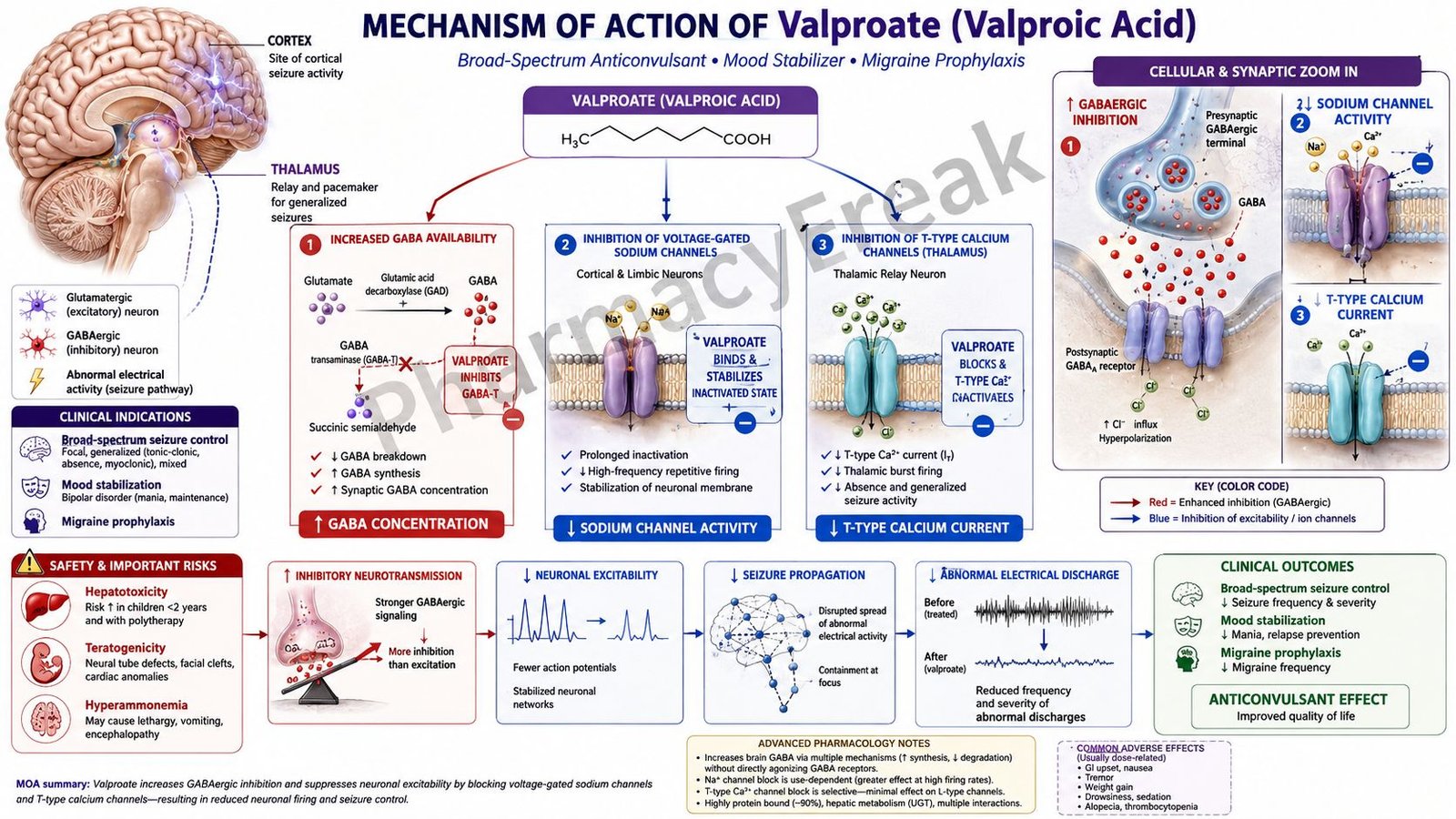
Valproate (valproic acid, sodium valproate, and divalproex sodium) is a broad-spectrum antiepileptic drug used in epilepsy, bipolar disorder, and migraine prophylaxis. It is effective against multiple seizure types because it acts through several mechanisms, including enhancement of GABAergic neurotransmission, blockade of voltage-gated sodium channels, and inhibition of T-type calcium channels.
Mechanism of Action (Step-wise)
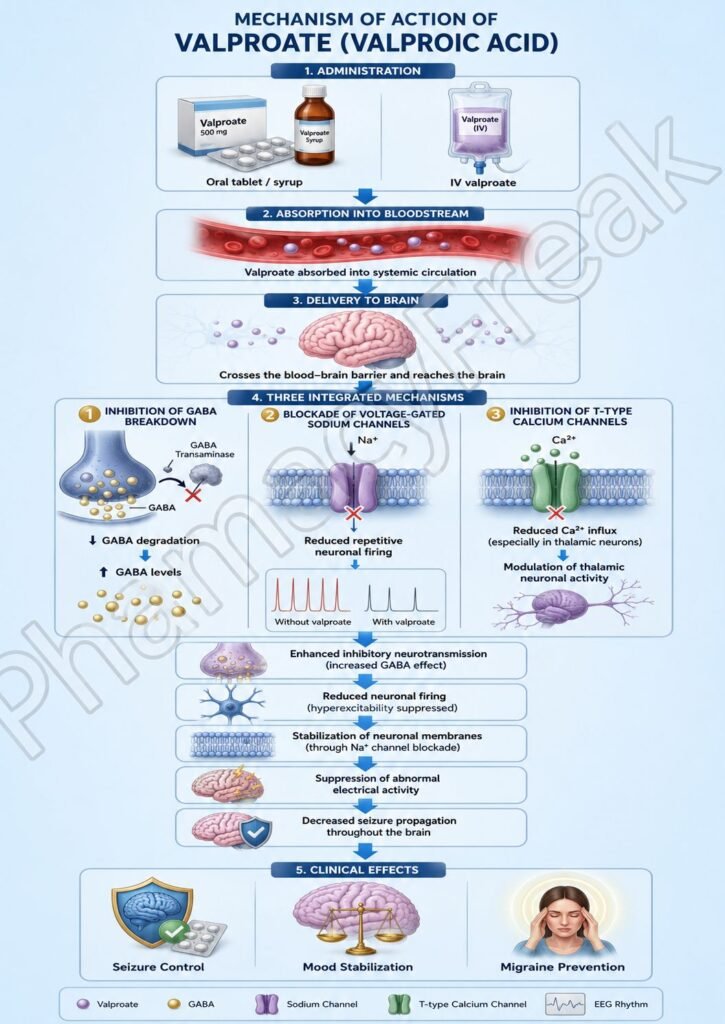
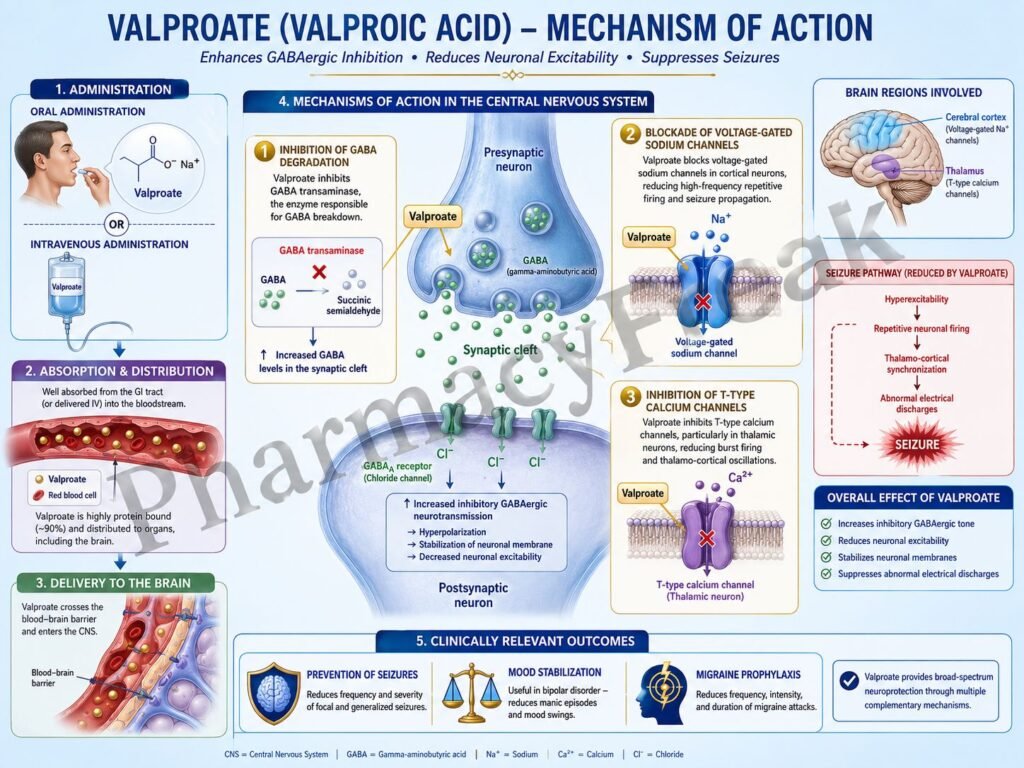
- Valproate enters the central nervous system after administration.
- It increases the concentration of gamma-aminobutyric acid (GABA), the major inhibitory neurotransmitter in the brain.
- Valproate inhibits GABA transaminase, the enzyme responsible for GABA degradation.
- It also inhibits succinic semialdehyde dehydrogenase, further reducing GABA metabolism.
- Brain GABA levels increase.
- Enhanced GABAergic neurotransmission suppresses excessive neuronal firing.
- Valproate blocks voltage-gated sodium channels in neurons.
- Sodium channel blockade prolongs the inactivated state of the channel.
- High-frequency repetitive neuronal firing decreases.
- Valproate also inhibits T-type calcium channels, particularly in thalamic neurons.
- Reduced T-type calcium currents suppress abnormal thalamocortical rhythmic activity.
- This mechanism is especially important in absence seizures.
- Excitatory neurotransmission decreases while inhibitory neurotransmission increases.
- The overall effect is stabilization of neuronal membranes and prevention of seizure propagation.
Key Exam Point: Valproate works by increasing GABA levels, blocking voltage-gated sodium channels, and inhibiting T-type calcium channels.
Pharmacokinetics
Valproate is well absorbed after oral administration and is highly protein-bound. It undergoes extensive hepatic metabolism, primarily through glucuronidation and mitochondrial β-oxidation. The drug has a relatively long half-life and is eliminated mainly through the kidneys as metabolites.
Clinical Uses
- Generalized tonic-clonic seizures
- Absence seizures
- Myoclonic seizures
- Focal seizures
- Bipolar disorder
- Migraine prophylaxis
- Lennox-Gastaut syndrome
Adverse Effects
Common adverse effects include:
- Nausea
- Vomiting
- Tremor
- Weight gain
- Sedation
- Hair loss (alopecia)
Serious adverse effects include:
- Hepatotoxicity
- Pancreatitis
- Hyperammonemia
- Thrombocytopenia
- Teratogenicity (neural tube defects)
Valproate is contraindicated during pregnancy whenever possible due to a high risk of fetal malformations.
Comparative Analysis
| Feature | Valproate | Phenytoin | Ethosuximide |
|---|---|---|---|
| Increases GABA | Yes | No | No |
| Sodium channel blockade | Yes | Yes | Minimal |
| T-type calcium channel blockade | Yes | No | Yes |
| Broad-spectrum antiepileptic | Yes | Moderate | No |
| Absence seizure efficacy | Excellent | Poor | Excellent |
| Bipolar disorder use | Yes | No | No |
Valproate differs from phenytoin because it increases GABA levels and inhibits T-type calcium channels. Compared with ethosuximide, valproate has broader antiepileptic activity and is effective against multiple seizure types.
MCQs
1. Valproate primarily increases the levels of:
a) Dopamine
b) Serotonin
c) GABA
d) Acetylcholine
Answer: c) GABA
2. Valproate inhibits:
a) GABA transaminase
b) Acetylcholinesterase
c) Monoamine oxidase
d) Cyclooxygenase
Answer: a) GABA transaminase
3. Valproate blocks which ion channels?
a) Chloride channels only
b) Sodium channels
c) Potassium channels only
d) TRPV channels
Answer: b) Sodium channels
4. Valproate also inhibits:
a) L-type calcium channels
b) T-type calcium channels
c) Ryanodine receptors
d) NMDA receptors
Answer: b) T-type calcium channels
5. T-type calcium channel inhibition is particularly important in:
a) Focal seizures
b) Absence seizures
c) Febrile seizures
d) Status epilepticus only
Answer: b) Absence seizures
6. Valproate is considered:
a) Narrow-spectrum antiepileptic
b) Broad-spectrum antiepileptic
c) Local anesthetic
d) Antipsychotic
Answer: b) Broad-spectrum antiepileptic
7. A common adverse effect is:
a) Weight gain
b) Hypercalcemia
c) Bradycardia
d) Polycythemia
Answer: a) Weight gain
8. A serious adverse effect is:
a) Hepatotoxicity
b) Cataracts
c) Hyperthyroidism
d) Glaucoma
Answer: a) Hepatotoxicity
9. Valproate is also used in:
a) Bipolar disorder
b) Asthma
c) Hypertension
d) Parkinson disease
Answer: a) Bipolar disorder
10. Valproate may cause:
a) Neural tube defects
b) Hypernatremia
c) Hypercalcemia
d) Hypokalemia
Answer: a) Neural tube defects
11. The antiepileptic effect of valproate results from:
a) Enhanced inhibitory neurotransmission
b) Increased excitatory neurotransmission
c) Histamine blockade
d) Dopamine stimulation
Answer: a) Enhanced inhibitory neurotransmission
12. Which seizure type responds particularly well to valproate?
a) Absence seizures
b) Psychogenic seizures
c) Syncope
d) Nonepileptic attacks
Answer: a) Absence seizures
FAQs
What is the mechanism of action of valproate?
Valproate increases GABA levels, blocks voltage-gated sodium channels, and inhibits T-type calcium channels to suppress abnormal neuronal activity.
Why is valproate considered a broad-spectrum antiepileptic?
Because it is effective against multiple seizure types, including generalized, focal, absence, and myoclonic seizures.
How does valproate increase GABA levels?
By inhibiting GABA transaminase and other enzymes involved in GABA degradation.
Why is valproate effective in absence seizures?
Because it inhibits T-type calcium channels in thalamic neurons.
What are common side effects of valproate?
Weight gain, tremor, nausea, sedation, and hair loss.
Why should valproate be avoided during pregnancy?
Because it significantly increases the risk of neural tube defects and other congenital malformations.
References
Goodman & Gilman’s The Pharmacological Basis of Therapeutics
Katzung’s Basic and Clinical Pharmacology
Tripathi KD. Essentials of Medical Pharmacology
Harrison’s Principles of Internal Medicine


excellent keep it up!!