Table of Contents
Introduction
Tizanidine is a centrally acting skeletal muscle relaxant used primarily for the management of spasticity associated with conditions such as multiple sclerosis, spinal cord injury, stroke, and other neurological disorders. It reduces excessive muscle tone by inhibiting excitatory neurotransmission within the central nervous system. Unlike neuromuscular blocking agents, tizanidine acts at the spinal cord level and does not directly affect skeletal muscle fibers.
Mechanism of Action (Step-wise)
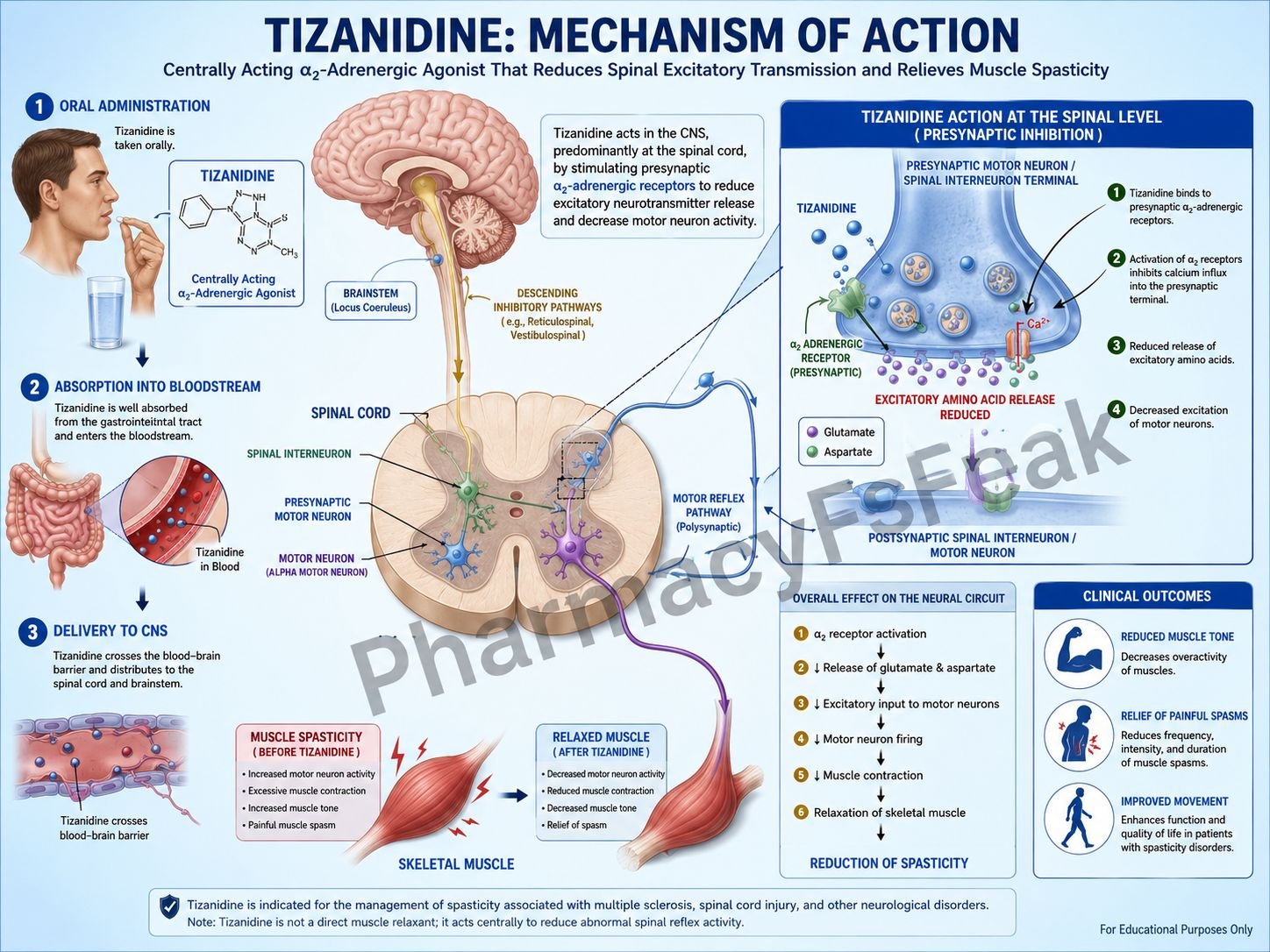
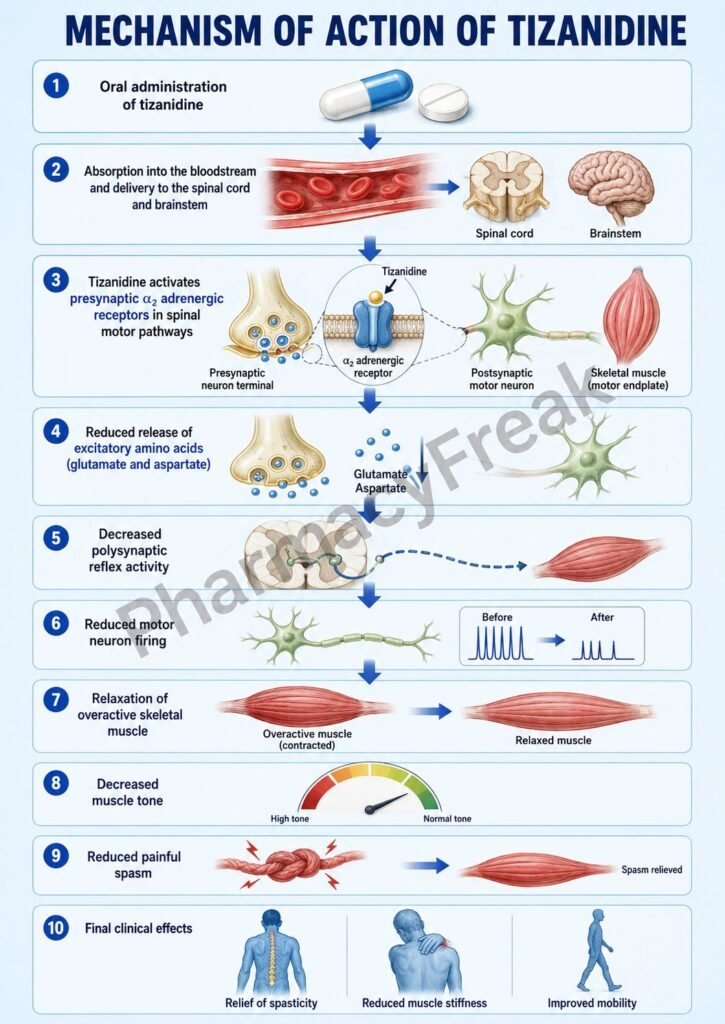
- Tizanidine enters the central nervous system after oral administration.
- It acts primarily as an agonist at central α2-adrenergic receptors.
- These receptors are located mainly in the spinal cord and brainstem.
- Activation of presynaptic α2 receptors inhibits the release of excitatory neurotransmitters.
- Release of glutamate and aspartate from interneurons decreases.
- Excitatory polysynaptic spinal reflex activity is suppressed.
- Transmission of excitatory signals to motor neurons decreases.
- Alpha motor neuron activity is reduced.
- Skeletal muscle tone decreases.
- Muscle spasms and spasticity are relieved.
- Tizanidine also produces mild analgesic effects through inhibition of nociceptive signal transmission.
- The overall effect is reduction of muscle spasticity while preserving muscle strength better than some alternative agents.
A key exam point is that tizanidine is a central α2-adrenergic agonist that inhibits excitatory neurotransmitter release in the spinal cord, reducing spasticity.
Pharmacokinetics
Tizanidine is administered orally and is rapidly absorbed. It undergoes extensive first-pass hepatic metabolism, primarily through CYP1A2. The drug has a relatively short half-life, requiring multiple daily doses in some patients. Elimination occurs mainly through the kidneys as metabolites.
Clinical Uses
Tizanidine is used in:
- Multiple sclerosis-associated spasticity
- Spinal cord injury
- Stroke-related spasticity
- Cerebral palsy
- Painful muscle spasms
- Chronic musculoskeletal conditions (selected cases)
Adverse Effects
Common adverse effects include:
- Drowsiness
- Dizziness
- Dry mouth
- Fatigue
- Weakness
Serious adverse effects may include:
- Hypotension
- Bradycardia
- Hepatotoxicity
- Excessive sedation
Liver function monitoring may be recommended during prolonged therapy.
Comparative Analysis
| Feature | Tizanidine | Baclofen | Diazepam |
|---|---|---|---|
| Drug class | α2 agonist | GABA-B agonist | Benzodiazepine |
| Main site of action | Spinal cord | Spinal cord | CNS |
| Mechanism | ↓ Excitatory neurotransmitter release | ↑ GABA-B activity | ↑ GABA-A activity |
| Spasticity control | Excellent | Excellent | Moderate |
| Sedation | Moderate | Moderate | High |
| Dependence risk | Low | Low | Higher |
Tizanidine differs from baclofen because it acts through α2-adrenergic receptors rather than GABA-B receptors. Compared with diazepam, it generally produces less dependence and abuse potential.
MCQs
1. Tizanidine primarily acts as a:
a) β2 agonist
b) α2 agonist
c) Dopamine agonist
d) Muscarinic antagonist
Answer: b) α2 agonist
2. Tizanidine acts mainly in the:
a) Neuromuscular junction
b) Spinal cord
c) Skeletal muscle membrane
d) Thyroid gland
Answer: b) Spinal cord
3. Activation of α2 receptors causes:
a) Increased neurotransmitter release
b) Decreased neurotransmitter release
c) Increased calcium influx
d) Enhanced muscle contraction
Answer: b) Decreased neurotransmitter release
4. Tizanidine decreases release of:
a) Glutamate and aspartate
b) Insulin and glucagon
c) Histamine and serotonin
d) Dopamine and acetylcholine
Answer: a) Glutamate and aspartate
5. Tizanidine is mainly used for:
a) Spasticity
b) Hypertension
c) Asthma
d) Epilepsy
Answer: a) Spasticity
6. A common adverse effect is:
a) Drowsiness
b) Hypercalcemia
c) Polycythemia
d) Hyperthyroidism
Answer: a) Drowsiness
7. Tizanidine may cause:
a) Hypotension
b) Severe hypertension
c) Hyperglycemia
d) Hypernatremia
Answer: a) Hypotension
8. Tizanidine is metabolized mainly by:
a) CYP2D6
b) CYP3A4
c) CYP1A2
d) MAO
Answer: c) CYP1A2
9. Compared with baclofen, tizanidine acts through:
a) GABA-A receptors
b) GABA-B receptors
c) α2 receptors
d) Dopamine receptors
Answer: c) α2 receptors
10. A serious adverse effect of tizanidine is:
a) Hepatotoxicity
b) Hypercalcemia
c) Cataracts
d) Glaucoma
Answer: a) Hepatotoxicity
11. The muscle relaxant effect results mainly from:
a) Reduced alpha motor neuron activity
b) Direct skeletal muscle paralysis
c) Acetylcholine receptor blockade
d) Sodium channel inhibition
Answer: a) Reduced alpha motor neuron activity
12. The primary therapeutic effect of tizanidine is:
a) Reduction of spasticity
b) Bronchodilation
c) Diuresis
d) Anticoagulation
Answer: a) Reduction of spasticity
FAQs
What is the mechanism of action of tizanidine?
Tizanidine is a central α2-adrenergic receptor agonist that decreases excitatory neurotransmitter release and reduces muscle spasticity.
Why is tizanidine used in multiple sclerosis?
It helps reduce muscle spasticity and improves mobility and comfort.
Does tizanidine act directly on skeletal muscle?
No, it acts primarily within the spinal cord and central nervous system.
What are common side effects of tizanidine?
Drowsiness, dry mouth, dizziness, fatigue, and weakness.
Why can tizanidine cause hypotension?
Because activation of α2 receptors suppresses sympathetic nervous system activity.
How does tizanidine differ from baclofen?
Tizanidine acts on α2 receptors, whereas baclofen acts on GABA-B receptors.
References
Goodman & Gilman’s The Pharmacological Basis of Therapeutics
https://accessmedicine.mhmedical.com/book.aspx?bookid=3191
Katzung’s Basic and Clinical Pharmacology
https://accessmedicine.mhmedical.com/content.aspx?bookid=3382
Tripathi KD. Essentials of Medical Pharmacology
https://www.jaypeedigital.com
Harrison’s Principles of Internal Medicine
https://accessmedicine.mhmedical.com