Table of Contents
Introduction
Steroids, specifically corticosteroids such as prednisone, prednisolone, dexamethasone, hydrocortisone, and methylprednisolone, are potent anti-inflammatory and immunosuppressive agents. They mimic the actions of endogenous cortisol and regulate the expression of numerous genes involved in inflammation, immunity, metabolism, and stress responses. Corticosteroids are widely used in autoimmune diseases, allergic disorders, inflammatory conditions, organ transplantation, and many other clinical settings.
Mechanism of Action (Step-wise)
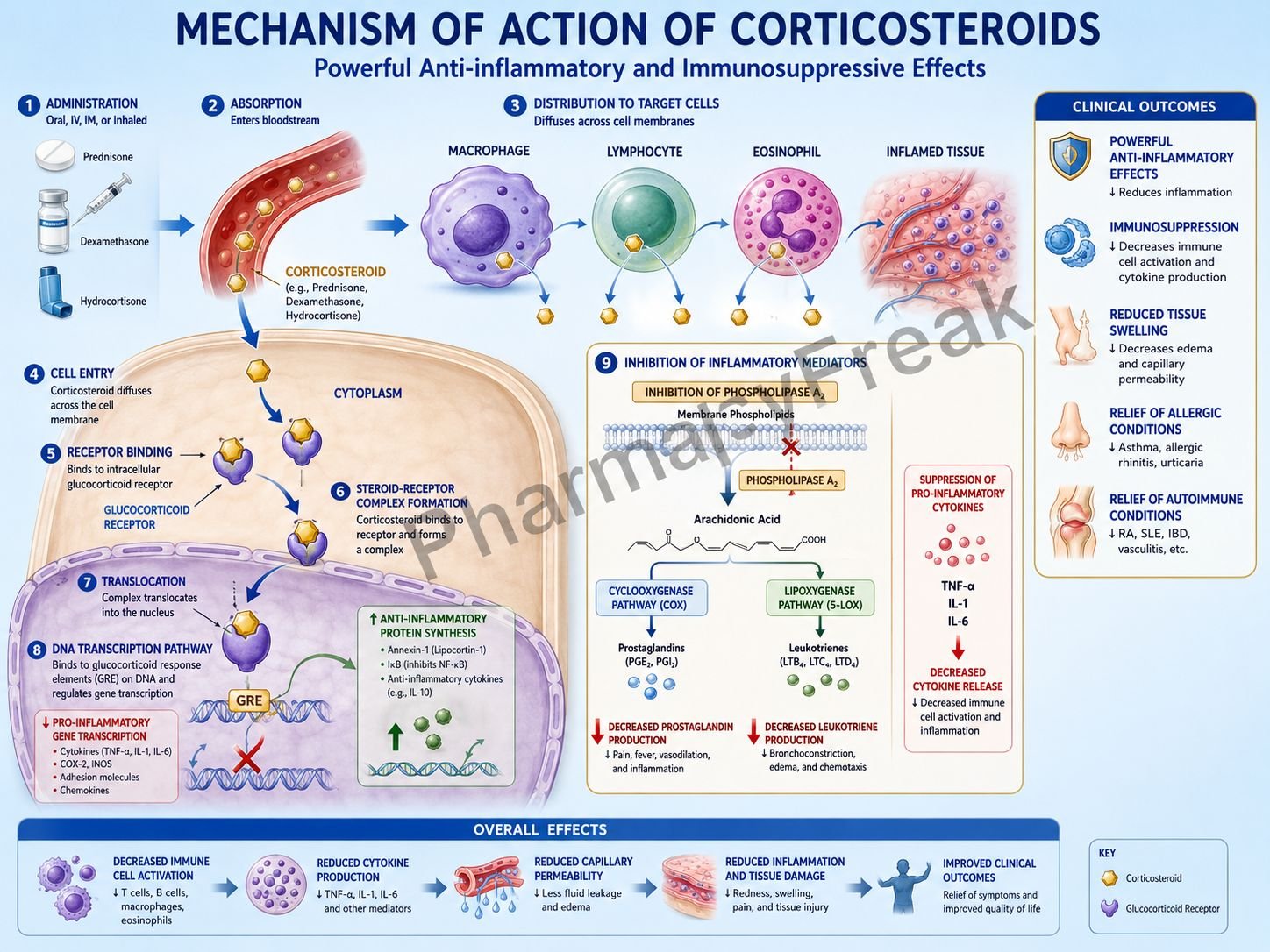
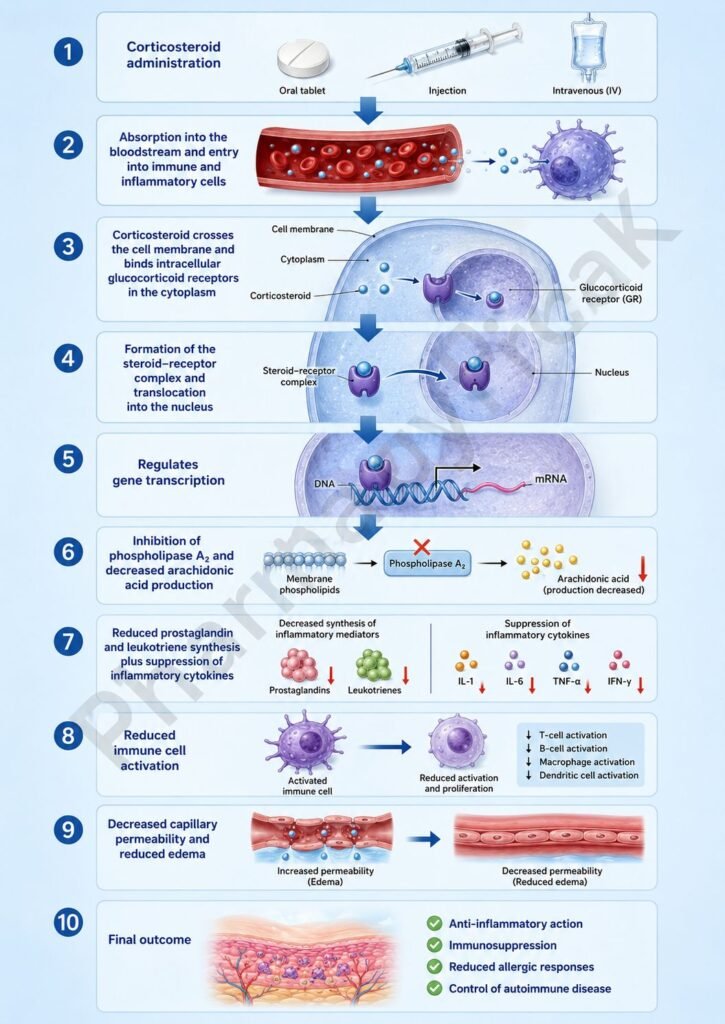
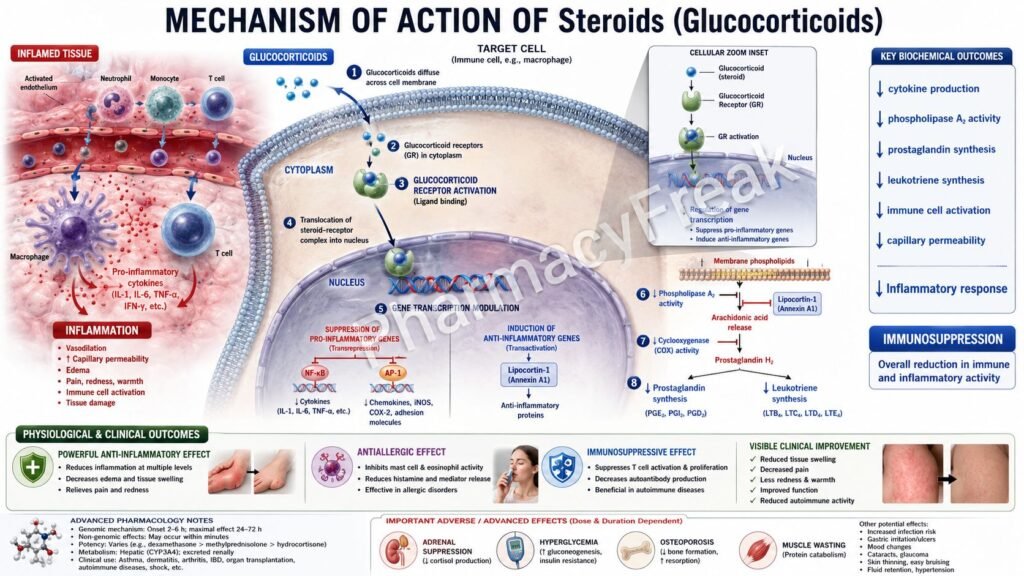
- Corticosteroids diffuse through the cell membrane because they are highly lipid-soluble molecules.
- Inside the cytoplasm, they bind to intracellular glucocorticoid receptors (GRs).
- The steroid-receptor complex undergoes conformational changes and dissociates from heat-shock proteins.
- The activated steroid-receptor complex translocates into the nucleus.
- Inside the nucleus, the complex binds to glucocorticoid response elements (GREs) on DNA.
- This interaction alters transcription of multiple genes.
- Anti-inflammatory protein synthesis is increased, including lipocortin-1 (annexin A1).
- Lipocortin inhibits phospholipase A₂.
- Inhibition of phospholipase A₂ prevents release of arachidonic acid from membrane phospholipids.
- As a result, synthesis of prostaglandins, thromboxanes, and leukotrienes decreases.
- Corticosteroids also suppress expression of inflammatory cytokines such as IL-1, IL-2, IL-6, TNF-α, and interferon-γ.
- Migration and activation of macrophages, eosinophils, mast cells, and lymphocytes are reduced.
- Capillary permeability decreases, reducing edema and tissue swelling.
- T-cell proliferation and immune responses are suppressed.
- The overall effect is powerful anti-inflammatory, antiallergic, and immunosuppressive activity.
A key exam point is that corticosteroids bind intracellular glucocorticoid receptors, alter gene transcription, and inhibit phospholipase A₂-mediated arachidonic acid release.
Pharmacokinetics
Most corticosteroids are well absorbed orally and may also be administered intravenously, intramuscularly, topically, inhalationally, or intra-articularly. They are metabolized primarily in the liver and excreted through the kidneys. Duration of action varies from short-acting hydrocortisone to long-acting dexamethasone.
Clinical Uses
Corticosteroids are used in:
- Asthma
- COPD exacerbations
- Allergic disorders
- Rheumatoid arthritis
- Systemic lupus erythematosus
- Inflammatory bowel disease
- Organ transplantation
- Cerebral edema
- Autoimmune diseases
- Adrenal insufficiency
- Certain malignancies
Adverse Effects
Common adverse effects include:
- Weight gain
- Hyperglycemia
- Hypertension
- Osteoporosis
- Muscle wasting
- Increased infection risk
- Gastric irritation
- Mood changes
- Cataracts
- Glaucoma
- Adrenal suppression
- Cushingoid appearance
Long-term use requires gradual tapering to prevent adrenal crisis.
Comparative Analysis
| Feature | Corticosteroids | NSAIDs | Antihistamines |
|---|---|---|---|
| Main target | Gene transcription | Cyclooxygenase enzymes | Histamine H1 receptors |
| Phospholipase A₂ inhibition | Yes | No | No |
| Prostaglandin inhibition | Yes | Yes | No |
| Leukotriene inhibition | Yes | No | No |
| Immunosuppression | Strong | Minimal | None |
| Anti-inflammatory potency | Very high | Moderate | Low |
Corticosteroids differ from NSAIDs because they block inflammation at an earlier step by inhibiting phospholipase A₂ and reducing both prostaglandin and leukotriene synthesis. NSAIDs only inhibit cyclooxygenase enzymes. Corticosteroids also possess powerful immunosuppressive effects that are absent with antihistamines and most NSAIDs.
MCQs
1. Corticosteroids exert their primary action through:
a) Cell surface receptors
b) Nuclear receptors
c) Histamine receptors
d) Sodium channels
Answer: b) Nuclear receptors
2. Corticosteroids bind to:
a) β receptors
b) Muscarinic receptors
c) Glucocorticoid receptors
d) Dopamine receptors
Answer: c) Glucocorticoid receptors
3. Corticosteroids inhibit:
a) Cyclooxygenase directly
b) Phospholipase A₂
c) Acetylcholinesterase
d) MAO
Answer: b) Phospholipase A₂
4. Inhibition of phospholipase A₂ reduces formation of:
a) Arachidonic acid
b) Dopamine
c) Histamine
d) Acetylcholine
Answer: a) Arachidonic acid
5. Corticosteroids decrease production of:
a) TNF-α
b) Insulin
c) Albumin
d) Hemoglobin
Answer: a) TNF-α
6. Which inflammatory mediators are reduced by corticosteroids?
a) Prostaglandins only
b) Leukotrienes only
c) Both prostaglandins and leukotrienes
d) Histamine only
Answer: c) Both prostaglandins and leukotrienes
7. Corticosteroids suppress:
a) T-cell proliferation
b) Calcium absorption only
c) Insulin secretion
d) Dopamine synthesis
Answer: a) T-cell proliferation
8. A common adverse effect is:
a) Osteoporosis
b) Hypoglycemia
c) Bradycardia
d) Hyperkalemia
Answer: a) Osteoporosis
9. Long-term corticosteroid therapy may cause:
a) Adrenal suppression
b) Hyperthyroidism
c) Polycythemia
d) Glaucoma prevention
Answer: a) Adrenal suppression
10. Corticosteroids are commonly used in:
a) Autoimmune diseases
b) Hyperthyroidism
c) Parkinson disease
d) Gout prevention only
Answer: a) Autoimmune diseases
11. Lipocortin produced by corticosteroids inhibits:
a) Cyclooxygenase
b) Phospholipase A₂
c) Histamine release only
d) Sodium channels
Answer: b) Phospholipase A₂
12. The anti-inflammatory action of corticosteroids mainly results from:
a) Gene regulation
b) Direct antibacterial activity
c) Calcium channel blockade
d) Dopamine inhibition
Answer: a) Gene regulation
FAQs
What is the mechanism of action of steroids?
Steroids bind intracellular glucocorticoid receptors and alter gene transcription, suppressing inflammatory and immune responses.
How do corticosteroids reduce inflammation?
They inhibit phospholipase A₂, reducing production of prostaglandins and leukotrienes.
Why are corticosteroids considered immunosuppressive?
They suppress cytokine production and reduce T-cell activation and proliferation.
What is the role of lipocortin in steroid action?
Lipocortin inhibits phospholipase A₂, blocking arachidonic acid release.
What are common side effects of corticosteroids?
Weight gain, osteoporosis, hyperglycemia, hypertension, and increased infection risk.
Why should corticosteroids not be stopped abruptly?
Abrupt withdrawal may cause adrenal insufficiency due to suppression of endogenous cortisol production.
References
Goodman & Gilman’s The Pharmacological Basis of Therapeutics
https://accessmedicine.mhmedical.com/book.aspx?bookid=3191
Katzung’s Basic and Clinical Pharmacology
https://accessmedicine.mhmedical.com/content.aspx?bookid=3382
Tripathi KD. Essentials of Medical Pharmacology
https://www.jaypeedigital.com
Harrison’s Principles of Internal Medicine
https://accessmedicine.mhmedical.com