Table of Contents
Introduction
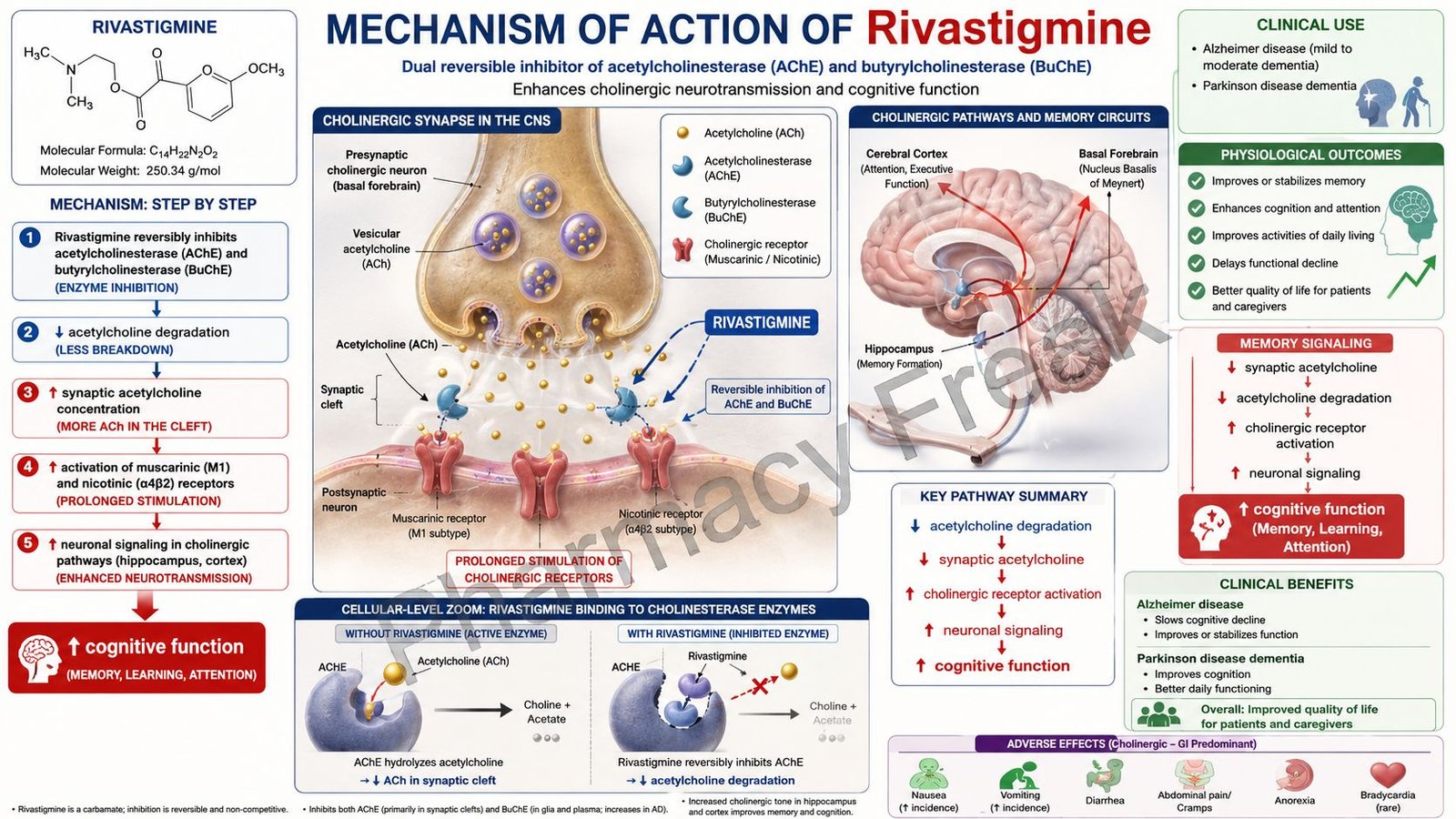
Rivastigmine is a centrally acting cholinesterase inhibitor used primarily in Alzheimer disease and Parkinson disease-associated dementia. It improves cognitive function by increasing acetylcholine levels in the brain. Rivastigmine inhibits both acetylcholinesterase and butyrylcholinesterase enzymes, enhancing cholinergic neurotransmission in cortical and hippocampal regions involved in memory and cognition.
Mechanism of Action (Step-wise)
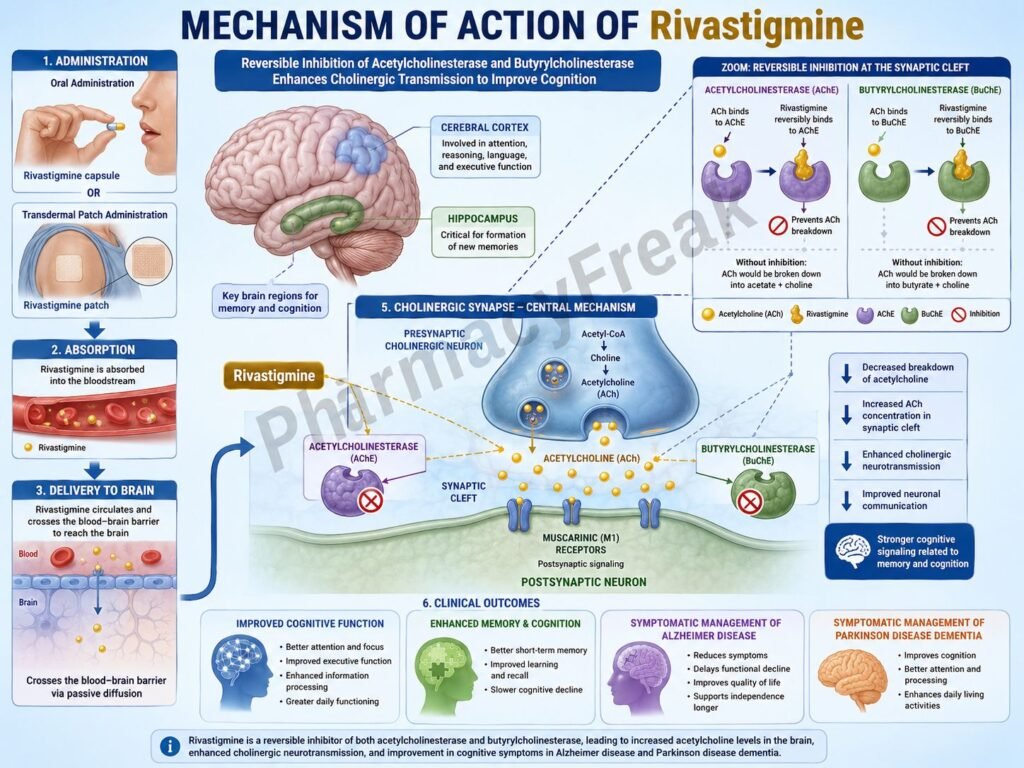
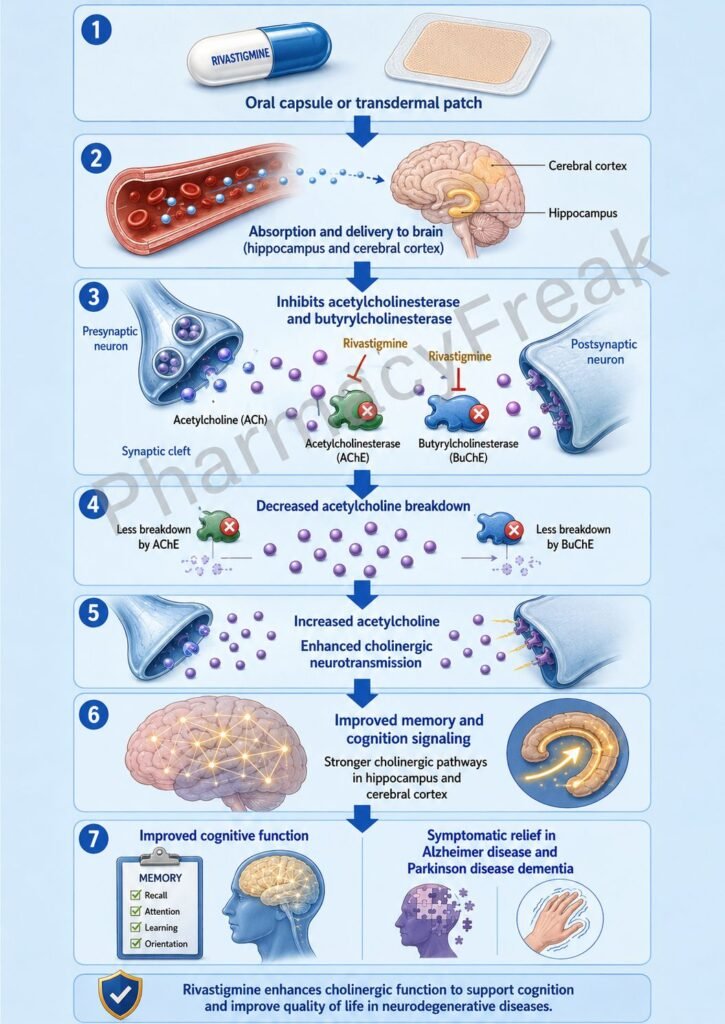
- Rivastigmine enters the central nervous system after administration.
- It reversibly inhibits acetylcholinesterase (AChE) and butyrylcholinesterase (BuChE).
- These enzymes normally break down acetylcholine in synaptic clefts.
- Inhibition of cholinesterase enzymes decreases acetylcholine degradation.
- Acetylcholine concentration increases in cholinergic synapses.
- Enhanced acetylcholine activity improves neurotransmission in the cerebral cortex and hippocampus.
- Increased cholinergic signaling supports memory formation, attention, and cognitive processing.
- In Alzheimer disease, cholinergic neuronal activity is deficient because of degeneration of cholinergic neurons.
- Rivastigmine partially compensates for this cholinergic deficit.
- The overall effect is temporary improvement or stabilization of cognitive symptoms and daily functioning.
A key exam point is that rivastigmine inhibits acetylcholinesterase and butyrylcholinesterase, increasing acetylcholine levels in the CNS.
Pharmacokinetics
Rivastigmine is available as oral capsules, oral solution, and transdermal patches. It is well absorbed and widely distributed in the CNS. The drug undergoes cholinesterase-mediated hydrolysis rather than extensive CYP450 metabolism. Transdermal patches provide steadier plasma levels and reduced gastrointestinal side effects.
Clinical Uses
Rivastigmine is used in mild to moderate Alzheimer disease and dementia associated with Parkinson disease. It helps improve cognition, memory, and activities of daily living.
Adverse Effects
Common adverse effects include nausea, vomiting, diarrhea, dizziness, anorexia, and weight loss due to cholinergic stimulation. Bradycardia and syncope may occur in susceptible patients. Gastrointestinal adverse effects are less frequent with transdermal patches.
Comparative Analysis
| Feature | Rivastigmine | Donepezil | Memantine |
|---|---|---|---|
| Drug class | Cholinesterase inhibitor | Cholinesterase inhibitor | NMDA receptor antagonist |
| Main target | AChE + BuChE | AChE | NMDA receptor |
| Main neurotransmitter affected | Acetylcholine | Acetylcholine | Glutamate |
| Parkinson dementia use | Yes | Less common | Limited |
| GI side effects | Common | Moderate | Less common |
| Transdermal form available | Yes | No | No |
Rivastigmine differs from donepezil because it inhibits both acetylcholinesterase and butyrylcholinesterase. Compared with memantine, rivastigmine enhances cholinergic transmission rather than modulating glutamatergic activity.
MCQs
- Rivastigmine belongs to which drug class?
a) NMDA antagonists
b) Cholinesterase inhibitors
c) Dopamine agonists
d) Antipsychotics
Answer: b) Cholinesterase inhibitors
- Rivastigmine inhibits which enzyme?
a) Monoamine oxidase
b) Acetylcholinesterase
c) Cyclooxygenase
d) Carbonic anhydrase
Answer: b) Acetylcholinesterase
- Rivastigmine also inhibits:
a) Butyrylcholinesterase
b) DNA polymerase
c) HMG-CoA reductase
d) Xanthine oxidase
Answer: a) Butyrylcholinesterase
- Inhibition of cholinesterase enzymes increases levels of:
a) Dopamine
b) Acetylcholine
c) Serotonin
d) Histamine
Answer: b) Acetylcholine
- Rivastigmine is mainly used in:
a) Hypertension
b) Alzheimer disease
c) Asthma
d) Hyperthyroidism
Answer: b) Alzheimer disease
- Rivastigmine improves cognitive function mainly in the:
a) Liver
b) Cortex and hippocampus
c) Kidneys
d) Thyroid gland
Answer: b) Cortex and hippocampus
- A common adverse effect is:
a) Nausea
b) Hypercalcemia
c) Severe hypertension
d) Cataracts
Answer: a) Nausea
- Rivastigmine may cause:
a) Weight loss
b) Hypernatremia
c) Hyperglycemia
d) Polycythemia
Answer: a) Weight loss
- Rivastigmine is also approved for dementia associated with:
a) Parkinson disease
b) Tuberculosis
c) Migraine
d) Epilepsy
Answer: a) Parkinson disease
- Compared with donepezil, rivastigmine inhibits:
a) Only acetylcholinesterase
b) Both AChE and BuChE
c) NMDA receptors only
d) Dopamine receptors only
Answer: b) Both AChE and BuChE
- Rivastigmine patches help reduce:
a) CNS penetration
b) Gastrointestinal side effects
c) Cognitive effects
d) Cholinergic activity
Answer: b) Gastrointestinal side effects
- Rivastigmine improves symptoms mainly by enhancing:
a) Cholinergic neurotransmission
b) GABA inhibition
c) Dopamine blockade
d) Serotonin degradation
Answer: a) Cholinergic neurotransmission
FAQs
What is the mechanism of action of rivastigmine?
Rivastigmine inhibits acetylcholinesterase and butyrylcholinesterase, increasing acetylcholine levels in the brain.
Why is rivastigmine used in Alzheimer disease?
Because it improves cholinergic neurotransmission involved in memory and cognition.
What neurotransmitter is increased by rivastigmine?
Acetylcholine.
What are common side effects of rivastigmine?
Nausea, vomiting, diarrhea, dizziness, and weight loss.
How does rivastigmine differ from memantine?
Rivastigmine enhances cholinergic signaling, while memantine blocks NMDA receptors.
Why are rivastigmine patches useful?
They provide steadier drug delivery with fewer gastrointestinal adverse effects.
References
Goodman & Gilman’s The Pharmacological Basis of Therapeutics – Drugs for Neurodegenerative Disorders
https://accessmedicine.mhmedical.com/book.aspx?bookid=3191
Katzung: Basic and Clinical Pharmacology – Drugs Used in Alzheimer Disease
https://accessmedicine.mhmedical.com/content.aspx?bookid=3382
Tripathi: Essentials of Medical Pharmacology – Cholinergic Drugs and Alzheimer Therapy
https://www.jaypeedigital.com
Harrison’s Principles of Internal Medicine – Dementia and Neurodegenerative Disorders
https://accessmedicine.mhmedical.com