Table of Contents
Introduction
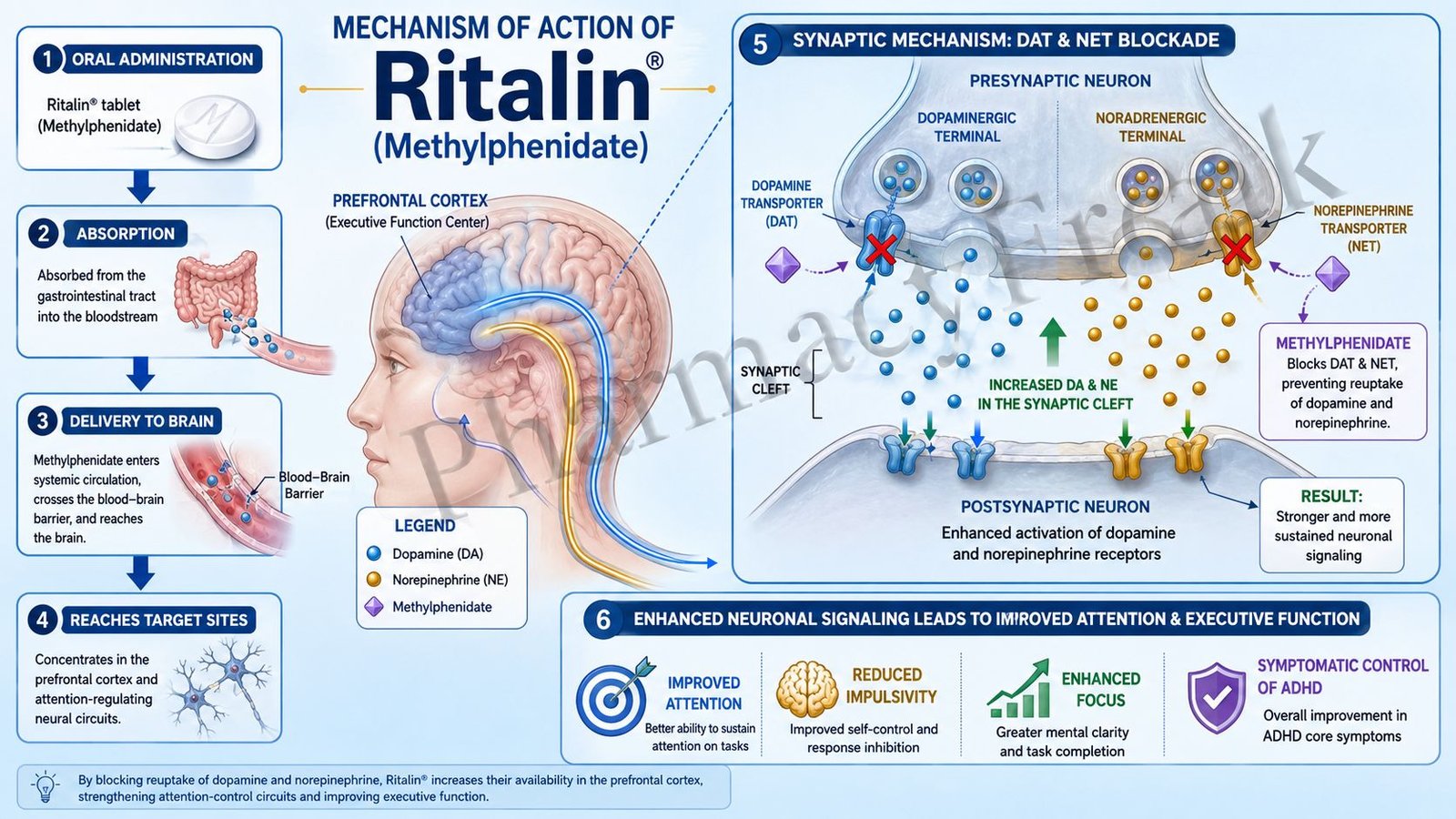
Ritalin is the brand name for methylphenidate, a central nervous system stimulant primarily used in attention-deficit/hyperactivity disorder (ADHD) and narcolepsy. It improves attention, concentration, and behavioral control by increasing dopamine and norepinephrine activity in the brain, especially in the prefrontal cortex.
Mechanism of Action (Step-wise)
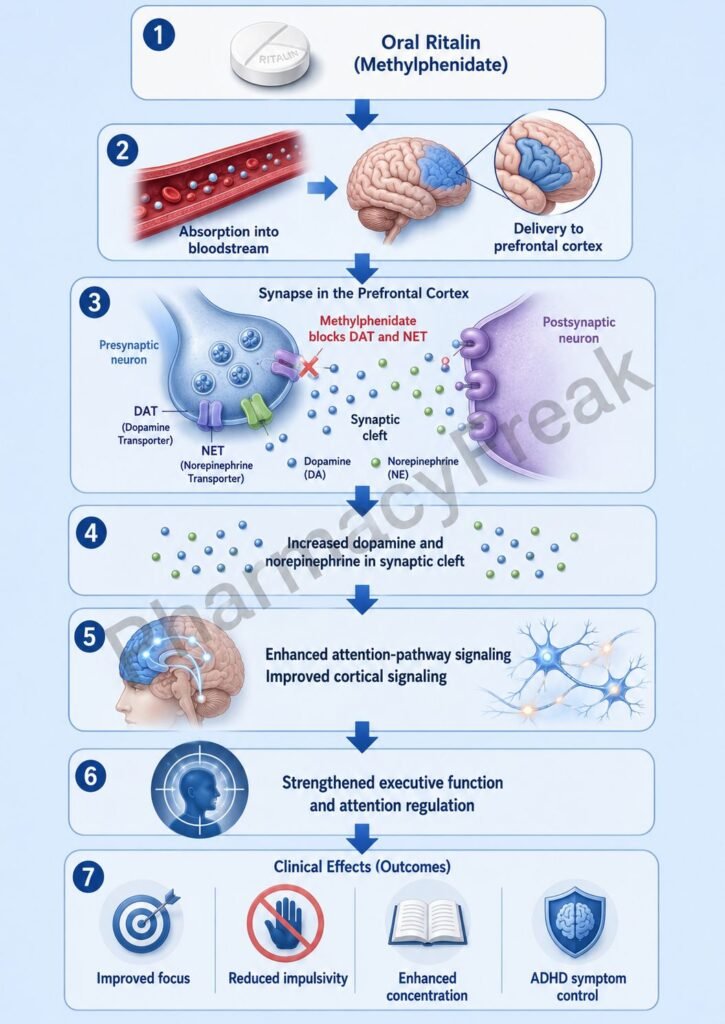
- Methylphenidate enters the central nervous system after oral administration.
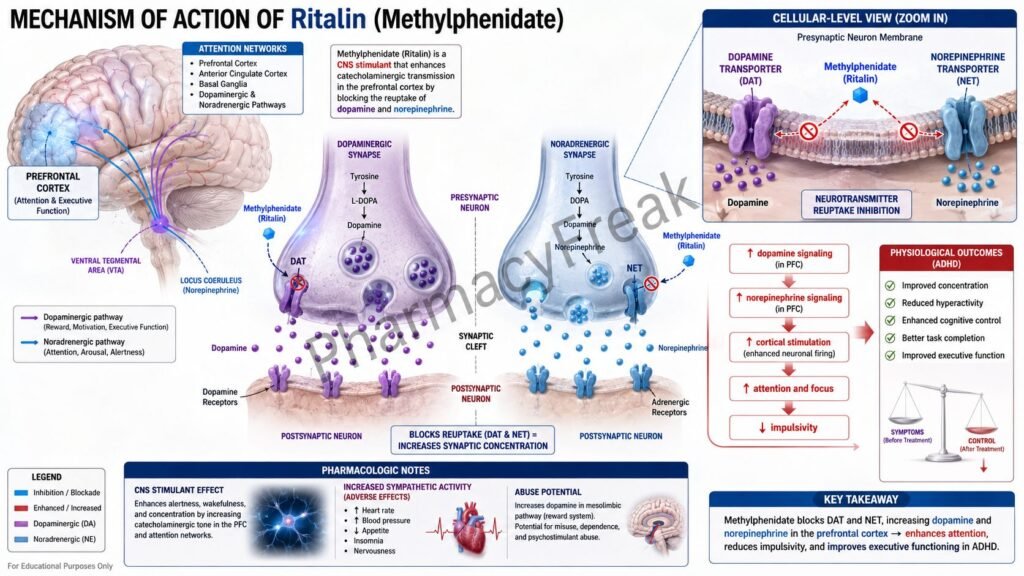
- It primarily inhibits dopamine transporter (DAT) proteins on presynaptic neurons.
- It also inhibits norepinephrine transporter (NET) proteins.
- Normally, DAT and NET reuptake dopamine and norepinephrine into presynaptic nerve terminals.
- Inhibition of these transporters increases dopamine and norepinephrine concentrations in the synaptic cleft.
- Increased catecholamine levels enhance neurotransmission in the prefrontal cortex.
- Enhanced prefrontal cortical activity improves attention span, impulse control, and executive function.
- Increased dopamine signaling also contributes to wakefulness and alertness.
- Methylphenidate has stimulant effects on the CNS but less peripheral sympathetic stimulation compared with amphetamines.
- The overall effect is improved concentration, reduced hyperactivity, and better behavioral regulation.
A key exam point is that methylphenidate blocks dopamine and norepinephrine reuptake transporters, increasing catecholamine levels in the CNS.
Pharmacokinetics
Methylphenidate is administered orally in immediate-release and extended-release formulations. It is rapidly absorbed and undergoes hepatic metabolism. Duration of action depends on formulation type. Elimination occurs mainly through urine as inactive metabolites.
Clinical Uses
Methylphenidate is primarily used in ADHD and narcolepsy. It helps improve focus, academic performance, impulse control, and daytime alertness.
Adverse Effects
Common adverse effects include insomnia, decreased appetite, weight loss, tachycardia, anxiety, and irritability. Long-term use may affect growth in children. High doses may increase blood pressure and risk of dependence.
Comparative Analysis
| Feature | Methylphenidate (Ritalin) | Amphetamine | Atomoxetine |
|---|---|---|---|
| Drug class | CNS stimulant | CNS stimulant | Non-stimulant ADHD drug |
| Main mechanism | DAT and NET inhibition | Increased catecholamine release | NET inhibition |
| Dopamine effect | Increased | Strongly increased | Mild indirect |
| Abuse potential | Moderate | Higher | Low |
| ADHD use | Yes | Yes | Yes |
| Appetite suppression | Common | Common | Less common |
Methylphenidate differs from amphetamines because it mainly blocks catecholamine reuptake rather than strongly promoting neurotransmitter release. Compared with atomoxetine, it has faster onset and greater stimulant activity.
MCQs
- Ritalin is the brand name for:
a) Amphetamine
b) Methylphenidate
c) Atomoxetine
d) Modafinil
Answer: b) Methylphenidate
- Methylphenidate primarily inhibits which transporters?
a) Serotonin transporters only
b) Dopamine and norepinephrine transporters
c) GABA transporters
d) Histamine transporters
Answer: b) Dopamine and norepinephrine transporters
- Methylphenidate increases levels of:
a) Dopamine and norepinephrine
b) Histamine only
c) Acetylcholine only
d) GABA only
Answer: a) Dopamine and norepinephrine
- Methylphenidate is mainly used in:
a) Hypertension
b) ADHD
c) Asthma
d) Hyperthyroidism
Answer: b) ADHD
- Increased catecholamine activity in which brain area improves attention?
a) Occipital cortex
b) Prefrontal cortex
c) Cerebellum
d) Hippocampus only
Answer: b) Prefrontal cortex
- Methylphenidate also treats:
a) Narcolepsy
b) Peptic ulcer disease
c) Epilepsy
d) Hypercalcemia
Answer: a) Narcolepsy
- A common adverse effect is:
a) Increased appetite
b) Insomnia
c) Bradycardia
d) Hypernatremia
Answer: b) Insomnia
- Methylphenidate may cause:
a) Weight loss
b) Severe hypoglycemia
c) Cataracts
d) Hypercalcemia
Answer: a) Weight loss
- Compared with amphetamines, methylphenidate mainly:
a) Blocks catecholamine reuptake
b) Strongly releases dopamine
c) Blocks serotonin receptors only
d) Inhibits MAO enzymes
Answer: a) Blocks catecholamine reuptake
- Methylphenidate belongs to which class?
a) Antidepressants
b) CNS stimulants
c) Antipsychotics
d) Benzodiazepines
Answer: b) CNS stimulants
- High doses of methylphenidate may increase risk of:
a) Dependence
b) Hyperkalemia
c) Hypotension only
d) Renal failure
Answer: a) Dependence
- Methylphenidate improves ADHD symptoms mainly by increasing:
a) GABA activity
b) Catecholamine signaling
c) Histamine degradation
d) Opioid receptor activation
Answer: b) Catecholamine signaling
FAQs
What is the mechanism of action of Ritalin?
Ritalin (methylphenidate) blocks dopamine and norepinephrine reuptake transporters, increasing catecholamine levels in the brain.
Why is methylphenidate used in ADHD?
Because it improves attention, focus, and impulse control through enhanced prefrontal cortical activity.
What are common side effects of Ritalin?
Insomnia, appetite suppression, weight loss, and tachycardia.
How does methylphenidate differ from amphetamines?
Methylphenidate mainly blocks reuptake of catecholamines, whereas amphetamines strongly promote neurotransmitter release.
Can methylphenidate cause dependence?
Yes, especially at high doses or with misuse.
Why is methylphenidate useful in narcolepsy?
Because it increases wakefulness and alertness.
References
Goodman & Gilman’s The Pharmacological Basis of Therapeutics – CNS Stimulants
https://accessmedicine.mhmedical.com/book.aspx?bookid=3191
Katzung: Basic and Clinical Pharmacology – Drugs Used in ADHD and Narcolepsy
https://accessmedicine.mhmedical.com/content.aspx?bookid=3382
Tripathi: Essentials of Medical Pharmacology – Central Nervous System Stimulants
https://www.jaypeedigital.com
Harrison’s Principles of Internal Medicine – Attention-Deficit/Hyperactivity Disorder and Sleep Disorders
https://accessmedicine.mhmedical.com