
Table of Contents
Introduction
Zolpidem is a non-benzodiazepine sedative-hypnotic drug primarily used for the short-term treatment of insomnia. It belongs to a class of medications commonly referred to as “Z-drugs,” which also includes zaleplon and zopiclone/eszopiclone. Although structurally different from benzodiazepines, zolpidem exerts its pharmacological effects through the gamma-aminobutyric acid (GABA) neurotransmitter system.
Zolpidem is particularly effective in reducing sleep latency, helping patients fall asleep faster. Because of its selective action on specific GABA-A receptor subtypes, it generally produces strong hypnotic effects with relatively less anxiolytic, anticonvulsant, and muscle relaxant activity compared with traditional benzodiazepines.
Mechanism of Action (Step-wise)
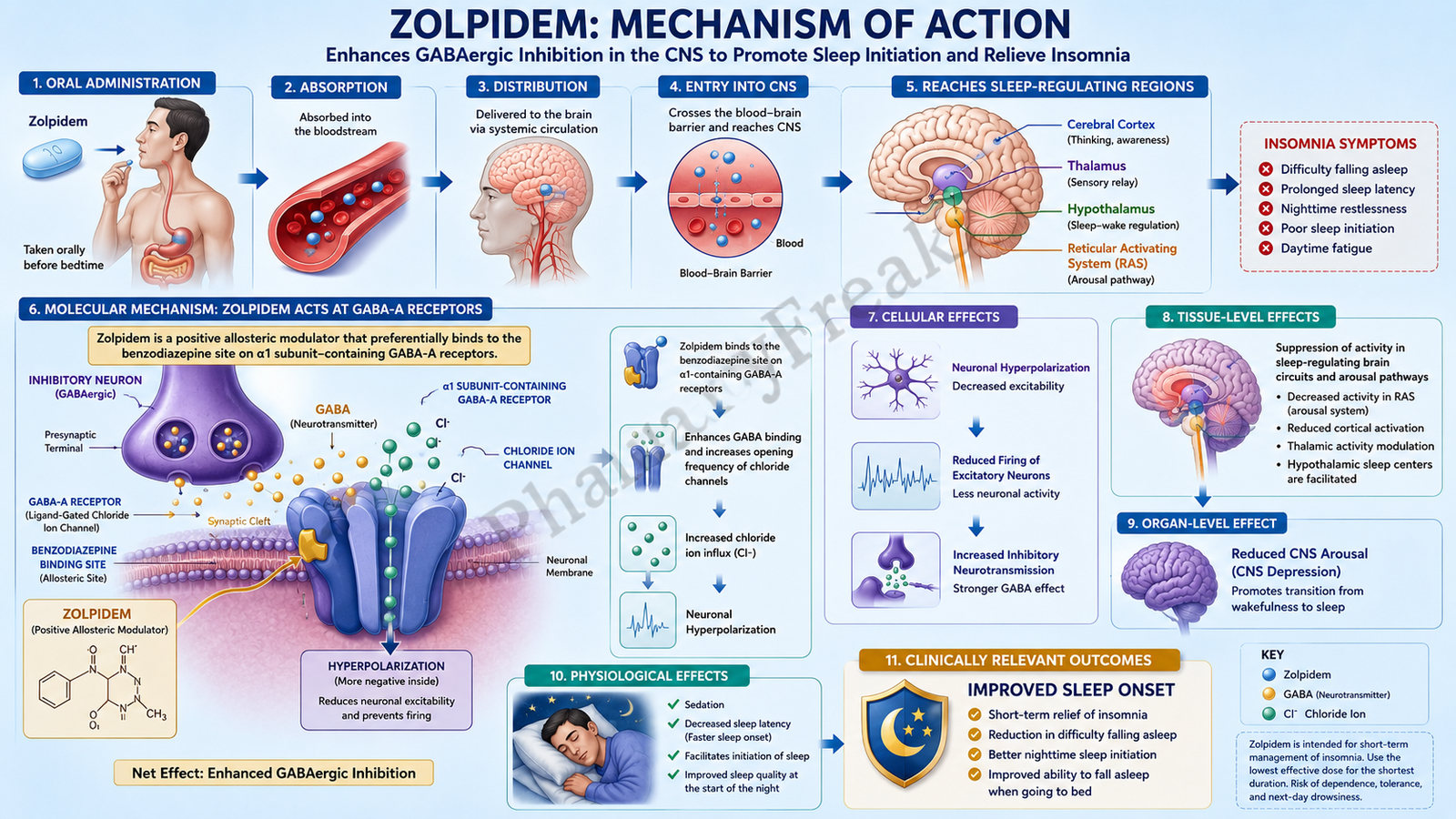
Zolpidem promotes sleep by enhancing inhibitory neurotransmission mediated by GABA within the central nervous system.
1. Oral Administration and CNS Distribution
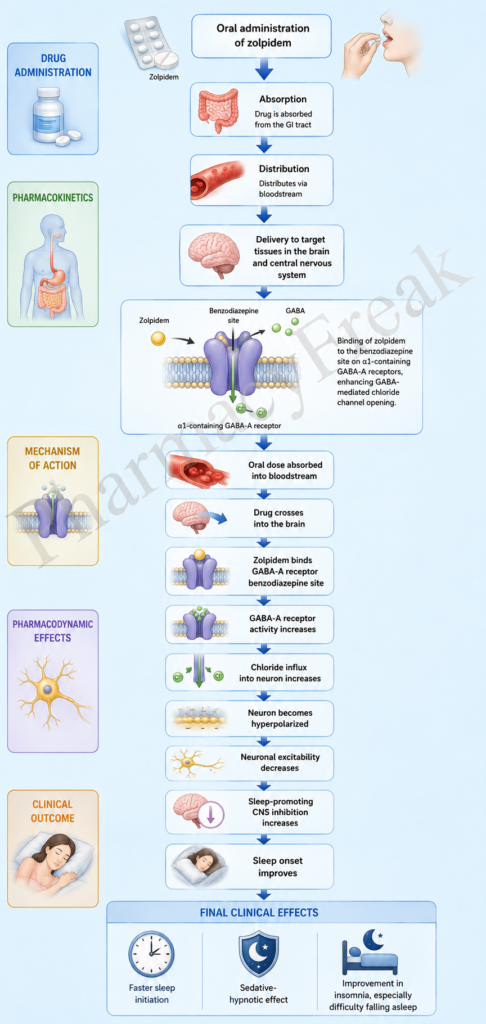
After oral administration, zolpidem is rapidly absorbed from the gastrointestinal tract.
The drug enters systemic circulation, crosses the blood-brain barrier, and reaches various regions of the brain involved in sleep regulation, including the cerebral cortex, thalamus, limbic system, and reticular activating system.
2. Binding to GABA-A Receptors
The GABA-A receptor is a ligand-gated chloride ion channel that mediates inhibitory neurotransmission in the central nervous system.
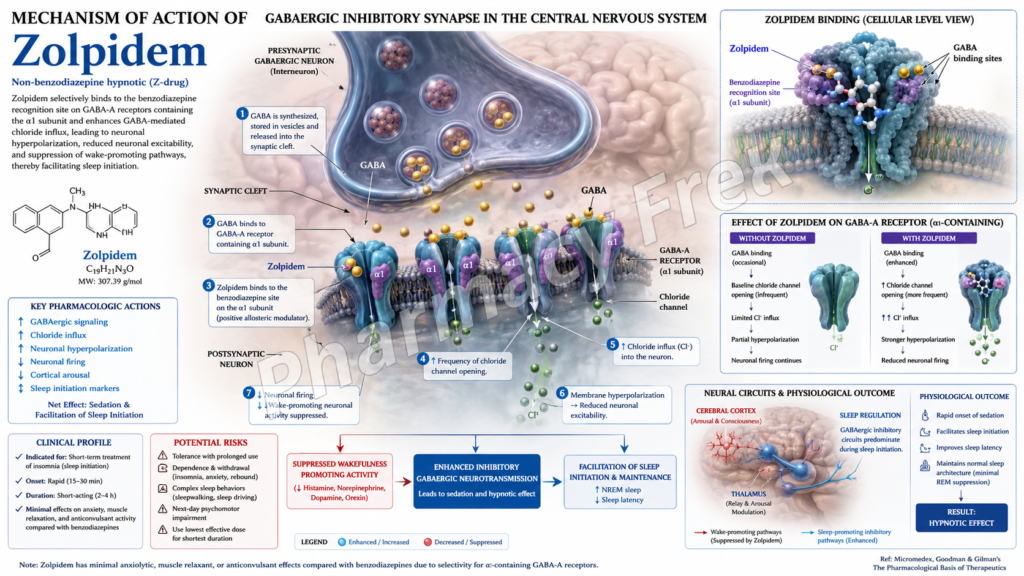
Zolpidem binds selectively to the benzodiazepine recognition site located on GABA-A receptors containing the α1 subunit (also called the ω1 receptor subtype).
Unlike benzodiazepines, zolpidem exhibits relatively high selectivity for α1-containing GABA-A receptors.
3. Positive Allosteric Modulation of GABA-A Receptors
Zolpidem does not directly activate the receptor.
Instead, it acts as a positive allosteric modulator.
When GABA binds to the receptor:
- Zolpidem enhances receptor responsiveness.
- Chloride channel opening becomes more frequent.
- Greater chloride influx occurs into neurons.
This potentiates the inhibitory effects of endogenous GABA.
4. Neuronal Hyperpolarization
Increased chloride influx makes the interior of neurons more negative.
This process is known as hyperpolarization.
Hyperpolarized neurons become less likely to generate action potentials.
As neuronal excitability decreases, central nervous system activity is suppressed.
5. Suppression of Wake-Promoting Neural Circuits
Enhanced GABAergic inhibition reduces activity in wakefulness-promoting pathways.
This leads to:
- Reduced arousal
- Decreased sleep latency
- Facilitation of sleep initiation
- Improved sleep continuity
6. Limited Effects on Other GABA-A Subunits
Because zolpidem preferentially targets α1-containing receptors, it produces:
- Strong hypnotic effects
- Relatively weaker muscle relaxation
- Less anticonvulsant activity
- Less anxiolytic activity compared with benzodiazepines
This receptor selectivity contributes to its primary use as a sleep aid.
7. Final Therapeutic Effect
The overall effects of zolpidem include:
- Faster sleep onset
- Improved sleep initiation
- Reduced nighttime awakenings
- Increased total sleep time
- Improved sleep quality
Thus, zolpidem acts as a selective GABA-A receptor positive allosteric modulator that enhances inhibitory neurotransmission and promotes sleep.
Pharmacokinetics
Zolpidem is rapidly absorbed after oral administration.
- Oral bioavailability is approximately 70%.
- Peak plasma concentrations occur within 0.5–2 hours.
- Rapid onset of action makes it useful for sleep initiation.
- Extensively metabolized in the liver.
- CYP3A4 is the major enzyme involved in metabolism.
- Metabolites are pharmacologically inactive.
- Excreted primarily through urine.
- Elimination half-life is approximately 2–3 hours in healthy adults.
- Extended-release formulations provide longer sleep maintenance effects.
The short half-life contributes to reduced next-day sedation in many patients.
Clinical Uses
Insomnia
Zolpidem is primarily prescribed for short-term treatment of insomnia.
Difficulty Falling Asleep
Particularly useful for patients with prolonged sleep latency.
Sleep Maintenance Insomnia
Extended-release formulations may help maintain sleep throughout the night.
Transient Insomnia
Useful in short-term sleep disturbances related to stress or environmental changes.
Short-Term Management of Sleep Disorders
Often used when non-pharmacological measures alone are insufficient.
Adverse Effects
Common adverse effects include:
- Drowsiness
- Dizziness
- Headache
- Fatigue
- Nausea
- Dry mouth
Important adverse effects include:
- Complex sleep behaviors (sleepwalking, sleep driving, sleep eating)
- Memory impairment
- Confusion
- Hallucinations
- Dependence
- Rebound insomnia
- Daytime sedation
- Falls, especially in elderly patients
- Respiratory depression when combined with other CNS depressants
Rare but serious behavioral changes have been reported.
Comparative Analysis
| Drug | Class | Primary Target | Major Clinical Use | Important Limitation |
|---|---|---|---|---|
| Zolpidem | Z-drug | GABA-A α1 receptor | Insomnia | Complex sleep behaviors |
| Zaleplon | Z-drug | GABA-A α1 receptor | Sleep initiation insomnia | Very short duration |
| Eszopiclone | Z-drug | GABA-A receptor | Sleep initiation and maintenance | Bitter taste |
| Diazepam | Benzodiazepine | Multiple GABA-A subunits | Anxiety, seizures, insomnia | Daytime sedation |
| Temazepam | Benzodiazepine | Multiple GABA-A subunits | Insomnia | Dependence potential |
Zolpidem differs from benzodiazepines because it selectively targets α1-containing GABA-A receptors, producing predominantly hypnotic effects. Benzodiazepines generally have broader actions including anxiolytic, anticonvulsant, and muscle relaxant effects.
MCQs
1. Zolpidem belongs to which class of drugs?
a) Benzodiazepines
b) Z-drugs
c) Barbiturates
d) Antipsychotics
Answer: b) Z-drugs
2. Zolpidem primarily acts on which receptor?
a) NMDA receptor
b) GABA-A receptor
c) Dopamine D2 receptor
d) Serotonin 5-HT2 receptor
Answer: b) GABA-A receptor
3. Zolpidem preferentially binds to which GABA-A receptor subunit?
a) α1
b) α2
c) α3
d) α5
Answer: a) α1
4. Zolpidem functions as:
a) Direct receptor agonist
b) Positive allosteric modulator
c) Competitive antagonist
d) Enzyme inhibitor
Answer: b) Positive allosteric modulator
5. Activation of GABA-A receptors causes:
a) Sodium influx
b) Potassium influx
c) Chloride influx
d) Calcium influx
Answer: c) Chloride influx
6. Increased chloride influx results in:
a) Depolarization
b) Hyperpolarization
c) Excitation
d) Neurotransmitter release
Answer: b) Hyperpolarization
7. The primary clinical use of zolpidem is:
a) Hypertension
b) Depression
c) Insomnia
d) Epilepsy
Answer: c) Insomnia
8. Which enzyme primarily metabolizes zolpidem?
a) CYP2D6
b) CYP1A2
c) CYP3A4
d) CYP2C9
Answer: c) CYP3A4
9. A characteristic adverse effect of zolpidem is:
a) Gingival hyperplasia
b) Complex sleep behaviors
c) Pulmonary fibrosis
d) Hyperthyroidism
Answer: b) Complex sleep behaviors
10. Zolpidem has a typical elimination half-life of:
a) 2–3 hours
b) 12–24 hours
c) 36 hours
d) 72 hours
Answer: a) 2–3 hours
11. Compared with benzodiazepines, zolpidem produces:
a) Greater muscle relaxation
b) Stronger anticonvulsant activity
c) More selective hypnotic effects
d) Complete absence of dependence
Answer: c) More selective hypnotic effects
12. Zolpidem enhances the action of:
a) Dopamine
b) Acetylcholine
c) GABA
d) Histamine
Answer: c) GABA
FAQs
What is the mechanism of action of zolpidem?
Zolpidem selectively binds to α1-containing GABA-A receptors and enhances the inhibitory effects of GABA, promoting sleep initiation and maintenance.
Is zolpidem a benzodiazepine?
No. Zolpidem is a non-benzodiazepine hypnotic drug classified as a Z-drug, although it acts at the benzodiazepine binding site of GABA-A receptors.
Why does zolpidem cause sleep?
It enhances GABA-mediated neuronal inhibition, suppressing wake-promoting pathways in the brain and facilitating sleep.
What makes zolpidem different from benzodiazepines?
Zolpidem preferentially targets α1-containing GABA-A receptors, producing mainly hypnotic effects with relatively less anxiolytic, anticonvulsant, and muscle relaxant activity.
Can zolpidem cause dependence?
Yes. Prolonged use may lead to tolerance, dependence, and withdrawal symptoms, which is why short-term use is generally recommended.
What are complex sleep behaviors associated with zolpidem?
These include sleepwalking, sleep driving, sleep eating, and other activities performed while not fully awake, often without memory of the event.
Is zolpidem useful for anxiety?
Zolpidem is primarily indicated for insomnia and has significantly less anxiolytic activity than benzodiazepines.
References
Goodman & Gilman’s The Pharmacological Basis of Therapeutics
Katzung Basic & Clinical Pharmacology
K.D. Tripathi Essentials of Medical Pharmacology
Harrison’s Principles of Internal Medicine
