Table of Contents
Introduction
Telmisartan is an angiotensin II receptor blocker (ARB) used primarily for the treatment of hypertension and cardiovascular risk reduction. It lowers blood pressure by selectively blocking the actions of angiotensin II at AT1 receptors. Unlike ACE inhibitors, telmisartan does not interfere with bradykinin metabolism, resulting in a lower incidence of cough and angioedema. Telmisartan also possesses partial peroxisome proliferator-activated receptor gamma (PPAR-γ) agonist activity, which may contribute to beneficial metabolic effects.
Mechanism of Action (Step-wise)
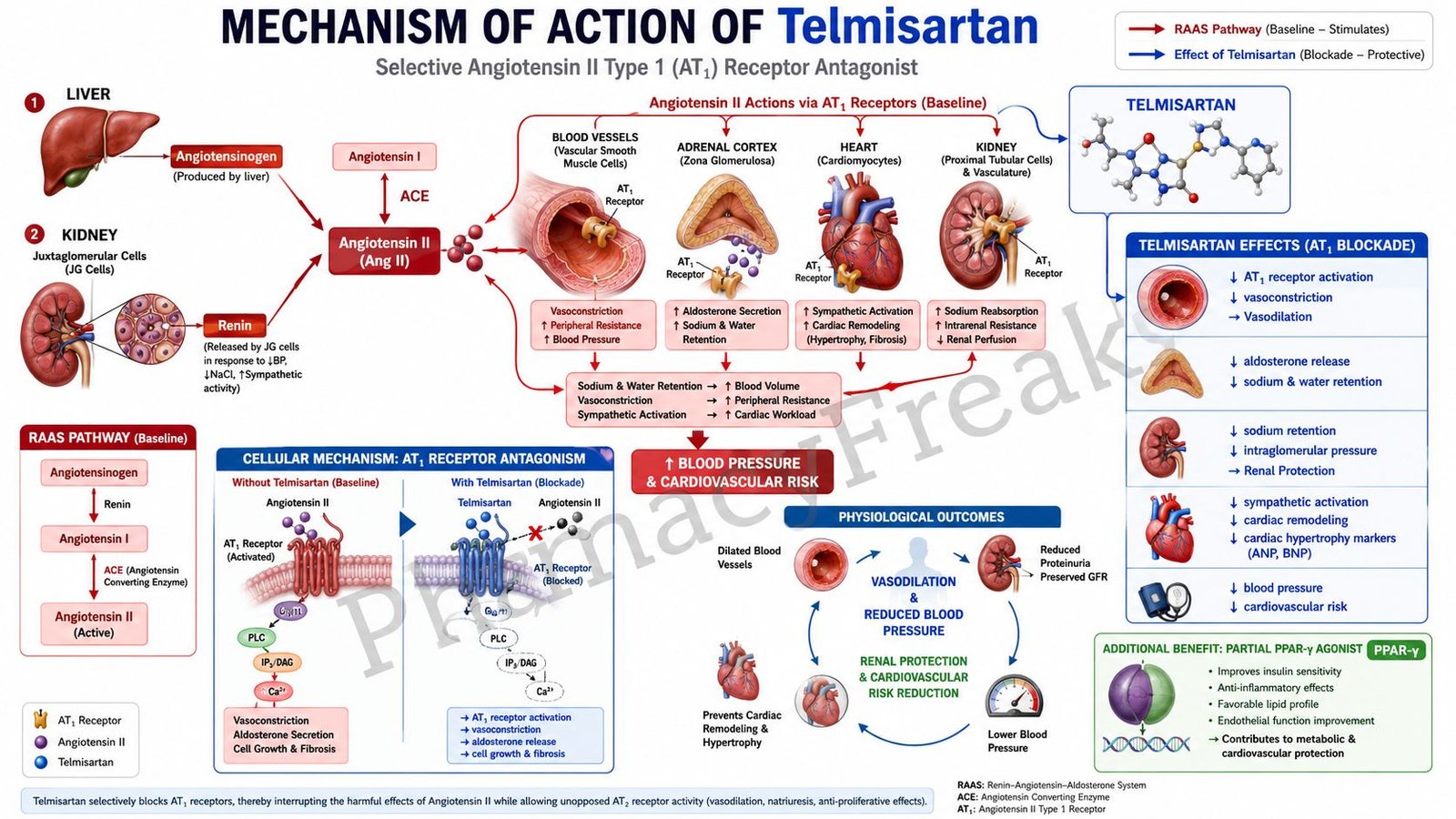
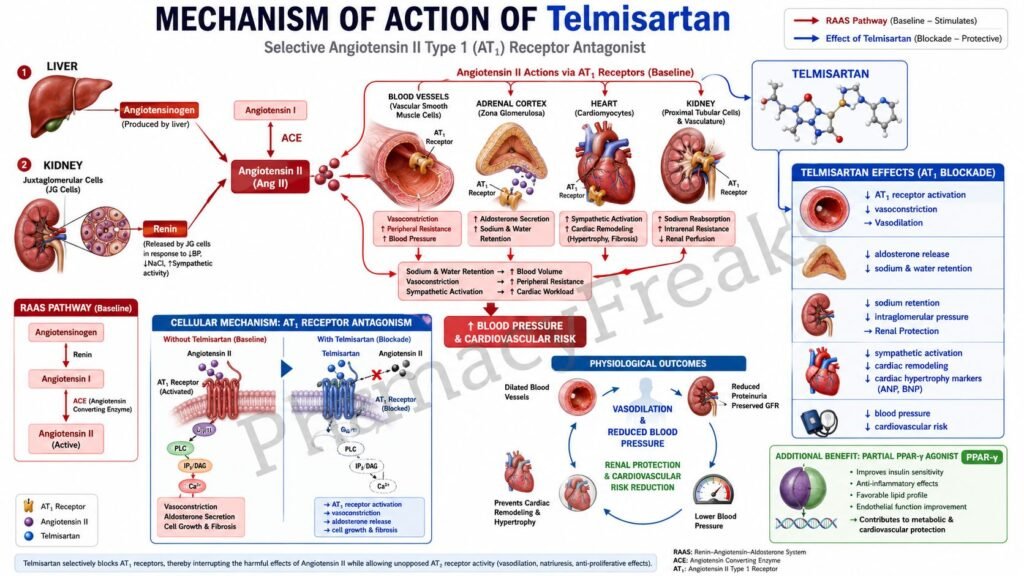
- The renin-angiotensin-aldosterone system (RAAS) regulates blood pressure and fluid balance.
- Renin converts angiotensinogen into angiotensin I.
- Angiotensin-converting enzyme (ACE) converts angiotensin I into angiotensin II.
- Angiotensin II binds primarily to angiotensin type 1 (AT1) receptors.
- Activation of AT1 receptors causes vasoconstriction.
- AT1 receptor stimulation also increases aldosterone secretion from the adrenal cortex.
- Aldosterone promotes sodium and water retention.
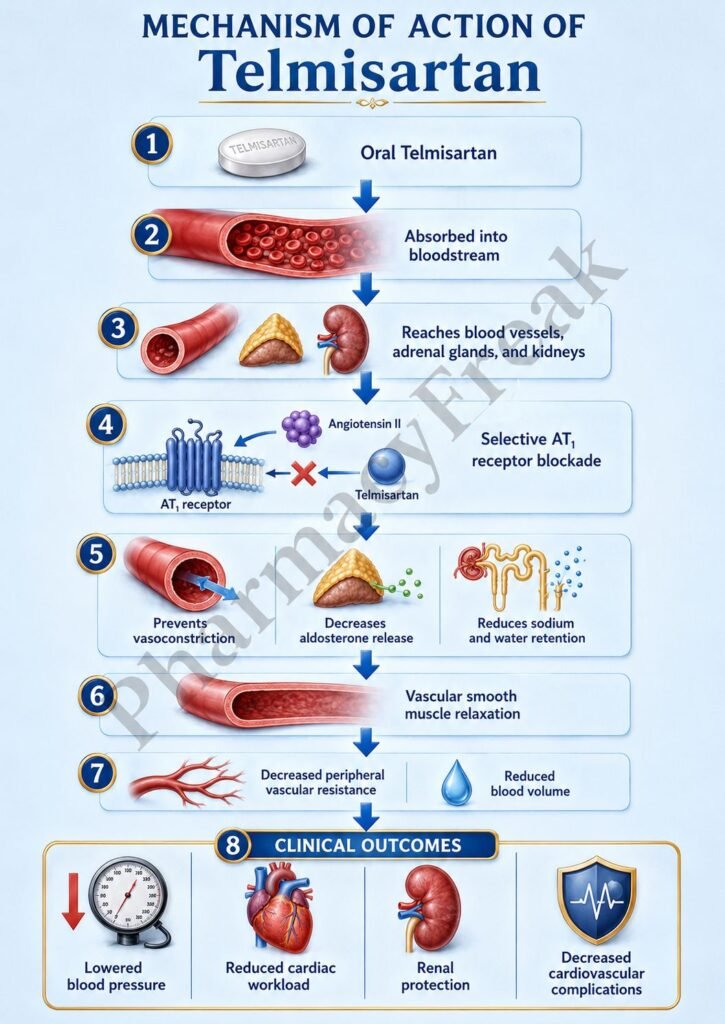
- Telmisartan selectively blocks AT1 receptors.
- Angiotensin II can no longer exert its vasoconstrictor effects through AT1 receptors.
- Peripheral vascular resistance decreases due to vasodilation.
- Aldosterone secretion decreases.
- Sodium and water retention are reduced.
- Blood volume and blood pressure decline.
- Cardiac workload decreases and cardiovascular protection improves.
- Telmisartan also exhibits partial PPAR-γ agonist activity, which may improve insulin sensitivity and metabolic parameters.
- The overall effect is reduction of blood pressure, decreased cardiovascular risk, and protection against target-organ damage.
A key exam point is that telmisartan selectively blocks angiotensin II AT1 receptors, preventing vasoconstriction and aldosterone-mediated sodium retention.
Pharmacokinetics
Telmisartan is administered orally and has high affinity for AT1 receptors. It possesses a long elimination half-life, allowing once-daily dosing. The drug undergoes minimal hepatic metabolism and is primarily excreted through bile and feces.
Clinical Uses
Telmisartan is used in:
- Hypertension
- Cardiovascular risk reduction
- Diabetic nephropathy
- Chronic kidney disease with proteinuria
- Heart failure (selected patients)
- Patients intolerant to ACE inhibitors
Adverse Effects
Common adverse effects include:
- Dizziness
- Hypotension
- Fatigue
- Hyperkalemia
Serious adverse effects may include:
- Acute kidney injury
- Severe hypotension
- Angioedema (rare)
- Fetal toxicity during pregnancy
Compared with ACE inhibitors, cough is uncommon.
Comparative Analysis
| Feature | Telmisartan | Losartan | Enalapril |
|---|---|---|---|
| Drug class | ARB | ARB | ACE inhibitor |
| Main target | AT1 receptor | AT1 receptor | ACE enzyme |
| Bradykinin effect | No increase | No increase | Increases bradykinin |
| Dry cough | Rare | Rare | Common |
| Hyperkalemia | Possible | Possible | Possible |
| PPAR-γ activity | Present | Minimal | Absent |
Telmisartan differs from ACE inhibitors because it blocks angiotensin II receptors directly rather than inhibiting ACE. Compared with losartan, telmisartan has stronger PPAR-γ activity and a longer duration of action.
MCQs
1. Telmisartan belongs to which drug class?
a) ACE inhibitors
b) Angiotensin receptor blockers
c) β blockers
d) Calcium channel blockers
Answer: b) Angiotensin receptor blockers
2. Telmisartan selectively blocks:
a) AT2 receptors
b) AT1 receptors
c) β1 receptors
d) α1 receptors
Answer: b) AT1 receptors
3. Angiotensin II normally causes:
a) Vasodilation
b) Vasoconstriction
c) Bronchodilation
d) Hypoglycemia
Answer: b) Vasoconstriction
4. Telmisartan decreases secretion of:
a) Insulin
b) Aldosterone
c) Thyroxine
d) Histamine
Answer: b) Aldosterone
5. Reduced aldosterone leads to:
a) Increased sodium retention
b) Reduced sodium retention
c) Increased calcium absorption
d) Increased glucose production
Answer: b) Reduced sodium retention
6. Telmisartan is mainly used in:
a) Hypertension
b) Asthma
c) Epilepsy
d) Parkinson disease
Answer: a) Hypertension
7. A common adverse effect is:
a) Dizziness
b) Hypercalcemia
c) Cataracts
d) Bradycardia
Answer: a) Dizziness
8. Telmisartan may cause:
a) Hyperkalemia
b) Hypokalemia
c) Hyperthyroidism
d) Polycythemia
Answer: a) Hyperkalemia
9. Compared with ACE inhibitors, telmisartan causes:
a) More cough
b) Less cough
c) More bradykinin accumulation
d) Greater angioedema incidence
Answer: b) Less cough
10. Telmisartan has additional activity at:
a) PPAR-γ receptors
b) Histamine receptors
c) Dopamine receptors
d) Muscarinic receptors
Answer: a) PPAR-γ receptors
11. Telmisartan is contraindicated during:
a) Pregnancy
b) Migraine
c) Diabetes mellitus
d) Hyperlipidemia
Answer: a) Pregnancy
12. The antihypertensive effect of telmisartan is mainly due to:
a) AT1 receptor blockade
b) Calcium channel blockade
c) β receptor stimulation
d) ACE activation
Answer: a) AT1 receptor blockade
FAQs
What is the mechanism of action of telmisartan?
Telmisartan selectively blocks angiotensin II AT1 receptors, preventing vasoconstriction and aldosterone release.
Why does telmisartan lower blood pressure?
Because AT1 receptor blockade causes vasodilation and reduces sodium and water retention.
How does telmisartan differ from ACE inhibitors?
It blocks angiotensin II receptors directly and does not increase bradykinin levels.
What are common side effects of telmisartan?
Dizziness, hypotension, fatigue, and hyperkalemia.
What is the significance of telmisartan’s PPAR-γ activity?
It may improve insulin sensitivity and provide additional metabolic benefits.
Can telmisartan be used in diabetic kidney disease?
Yes, it is commonly used to reduce proteinuria and protect renal function.
References
Goodman & Gilman’s The Pharmacological Basis of Therapeutics
https://accessmedicine.mhmedical.com/book.aspx?bookid=3191
Katzung’s Basic and Clinical Pharmacology
https://accessmedicine.mhmedical.com/content.aspx?bookid=3382
Tripathi KD. Essentials of Medical Pharmacology
https://www.jaypeedigital.com
Harrison’s Principles of Internal Medicine
https://accessmedicine.mhmedical.com