Table of Contents
Introduction
Solifenacin is an antimuscarinic medication primarily used in overactive bladder and urge urinary incontinence. It works by selectively blocking muscarinic receptors in the urinary bladder, reducing involuntary bladder contractions and improving urinary storage capacity.
Mechanism of Action (Step-wise)
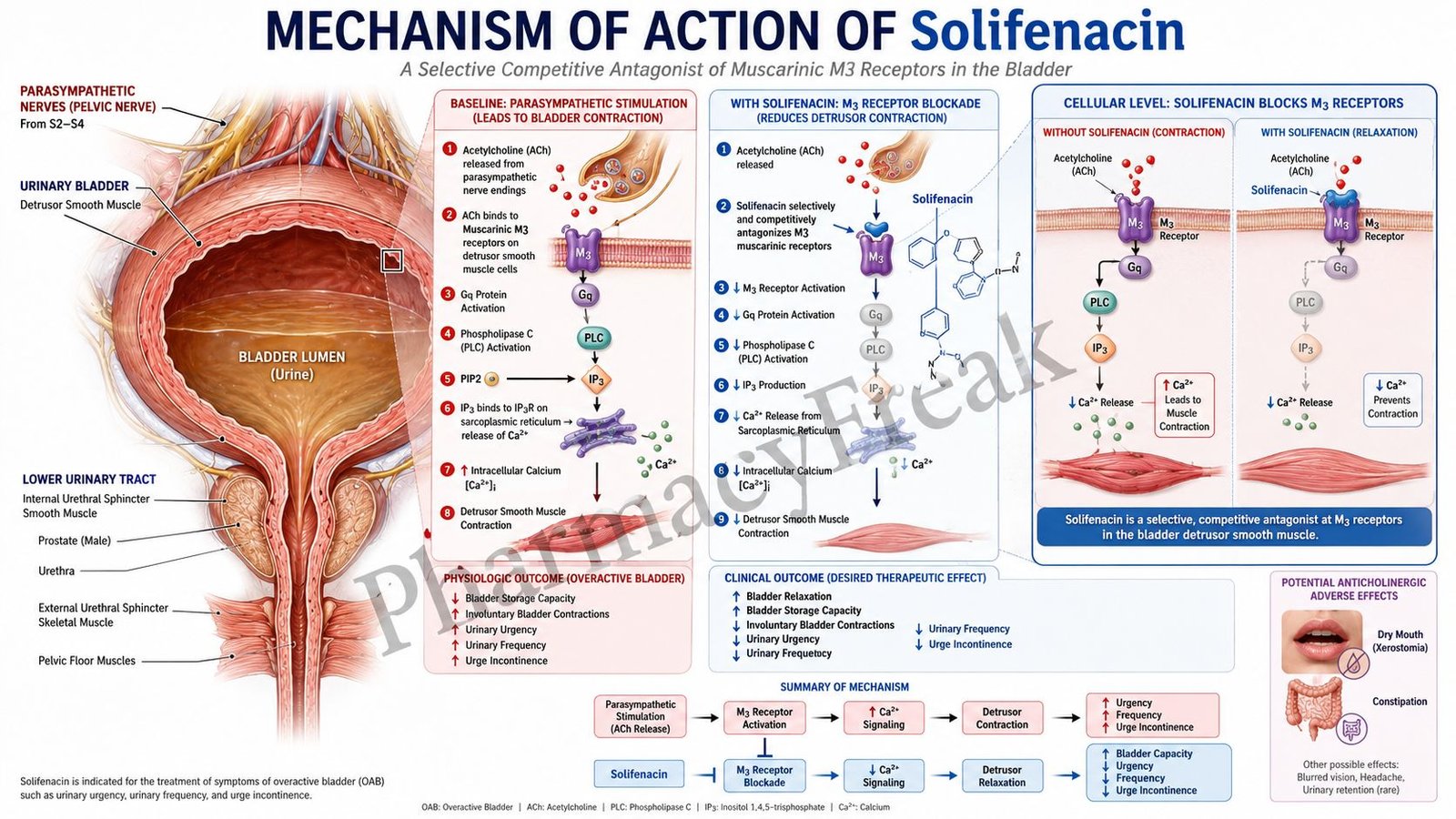
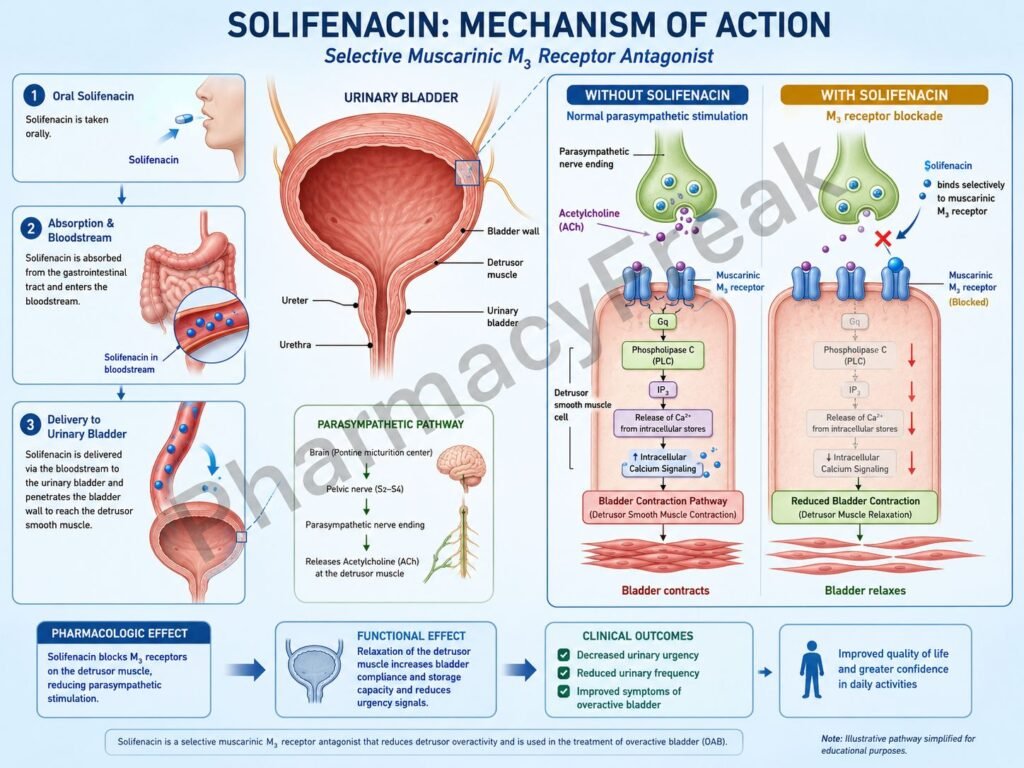
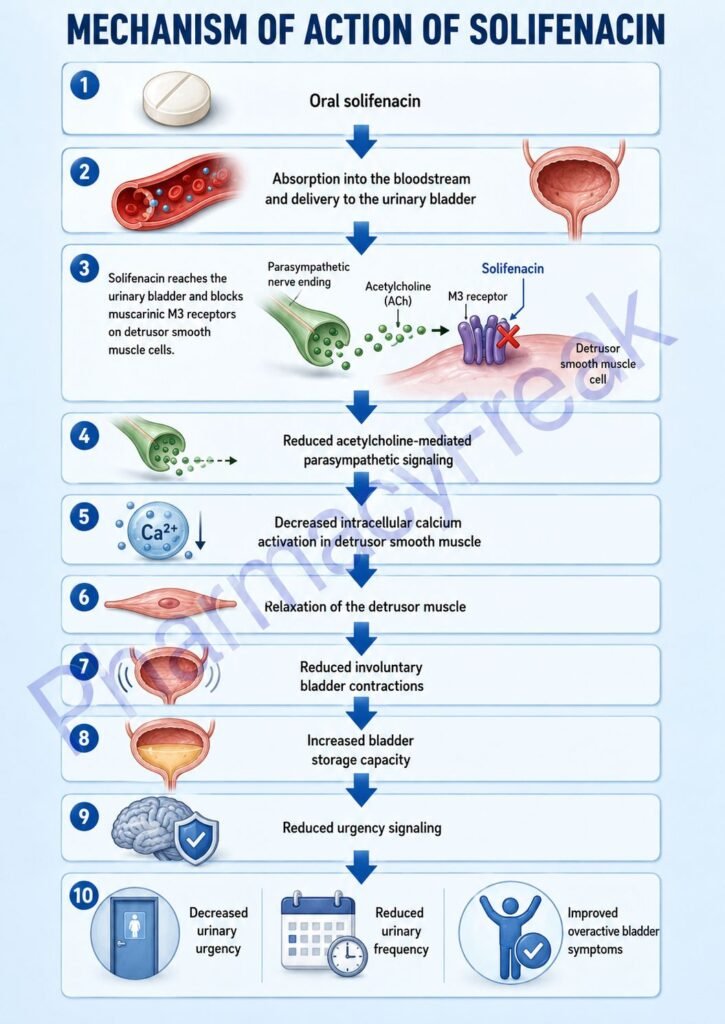
- Solifenacin selectively blocks muscarinic acetylcholine receptors, mainly M3 receptors.
- M3 receptors are present on detrusor smooth muscle in the urinary bladder.
- Normally, acetylcholine released from parasympathetic nerves binds to M3 receptors.
- Activation of M3 receptors increases intracellular calcium in detrusor muscle cells.
- Increased intracellular calcium causes bladder contraction during urination.
- Solifenacin competitively inhibits acetylcholine binding to M3 receptors.
- Detrusor muscle contractions decrease.
- Bladder relaxation during the filling phase improves.
- Functional bladder capacity increases.
- Urinary urgency, frequency, and urge incontinence episodes decrease.
- The overall effect is improved bladder control and reduced symptoms of overactive bladder.
A key exam point is that solifenacin blocks M3 muscarinic receptors in the bladder, reducing detrusor muscle contractions.
Pharmacokinetics
Solifenacin is administered orally and is well absorbed. It has a long half-life, allowing once-daily dosing. The drug is metabolized mainly through CYP3A4 in the liver and excreted through urine and feces.
Clinical Uses
Solifenacin is used in overactive bladder, urinary urgency, increased urinary frequency, and urge urinary incontinence.
Adverse Effects
Common adverse effects include dry mouth, constipation, blurred vision, urinary retention, and dry eyes due to anticholinergic activity. Elderly patients may be more susceptible to confusion and cognitive effects.
Comparative Analysis
| Feature | Solifenacin | Oxybutynin | Mirabegron |
|---|---|---|---|
| Drug class | Antimuscarinic | Antimuscarinic | β3 agonist |
| Main target | M3 receptor | Muscarinic receptors | β3 adrenergic receptor |
| Main effect | Detrusor relaxation | Detrusor relaxation | Bladder relaxation |
| Dry mouth risk | Moderate | Higher | Lower |
| Constipation | Common | Common | Less common |
| Cognitive effects | Mild to moderate | More common | Minimal |
Solifenacin differs from mirabegron because it works through muscarinic receptor blockade rather than β3 receptor stimulation. Compared with oxybutynin, solifenacin is more selective for M3 receptors and may produce fewer CNS adverse effects.
MCQs
- Solifenacin belongs to which drug class?
a) β blockers
b) Antimuscarinics
c) Diuretics
d) α agonists
Answer: b) Antimuscarinics
- Solifenacin mainly blocks which receptor subtype?
a) M1
b) M2
c) M3
d) M4
Answer: c) M3
- M3 receptors are mainly located in the bladder on:
a) Urothelial cells only
b) Detrusor smooth muscle
c) Renal tubules
d) Prostate gland only
Answer: b) Detrusor smooth muscle
- Acetylcholine normally causes bladder:
a) Relaxation
b) Contraction
c) Atrophy
d) Fibrosis
Answer: b) Contraction
- Solifenacin reduces symptoms of:
a) Overactive bladder
b) Asthma
c) Hyperthyroidism
d) Epilepsy
Answer: a) Overactive bladder
- Solifenacin increases:
a) Urinary urgency
b) Functional bladder capacity
c) Histamine release
d) Blood glucose
Answer: b) Functional bladder capacity
- A common adverse effect is:
a) Dry mouth
b) Severe hypoglycemia
c) Hypercalcemia
d) Bradycardia
Answer: a) Dry mouth
- Solifenacin may cause:
a) Constipation
b) Hypernatremia
c) Polycythemia
d) Cataracts
Answer: a) Constipation
- Solifenacin is metabolized mainly by:
a) CYP2D6
b) CYP3A4
c) MAO
d) Acetylcholinesterase
Answer: b) CYP3A4
- Compared with mirabegron, solifenacin works by:
a) β3 receptor stimulation
b) Muscarinic receptor blockade
c) Dopamine inhibition
d) Histamine blockade
Answer: b) Muscarinic receptor blockade
- Excessive anticholinergic activity may cause:
a) Urinary retention
b) Bronchospasm
c) Hypotension only
d) Hyperglycemia
Answer: a) Urinary retention
- Solifenacin improves bladder storage mainly by reducing:
a) Detrusor muscle contractions
b) Renal blood flow
c) Sodium excretion
d) Histamine release
Answer: a) Detrusor muscle contractions
FAQs
What is the mechanism of action of solifenacin?
Solifenacin blocks M3 muscarinic receptors in the bladder, reducing detrusor muscle contractions.
Why is solifenacin used in overactive bladder?
Because it decreases urinary urgency, frequency, and urge incontinence.
What are common side effects of solifenacin?
Dry mouth, constipation, blurred vision, and urinary retention.
How does solifenacin improve bladder capacity?
By relaxing the detrusor muscle during the bladder filling phase.
How does solifenacin differ from mirabegron?
Solifenacin blocks muscarinic receptors, while mirabegron stimulates β3 receptors.
Why can elderly patients be sensitive to solifenacin?
Because anticholinergic drugs may cause confusion and cognitive effects.
References
Goodman & Gilman’s The Pharmacological Basis of Therapeutics – Drugs Affecting Urinary Function
https://accessmedicine.mhmedical.com/book.aspx?bookid=3191
Katzung: Basic and Clinical Pharmacology – Autonomic Pharmacology and Bladder Drugs
https://accessmedicine.mhmedical.com/content.aspx?bookid=3382
Tripathi: Essentials of Medical Pharmacology – Drugs for Urinary Disorders
https://www.jaypeedigital.com
Harrison’s Principles of Internal Medicine – Urinary Incontinence and Overactive Bladder
https://accessmedicine.mhmedical.com