Table of Contents
Introduction
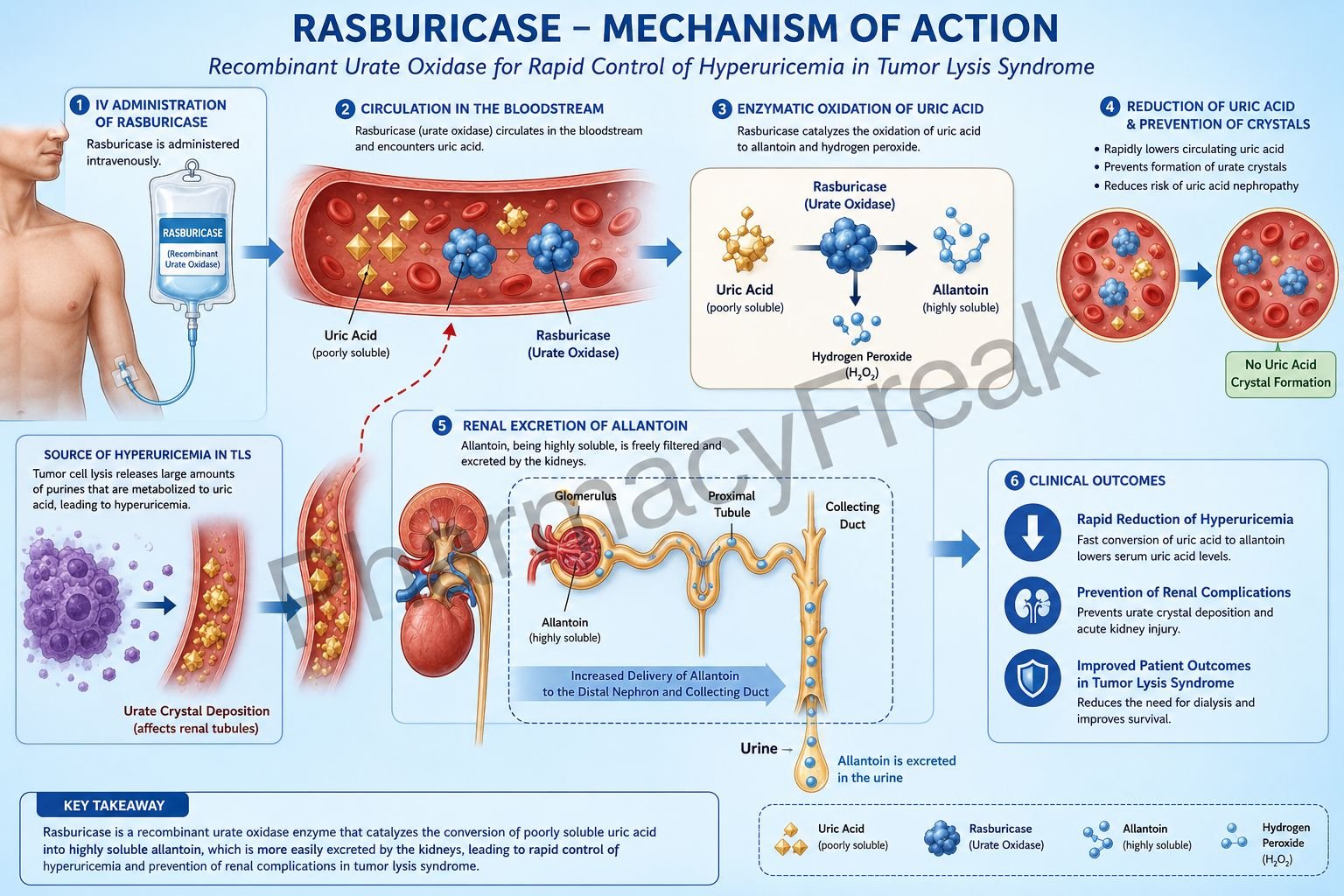
Rasburicase is a recombinant urate oxidase enzyme used for the prevention and treatment of hyperuricemia associated with tumor lysis syndrome (TLS). It rapidly lowers serum uric acid levels by converting uric acid into allantoin, a more water-soluble and easily excreted metabolite. Rasburicase is particularly useful in oncology patients with rapidly proliferating tumors undergoing chemotherapy.
Mechanism of Action (Step-wise)
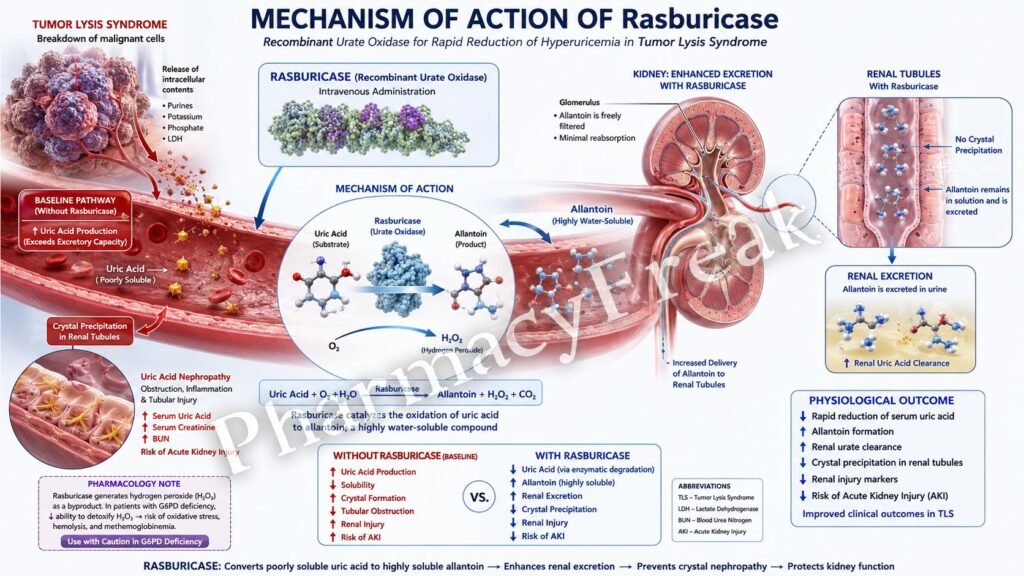
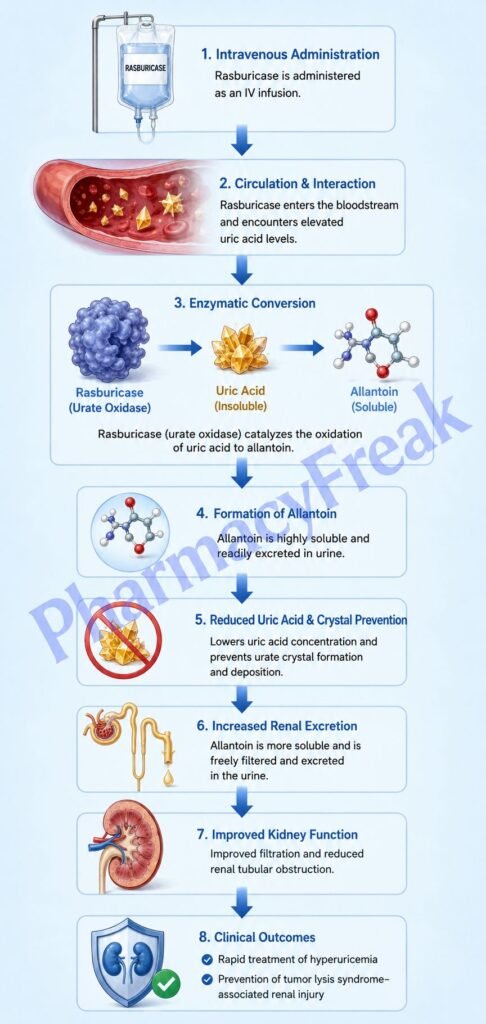
- Rapid destruction of tumor cells releases large amounts of nucleic acids into the bloodstream.
- Purine nucleic acids are metabolized into uric acid.
- Excess uric acid can precipitate in renal tubules, causing acute kidney injury.
- Rasburicase acts as a recombinant urate oxidase enzyme.
- Urate oxidase catalyzes oxidation of uric acid into allantoin.
- During this reaction, hydrogen peroxide and carbon dioxide are also produced.
- Allantoin is highly water soluble compared with uric acid.
- Increased solubility allows rapid renal excretion of allantoin.
- Serum uric acid concentration decreases rapidly.
- Reduced uric acid levels prevent urate crystal deposition in kidneys and tissues.
- The overall effect is prevention and treatment of hyperuricemia and renal complications in tumor lysis syndrome.
A key exam point is that rasburicase converts uric acid into allantoin, which is more soluble and easily excreted.
Pharmacokinetics
Rasburicase is administered intravenously. It acts rapidly after infusion and significantly lowers uric acid levels within hours. The drug is metabolized by peptide hydrolysis and is not dependent on renal excretion for clearance.
Clinical Uses
Rasburicase is primarily used in prevention and treatment of tumor lysis syndrome in patients with leukemia, lymphoma, and other rapidly proliferating malignancies undergoing chemotherapy.
Adverse Effects
Common adverse effects include fever, nausea, vomiting, and headache. Serious adverse effects include hypersensitivity reactions, hemolysis, and methemoglobinemia, especially in patients with glucose-6-phosphate dehydrogenase (G6PD) deficiency. Screening for G6PD deficiency is recommended before administration.
Comparative Analysis
| Feature | Rasburicase | Allopurinol | Febuxostat |
|---|---|---|---|
| Main mechanism | Converts uric acid to allantoin | Xanthine oxidase inhibition | Xanthine oxidase inhibition |
| Effect on existing uric acid | Rapidly removes | No removal | No removal |
| Route | IV | Oral | Oral |
| Main use | Tumor lysis syndrome | Chronic gout, TLS prevention | Chronic gout |
| Onset | Rapid | Slower | Moderate |
| G6PD concern | Yes | No | No |
Rasburicase differs from allopurinol and febuxostat because it directly degrades existing uric acid rather than preventing uric acid formation.
MCQs
- Rasburicase is mainly used in:
a) Asthma
b) Tumor lysis syndrome
c) Hypertension
d) Diabetes mellitus
Answer: b) Tumor lysis syndrome
- Rasburicase is a recombinant form of:
a) Xanthine oxidase
b) Urate oxidase
c) Carbonic anhydrase
d) Cyclooxygenase
Answer: b) Urate oxidase
- Rasburicase converts uric acid into:
a) Hypoxanthine
b) Allantoin
c) Xanthine
d) Urea
Answer: b) Allantoin
- Allantoin is:
a) Less soluble than uric acid
b) More water soluble than uric acid
c) A calcium salt
d) An insoluble crystal
Answer: b) More water soluble than uric acid
- Tumor lysis syndrome causes increased release of:
a) Lipids only
b) Nucleic acids
c) Histamine
d) Insulin
Answer: b) Nucleic acids
- Rasburicase lowers serum:
a) Glucose
b) Uric acid
c) Sodium
d) Calcium
Answer: b) Uric acid
- Rasburicase is administered by which route?
a) Oral
b) Intravenous
c) Sublingual
d) Intramuscular only
Answer: b) Intravenous
- A major complication prevented by rasburicase is:
a) Pulmonary fibrosis
b) Acute kidney injury
c) Hyperthyroidism
d) Cataracts
Answer: b) Acute kidney injury
- Rasburicase can cause hemolysis in patients with deficiency of:
a) CYP3A4
b) G6PD
c) MAO
d) ACE
Answer: b) G6PD
- Compared with allopurinol, rasburicase:
a) Prevents only new uric acid formation
b) Rapidly degrades existing uric acid
c) Blocks prostaglandin synthesis
d) Inhibits renin release
Answer: b) Rapidly degrades existing uric acid
- During the rasburicase reaction, which byproduct is produced?
a) Nitric oxide
b) Hydrogen peroxide
c) Acetylcholine
d) Dopamine
Answer: b) Hydrogen peroxide
- Rasburicase acts rapidly because it:
a) Directly metabolizes uric acid
b) Blocks sodium channels
c) Stimulates insulin release
d) Inhibits aldosterone synthesis
Answer: a) Directly metabolizes uric acid
FAQs
What is the mechanism of action of rasburicase?
Rasburicase converts uric acid into allantoin, which is more water soluble and easily excreted.
Why is rasburicase useful in tumor lysis syndrome?
Because it rapidly lowers dangerously high uric acid levels.
How does rasburicase differ from allopurinol?
Rasburicase degrades existing uric acid, while allopurinol prevents new uric acid formation.
Why must G6PD deficiency be checked before use?
Because rasburicase can cause hemolysis and methemoglobinemia in G6PD-deficient patients.
What route is used for rasburicase administration?
Intravenous infusion.
What is allantoin?
A highly water-soluble metabolite formed from uric acid degradation.
References
Goodman & Gilman’s The Pharmacological Basis of Therapeutics – Drugs Used in Gout and Hyperuricemia
https://accessmedicine.mhmedical.com/book.aspx?bookid=3191
Katzung: Basic and Clinical Pharmacology – Antigout Drugs
https://accessmedicine.mhmedical.com/content.aspx?bookid=3382
Tripathi: Essentials of Medical Pharmacology – Drugs for Gout
https://www.jaypeedigital.com
Harrison’s Principles of Internal Medicine – Tumor Lysis Syndrome
https://accessmedicine.mhmedical.com