Trusted by 50K+ Pharmacy StudentsHigh Quality Notes, MCQs, Mock Tests & Study ResourcesGo Premium (Ads Free)
Pharmacy Freak

Mechanism of Action of Antacids
MOA of Antacids

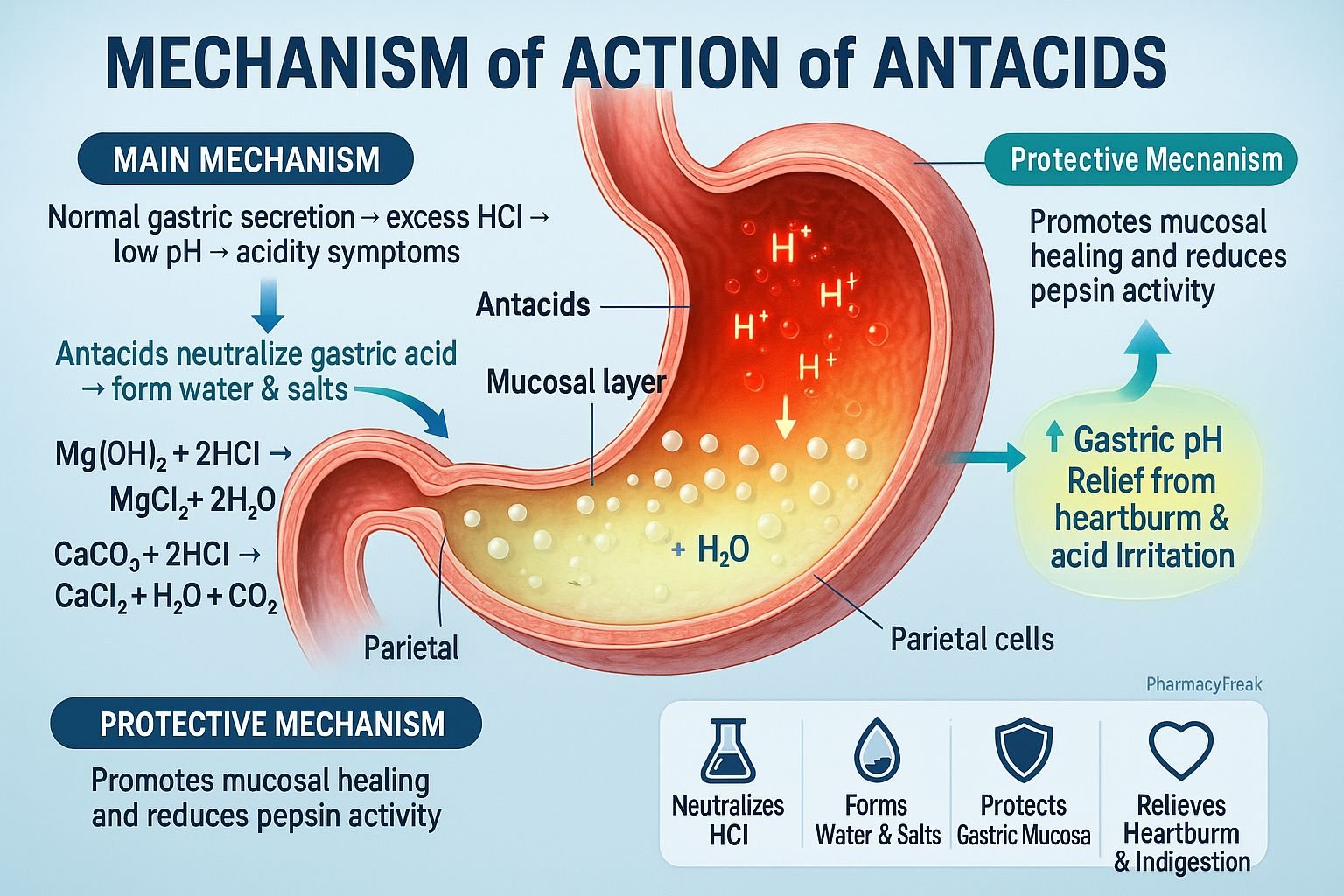
Introduction Antacids are weakly basic compounds that neutralize excess gastric acid in the stomach, providing rapid relief from heartburn, acid reflux, gastritis, and peptic ulcer disease. Mechanism of Action of Antacids involves a direct chemical reaction with hydrochloric acid (HCl) in gastric juice to form salt and water, thereby increasing gastric pH and reducing acidity. … Read more

Essential requirements for parenteral formulations MCQs With Answer

Essential requirements for parenteral formulations MCQs With Answer

Parenteral formulations require strict control of sterility, stability, safety, and compatibility to ensure patient safety and therapeutic efficacy. This concise resource covers essential requirements for parenteral formulations MCQs with answer, focusing on sterility assurance, pyrogen control, sterilization methods, container–closure systems, water for injection, tonicity, pH, preservatives, particulate limits, and stability testing. Each question emphasizes practical … Read more

Resume for US Pharmacy Jobs: Stop Using an Indian Resume Format, Here’s a Sample That Gets Past HR and Lands You an Interview.

Resume for US Pharmacy Jobs: Stop Using an Indian Resume Format, Here’s a Sample That Gets Past HR and Lands You an Interview.

If you are applying for a pharmacist, intern, or pharmacy technician role in the United States with an Indian-style CV, you are likely getting filtered out by ATS and HR. The format is the problem, not your skills. US pharmacy resumes favor clear, scannable sections, state licensure up front, and measurable results. They avoid photos, … Read more

Preformulation factors for parenteral dosage forms MCQs With Answer

Preformulation factors for parenteral dosage forms MCQs With Answer

Introduction: Preformulation factors for parenteral dosage forms are critical fundamentals every B.Pharm student must master. Preformulation evaluates drug properties—solubility, pKa, stability, partitioning, particle size, and hygroscopicity—and their interaction with excipients, container-closure systems, and sterilization processes. Key considerations include pH, tonicity/osmolality, buffer selection, adsorption, aggregation, degradation pathways (hydrolysis, oxidation, photolysis), preservatives, pyrogen control, and compatibility with … Read more

Advantages and limitations of parenteral products MCQs With Answer

Advantages and limitations of parenteral products MCQs With Answer

Advantages and limitations of parenteral products MCQs With Answer is an essential topic for B. Pharm students studying sterile dosage forms. This introduction covers key concepts such as parenteral routes (IV, IM, SC, intrathecal), sterile formulations, aseptic processing, stability, compatibility, dosing accuracy, bioavailability, immunogenicity, particulate contamination, preservatives, and packaging types (ampoules, vials, prefilled syringes). Understanding … Read more

Types of parenteral products MCQs With Answer

Types of parenteral products MCQs With Answer

Introduction: Understanding types of parenteral products is essential for B.Pharm students preparing for clinical, regulatory, and manufacturing roles. This guide covers classifications such as small volume parenterals (SVP), large volume parenterals (LVP), sterile powders for injection, emulsions, suspensions, depot formulations, and implants. Key concepts include aseptic processing, sterilization methods (filtration, autoclaving, dry heat), pyrogen control, … Read more

Definition of parenteral products MCQs With Answer

Definition of parenteral products MCQs With Answer

Parenteral products are sterile pharmaceutical preparations intended for administration by injection, infusion, or implantation, bypassing the gastrointestinal tract. This topic covers definitions, classification (SVP, LVP, depot), routes (intravenous, intramuscular, subcutaneous), formulation issues (sterility, tonicity, pH, preservatives), sterilization methods, aseptic processing, containers and closures, pyrogen control, particulate limits, and storage. B.Pharm students should master regulatory tests, … Read more

Equipment for pellet manufacture MCQs With Answer

Equipment for pellet manufacture MCQs With Answer

Pellet manufacture involves specialized equipment and process control to convert powders into uniform, spherical multiparticulates for controlled release, taste masking, and enhanced flow. This concise overview highlights key pelletization equipment — high-shear granulators, extruders, spheronizers, pellet presses, and fluid-bed processors — and critical concepts like die design, pellet size distribution, coating systems, binder selection, porosity, … Read more

Pelletization process MCQs With Answer

Pelletization process MCQs With Answer

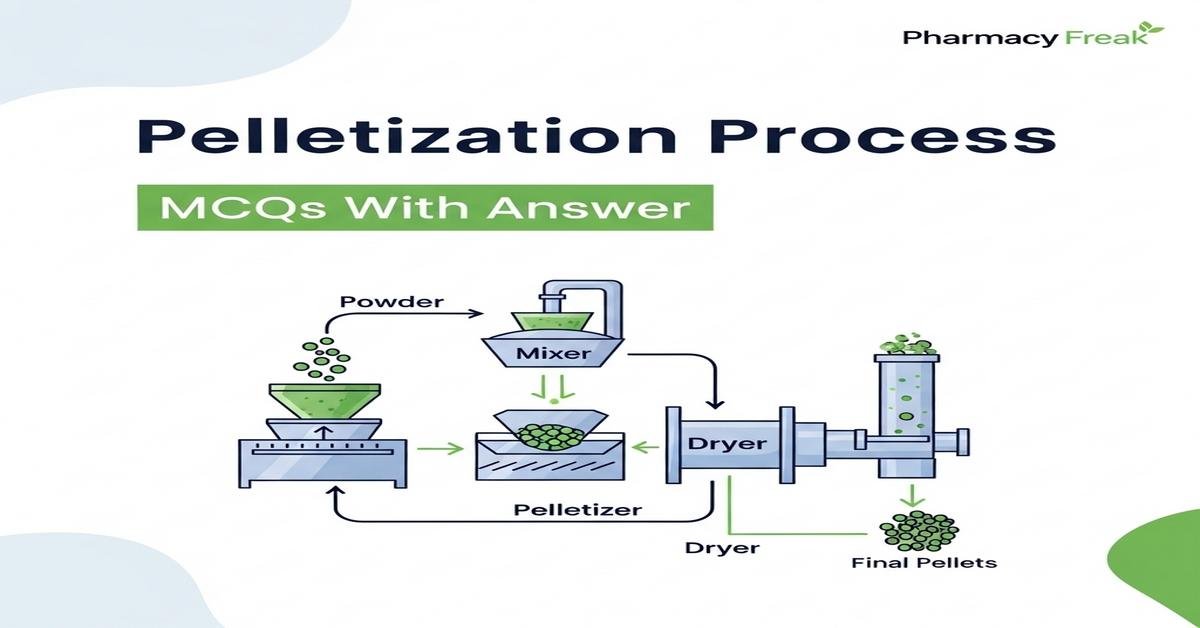
Pelletization is a key unit operation in pharmaceutical technology that converts fine powders into free‑flowing, spherical aggregates (pellets) suitable for capsule filling, tableting, and modified‑release formulations. This process—using techniques like extrusion–spheronization, pan (disc) pelletizing, and layered pelletization—depends on controlled nucleation, accretion, and consolidation influenced by binders, granulation liquid, equipment speed, and drying method. Critical quality … Read more

Formulation requirements for pellets MCQs With Answer

Formulation requirements for pellets MCQs With Answer

Formulation requirements for pellets MCQs With Answer — This concise guide introduces B.Pharm students to essential pellet formulation concepts. Pellet drug delivery uses multiparticulate systems that demand precise control of particle size, shape, density, porosity, and mechanical strength to ensure flow, content uniformity, and predictable drug release. Key formulation variables include binder type and concentration, … Read more

PRO
Ad-Free Access
$3.99 / month
  • ✓ No Interruptions
  • ✓ Faster Page Loads
  • ✓ Support Content Creators