
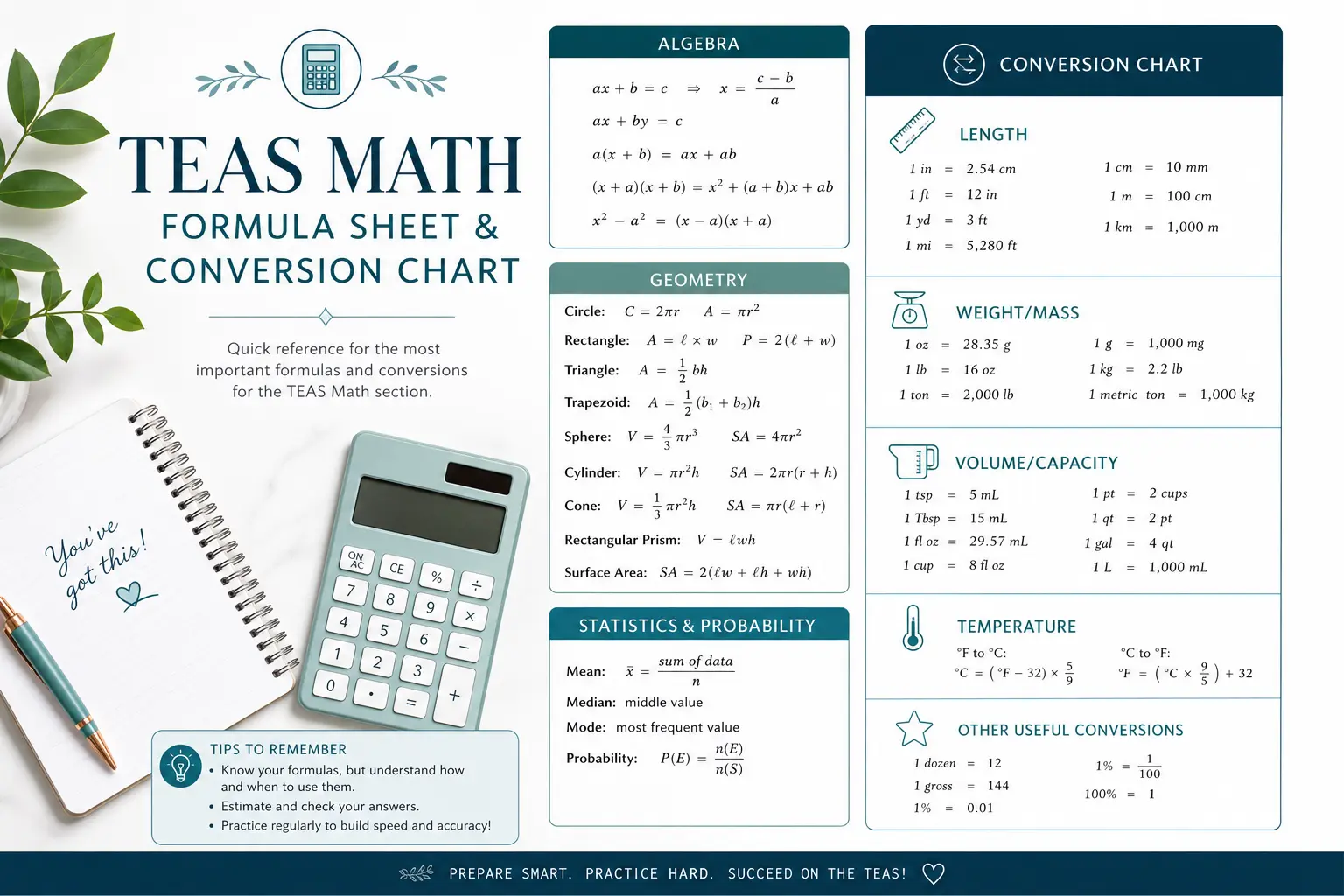
TEAS Math Formula Sheet and Conversion Chart
Use this page to review the formulas and conversions you are most likely to need while preparing for ATI TEAS 7 Math. Each section explains what the formula does and shows how to use it in a worked example.
Last reviewed: July 13, 2026
Don’t try to memorize the whole sheet at once. Review one group, solve a few problems without looking, and check whether your answer and units make sense.
How to use this formula sheet
Start with the formulas you miss most often. Rewrite each one from memory, solve a new problem, and then check your work. Reading a formula can make it feel familiar. Solving without help shows whether you actually know it.
- Choose one topic, such as percentages or geometry.
- Read the formula and example.
- Close the page or cover the formula.
- Solve a different question.
- Check the calculation and units.
- Write down mistakes that appear more than once.
Fractions, decimals, and percentages
Convert a fraction to a decimal
Example: Convert 3/8 to a decimal.
3 ÷ 8 = 0.375
Answer: 0.375
Convert a decimal to a percentage
Example: Convert 0.375 to a percentage.
0.375 × 100 = 37.5%
Answer: 37.5%
Convert a percentage to a decimal
Example: Convert 62% to a decimal.
62 ÷ 100 = 0.62
Answer: 0.62
Find a percentage of a number
Example: Find 35% of 80.
35% = 0.35
0.35 × 80 = 28
Answer: 28
Find the whole when the part and percentage are known
Example: Eighteen students represent 30% of a class.
Whole = 180.30 = 60
Answer: 60 students
Find what percentage one number is of another
Example: Twenty-four of 40 students completed an assignment.
2440 × 100 = 60%
Answer: 60%
Percentage increase or decrease
Example: A price falls from $80 to $68.
Amount of decrease = 80 − 68 = 12
Percentage decrease = 1280 × 100 = 15%
Answer: 15% decrease
Use the original value in the denominator. Dividing by the new value changes the result.
Common fraction, decimal, and percentage equivalents
| Fraction | Decimal | Percentage |
|---|---|---|
| 1/10 | 0.10 | 10% |
| 1/8 | 0.125 | 12.5% |
| 1/5 | 0.20 | 20% |
| 1/4 | 0.25 | 25% |
| 1/3 | 0.333… | 33.3…% |
| 3/8 | 0.375 | 37.5% |
| 2/5 | 0.40 | 40% |
| 1/2 | 0.50 | 50% |
| 3/5 | 0.60 | 60% |
| 2/3 | 0.666… | About 66.7% |
| 3/4 | 0.75 | 75% |
| 4/5 | 0.80 | 80% |
| 7/8 | 0.875 | 87.5% |
Keep repeating decimals unrounded during intermediate steps. Round when the question tells you to or when you reach the final answer.
Ratios, proportions, and rates
Write a ratio
Order matters. A ratio of three nurses to five patients is 3:5, not 5:3.
Solve a proportion
Example:
35 = 24x
3x = 120
x = 40
Find a unit rate
Example: A car travels 210 miles in 3.5 hours.
210 ÷ 3.5 = 60 miles per hour
Distance, rate, and time
Example: How long does it take to travel 180 miles at 60 miles per hour?
Time = 180 miles60 miles per hour = 3 hours
Algebra formulas and relationships
Solve a one-variable equation
Use inverse operations to isolate the variable. Perform the same operation on both sides.
3x + 7 = 25
3x = 18
x = 6
Check: 3(6) + 7 = 25
Distributive property
4(x + 3) = 4x + 12
With a negative number:
−2(x − 5) = −2x + 10
Slope
Example: Find the slope through the points (2, 3) and (6, 11).
Slope = 11 − 36 − 2 = 84 = 2
Slope-intercept form
- m is the slope.
- b is the y-intercept.
Quadratic equation in standard form
Pythagorean theorem
Use this only for right triangles. The variable c is the hypotenuse.
62 + 82 = c2
36 + 64 = 100
c = 10
Simple interest
- I = interest
- P = principal
- r = annual interest rate as a decimal
- t = time in years
Example: Find the simple interest on $500 at 4% for three years.
I = 500 × 0.04 × 3 = 60
Answer: $60 interest
Mean, median, mode, and range
Mean
Example: Find the mean of 8, 11, 15, and 6.
Mean = 8 + 11 + 15 + 64 = 404 = 10
Median
Arrange the values from least to greatest. For an odd number of values, choose the middle one. For an even number, average the two middle values.
Example: Find the median of 3, 7, 9, and 14.
Median = 7 + 92 = 8
Mode
The mode is the value that appears most often. A data set may have one mode, more than one mode, or no mode.
Range
Example: Find the range of 4, 6, 9, and 15.
15 − 4 = 11
Standard deviation
Standard deviation describes how spread out values are around the mean. A smaller standard deviation means the values are grouped more closely. A larger standard deviation means they are more spread out.
Geometry formulas
Square
Rectangle
Triangle
The height must meet the chosen base at a right angle.
Circle
Example: A circle has a diameter of 10 cm. Find its area using π ≈ 3.14.
Radius = 10 ÷ 2 = 5 cm
Area = π × 52
Area = 3.14 × 25
Area = 78.5 cm2
Circle area and cylinder volume use the radius, not the diameter.
Rectangular prism
Cube
Cylinder
Basic right-triangle ratios
Memory aid: SOH-CAH-TOA.
Metric conversion chart
| Prefix | Symbol | Value compared with the base unit |
|---|---|---|
| Kilo | k | 1,000 |
| Hecto | h | 100 |
| Deka | da | 10 |
| Base unit | m, g, L | 1 |
| Deci | d | 0.1 |
| Centi | c | 0.01 |
| Milli | m | 0.001 |
The base unit may be the meter for length, gram for mass, or liter for volume.
Common metric equivalents
| Conversion | Equivalent |
|---|---|
| 1 kilometer | 1,000 meters |
| 1 meter | 100 centimeters |
| 1 meter | 1,000 millimeters |
| 1 kilogram | 1,000 grams |
| 1 gram | 1,000 milligrams |
| 1 liter | 1,000 milliliters |
| 1 centimeter | 10 millimeters |
Move from a larger unit to a smaller unit
Multiply.
2.4 L × 1,000 = 2,400 mL
Move from a smaller unit to a larger unit
Divide.
750 mg ÷ 1,000 = 0.75 g
US customary conversions
Length
- 1 foot = 12 inches
- 1 yard = 3 feet
- 1 yard = 36 inches
- 1 mile = 5,280 feet
Weight
- 1 pound = 16 ounces
- 1 ton = 2,000 pounds
Liquid volume
- 1 cup = 8 fluid ounces
- 1 pint = 2 cups
- 1 quart = 2 pints
- 1 gallon = 4 quarts
- 1 gallon = 16 cups
Time
- 1 minute = 60 seconds
- 1 hour = 60 minutes
- 1 day = 24 hours
- 1 week = 7 days
Dimensional analysis
Dimensional analysis places units inside the calculation so the unwanted unit cancels.
Example 1: Convert 2.5 liters to milliliters.
2.5 L × 1,000 mL1 L = 2,500 mL
Example 2: Convert 3.5 feet to inches.
3.5 ft × 12 in1 ft = 42 in
Place the unwanted unit on the opposite side of the conversion factor so it cancels.
Rounding and calculator use
Round to the nearest whole number
Look at the tenths digit.
18.6 ≈ 19
Round to the nearest tenth
Look at the hundredths digit.
7.46 ≈ 7.5
Round to the nearest hundredth
Look at the thousandths digit.
3.174 ≈ 3.17
Keep extra decimal places during intermediate calculations. Rounding too early can move the final answer enough to select the wrong option.
How to use the TEAS calculator
ATI provides a calculator during the exam. The online version uses a built-in calculator, while a proctor supplies one for paper-and-pencil testing. Personal calculators are not allowed.
The calculator performs arithmetic. You still need to:
- Choose the correct operation.
- Enter parentheses correctly.
- Convert percentages to decimals.
- Keep track of units.
- Check whether the result is reasonable.
Estimate before calculating. When you expect an answer near 30 and the calculator displays 3,000, check the setup before moving on.
Common TEAS Math mistakes
| Mistake | Better approach |
|---|---|
| Using diameter as the radius | Divide the diameter by two before using a radius-based formula. |
| Mixing square and cubic units | Use square units for area and cubic units for volume. |
| Using the new value for percentage change | Divide the change by the original value. |
| Mixing inches and feet in one calculation | Convert every measurement to the same unit first. |
| Rounding during an intermediate step | Keep extra decimal places until the final answer. |
| Solving for the wrong quantity | Write the required variable and unit before calculating. |
| Trusting an unrealistic calculator result | Estimate the expected size of the answer first. |
| Reversing a ratio | Keep the quantities in the same order on both sides. |
Quick TEAS Math formula practice
Answers and worked solutions
1. 37.5%
3 ÷ 8 = 0.375
0.375 × 100 = 37.5%
2. 60
Whole = 180.30 = 60
3. 15% decrease
80 − 68 = 12
1280 × 100 = 15%
4. 40 blue markers
35 = 24x
3x = 120
x = 40
5. 3 hours
Time = 18060 = 3
6. 42 cm2
Area = 12 × 12 × 7 = 42 cm2
7. 31.4 cm
Circumference = π × diameter
3.14 × 10 = 31.4 cm
8. 10
Mean = 8 + 11 + 15 + 64 = 404 = 10
9. 2,400 mL
2.4 × 1,000 = 2,400 mL
10. 68 inches
5 × 12 = 60 inches
60 + 8 = 68 inches
Apply the formulas in free timed Math practice
Review the formulas first, then close this page before starting a timed test. The result should show what you can recall and apply without help.
Free ATI TEAS 7 Math practice tests
Each Pharmacy Freak Math test contains 30 questions, uses a 45-minute timer, and includes instant results, answer explanations, topic-wise performance, and a downloadable PDF review. No login is required.
Why these tests are more useful than a score-only worksheet
A worksheet may tell you that six answers were wrong. It may not show whether those mistakes came from Numbers and Algebra, Measurement and Data, conversions, or rushed calculator entries.
Pharmacy Freak’s Math tests include explanations and topic-level performance. You can also download the review as a PDF. That gives you something specific to study before the next attempt instead of leaving you with only a percentage.
- Review the formulas on this page.
- Take Math Practice Test 1 without keeping the formula sheet open.
- Review every wrong and unanswered question.
- Study the weakest topic.
- Take Math Practice Test 2 later under the full timer.
For free practice across all four subjects, visit the ATI TEAS practice-test hub.
When to move to a full-length TEAS practice test
Use a full-length test after you have reviewed your main Math weaknesses. At that stage, the goal is to practise the complete section order, calculator use, pacing, and concentration across a 170-question session.
Pharmacy Freak’s full-length ATI TEAS 7 practice-test package includes 10 complete tests for $9. Each test has four separately timed sections, automatic saving, detailed section results, emailed reports, and downloadable PDFs.
Pharmacy Freak results are practice percentages. They are not official ATI equated scores and do not predict admission decisions.
Print or save this formula sheet
- Open your browser’s Print menu.
- Select portrait orientation.
- Choose “Save as PDF” for a digital copy.
- Disable browser headers and footers when they clutter the page.
- Keep the online page bookmarked for the practice-test links.
Use the sheet while learning. Put it away before a timed practice test.
Frequently asked questions
What formulas should I know for ATI TEAS Math?
Review fractions, decimals, percentages, ratios, proportions, algebraic equations, distance and rate, geometry, averages, statistics, and standard and metric conversions. Also review the Pythagorean theorem, slope-intercept form, simple interest, and basic right-triangle relationships.
How many Math questions are on the ATI TEAS 7?
The Mathematics section delivers 38 questions in 57 minutes. Four are unidentified unscored questions. The 34 scored questions include Numbers and Algebra plus Measurement and Data.
Are formulas provided during the ATI TEAS?
ATI publishes formula-preparation guidance but does not promise a general formula sheet during the exam. Prepare to recall and apply the formulas yourself.
Can I use a calculator on the ATI TEAS?
Yes. ATI provides a calculator. Computer-based testing uses a built-in calculator, while a proctor supplies one for paper-and-pencil testing. Personal calculators are not allowed.
Are metric conversions tested on the TEAS?
Yes. The ATI TEAS 7 Math outline includes conversions within and between standard and metric systems.
Which geometry formulas should I study?
Review perimeter, area, circumference, surface area, and volume for common shapes. Also know the Pythagorean theorem for right triangles.
How can I remember TEAS Math formulas?
Group formulas by purpose, rewrite them from memory, and solve a new problem without looking. A formula becomes useful when you can recognize the situation that requires it.
Should I keep the formula sheet open during practice tests?
Use the sheet while learning. Close it during timed tests so the result shows what you can recall and apply independently.
Are Pharmacy Freak Math scores official ATI scores?
No. Pharmacy Freak provides practice percentages for study tracking. They are not official ATI equated scores and do not predict admission decisions.
Exam structure, calculator rules, and formula topics should be checked against current ATI information before publication. Pharmacy Freak is an independent educational resource and is not affiliated with or endorsed by Assessment Technologies Institute. ATI and TEAS are trademarks of their respective owner.
