
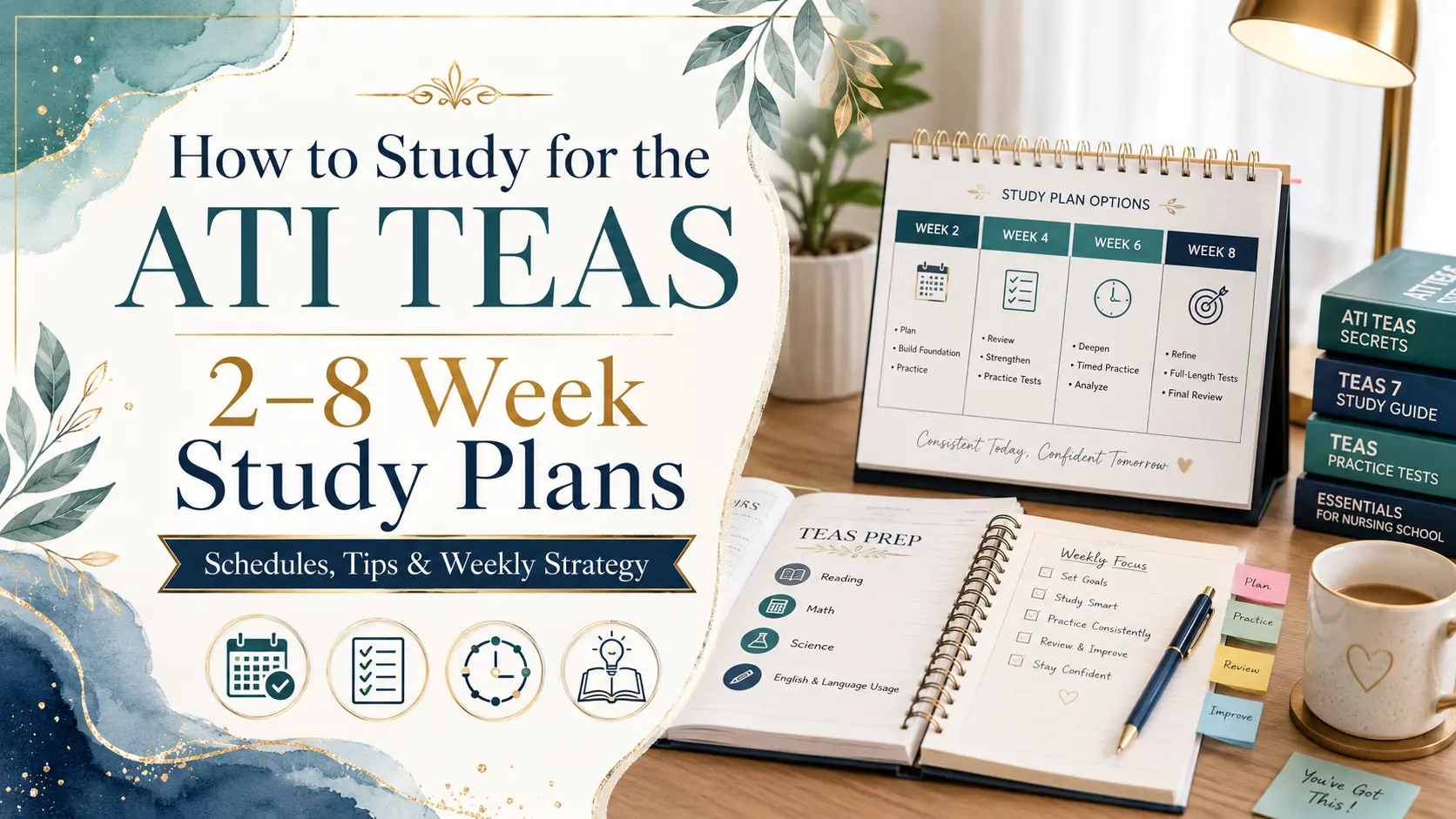
How to Study for the ATI TEAS
The most reliable way to study for the ATI TEAS is to start with a timed diagnostic test, find the subjects and question types costing you marks, review those areas, and then test again. Don’t spend six weeks reading notes without checking whether you can answer questions under time pressure. Study, practise, review, and repeat.
ATI recommends allowing at least six weeks to prepare when your schedule permits. A shorter plan can still work, but it needs tighter priorities and less wasted study time.
Last reviewed: July 13, 2026
The basic TEAS study method
A useful TEAS study plan follows seven steps:
- Learn the exam structure.
- Take a baseline test.
- Separate content weaknesses from timing and reading errors.
- Review one weak area at a time.
- Complete focused practice questions.
- Retest under realistic timing.
- Finish with one or more spaced full-length simulations.
This order matters.
Students often jump straight into random questions. That can feel productive because they are answering something, but the results don’t always lead to a clear study decision. A diagnostic test gives the rest of the plan a purpose.
Understand the ATI TEAS format before studying
The ATI TEAS 7 contains 170 delivered questions across Reading, Mathematics, Science, and English and Language Usage. The exam includes 150 scored questions and 20 unidentified unscored pretest questions. Each section has its own timer, and the total allocated testing time is 209 minutes.
| Section | Questions delivered | Time |
|---|---|---|
| Reading | 45 | 55 minutes |
| Mathematics | 38 | 57 minutes |
| Science | 50 | 60 minutes |
| English and Language Usage | 37 | 37 minutes |
The scored content is distributed as follows:
| Subject | Scored questions | Share of scored exam |
|---|---|---|
| Reading | 39 | 26% |
| Mathematics | 34 | 23% |
| Science | 44 | 29% |
| English and Language Usage | 33 | 22% |
These percentages help with planning, but they shouldn’t dictate every hour you study. A student who already performs well in Science may need to spend more time on Math even though Science has a larger share of scored questions.
Use the exam blueprint as a starting point. Use your test results to decide the final balance.
Take a baseline test before building your schedule
Your first practice test is a measurement, not a final judgment.
Take it before completing weeks of revision. Otherwise, you may spend time reviewing topics you already understand while missing the ones that need attention.
A baseline should show:
- Your current performance in all four subjects
- Whether you finish within the timer
- How many questions you leave unanswered
- Which question formats slow you down
- Whether mistakes come from missing knowledge or careless reading
- Whether performance drops later in the test
Pharmacy Freak’s TEAS Practice Test 1 works well for this stage because it is a free 50-question mixed test covering all four subjects. It uses a 61-minute timer and includes instant scoring, explanations, section-wise performance, question review, and a downloadable PDF. No login is required.
Don’t study during the baseline. Don’t search for formulas halfway through or pause to review anatomy notes. You need an honest picture of what you can do without help.
Turn your baseline result into a weakness map
A total percentage can hide the real problem.
Two students may both score 68 percent, but their study plans should look very different.
One may have strong Reading and English results but struggle with Anatomy and Physiology. The other may understand the content yet leave ten Math questions unanswered because of pacing.
Record the result in a table like this:
| Subject | Result | Weak topics | Main error type | Priority |
|---|---|---|---|---|
| Reading | ||||
| Mathematics | ||||
| Science | ||||
| English |
Use one or more of these labels for the error type:
- Missing knowledge
- Misread question
- Calculation mistake
- Poor pacing
- Vocabulary problem
- Changed a correct answer
- Guessed without eliminating options
- Careless selection
- Didn’t understand the question format
This is more useful than writing “study Science” on a weekly schedule. Science is too broad. “Review blood flow through the heart and pulmonary circulation” is a task you can complete.
Decide how much time each subject needs
Don’t divide study time equally by default.
Base your decision on four things:
- Your baseline result
- The amount of content in the section
- Your school’s score expectations
- The time left before the exam
A student with six weeks and weak Science fundamentals has time to rebuild the subject carefully.
A student with twelve days needs to focus on the topics most likely to produce a practical improvement. That may mean fixing fractions, ratios, punctuation, and a few high-use anatomy processes rather than trying to relearn every course taken in high school.
A simple priority rule
Give a topic high priority when:
- It appears in a meaningful part of the blueprint
- You regularly miss it
- The errors come from knowledge, not one accidental mistake
- You have enough time to improve it
- The skill supports other questions
Fractions are a good example. They connect with percentages, ratios, proportions, measurement, and word problems.
Main idea and textual evidence support several Reading objectives.
Cell structure, genetics, and body-system pathways can influence several Science questions rather than one narrow fact.
How to study for TEAS Reading
Reading improves through active passage work. Re-reading a list of strategies won’t do much unless you apply them.
Focus on:
- Main idea and supporting details
- Inference
- Objective summaries
- Written directions
- Sequence
- Author’s purpose
- Point of view and tone
- Fact versus opinion
- Context clues
- Textual evidence
- Comparing sources
- Charts and tables
Use evidence, not instinct
For every missed Reading question, find the sentence, detail, or visual evidence that supports the correct answer.
Then ask why your choice failed.
Was it too broad? Too narrow? True but irrelevant? Based on something you already knew rather than the passage?
That explanation matters more than copying the correct letter into a notebook.
Practise passage sets
Work with several questions tied to the same passage. The official section may require you to find facts, infer meaning, evaluate the writer, and interpret evidence from one source.
Single isolated questions don’t fully train that skill.
Time your Reading work
The official Reading section delivers 45 questions in 55 minutes.
Don’t force yourself to spend the same number of seconds on every question. A passage takes time to read but may support several items.
Track whether you:
- Reread the entire passage too often
- Spend too long debating two options
- Miss qualifying words such as “most likely” or “best supported”
- Leave questions unanswered at the end
Use Reading Practice Test 1 after your first review and Reading Practice Test 2 later in the plan.
Each free test contains 30 timed questions and provides explanations, skill-wise analysis, instant results, and PDF review.
How to study for TEAS Math
Math study should include three parts:
- Understanding the method
- Solving without notes
- Checking the setup and units
Watching someone solve a percentage problem can make the method look familiar. That isn’t the same as solving a new problem from a blank page.
Review the main Math areas
Spend time on:
- Fractions
- Decimals
- Percentages
- Ratios
- Proportions
- Rates
- Algebraic expressions
- One-variable equations
- Word problems
- Perimeter and area
- Volume
- Tables and graphs
- Mean, median, mode, and range
- Metric and customary conversions
The official Math content is divided between Numbers and Algebra and Measurement and Data.
Keep a calculation error log
Write down the exact reason for each mistake.
Examples:
- Used the original value instead of the new value
- Divided the ratio in the wrong order
- Used diameter as radius
- Converted centimetres to metres in the wrong direction
- Rounded before the final step
- Entered the formula incorrectly
- Solved for a quantity the question did not ask for
Patterns become obvious after a few study sessions.
Estimate before using the calculator
ATI provides a calculator for the exam; students should not bring a personal calculator. Online tests use a built-in calculator.
Before calculating, estimate the likely answer.
If 19 percent of a number produces an answer larger than the original number, something is wrong. Estimation catches bad setups and mistyped entries quickly.
Use Math Practice Test 1 and Math Practice Test 2 once you can solve the core question types without keeping formulas open.
Each test has 30 questions, a 45-minute timer, topic analysis, answer explanations, and downloadable PDF review.
How to study for TEAS Science
Science is the largest scored section, with 44 scored items. It covers Human Anatomy and Physiology, Biology, Chemistry, and Scientific Reasoning.
Anatomy and Physiology is the largest Science sub-content area, but it shouldn’t consume every Science session.
Study body systems as processes
Lists of organs are useful at first. Then move past them.
For each system, learn:
- The main structures
- What each structure does
- The order of the process
- How the system interacts with another system
- What changes when part of the process fails
For the cardiovascular system, don’t stop at naming the chambers. Follow blood from the body to the right side of the heart, through the lungs, back to the left side, and out to the body.
For the urinary system, connect filtration, reabsorption, secretion, and excretion.
For the endocrine system, connect the gland, hormone, target, and feedback response.
Draw from memory
Simple hand-drawn diagrams work.
Try drawing:
- Blood flow through the heart
- The path of air
- The digestive tract
- A nephron
- A neuron
- A cell
- DNA to RNA to protein
- Mitosis versus meiosis
Label what you can. Check the diagram. Draw it again later without looking.
Don’t neglect Scientific Reasoning
Students sometimes treat Scientific Reasoning as common sense. That can lead to avoidable mistakes.
Review:
- Independent and dependent variables
- Experimental and control groups
- Constants
- Hypotheses
- Accuracy and precision
- Reliability and validity
- Correlation versus causation
- Reading tables and graphs
- Evidence-based conclusions
When reading an experiment, identify what the researcher changed and what was measured before looking at the answer choices.
Use Science Practice Test 1 and Science Practice Test 2 after content review.
Each free test contains 30 questions in 36 minutes. The subject blueprint includes Anatomy and Physiology, Biology, Chemistry, and Scientific Reasoning, followed by topic-wise results and explanations.
How to study for TEAS English and Language Usage
English preparation works best when you edit real sentences.
Reviewing a punctuation rule is a start. The next step is deciding whether the rule applies in a new sentence.
Focus on:
- Complete sentences
- Fragments
- Run-ons
- Comma splices
- Subject-verb agreement
- Pronoun agreement
- Verb tense
- Modifiers
- Parallel structure
- Commas
- Semicolons
- Colons
- Apostrophes
- Capitalization
- Paragraph order
- Clear and concise wording
- Prefixes, suffixes, and roots
- Context clues
Read the whole sentence
A common mistake is looking only at the underlined phrase.
A verb may appear correct until you find the subject earlier in the sentence. A pronoun may sound natural but fail to agree with its antecedent. A comma may depend on whether the clause before it can stand alone.
Read before and after the marked section.
Explain why the wrong choices are wrong
This takes more effort than checking the correct answer, but it teaches the boundary of the rule.
For example:
- One choice creates a fragment.
- One joins two independent clauses with only a comma.
- One changes the original meaning.
- One is grammatically correct but unnecessarily wordy.
Use English and Language Usage Practice Test 1 and English and Language Usage Practice Test 2 for timed practice.
Each test includes 30 questions, a 30-minute timer, explanations, skill analysis, and PDF review.
A productive daily TEAS study session
A study session should include recall, learning, practice, and review.
You don’t need to use the same schedule every day.
Thirty-minute session
Use this when your schedule is tight:
- 5 minutes: recall yesterday’s rules or facts
- 10 minutes: review one narrow topic
- 10 minutes: answer questions without notes
- 5 minutes: record mistakes
A narrow topic means something like “comma splices,” not “English.”
Sixty-minute session
A balanced hour might look like this:
- 10 minutes: retrieval practice
- 20 minutes: content review
- 20 minutes: timed questions
- 10 minutes: explanations and error log
Ninety-minute session
Use longer sessions for difficult topics or timed sets:
- 10 minutes: recall
- 30 minutes: focused content study
- 30 minutes: questions
- 15 minutes: review every miss
- 5 minutes: choose the next task
Take a short break between blocks when needed. Sitting at a desk for ninety minutes while repeatedly checking your phone isn’t a ninety-minute study session.
Two-week ATI TEAS study plan
Two weeks is tight. You need to study what the results show, not what feels comfortable.
This plan assumes roughly two to three focused hours on most days. Adjust it around work, classes, and family responsibilities.
| Day | Main work |
|---|---|
| 1 | Learn the exam format and take Mixed Practice Test 1 |
| 2 | Review the full result; build the weakness map |
| 3 | Study the weakest Science area |
| 4 | Study Math fundamentals and conversions |
| 5 | Study Reading strategies and complete passage practice |
| 6 | Study English grammar and editing |
| 7 | Take one subject-wise test in the weakest subject |
| 8 | Review that test and repair the weakest topics |
| 9 | Complete timed Math and Science practice |
| 10 | Complete timed Reading and English practice |
| 11 | Take Mixed Practice Test 2 |
| 12 | Review every mistake; revise only the remaining weak areas |
| 13 | Take a full-length test if you have enough time and energy |
| 14 | Light review, logistics, and rest |
Don’t place the full-length test late at night before the official exam. You need enough time to review the result and recover from the session.
Four-week ATI TEAS study plan
Four weeks gives you time to diagnose, repair, and retest.
Week 1: Baseline and foundations
- Learn the format.
- Take Mixed Practice Test 1.
- Review every incorrect and unanswered question.
- Build a weakness map.
- Start the two weakest subjects.
Week 2: Focused subject work
- Continue the weakest subject.
- Review a second subject.
- Complete short timed sets.
- Take one or two subject-wise tests.
- Update the error log.
Week 3: Mixed practice and repair
- Take Mixed Practice Test 2.
- Compare it with the baseline.
- Review any subject that failed to improve.
- Practise pacing.
- Take another subject test if the breakdown shows a clear weakness.
Week 4: Full-length rehearsal and final review
- Take a full-length test early in the week.
- Review the section report.
- Repair only the most important remaining problems.
- Complete one final mixed test if useful.
- Reduce study intensity near the official exam.
Six-week ATI TEAS study plan
ATI recommends at least six weeks of preparation, and the company provides a six-week study-plan resource.
Six weeks is long enough to learn, practise, and retest without cramming everything into the final days.
Week 1: Diagnose and organise
- Review the ATI TEAS format.
- Take Mixed Practice Test 1.
- Record subject and timing results.
- Create an error log.
- Choose study days and session lengths.
- Begin with the weakest high-priority topic.
Week 2: Reading and Mathematics
For Reading:
- Main idea
- Inference
- Evidence
- Purpose and tone
- Charts and paired texts
For Math:
- Fractions and decimals
- Percentages
- Ratios and proportions
- Algebra
- Units and conversions
Finish the week with Reading Practice Test 1 or Math Practice Test 1, depending on which area needs measurement first.
Week 3: Anatomy and Physiology
Cover major systems and processes:
- Cardiovascular
- Respiratory
- Digestive
- Nervous
- Endocrine
- Urinary
- Immune
- Reproductive
- Skeletal and muscular
Use diagrams and recall. Don’t spend the week copying textbook paragraphs.
Take Science Practice Test 1 near the end of the week. Use its topic breakdown to decide what stays on the schedule.
Week 4: Biology, Chemistry, Scientific Reasoning, and English
Science work:
- Cells
- Genetics
- Macromolecules
- Microorganisms
- Atomic structure
- Reactions
- Solutions
- Acids and bases
- Variables and experimental design
English work:
- Sentence boundaries
- Agreement
- Punctuation
- Paragraph organisation
- Word parts and context clues
Take English Practice Test 1 and complete short Science sets.
Week 5: Timed subject and mixed practice
- Take Mixed Practice Test 2.
- Compare subject results with the baseline.
- Take a second subject test where needed.
- Practise alternate question formats.
- Work on unanswered questions and pacing.
- Review explanations before starting another test.
Week 6: Full-length simulation and targeted repair
- Take one full-length test early in the week.
- Review section performance.
- Study only the weaknesses that still affect several questions.
- Take a final mixed or subject test if it answers a specific question.
- Stop heavy testing close to exam day.
- Confirm registration, identification, route, or technical requirements.
Eight-week ATI TEAS study plan
Eight weeks suits students who have been away from school for a while, have several weak subjects, or need to study around a demanding schedule.
Weeks 1–2: Foundation
- Learn the exam format.
- Take a baseline.
- Rebuild basic Math and grammar.
- Begin Anatomy and Physiology.
- Start an error log.
Weeks 3–4: Subject development
- Study all four subjects.
- Complete short question sets.
- Take the first round of subject tests.
- Review every explanation.
- Use the results to change the next two weeks.
Weeks 5–6: Timed application
- Take Mixed Practice Tests 2 and 3 on different days.
- Complete second subject tests where useful.
- Work on pacing and alternate item formats.
- Take the first full-length simulation.
Weeks 7–8: Readiness and final repair
- Review the full-length report.
- Revisit recurring errors.
- Take another spaced full-length test if the result will guide further study.
- Use Mixed Practice Tests 4 and 5 as late checkpoints rather than random drills.
- Reduce the workload in the final days.
An eight-week plan doesn’t require eight weeks of daily full-length study. Consistency matters more than forcing long sessions when you’re too tired to learn.
How to use the five free mixed TEAS tests
The five Pharmacy Freak mixed tests should have different jobs.
Mixed Practice Test 1: Baseline
Take it before heavy review.
Use the result to choose subjects and topics.
Mixed Practice Test 2: Early progress check
Take it after your first round of subject review.
Look for improvement in the topics you studied. If nothing changed, reconsider the study method rather than simply increasing the number of questions.
Mixed Practice Test 3: Mid-plan check
Use this to see how well you switch between subjects.
A student may perform well during isolated Math practice but lose accuracy when Math appears between Reading and Science work.
Mixed Practice Test 4: Weak-area verification
Take this after repairing the remaining problem areas.
The goal is to see whether the same mistakes continue.
Mixed Practice Test 5: Final mixed review
Use it near the end of the plan for pacing and balance.
Don’t treat it as a prediction of your official score.
The five mixed tests are available here:
- TEAS Practice Test 1
- TEAS Practice Test 2
- TEAS Practice Test 3
- TEAS Practice Test 4
- TEAS Practice Test 5
Each contains 50 questions covering all four subjects, uses a 61-minute timer, gives instant results, and includes explanations, section analysis, and PDF review. They are free and require no login.
How to use subject-wise tests
Take a subject test after reviewing that subject, not before every study session.
A useful sequence is:
- Review the topic.
- Answer a small set of untimed questions.
- Correct the mistakes.
- Complete a timed subject test.
- Study the weakest sub-content area.
- Take the second subject test later.
The Pharmacy Freak subject tests include 30 questions with subject-appropriate timers, instant results, detailed explanations, and topic- or skill-wise performance. They also support several response formats instead of relying only on standard multiple choice.
That reporting matters. A Science score of 70 percent tells you less than a result showing strong Biology performance but repeated mistakes in Scientific Reasoning and Anatomy and Physiology.
How to use full-length tests without wasting them
A full-length test asks more than whether you know the content.
It shows whether you can:
- Maintain concentration across 170 questions
- Work through the four sections in order
- Follow separate timers
- Use review time without repeatedly changing answers
- Handle uncertain questions without losing pace
- Recover after a difficult section
- Maintain accuracy late in the exam
Pharmacy Freak’s full-length ATI TEAS 7 practice-test package includes 10 full-length tests for $9.
Each test delivers 170 questions across four separately timed sections, including 150 scored and 20 unidentified unscored questions. The system includes automatic saving, server-controlled timing, a question navigator, Mark for Review, section review, a Math calculator, an optional break after Math, locked submitted sections, emailed results, detailed performance reports, and downloadable PDFs.
When to take them
A sensible schedule might include:
- One early baseline, only when you have enough time to act on the result
- One mid-plan checkpoint
- One or two late full-length rehearsals
- Additional tests when each result leads to a specific revision cycle
Ten tests are available. That doesn’t mean every student should finish all ten.
Taking several full-length tests in consecutive days leaves little time to learn from them. Space the attempts and review the reports.
Why Pharmacy Freak practice tests are more useful than score-only quizzes
Some practice tools give a final percentage and stop there.
That format answers one question: how many did you get right?
It doesn’t always show why you missed them or what should appear on tomorrow’s schedule.
Compared with a score-only quiz, Pharmacy Freak’s free mixed tests provide:
- A timed four-subject set
- Review for each question
- Correct answers and explanations
- Section-wise performance
- A downloadable PDF
- No-login access
The subject-wise tests add topic-level analysis, which is more useful when you’re trying to repair one section.
The full-length tests serve a different purpose. They use four separately timed sections, server-controlled timing, saved progress, review tools, locked completed sections, an optional break, and detailed results.
Those features make Pharmacy Freak a better fit than a basic online quiz when you need diagnosis, structured review, or a complete test rehearsal.
The wording matters here: these are independent practice questions. They are not official ATI questions, and a Pharmacy Freak percentage is not an official ATI equated score.
Official ATI total and content-area scores are equated, which means they are adjusted to account for differences among exam forms rather than being calculated as a simple raw percentage.
Keep an error log that changes your study plan
An error log should record enough detail to prevent the same mistake.
Use these columns:
| Date | Subject | Topic | Error | Why it happened | What to review | Retest date |
|---|
Weak entry:
Science question wrong.
Useful entry:
Confused pulmonary artery and pulmonary vein because I classified vessels by oxygen level instead of direction of blood flow.
The second entry tells you what to fix.
Review the error log at the beginning of each study week. Topics that repeat should move higher in the schedule.
Separate knowledge errors from test-taking errors
Not every wrong answer requires another hour of content review.
Knowledge error
You didn’t know the rule, fact, process, or formula.
Action: study the concept and answer new questions.
Reading error
You missed a word such as “except,” “least,” or “best.”
Action: slow down during the question stem and underline the task mentally.
Pacing error
You knew the material but ran out of time.
Action: use timed sets and practise moving on from difficult items.
Calculation error
The setup was right but the arithmetic or calculator entry was wrong.
Action: estimate first and build a final checking step.
Answer-choice error
You narrowed the question to two options and chose the less-supported one.
Action: compare each remaining option with the exact wording of the question.
This distinction saves time. Reviewing an entire chapter won’t solve a habit of overlooking “not” in the question.
Common TEAS study mistakes
Reading notes without retrieving anything
Highlighting can help you find information later, but it doesn’t prove you can recall it.
Close the book. Explain the process. Draw the diagram. Solve the problem.
Taking tests without reviewing them
A practice test followed immediately by another practice test becomes a collection of scores.
Spend at least as much attention on the explanation and error pattern as you spend on the percentage.
Avoiding the weakest subject
Students often return to the subject that feels comfortable because progress is easier to see.
Your schedule should contain more work from the weak section, not more work from the favourite one.
Memorising answers
Retaking the same questions too soon may improve the score because you remember the options.
That result doesn’t show whether you can solve a new question testing the same concept.
Using only short quizzes
Short practice is useful for learning. It doesn’t test full-exam endurance.
Add mixed and full-length work when the content foundation is ready.
Taking full-length tests too often
A full-length result is useful only when it changes what you study next.
Space the tests. Review. Repair. Then test again.
Treating a practice percentage as an admission prediction
A practice score helps track progress. It doesn’t set a universal passing standard, predict an official equated score, or determine whether a school will admit you.
What to do during the final week
The final week should become narrower, not more chaotic.
Review the error log
Look for mistakes that have appeared more than once.
Those deserve attention before a brand-new obscure topic.
Use short recall sessions
Review formulas, grammar rules, body-system pathways, scientific variables, and Reading strategies.
Keep the sessions active. Cover the answer and recall it.
Take one final timed test only when useful
A final full-length test can help when:
- You haven’t yet completed a realistic simulation
- You still need to check pacing
- There is enough time to review the result
- The attempt won’t interfere with sleep or recovery
Skip it when you have already completed several simulations and the result won’t change the final plan.
Confirm exam logistics
Check:
- Test date and time
- Time zone for online appointments
- Testing location
- Identification requirements
- Login details
- Computer and internet requirements
- Travel time
- School-specific instructions
Rules can vary by testing arrangement, so follow the instructions attached to your registration.
Protect sleep
Late-night cramming has a clear cost the next morning: attention, reading accuracy, and calculation checking become harder.
End heavy study early enough to settle before bed.
How do you know when you are ready?
No checklist can guarantee a score, but readiness usually looks like this:
- You understand the exam format.
- You can finish timed subject sets.
- You don’t leave a large number of questions unanswered.
- Weak topics have improved across more than one test.
- You can explain common mistakes.
- Results are reasonably stable rather than swinging sharply.
- You have completed a realistic full-length rehearsal.
- Your practice target reflects the requirements of the programs you’re applying to.
You don’t need to feel completely calm. Many prepared students still feel nervous.
The better question is whether your recent work shows a repeatable process under time pressure.
Frequently asked questions
How long should I study for the ATI TEAS?
ATI recommends allowing at least six weeks when possible. Your actual timeline depends on your starting point, schedule, and target program.
Is two weeks enough to study for the TEAS?
Two weeks can be enough for targeted review when your baseline is already close to your goal. It is a difficult timeline when several subjects need rebuilding.
Use a diagnostic test immediately and focus on the errors with the greatest effect.
How many hours per day should I study?
There is no fixed requirement. A focused hour with active practice and review is worth more than several distracted hours.
Many students can use 60 to 90 minutes on weekdays and longer timed sessions on selected days. Adjust that around work, school, and family demands.
Which TEAS subject should I study first?
Begin with the weakest high-priority subject shown by your diagnostic result.
Science has the largest number of scored questions, but a student with strong Science and weak Math should not automatically place Science first.
Should I take a practice test before studying?
Yes. A baseline test shows what needs attention and prevents you from spending equal time on unequal weaknesses.
Take it honestly, under the timer, without notes.
How many TEAS practice tests should I take?
Take as many as you can review properly.
Three well-spaced tests with careful correction may be more useful than ten rushed attempts. Use subject tests for focused work, mixed tests for balance, and full-length tests for timing and endurance.
When should I take a full-length TEAS test?
Take one after enough content review to make the result useful. A mid-plan test can expose remaining weaknesses, while a later test can check pacing and endurance.
Leave enough time after each test to review and revise.
Should I study every day?
You don’t need a long session every day. Regular contact with the material helps, but rest and schedule flexibility matter.
Use shorter recall sessions on busy days and protect longer blocks for timed testing.
Can I prepare using only practice questions?
Practice questions are necessary, but they may not be enough when you don’t understand the underlying content.
Use explanations to decide when you need deeper review. Then return to new questions.
What should I do the day before the TEAS?
Use light recall, check your appointment details, prepare identification and required equipment, and stop heavy studying early.
Don’t begin a full-length exam late in the evening.
Are Pharmacy Freak practice scores official ATI scores?
No. Pharmacy Freak reports practice percentages for study tracking. They are not official ATI equated scores and don’t predict admission decisions.
Your next study step
Start with one task:
- Visit the ATI TEAS practice-test hub.
- Take TEAS Practice Test 1 as your baseline.
- Review the section breakdown.
- Choose one weak topic for the next study session.
- Record what you missed and why.
That first result doesn’t need to be impressive. It needs to be honest.
Sources and independence statement
Current exam structure and timing were checked against official ATI TEAS exam details, ATI Help Center pages, and the ATI TEAS Version 7 content outline on July 13, 2026. ATI’s recommendation to allow at least six weeks for preparation was also verified through official ATI resources.
Pharmacy Freak is an independent educational resource and is not affiliated with or endorsed by Assessment Technologies Institute. ATI and TEAS are trademarks of their respective owner.
