Trusted by 50K+ Pharmacy StudentsHigh Quality Notes, MCQs, Mock Tests & Study ResourcesGo Premium (Ads Free)
Pharmacy Freak

Drug metabolism – basic metabolic pathways MCQs With Answer

Drug metabolism – basic metabolic pathways MCQs With Answer

Drug metabolism is a core topic for B. Pharm students covering phase I and phase II metabolic pathways, key enzymes (CYP450, UGT, SULT, NAT, GST), cofactors (NADPH, UDPGA, PAPS, SAM, GSH) and mechanisms of biotransformation. Understanding oxidation, reduction, hydrolysis, glucuronidation, sulfation, acetylation, methylation and glutathione conjugation helps predict drug interactions, bioactivation, toxicity and variability from … Read more
Kinetics of protein binding and clinical significance MCQs With Answer

Kinetics of protein binding and clinical significance MCQs With Answer

Kinetics of protein binding and clinical significance MCQs With Answer The kinetics of protein binding describes how drugs interact dynamically with plasma proteins—primarily albumin and alpha-1 acid glycoprotein—through association (kon) and dissociation (koff) processes that determine the equilibrium dissociation constant (Kd) and fraction unbound (fu). Understanding protein binding kinetics is essential for B.Pharm students to … Read more

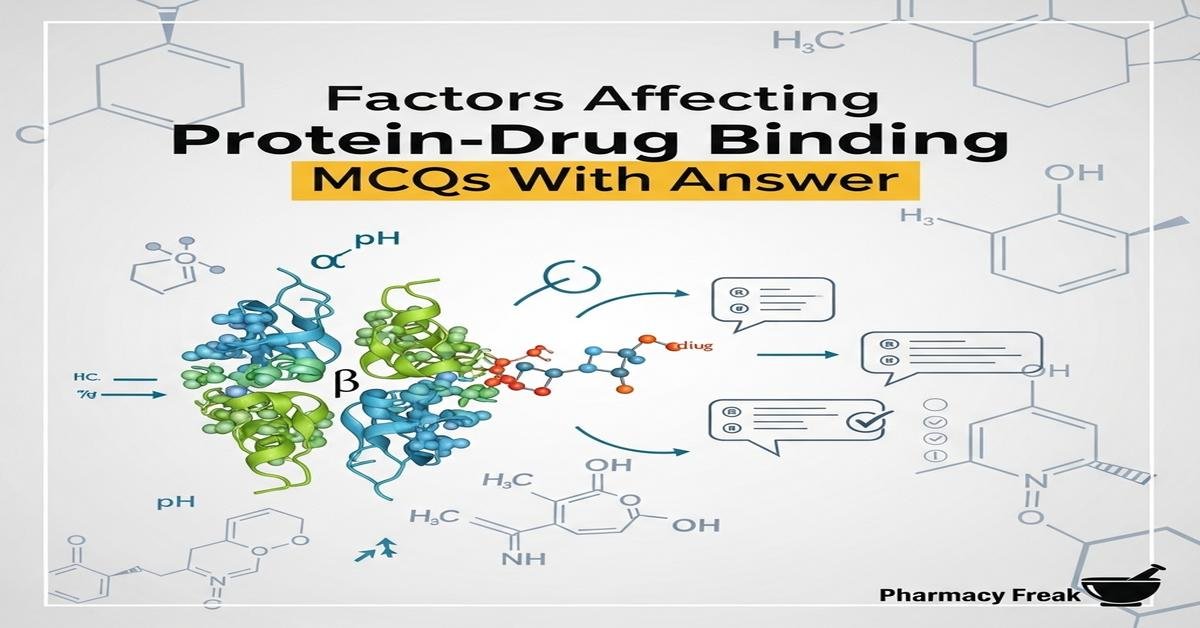
Factors affecting protein–drug binding MCQs With Answer

Factors affecting protein–drug binding MCQs With Answer

Understanding factors affecting protein–drug binding is essential for B.Pharm students because plasma protein binding critically influences pharmacokinetics, pharmacodynamics, and drug interactions. This overview emphasizes key keywords: protein–drug binding, plasma protein binding, albumin, alpha-1-acid glycoprotein, binding affinity, association/dissociation constants, unbound drug fraction, displacement interactions, volume of distribution, clearance, equilibrium dialysis, and ultrafiltration. We discuss how drug … Read more

Plasma and tissue protein binding of drugs MCQs With Answer

Plasma and tissue protein binding of drugs MCQs With Answer

Introduction Plasma and tissue protein binding of drugs is a key topic in pharmacokinetics and pharmacology for B. Pharm students. Understanding plasma protein binding, primarily to albumin and alpha-1 acid glycoprotein, and tissue binding to lipids, bone, and intracellular proteins helps predict free drug concentration, volume of distribution, clearance, and drug interactions. Concepts such as … Read more

Binding of drugs and apparent volume of distribution MCQs With Answer

Binding of drugs and apparent volume of distribution MCQs With Answer

Understanding binding of drugs and apparent volume of distribution (Vd) is essential for pharmacokinetics in B. Pharm students. Drug–protein binding, tissue binding and physicochemical properties determine the free fraction, distribution, and apparent Vd, influencing dosing, loading dose, half-life, and drug interactions. Key concepts include plasma protein binding (albumin, alpha-1-acid glycoprotein), Vd calculation (Vd = dose … Read more

Distribution of drugs and tissue permeability MCQs With Answer

Distribution of drugs and tissue permeability MCQs With Answer

Distribution of drugs and tissue permeability are core topics in pharmacokinetics for B.Pharm students. Mastery of concepts such as plasma protein binding, volume of distribution (Vd), blood–brain barrier, membrane permeability, partition coefficient, tissue binding, and pH-dependent ionization clarifies how drugs reach targets, accumulate, or form tissue reservoirs. Key determinants include organ blood flow, capillary type, … Read more

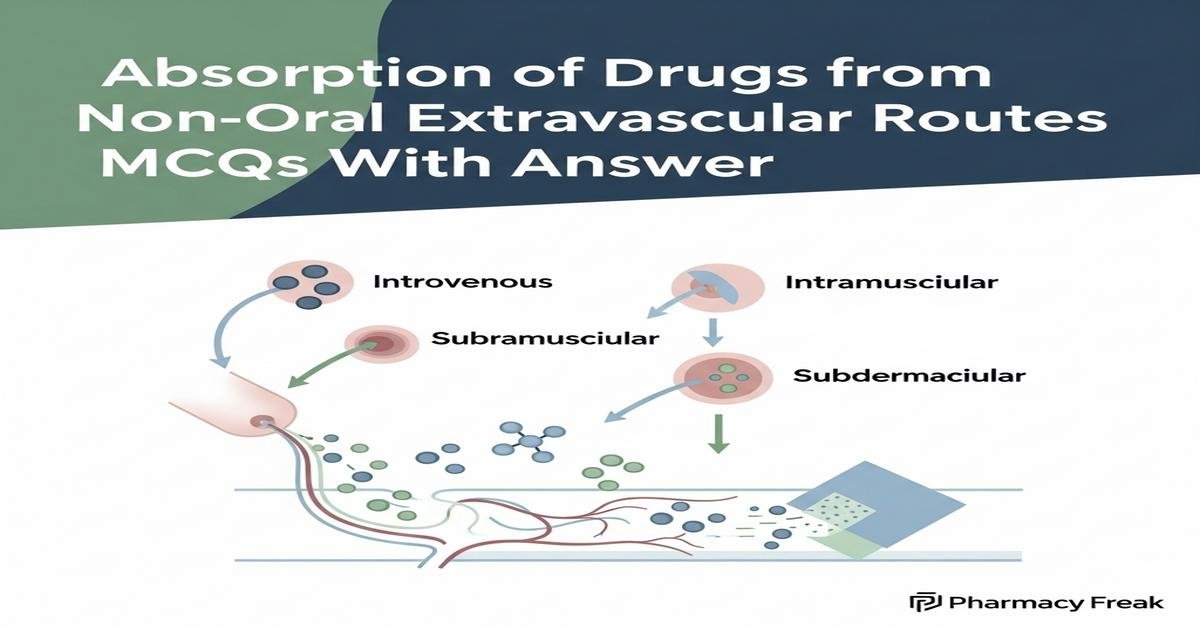
Absorption of drugs from non-oral extravascular routes MCQs With Answer

Absorption of drugs from non-oral extravascular routes MCQs With Answer

Absorption of drugs from non-oral extravascular routes is a vital area in pharmaceutics and pharmacokinetics for B.Pharm students. This topic covers how drugs enter systemic circulation when administered via routes such as transdermal, sublingual, buccal, nasal, pulmonary, rectal, vaginal, intramuscular, and subcutaneous. Key concepts include permeability barriers, Fick’s law, pKa and ionization, lipid solubility, blood … Read more

Factors influencing drug absorption through GIT MCQs With Answer

Factors influencing drug absorption through GIT MCQs With Answer

Introduction Understanding the factors influencing drug absorption through the GIT is essential for B.Pharm students. Drug absorption depends on physicochemical properties (solubility, pKa, lipophilicity/log P), formulation factors (particle size, salt form, excipients), physiological variables (gastric pH, gastric emptying, intestinal transit time, surface area, blood flow), and biological barriers (first‑pass metabolism, P‑glycoprotein efflux, intestinal enzymes). Concepts … Read more

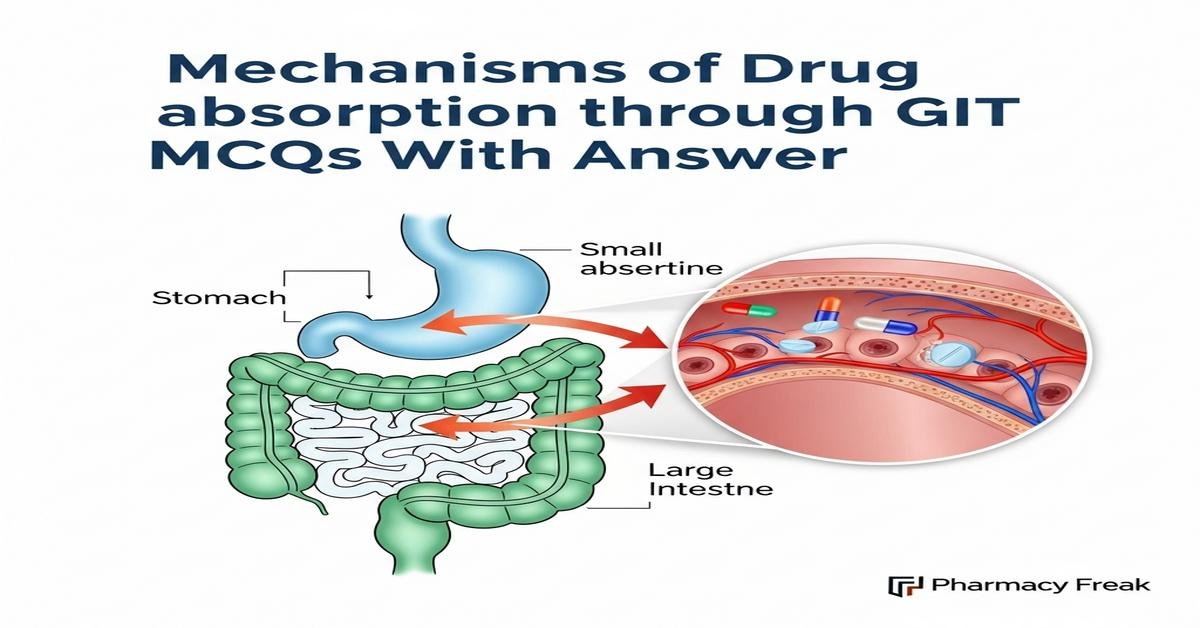
Mechanisms of drug absorption through GIT MCQs With Answer

Mechanisms of drug absorption through GIT MCQs With Answer

Mechanisms of drug absorption through GIT MCQs With Answer Understanding drug absorption mechanisms across the gastrointestinal tract is essential for B. Pharm students designing effective oral therapies. This concise guide covers passive transcellular and paracellular diffusion, carrier-mediated uptake, endocytosis, lymphatic transport, and the impact of pH-partitioning, surface area, gastric emptying, bile salts, efflux transporters (e.g., … Read more

Introduction to Biopharmaceutics MCQs With Answer

Introduction to Biopharmaceutics MCQs With Answer

Introduction to Biopharmaceutics MCQs With Answer Biopharmaceutics explores how drug formulation, dosage form and physiological factors influence drug absorption, distribution, metabolism and excretion. This concise MCQ set for B.Pharm students emphasizes key concepts such as bioavailability, pharmacokinetics, dissolution (Noyes-Whitney), permeability, pKa and ionization, the Biopharmaceutics Classification System (BCS), first-pass metabolism, protein binding, and strategies to … Read more

PRO
Ad-Free Access
$3.99 / month
  • ✓ No Interruptions
  • ✓ Faster Page Loads
  • ✓ Support Content Creators