Trusted by 50K+ Pharmacy StudentsHigh Quality Notes, MCQs, Mock Tests & Study ResourcesGo Premium (Ads Free)
Pharmacy Freak

Methods to enhance dissolution rate and bioavailability of poorly soluble drugs MCQs With Answer
Methods to enhance dissolution rate and bioavailability of poorly soluble drugs MCQs With Answer

Introduction Improving the dissolution rate and bioavailability of poorly soluble drugs is a core challenge in pharmaceutics. B. Pharm students must understand solubility enhancement strategies such as particle size reduction, solid dispersions, amorphous conversion, salt formation, cyclodextrin complexation, surfactants, lipid-based formulations (SEDDS/SMEDDS), and nanotechnology. Key concepts include BCS classification, wettability, dissolution testing, permeability interplay, and … Read more

Bioequivalence studies and regulatory aspects MCQs With Answer

Bioequivalence studies and regulatory aspects MCQs With Answer

Bioequivalence studies and regulatory aspects MCQs With Answer Bioequivalence studies assess whether two drug products (usually a generic and a reference) have comparable pharmacokinetics — mainly AUC and Cmax — ensuring equivalent rate and extent of absorption. B.Pharm students should understand study designs (crossover, replicate), statistical concepts (log-transformation, 90% CI, TOST), regulatory criteria (80–125% limits, … Read more

In-vitro – in-vivo correlation (IVIVC) MCQs With Answer

In-vitro – in-vivo correlation (IVIVC) MCQs With Answer

Introduction: In-vitro–in-vivo correlation (IVIVC) is a predictive scientific approach that links in vitro dissolution data with in vivo bioavailability and pharmacokinetic responses. IVIVC concepts — including Level A, B, and C correlations, deconvolution, Wagner–Nelson and Loo–Riegelman methods — are central to biopharmaceutics and formulation development. Mastery of IVIVC helps B. Pharm students understand bioavailability, dissolution … Read more

In-vitro drug dissolution models MCQs With Answer

In-vitro drug dissolution models MCQs With Answer

Introduction: In-vitro drug dissolution models MCQs With Answer provide B.Pharm students a focused way to master dissolution testing principles, USP apparatus selection, dissolution media, and release kinetics. This concise guide emphasizes key concepts such as sink conditions, biorelevant media, discriminatory power, IVIVC, similarity factor (f2), and common kinetic models (zero-order, first-order, Higuchi, Korsmeyer-Peppas). Questions explore … Read more

Measurement of bioavailability MCQs With Answer

Measurement of bioavailability MCQs With Answer

Understanding measurement of bioavailability is essential for B.Pharm students focusing on pharmacokinetics, drug development, and therapeutic optimization. This topic covers principles and methods used to quantify the fraction and rate of drug absorbed into systemic circulation, including key parameters such as AUC, Cmax, Tmax, and absolute versus relative bioavailability. You will learn sampling strategies, analytical … Read more

Absolute and relative bioavailability MCQs With Answer

Absolute and relative bioavailability MCQs With Answer

Introduction Understanding absolute and relative bioavailability is essential for B. Pharm students studying pharmacokinetics, formulation development, and therapeutic drug monitoring. Absolute bioavailability quantifies the fraction of an administered dose reaching systemic circulation compared with an intravenous reference, using parameters like AUC, Cmax and Tmax. Relative bioavailability compares two non‑intravenous formulations or routes, informing bioequivalence and … Read more

Bioavailability – definition, objectives and importance MCQs With Answer

Bioavailability – definition, objectives and importance MCQs With Answer

Bioavailability is a core pharmacokinetic parameter that defines the fraction of an administered dose reaching systemic circulation intact. For B. Pharm students, mastering its definition, objectives—such as assessing absorption, formulation performance and therapeutic equivalence—and clinical importance in dose design, drug development and regulatory approval is essential. Key concepts include routes of administration, absorption rate and … Read more

Non-renal routes of drug excretion MCQs With Answer

Non-renal routes of drug excretion MCQs With Answer

Non-renal routes of drug excretion MCQs With Answer Non-renal routes of drug excretion encompass biliary, faecal, pulmonary, salivary, sweat, breast milk, dermal and other minor pathways essential for comprehensive pharmacokinetics. Topics include mechanisms (biliary secretion, enterohepatic recycling, pulmonary exhalation, ion trapping in saliva and milk), determinants (molecular weight, lipophilicity, plasma protein binding, transporters like OATP, … Read more

Factors affecting renal excretion of drugs MCQs With Answer

Factors affecting renal excretion of drugs MCQs With Answer

Introduction: Understanding the factors affecting renal excretion of drugs is essential for B. Pharm students studying pharmacokinetics, dose adjustment, and drug safety. Key concepts include glomerular filtration rate (GFR), tubular secretion and reabsorption, plasma protein binding, drug ionization (pKa), urinary pH, renal blood flow, transporters (OAT, OCT, MATE), and drug–drug interactions. Pathophysiological conditions—age, renal impairment, … Read more

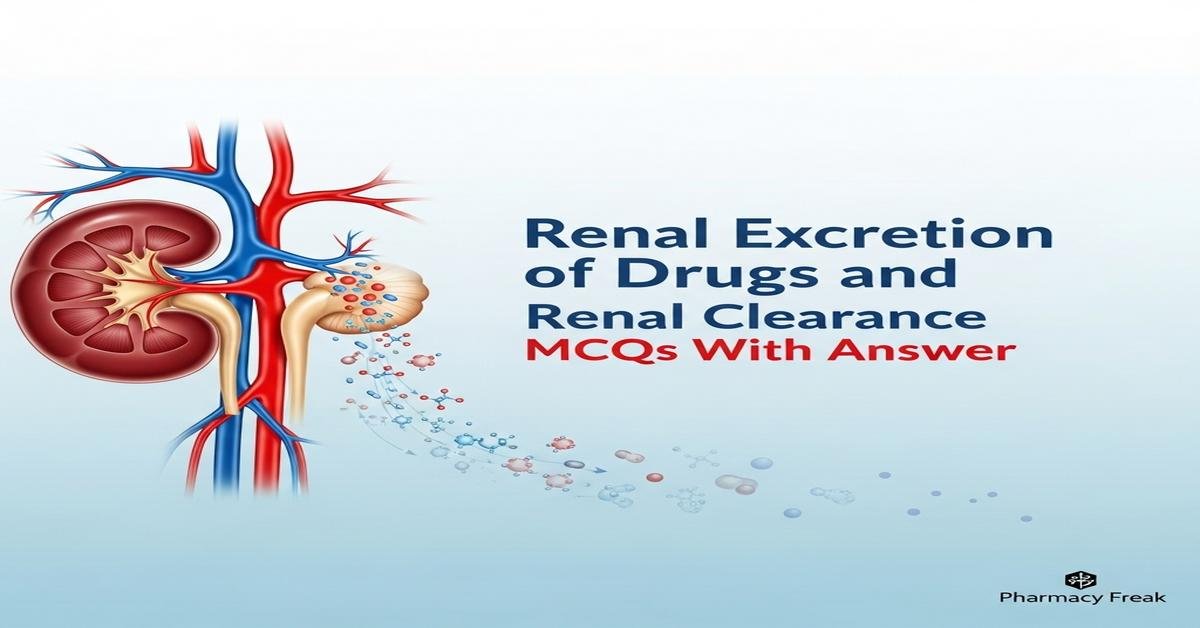
Renal excretion of drugs and renal clearance MCQs With Answer

Renal excretion of drugs and renal clearance MCQs With Answer

Introduction: Renal excretion of drugs and renal clearance are central topics in pharmacokinetics for B.Pharm students. Understanding glomerular filtration, tubular secretion, and tubular reabsorption explains how drugs and metabolites are removed by the kidney. Key concepts include renal clearance calculations, creatinine clearance as a GFR estimator, renal plasma flow, transporter-mediated secretion (OAT/OCT), urine pH effects, … Read more

PRO
Ad-Free Access
$3.99 / month
  • ✓ No Interruptions
  • ✓ Faster Page Loads
  • ✓ Support Content Creators