Trusted by 50K+ Pharmacy StudentsHigh Quality Notes, MCQs, Mock Tests & Study ResourcesGo Premium (Ads Free)
Pharmacy Freak

SOPs, health and hygiene, documentation and records in herbal industry MCQs With Answer

SOPs, health and hygiene, documentation and records in herbal industry MCQs With Answer

Introduction The herbal industry demands strict adherence to SOPs, health and hygiene, documentation, and records to ensure safe, consistent herbal medicines. For B.Pharm students, understanding Good Manufacturing Practices (GMP), Good Agricultural and Collection Practices (GACP), controlled documents, master batch records, traceability, and cleaning and sanitation SOPs is essential. Proper personnel hygiene, PPE use, training records, … Read more


Components of GMP – infrastructural requirements, working space, storage area, machinery and equipment MCQs With Answer

Components of GMP – infrastructural requirements, working space, storage area, machinery and equipment MCQs With Answer

Understanding the components of GMP — infrastructural requirements, working space, storage area, and machinery and equipment — is essential for B. Pharm students preparing for roles in pharmaceutical production and quality assurance. This concise introduction covers design and layout principles, controlled clean rooms, HVAC systems, pressure differentials, non-shedding finishes, secured and temperature‑controlled storage, segregation of … Read more

Schedule T – Good Manufacturing Practice for Indian Systems of Medicine MCQs With Answer

Schedule T – Good Manufacturing Practice for Indian Systems of Medicine MCQs With Answer

Introduction: Schedule T outlines the Good Manufacturing Practice (GMP) requirements for Indian Systems of Medicine, including Ayurveda, Siddha, and Unani. This guideline emphasizes quality assurance, documentation, sanitation, validated manufacturing processes, qualified personnel, raw material control, in-process checks, and finished product testing to ensure safety, efficacy, and consistency of traditional formulations. B.Pharm students must understand premises, … Read more

Overview of plant-based industries and institutions working on medicinal and aromatic plants in India MCQs With Answer

Overview of plant-based industries and institutions working on medicinal and aromatic plants in India MCQs With Answer

The study of medicinal and aromatic plants (MAPs) bridges pharmacognosy, phytochemistry, cultivation, conservation, and industry. This overview introduces plant-based industries, research institutions, regulatory bodies, quality control practices, and value-chain issues in India — including cultivation, germplasm conservation, bioprospecting, standardization, and export. Key keywords include medicinal and aromatic plants, MAPs, CIMAP, NMPB, NBPGR, GACP, phytochemical standardization, … Read more

Herbal drug industry – current scenario, scope and future prospects MCQs With Answer

Herbal drug industry – current scenario, scope and future prospects MCQs With Answer

Herbal drug industry – current scenario, scope and future prospects MCQs With Answer The herbal drug industry is rapidly evolving, driven by growing global demand for phytopharmaceuticals, traditional medicines and herbal formulations. B. Pharm students must understand the current scenario, regulatory frameworks (WHO, CDSCO, AYUSH, FDA botanical guidance), quality control, standardization techniques (HPLC, HPTLC, GC-MS, … Read more

Regulations for manufacture of ASU drugs – Schedule Z of Drugs & Cosmetics Act MCQs With Answer

Regulations for manufacture of ASU drugs – Schedule Z of Drugs & Cosmetics Act MCQs With Answer

Regulations for manufacture of ASU drugs – Schedule Z of Drugs & Cosmetics Act is a vital area for B. Pharm students studying quality, compliance and manufacturing of traditional systems. This introduction covers scope, licensing, Good Manufacturing Practices (GMP), documentation, labeling and reference standards such as the Ayurvedic Pharmacopoeia of India. Familiarity with State and … Read more

Regulatory authorities in India – ASU DTAB and ASU DCC MCQs With Answer

Regulatory authorities in India – ASU DTAB and ASU DCC MCQs With Answer

Regulatory authorities in India – ASU DTAB and ASU DCC MCQs With Answer Understanding regulatory authorities in India is essential for B. Pharm students, especially the roles of ASU DTAB and ASU DCC in Ayurveda, Siddha and Unani (ASU) drug governance. This introduction covers legal framework, advisory functions, coordination between central and state drug control … Read more

Patenting of traditional knowledge and natural products – case study of Curcuma and Neem MCQs With Answer

Patenting of traditional knowledge and natural products – case study of Curcuma and Neem MCQs With Answer

Patenting of traditional knowledge and natural products examines how intellectual property law intersects with biodiversity, indigenous knowledge and pharmaceutical development. This concise introduction covers core keywords: patenting, traditional knowledge, natural products, Curcuma (turmeric), Neem (Azadirachta indica), biopiracy, prior art, novelty, inventive step, disclosure of origin, benefit-sharing, TKDL, TRIPS and national patent laws. For B. Pharm … Read more

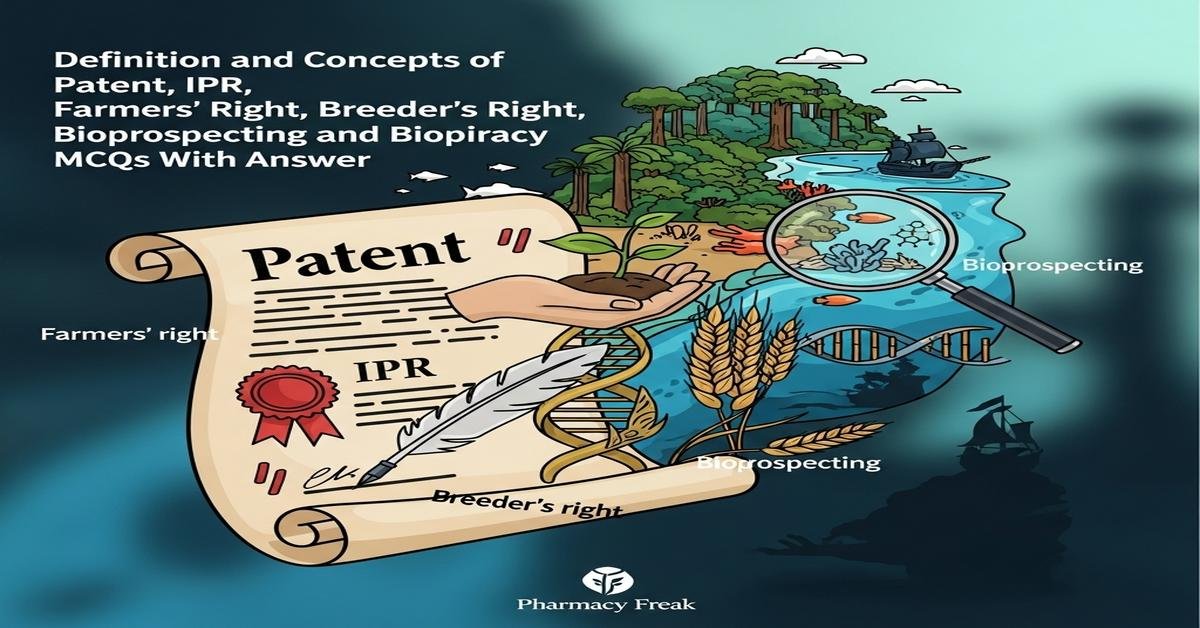
Definition and concepts of Patent, IPR, Farmers’ right, Breeder’s right, Bioprospecting and Biopiracy MCQs With Answer

Definition and concepts of Patent, IPR, Farmers’ right, Breeder’s right, Bioprospecting and Biopiracy MCQs With Answer

Introduction: This concise guide introduces key concepts in intellectual property relevant to pharmacy: Patent basics, broader IPR (intellectual property rights), Farmers’ right and Breeder’s right, plus ethical and legal issues in Bioprospecting and Biopiracy. B. Pharm students will learn patentability criteria, claim scope, disclosure and enforcement, plant variety protection, benefit-sharing, traditional knowledge protection, and international … Read more

Stability testing of herbal drugs – principles and procedures MCQs With Answer

Stability testing of herbal drugs – principles and procedures MCQs With Answer

Stability testing of herbal drugs is essential to ensure safety, efficacy, and consistent quality of herbal formulations. B.Pharm students must learn core principles such as degradation pathways (hydrolysis, oxidation, photodegradation), stability-indicating methods, forced degradation studies, and relevant guidelines like ICH and WHO for storage conditions. Practical procedures include accelerated and long-term studies, packaging evaluation, moisture … Read more

PRO
Ad-Free Access
$3.99 / month
  • ✓ No Interruptions
  • ✓ Faster Page Loads
  • ✓ Support Content Creators