Trusted by 50K+ Pharmacy StudentsHigh Quality Notes, MCQs, Mock Tests & Study ResourcesGo Premium (Ads Free)
Pharmacy Freak

Ion exchange chromatography – introduction and classification MCQs With Answer
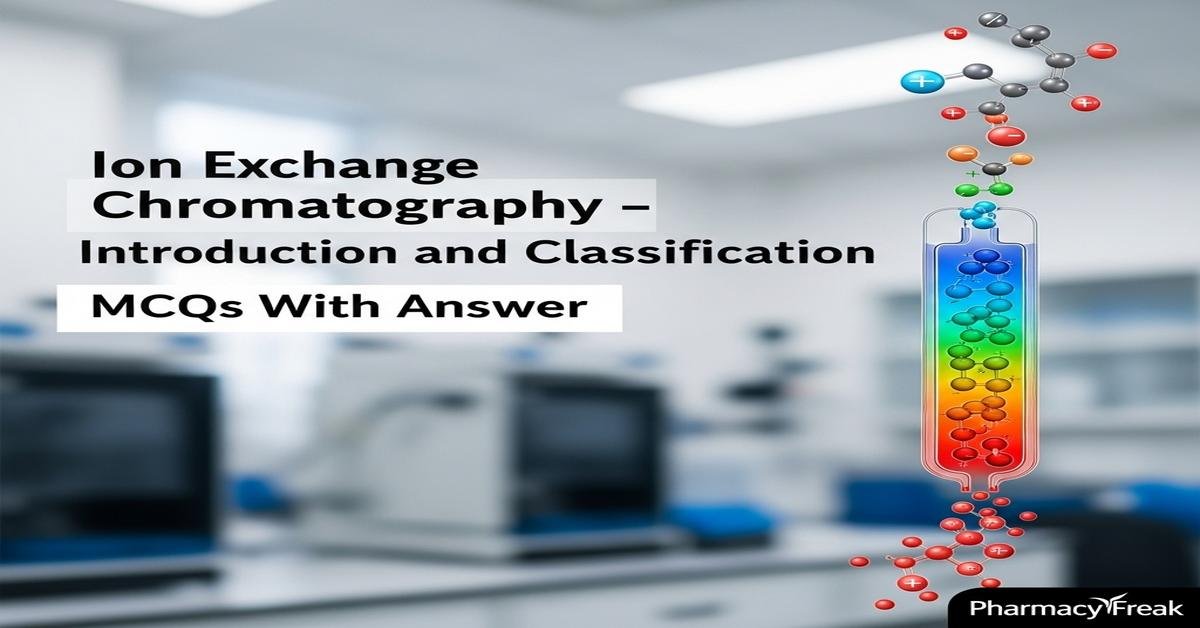
Ion exchange chromatography – introduction and classification MCQs With Answer

Ion exchange chromatography is a core separation technique in pharmaceutical analysis that separates molecules by charge using charged stationary phases (resins). In B. Pharm labs it’s essential for protein and peptide purification, drug impurity profiling, formulation characterization, and quality control. Key concepts include stationary phase chemistry (strong vs weak exchangers), functional groups (sulfonic, carboxylic, quaternary … Read more
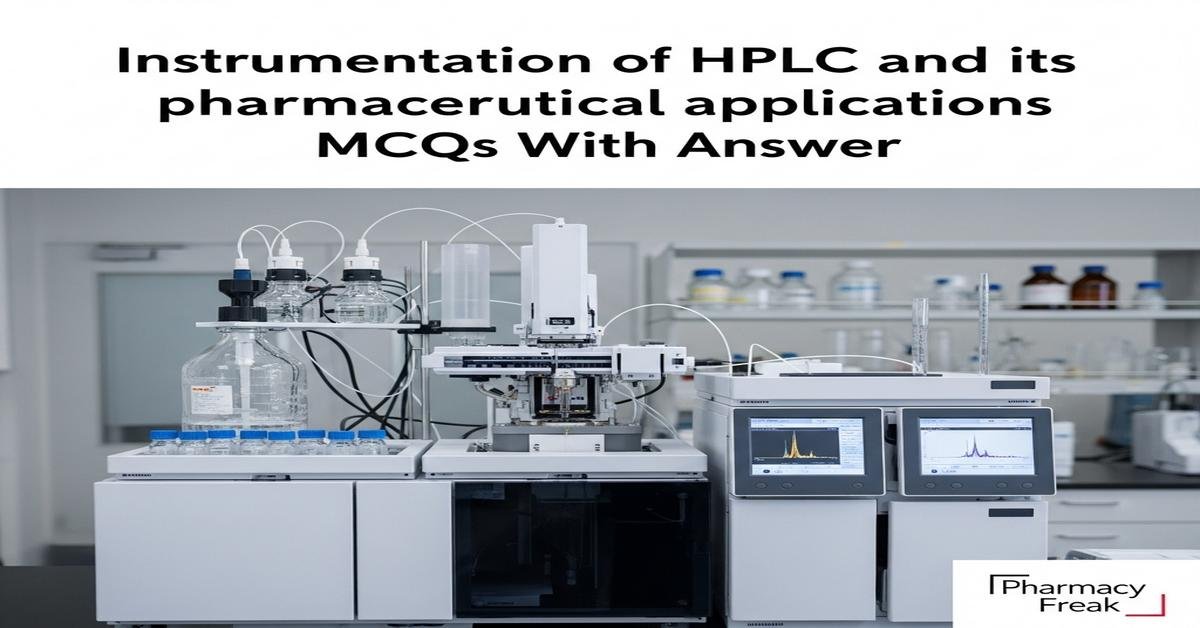
Instrumentation of HPLC and its pharmaceutical applications MCQs With Answer

Instrumentation of HPLC and its pharmaceutical applications MCQs With Answer

Introduction: Instrumentation of HPLC and its pharmaceutical applications MCQs With Answer provides B.Pharm students with a practical, focused review of high-performance liquid chromatography (HPLC) instrumentation, detectors, columns, mobile phases, and method validation. This introduction covers essential keywords such as HPLC, chromatography, stationary phase, mobile phase, pumps, detectors (UV, PDA, RID, MS), system suitability, assay, impurity … Read more

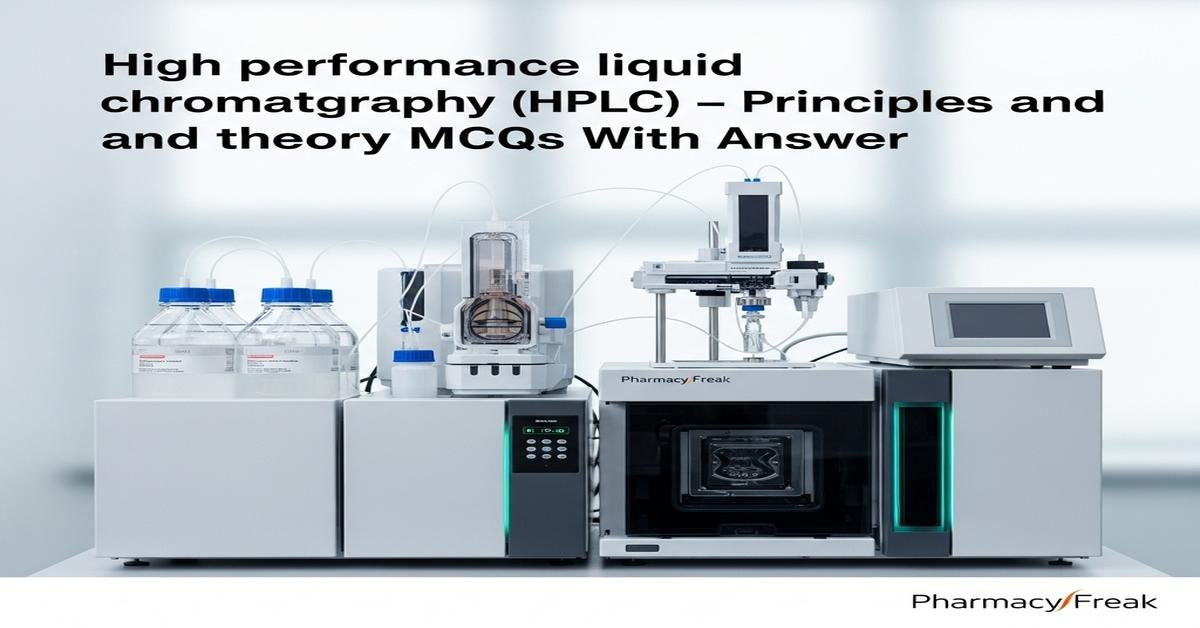
High performance liquid chromatography (HPLC) – principles and theory MCQs With Answer

High performance liquid chromatography (HPLC) – principles and theory MCQs With Answer

High performance liquid chromatography (HPLC) is an essential analytical technique for B. Pharm students, focusing on separation, identification, and quantification of pharmaceutical compounds. This introduction covers core principles and chromatographic theory: mobile phase and stationary phase interactions, retention time, capacity factor (k′), selectivity (α), resolution, column efficiency (N), van Deemter theory, isocratic and gradient elution, … Read more

Advantages, limitations and pharmaceutical applications of GC MCQs With Answer

Advantages, limitations and pharmaceutical applications of GC MCQs With Answer

Introduction: Gas chromatography (GC) is a core analytical technique in pharmaceutical analysis, providing high resolution, sensitivity and rapid separation of volatile and semi-volatile compounds. This overview covers the advantages (speed, selectivity, quantitative accuracy, automation), limitations (inability to analyze non‑volatile or thermally labile compounds without derivatization, matrix interferences, limited chiral separation) and key pharmaceutical applications such … Read more

Derivatization techniques and temperature programming in GC MCQs With Answer

Derivatization techniques and temperature programming in GC MCQs With Answer

Derivatization techniques and temperature programming in GC are essential topics for B. Pharm students learning gas chromatography (GC) and GC‑MS. Derivatization (silylation, acylation, alkylation) improves volatility, thermal stability, and detectability of polar drugs and metabolites; common reagents include BSTFA, MSTFA, TMCS and BSA. Temperature programming (initial temp, ramp rate, hold time, final temp) optimizes separation … Read more

Gas chromatography – introduction, theory and instrumentation MCQs With Answer

Gas chromatography – introduction, theory and instrumentation MCQs With Answer

Gas chromatography (GC) is an essential analytical technique in pharmaceutical analysis, used for separation, identification, and quantitation of volatile and semi-volatile compounds. This introduction covers GC theory — retention time, partitioning, adsorption, capacity factor (k’), plate theory (HETP, number of theoretical plates) and the Van Deemter relationship — and instrumentation — injector types, capillary and … Read more

Applications of electrophoresis in drug analysis MCQs With Answer

Applications of electrophoresis in drug analysis MCQs With Answer

Introduction Electrophoresis is a vital analytical tool in drug analysis, widely used in pharmaceutical quality control, impurity profiling, formulation studies and forensic investigations. B.Pharm students should master capillary electrophoresis (CE), gel techniques (SDS-PAGE, native PAGE, agarose), isoelectric focusing (IEF) and hyphenated methods like CE-MS for the separation and identification of small molecules, peptides and protein … Read more

Techniques of paper, gel and capillary electrophoresis MCQs With Answer

Techniques of paper, gel and capillary electrophoresis MCQs With Answer

Introduction: Paper, gel and capillary electrophoresis are essential separation techniques in pharmaceutical analysis, used for resolving proteins, nucleic acids, small ions and drug enantiomers. This concise guide for B. Pharm students covers principles of electrophoretic mobility, buffer systems, matrix sieving (agarose, polyacrylamide), capillary formats, electroosmotic flow, staining and detection (UV, fluorescence, MS). Emphasis is placed … Read more

Electrophoresis – basic concepts and electrophoretic mobility MCQs With Answer

Electrophoresis – basic concepts and electrophoretic mobility MCQs With Answer

Electrophoresis – basic concepts and electrophoretic mobility MCQs With Answer Electrophoresis is a core analytical technique in pharmaceutical sciences used for separation and characterization of charged biomolecules. B.Pharm students should understand electrophoretic mobility, electric field effects, buffer selection, zeta potential, and gel matrices like agarose and polyacrylamide. Key concepts include mobility (µ = v/E), electroosmotic … Read more

Paper chromatography – principle, development techniques and applications MCQs With Answer

Paper chromatography – principle, development techniques and applications MCQs With Answer

Paper chromatography is a classical analytical technique that separates components by the principle of partition between a liquid mobile phase and the thin aqueous layer adsorbed on cellulose paper as the stationary phase. Widely used in pharmaceutical analysis, it employs development techniques such as ascending, descending, horizontal and radial chromatography; choice of solvent system, chamber … Read more

PRO
Ad-Free Access
$3.99 / month
  • ✓ No Interruptions
  • ✓ Faster Page Loads
  • ✓ Support Content Creators