Trusted by 50K+ Pharmacy StudentsHigh Quality Notes, MCQs, Mock Tests & Study ResourcesGo Premium (Ads Free)
Pharmacy Freak

Personnel and space requirements for pilot plant MCQs With Answer
Personnel and space requirements for pilot plant MCQs With Answer

Introduction: In a pilot plant, clear personnel requirements and precise space planning ensure safe, compliant small-scale manufacturing and reliable scale-up. B.Pharm students should learn personnel roles, training, gowning, competency, and GMP responsibilities alongside layout topics such as segregation, cleanroom classification, HVAC, utilities, material and personnel flow, and documentation. Detailed space requirements include unit operations, sampling … Read more
Concept and importance of pilot plant and scale-up techniques MCQs With Answer

Concept and importance of pilot plant and scale-up techniques MCQs With Answer

Pilot plant and scale-up techniques are essential in pharmaceutical manufacturing, linking bench-top research to commercial production. For B.Pharm students, mastering pilot-scale design, process development, formulation transfer, and scale-up strategies ensures consistent drug quality, safety, and regulatory compliance. Important keywords include pilot plant, scale-up techniques, process optimization, process validation, mixing, heat and mass transfer, residence time, … Read more

Introduction to Industrial Pharmacy II MCQs With Answer

Introduction to Industrial Pharmacy II MCQs With Answer

This collection of Industrial Pharmacy II MCQs with answers is tailored for B.Pharm students to strengthen knowledge of pharmaceutical manufacturing, unit operations, aseptic processing, sterilization, validation and packaging. Covering granulation, drying, compression, coating, sterile production, cleanroom classifications, GMP, quality control, stability testing and scale-up, these questions balance theory with practical production scenarios. Emphasis is on … Read more

Applications of affinity chromatography in biopharmaceutical analysis MCQs With Answer

Applications of affinity chromatography in biopharmaceutical analysis MCQs With Answer

Introduction Affinity chromatography is a powerful, selective technique widely used in biopharmaceutical analysis for purification, characterization, and quality control of proteins, antibodies, enzymes and biotherapeutics. B. Pharm students should understand ligand–target interactions, resin selection, affinity tags (e.g., His‑tag), Protein A/G, lectins, immobilization chemistry, elution strategies, dynamic binding capacity, and common problems like ligand leaching and … Read more

Affinity chromatography – principle, theory and instrumentation MCQs With Answer

Affinity chromatography – principle, theory and instrumentation MCQs With Answer

Affinity chromatography – principle, theory and instrumentation MCQs With Answer Affinity chromatography is a powerful bioseparation technique that isolates target biomolecules using specific biospecific interactions between an immobilized ligand and its target. B. Pharm students should understand the principle, binding theory, common matrices (agarose, sepharose), coupling chemistries (CNBr, glutaraldehyde), elution strategies (pH shift, competitive ligand, … Read more

Applications of gel filtration chromatography in pharmaceuticals MCQs With Answer

Applications of gel filtration chromatography in pharmaceuticals MCQs With Answer

Introduction: Gel filtration chromatography, also known as size-exclusion chromatography (SEC), is a vital technique in pharmaceutical analysis for separating molecules by size. B. Pharm students should understand how porous gel beads (e.g., Sephadex, Sephacryl) fractionate proteins, peptides, polymers, and drug aggregates without altering biological activity. Key applications include desalting, buffer exchange, removal of aggregates, molecular … Read more

Gel chromatography – principle, theory and instrumentation MCQs With Answer

Gel chromatography – principle, theory and instrumentation MCQs With Answer

Gel chromatography, also called size-exclusion chromatography (SEC) or gel filtration, separates molecules by size using porous stationary phases. This introduction explains the principle and theory—pore size, exclusion limit, partition coefficient (Kav), elution volume, void and total column volumes—and describes instrumentation such as columns, gels (Sephadex, agarose, polyacrylamide), pumps, detectors and fraction collectors. Practical considerations for … Read more

Applications of ion exchange chromatography MCQs With Answer

Applications of ion exchange chromatography MCQs With Answer

Ion exchange chromatography (IEC) is a fundamental separation technique in pharmaceutical analysis, widely used for drug purification, protein separation, and formulation development. B. Pharm students should learn about ion-exchange resins, strong and weak cation and anion exchangers, buffer selection, pH effects, selectivity, capacity, and elution strategies to apply IEC effectively in quality control, impurity removal, … Read more

Factors affecting ion exchange process and methodology MCQs With Answer

Factors affecting ion exchange process and methodology MCQs With Answer

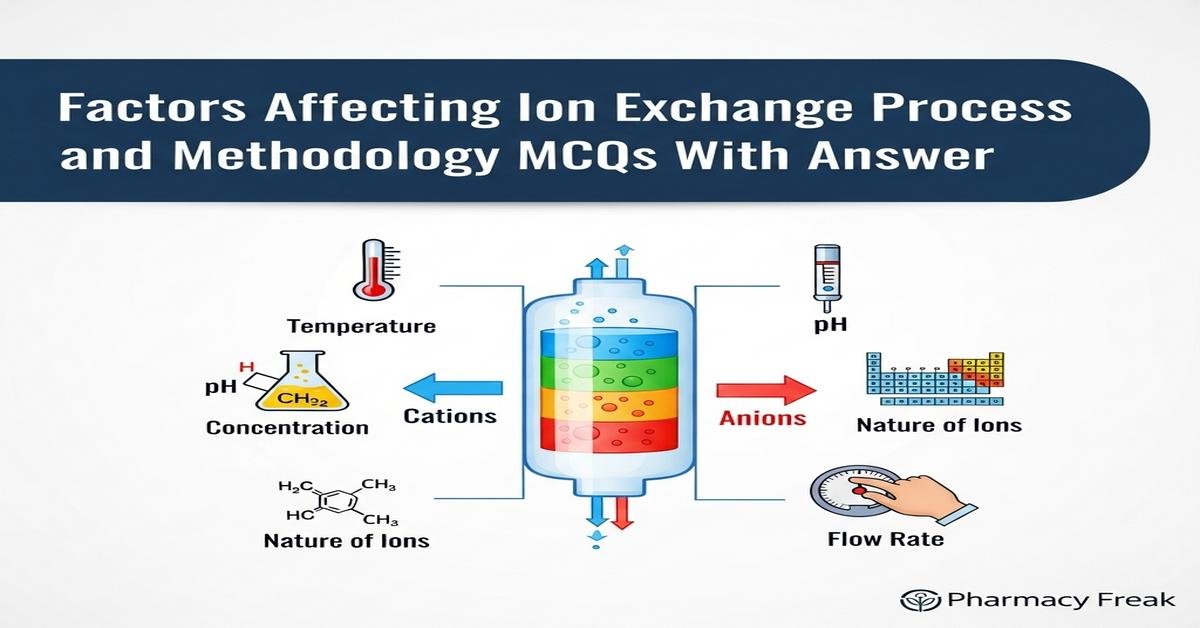
Introduction Ion exchange is a vital separation technique in pharmaceutical analysis and formulation. Understanding factors affecting ion exchange — such as resin type, functional groups, exchange capacity, selectivity, pH, ionic strength, temperature, flow rate and bead porosity — helps B. Pharm students optimize the ion exchange process and methodology. Practical knowledge of column packing, regeneration, … Read more

Ion exchange resins – properties and mechanism MCQs With Answer

Ion exchange resins – properties and mechanism MCQs With Answer

Introduction: Ion exchange resins are crosslinked polymeric beads (commonly polystyrene‑divinylbenzene) bearing ionizable functional groups that exchange ions with surrounding media. Key properties include exchange capacity (meq/g), selectivity, degree of crosslinking, water uptake, kinetics, and stability. Mechanistically, ion exchange proceeds by reversible equilibrium influenced by charge, hydrated radius, pH, ionic strength, and Donnan effects. In pharmaceutics, … Read more

PRO
Ad-Free Access
$3.99 / month
  • ✓ No Interruptions
  • ✓ Faster Page Loads
  • ✓ Support Content Creators