
Physical distribution management – objectives and tasks MCQs With Answer
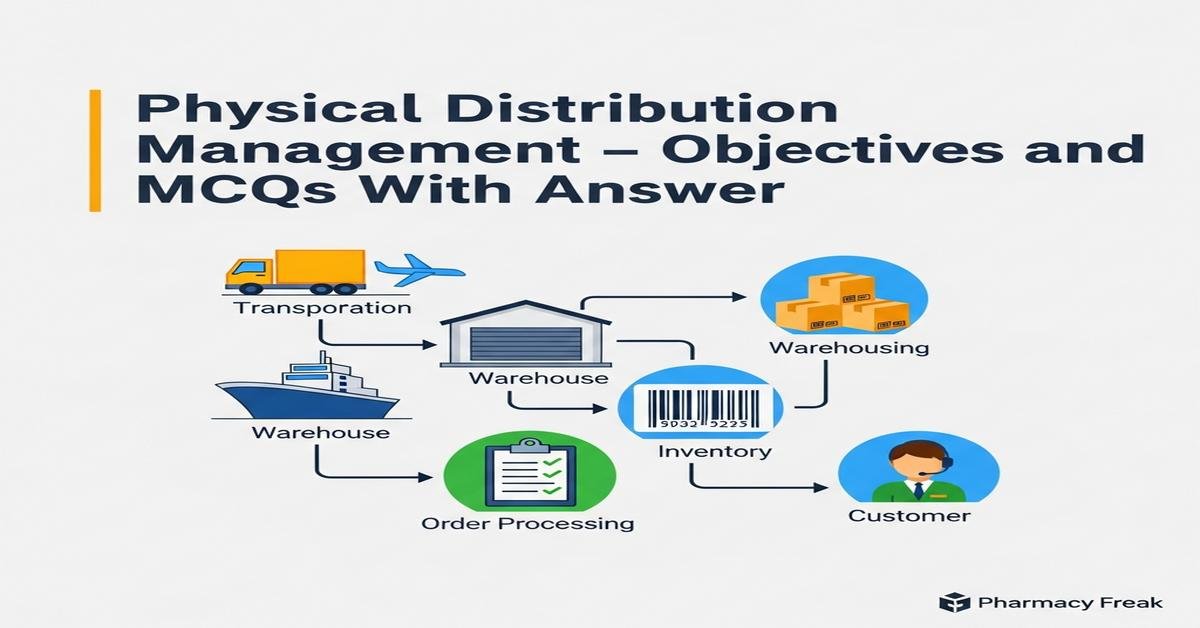
Physical distribution management in the pharmaceutical sector covers planning and controlling the movement and storage of medicines from manufacturer to patient. For B.Pharm students, understanding objectives — such as minimizing cost, ensuring timely delivery, maintaining product integrity, regulatory compliance, and maximizing customer service — is essential. Key tasks include inventory control, warehousing, temperature-controlled transport (cold chain), order processing, packaging, documentation, and returns management. Familiarity with logistics concepts like supply chain management, distribution channels, GDP (Good Distribution Practice), and traceability prepares students for real-world pharmacy operations. Now let’s test your knowledge with 30 MCQs on this topic.
Q1. Which is the primary objective of physical distribution management in pharmaceuticals?
- Maximizing manufacturing output regardless of delivery
- Minimizing total distribution cost while ensuring timely and safe delivery
- Eliminating all inventory in the supply chain
- Reducing product development time
Correct Answer: Minimizing total distribution cost while ensuring timely and safe delivery
Q2. What task ensures medicines maintain efficacy during transport?
- Demand forecasting
- Quality assurance testing
- Cold chain management
- Market research
Correct Answer: Cold chain management
Q3. Which document is most critical for tracking batch-level pharmaceutical shipments?
- Invoice
- Batch traceability record (batch traceability log)
- Marketing brochure
- Purchase order
Correct Answer: Batch traceability record (batch traceability log)
Q4. In warehousing, what does FIFO stand for and why is it used?
- First In First Out; to rotate stock and prevent expiry
- Fast In Fast Out; to speed operations
- First In Fast Out; to prioritize new stock
- Full Inventory, Fast Order; to reduce paperwork
Correct Answer: First In First Out; to rotate stock and prevent expiry
Q5. Which KPI measures the percentage of customer orders delivered on time and in full?
- Cycle time
- OTIF (On Time In Full)
- Fill rate
- Return rate
Correct Answer: OTIF (On Time In Full)
Q6. What is a major regulatory requirement for pharmaceutical distribution?
- Good Distribution Practice (GDP)
- ISO 9000 certification only for marketing
- Patent registration
- Consumer ratings
Correct Answer: Good Distribution Practice (GDP)
Q7. Which transportation mode is preferred for rapid, high-value pharmaceutical shipments?
- Sea freight
- Air freight
- Rail freight
- Pipeline transport
Correct Answer: Air freight
Q8. What is the main benefit of using 3PL (third-party logistics) in pharma distribution?
- Control every internal process directly
- Access to specialized logistics expertise and infrastructure
- Reduce product potency
- Avoid regulatory compliance
Correct Answer: Access to specialized logistics expertise and infrastructure
Q9. Which inventory method helps determine safety stock to avoid stockouts?
- Economic Order Quantity (EOQ) without safety margin
- Reorder point calculation including lead time variability
- Random ordering
- Just-in-case without demand data
Correct Answer: Reorder point calculation including lead time variability
Q10. Why is packaging a critical task in pharmaceutical distribution?
- Only for advertising purposes
- To ensure product protection, stability, and regulatory compliance
- To increase shipment weight
- To complicate returns
Correct Answer: To ensure product protection, stability, and regulatory compliance
Q11. What is cross-docking and when is it useful in pharma distribution?
- Storing items long-term; useful for shelf-life extension
- Direct transfer from inbound to outbound transport; useful to reduce storage time for fast-moving products
- Customs clearance service; useful for imports only
- Batch testing procedure; useful before release
Correct Answer: Direct transfer from inbound to outbound transport; useful to reduce storage time for fast-moving products
Q12. Which task involves handling expired or damaged medicines?
- Order picking
- Reverse logistics and returns management
- Demand forecasting
- Product promotion
Correct Answer: Reverse logistics and returns management
Q13. Lead time in distribution refers to:
- Time taken for manufacturing validation only
- Time from order placement to delivery to the customer
- Time to advertise a product
- Time taken by regulators to approve a drug
Correct Answer: Time from order placement to delivery to the customer
Q14. Which practice improves traceability across the pharmaceutical distribution chain?
- Manual records with no centralization
- Implementing a logistics information system with batch-level tracking
- Using paper invoices only
- Reducing documentation
Correct Answer: Implementing a logistics information system with batch-level tracking
Q15. What task is focused on choosing the most efficient routes and carriers?
- Inventory auditing
- Transportation planning and routing
- Pharmacovigilance
- Product formulation
Correct Answer: Transportation planning and routing
Q16. Which objective addresses customer satisfaction in distribution?
- Minimizing employee training
- Ensuring order accuracy, timely delivery, and product integrity
- Maximizing warehouse clutter
- Prolonging lead times intentionally
Correct Answer: Ensuring order accuracy, timely delivery, and product integrity
Q17. What is the purpose of distribution network design?
- To complicate supply chain visibility
- To determine optimal number and location of warehouses and distribution centers
- To eliminate all intermediaries irrespective of cost
- To increase transit times
Correct Answer: To determine optimal number and location of warehouses and distribution centers
Q18. How does consolidation benefit pharmaceutical shipments?
- It increases per-unit freight cost
- It combines multiple small shipments to reduce overall transport cost and improve efficiency
- It delays deliveries for no reason
- It removes the need for temperature control
Correct Answer: It combines multiple small shipments to reduce overall transport cost and improve efficiency
Q19. Which task ensures compliance with regulations during cross-border distribution?
- Marketing campaign planning
- Customs documentation and regulatory clearance
- Label design alone
- Local sales promotions
Correct Answer: Customs documentation and regulatory clearance
Q20. What role does inventory segmentation (ABC analysis) play in pharmaceuticals?
- It disregards critical items
- It prioritizes inventory control efforts based on value and turnover
- It randomly assigns storage locations
- It removes the need for forecasting
Correct Answer: It prioritizes inventory control efforts based on value and turnover
Q21. Which metric indicates warehouse efficiency in order processing?
- Order pick accuracy and order cycle time
- Number of sales calls
- Total marketing spend
- Regulatory inspection frequency
Correct Answer: Order pick accuracy and order cycle time
Q22. What is hub-and-spoke distribution design useful for?
- Decentralizing all inventory to many small sites
- Centralizing inventory in hubs for consolidation and efficient last-mile delivery
- Eliminating last-mile delivery
- Bypassing quality checks
Correct Answer: Centralizing inventory in hubs for consolidation and efficient last-mile delivery
Q23. Why is documentation control a crucial task in pharmaceutical distribution?
- To enable accountability, traceability, and regulatory compliance
- To increase paperwork without purpose
- To hide batch information
- To slow down distribution intentionally
Correct Answer: To enable accountability, traceability, and regulatory compliance
Q24. Which action reduces risk of temperature excursions during transport?
- Ignoring packaging specifications
- Using validated temperature-controlled packaging and real-time monitoring
- Choosing the slowest shipping method
- Removing insulation from containers
Correct Answer: Using validated temperature-controlled packaging and real-time monitoring
Q25. What is a key task in ensuring product security during distribution?
- Open labeling of high-value shipments
- Implementing tamper-evident packaging, seals, and secure chain-of-custody
- Ignoring inventory discrepancies
- Using public transport for all shipments
Correct Answer: Implementing tamper-evident packaging, seals, and secure chain-of-custody
Q26. Which distribution channel is commonly used to reach community pharmacies?
- Direct-to-consumer mail only
- Wholesale distributors and pharmacy wholesalers
- Only hospital procurement
- Social media influencers
Correct Answer: Wholesale distributors and pharmacy wholesalers
Q27. What task involves forecasting demand to set replenishment schedules?
- Product labeling design
- Demand forecasting and inventory planning
- Regulatory submission writing
- Sales incentive planning
Correct Answer: Demand forecasting and inventory planning
Q28. Which approach helps manage returns of medicines safely and compliantly?
- Accept all returns without inspection
- Structured reverse logistics with quarantine, inspection, and disposition
- Dispose of all returns immediately
- Resell returns without checks
Correct Answer: Structured reverse logistics with quarantine, inspection, and disposition
Q29. How does route optimization impact pharmaceutical distribution costs?
- Increases fuel consumption intentionally
- Reduces transport time and fuel use, lowering overall distribution costs
- Has no effect on costs
- Only affects manufacturing cost
Correct Answer: Reduces transport time and fuel use, lowering overall distribution costs
Q30. What is a common task to ensure readiness for regulatory inspections in distribution?
- Ignoring record keeping
- Maintaining up-to-date SOPs, training records, and audit trails
- Removing temperature logs
- Delaying corrective actions indefinitely
Correct Answer: Maintaining up-to-date SOPs, training records, and audit trails


