
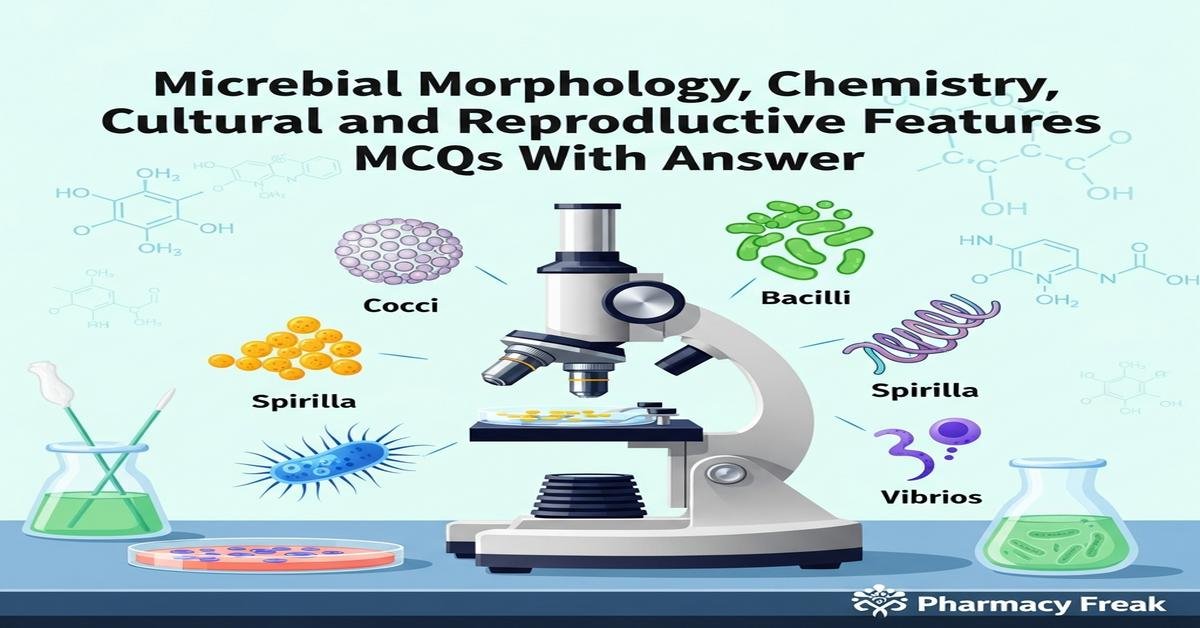
Introduction: This quiz collection on Microbial morphology, chemistry, cultural and reproductive features is tailored for M.Pharm students preparing for Microbial and Cellular Biology (MPB102T). It focuses on core structural traits of bacteria and fungi, the chemical composition of cell envelopes, growth and culture characteristics, and modes of reproduction. Questions reinforce understanding of diagnostic features, laboratory cultivation methods, and biologically relevant processes such as sporulation, budding, quorum sensing and biofilm formation. Practicing these MCQs will help students connect microbial form and chemistry to practical implications in pharmaceutical microbiology, including identification, sterilization, and antimicrobial targeting.
Q1. Which cellular arrangement is most characteristic of Staphylococcus species?
- Chains of cocci in linear arrangement
- Pairs of cocci (diplococci)
- Irregular clusters of cocci (grape-like)
- Tetrads of cocci
Correct Answer: Irregular clusters of cocci (grape-like)
Q2. The fundamental repeating disaccharide units in bacterial peptidoglycan are composed of which two sugars?
- N-acetylgalactosamine and glucuronic acid
- N-acetylmuramic acid and N-acetylglucosamine
- Glucose and fructose
- Ribose and deoxyribose
Correct Answer: N-acetylmuramic acid and N-acetylglucosamine
Q3. Which molecule is a defining component of the outer membrane of Gram-negative bacteria and is responsible for endotoxic activity?
- Teichoic acid
- Lipoprotein
- Lipopolysaccharide (LPS)
- Mycolic acid
Correct Answer: Lipopolysaccharide (LPS)
Q4. Teichoic acids are typically found in which part of bacterial cell architecture?
- Outer membrane of Gram-negative bacteria
- Capsule of encapsulated bacteria
- Cell membrane of archaea
- Cell wall of Gram-positive bacteria, anchored to peptidoglycan or membrane
Correct Answer: Cell wall of Gram-positive bacteria, anchored to peptidoglycan or membrane
Q5. Which structural component confers acid-fast staining properties to Mycobacterium species?
- High teichoic acid content
- Short-chain fatty acids in the membrane
- Long-chain mycolic acids in the cell envelope
- Thick peptidoglycan layer with O-acetylation
Correct Answer: Long-chain mycolic acids in the cell envelope
Q6. Which layers are correctly associated with a bacterial endospore structure?
- Capsule, slime layer, flagellum
- Core, cortex, spore coat, exosporium
- Inner membrane only
- Thylakoid, carboxysome, S-layer
Correct Answer: Core, cortex, spore coat, exosporium
Q7. What cellular machinery is essential for septum formation during bacterial binary fission?
- Actin filaments forming a contractile ring
- FtsZ protein polymerizing into a Z-ring at midcell
- Tubulin dimers forming microtubules
- Flagellar basal body proteins
Correct Answer: FtsZ protein polymerizing into a Z-ring at midcell
Q8. Which reproductive mode is typical for Saccharomyces cerevisiae when producing progeny from a mother cell?
- Binary fission with septation
- Budding with formation of a daughter bud
- Endospore formation
- Conidiospore formation on conidiophores
Correct Answer: Budding with formation of a daughter bud
Q9. Sporangiospores are characteristic of which fungal reproductive process?
- Sexual ascosporogenesis in Ascomycota
- External conidial formation by Aspergillus
- Internal spore formation within a sporangium as in Rhizopus
- Budding reproduction of yeasts
Correct Answer: Internal spore formation within a sporangium as in Rhizopus
Q10. Conidia differ from sporangiospores in that conidia are generally:
- Formed internally within a sac-like structure
- Motile spores with flagella
- Formed externally on specialized hyphae (conidiophores)
- Always sexual spores formed after meiosis
Correct Answer: Formed externally on specialized hyphae (conidiophores)
Q11. Mucoid colony appearance on agar is most directly associated with which microbial structure?
- Endospore-forming ability
- Presence of a polysaccharide capsule or heavy extracellular polysaccharide production
- High degree of cell filamentation
- Presence of flagella and motility
Correct Answer: Presence of a polysaccharide capsule or heavy extracellular polysaccharide production
Q12. Which sequence correctly lists the classical phases of a bacterial growth curve in batch culture?
- Lag, stationary, log (exponential), death
- Log (exponential), lag, stationary, death
- Lag, log (exponential), stationary, death
- Log (exponential), death, stationary, lag
Correct Answer: Lag, log (exponential), stationary, death
Q13. Generation time in microbiology is defined as:
- The time required for a single cell to undergo sporulation
- The time for a population to double in number during exponential growth
- The time bacteria survive in stationary phase
- The time taken for a colony to appear on solid media
Correct Answer: The time for a population to double in number during exponential growth
Q14. Which culture technique is primarily used for isolating single colonies from a mixed bacterial sample?
- Pour plate method for total viable counts
- Streak plate method for colony isolation
- Spread plate for antibiotic susceptibility testing
- Broth enrichment culture for enumeration
Correct Answer: Streak plate method for colony isolation
Q15. A facultative anaerobe is best described as an organism that:
- Requires oxygen for growth and cannot grow anaerobically
- Cannot tolerate oxygen and grows only anaerobically
- Grows both in the presence and absence of oxygen but often better with oxygen
- Only survives in microaerophilic conditions with very low oxygen
Correct Answer: Grows both in the presence and absence of oxygen but often better with oxygen
Q16. Which staining technique is most appropriate to differentiate bacteria based on the thickness of their peptidoglycan layer?
- Acid-fast staining
- Gram staining
- India ink negative staining
- Endospore staining
Correct Answer: Gram staining
Q17. Bacterial capsules are most commonly composed of which type of macromolecule?
- Polysaccharides in most species, with some polypeptide exceptions
- Phospholipids exclusively
- Peptidoglycan layers identical to the cell wall
- DNA and RNA bound together
Correct Answer: Polysaccharides in most species, with some polypeptide exceptions
Q18. Quorum sensing in Gram-negative bacteria frequently uses which class of signaling molecules?
- Peptidoglycan fragments
- Autoinducing N-acyl homoserine lactones (AHLs)
- Teichoic acid oligosaccharides
- Steroid hormones
Correct Answer: Autoinducing N-acyl homoserine lactones (AHLs)
Q19. The extracellular polymeric substance (EPS) of a biofilm typically contains which combination of components?
- Only lipids and metal ions
- Polysaccharides, extracellular DNA, and proteins
- Ribosomes and chromosomal DNA
- Mycolic acids and teichoic acids exclusively
Correct Answer: Polysaccharides, extracellular DNA, and proteins
Q20. In Bacillus species, initiation of sporulation is most commonly induced by which condition and regulated by which gene set?
- Abundant nutrients; regulated by ribosomal protein operons
- Exposure to oxygen; controlled by flagellar genes
- Nutrient limitation/starvation; regulated by Spo (sporulation) genes
- High osmolarity; regulated by porin genes
Correct Answer: Nutrient limitation/starvation; regulated by Spo (sporulation) genes

