Trusted by 50K+ Pharmacy StudentsHigh Quality Notes, MCQs, Mock Tests & Study ResourcesGo Premium (Ads Free)
Pharmacy Freak

Charging policy and labelling requirements for hospital dispensing MCQs With Answer
Charging policy and labelling requirements for hospital dispensing MCQs With Answer

Charging policy and labelling requirements for hospital dispensing MCQs With Answer Understanding charging policy and labelling requirements is essential for B. Pharm students involved in hospital dispensing. This topic covers hospital drug pricing, billing components, exemptions, reimbursement schemes, and transparent charging policies alongside regulatory labelling elements such as generic name, strength, batch number, expiry date, … Read more
Dispensing of drugs to inpatients and ambulatory patients MCQs With Answer

Dispensing of drugs to inpatients and ambulatory patients MCQs With Answer

Dispensing of drugs to inpatients and ambulatory patients MCQs With Answer Dispensing of drugs to inpatients and ambulatory patients is a core pharmacy practice area for B. Pharm students, focusing on prescription interpretation, dosage calculation, unit-dose and IV admixture processes, labeling, storage, documentation, medication reconciliation and patient counseling. This topic covers hospital and ambulatory pharmacy … Read more

Drug distribution systems in hospitals – types and policies MCQs With Answer

Drug distribution systems in hospitals – types and policies MCQs With Answer

Drug distribution systems in hospitals are essential to safe, efficient pharmacy practice, linking procurement, storage, dispensing, and administration. This overview covers major types—centralized, decentralized, unit-dose, ward-stock, satellite, and automated dispensing systems—and key policies on formulary management, controlled substances, cold chain, compounding, and medication returns. B.Pharm students should understand inventory control methods (ABC, VED), labeling, barcoding, … Read more

Dispensing of proprietary products and controlled substances MCQs With Answer

Dispensing of proprietary products and controlled substances MCQs With Answer

Dispensing of proprietary products and controlled substances is a critical subject for B. Pharm students, blending pharmacy law, safe dispensing practices, and patient care. This topic covers prescription validation, drug scheduling, secure storage, inventory control, labeling, record keeping, and measures to prevent diversion of controlled substances like opioids. Mastery of regulatory frameworks, pharmacovigilance, counseling for … Read more

Design, layout and records maintenance of community pharmacy MCQs With Answer

Design, layout and records maintenance of community pharmacy MCQs With Answer

Introduction Design, layout and records maintenance of community pharmacy are foundational topics for B.Pharm students preparing for practical pharmacy practice. Effective pharmacy design and ergonomic layout improve workflow, patient safety, inventory control and regulatory compliance. Key concepts include dispensing counter planning, storage zones, temperature control, controlled-drug security, signage, compounding area design, waste management and SOPs. … Read more

Legal requirements for establishment of a retail and wholesale drug store MCQs With Answer

Legal requirements for establishment of a retail and wholesale drug store MCQs With Answer

Establishing a retail or wholesale drug store requires compliance with multiple legal requirements governed by the Drugs and Cosmetics Act, state drug control authorities, and Good Distribution Practices. B.Pharm students must learn licensing procedures, pharmacist qualification and registration, premises and storage standards, temperature-controlled supply chain management, record-keeping, prescription rules for Schedule drugs (H, H1, X), … Read more

Organization and structure of community pharmacy MCQs With Answer

Organization and structure of community pharmacy MCQs With Answer

Introduction The topic Organization and structure of community pharmacy MCQs With Answer covers essential concepts for B.Pharm students, including community pharmacy layout, workflow design, dispensing procedures, patient counseling, inventory management, cold chain, SOPs, Good Pharmacy Practice, regulatory compliance and pharmacovigilance. This concise, keyword-rich guide emphasizes patient safety, medication accuracy, controlled-drug handling, record keeping and quality … Read more

Adverse drug reaction reporting and management systems MCQs With Answer

Adverse drug reaction reporting and management systems MCQs With Answer

Adverse drug reaction reporting and management systems are core elements of pharmacovigilance that help detect, assess, and prevent harmful drug effects. This short overview for B. Pharm students covers essential keywords such as adverse drug reaction, pharmacovigilance, ADR reporting, causality assessment (Naranjo, WHO‑UMC), signal detection, MedDRA coding, ICSRs and regulatory reporting systems (Yellow Card, MedWatch, … Read more

Methods for detecting drug interactions MCQs With Answer

Methods for detecting drug interactions MCQs With Answer

Understanding methods for detecting drug interactions is essential for B. Pharm students to ensure safe and effective therapy. This concise overview highlights key approaches: in vitro assays (CYP inhibition/induction, transporter and protein‑binding studies), in vivo clinical DDI studies, therapeutic drug monitoring, and advanced pharmacokinetic modeling such as PBPK. It also covers pharmacodynamic interaction testing, pharmacogenomics, … Read more

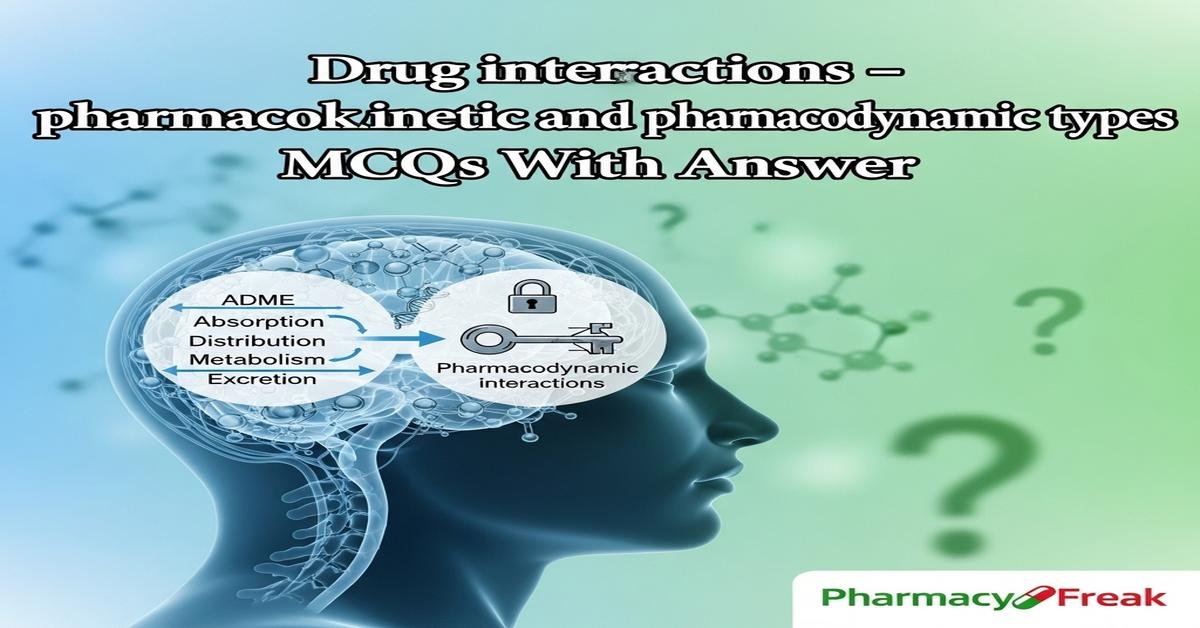
Drug interactions – pharmacokinetic and pharmacodynamic types MCQs With Answer

Drug interactions – pharmacokinetic and pharmacodynamic types MCQs With Answer

Pharmacokinetic and pharmacodynamic drug interactions are central to safe medication use and essential knowledge for B. Pharm students. This set of MCQs focuses on mechanisms—absorption, distribution (protein binding), metabolism (CYP450 enzymes, enzyme induction and inhibition), and excretion (renal transporters, P‑glycoprotein)—and pharmacodynamic concepts such as synergism, antagonism, and adverse effects like QT prolongation or serotonin syndrome. … Read more

PRO
Ad-Free Access
$3.99 / month
  • ✓ No Interruptions
  • ✓ Faster Page Loads
  • ✓ Support Content Creators