Trusted by 50K+ Pharmacy StudentsHigh Quality Notes, MCQs, Mock Tests & Study ResourcesGo Premium (Ads Free)
Pharmacy Freak

Partition coefficient and its significance MCQs With Answer

Partition coefficient and its significance MCQs With Answer

Partition coefficient (P) and related terms like log P and log D describe drug lipophilicity—the tendency of a molecule to distribute between an organic phase (usually octanol) and water. For B. Pharm students, mastering partition coefficient concepts, measurement methods (shake‑flask, HPLC, potentiometric), and computational estimates (CLogP, Hansch analysis) is essential to predict absorption, permeability, distribution, … Read more

Theoretical approaches for determining physicochemical parameters MCQs With Answer

Theoretical approaches for determining physicochemical parameters MCQs With Answer

Theoretical approaches for determining physicochemical parameters are essential for B. Pharm students to predict drug behavior during formulation and development. This introduction covers key concepts—partition coefficient (logP), distribution coefficient (logD), pKa, solubility, lipophilicity, Hansen solubility parameters, dielectric effects, and in silico prediction methods—along with experimental approaches like shake-flask, potentiometric titration, spectrophotometric, HPLC-based, and computational QSAR … Read more

Experimental determination of physicochemical parameters MCQs With Answer

Experimental determination of physicochemical parameters MCQs With Answer

Introduction: Experimental determination of physicochemical parameters is essential for B.Pharm students to understand drug behavior, formulation design, and quality control. This topic covers methods to measure solubility, partition coefficient (log P), pH, melting point, boiling point, refractive index, density, viscosity, surface tension, osmolarity, and water content (Karl Fischer). It also includes instrumental techniques such as … Read more

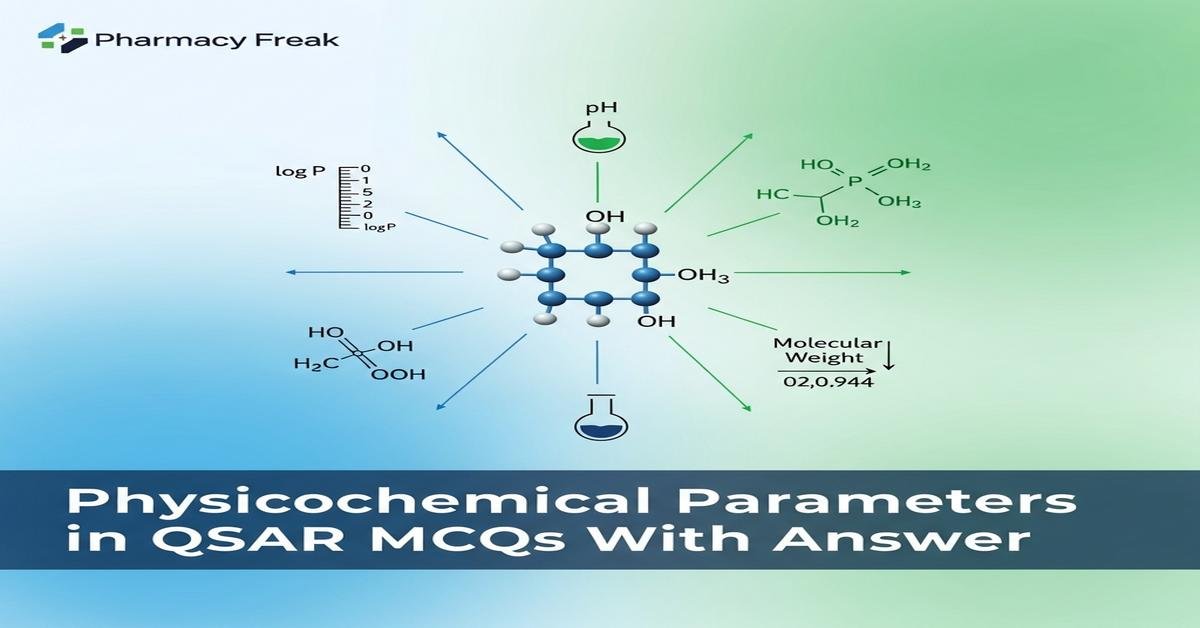
Physicochemical parameters in QSAR MCQs With Answer

Physicochemical parameters in QSAR MCQs With Answer

Understanding physicochemical parameters is essential for developing reliable QSAR (Quantitative Structure–Activity Relationship) models in pharmacy. This introduction covers key descriptors such as lipophilicity (LogP/LogD), pKa, aqueous solubility (LogS), molecular weight, hydrogen bond donors/acceptors, polar surface area (PSA), rotatable bonds, electronic (Hammett) and steric (Taft) parameters, and molecular refractivity. These parameters influence ADME properties, membrane permeability, … Read more

History and development of QSAR MCQs With Answer

History and development of QSAR MCQs With Answer

Quantitative Structure–Activity Relationship (QSAR) traces its history from classical Hansch and Free–Wilson approaches to modern 3D‑QSAR, chemoinformatics and machine‑learning models used in drug discovery and toxicity prediction. The development of QSAR introduced descriptor calculation, descriptor types (constitutional, topological, electronic, geometrical), statistical modeling (regression, PLS, ANN), descriptor selection, model validation (cross‑validation, external test sets, Y‑randomization) and … Read more

SAR versus QSAR comparison MCQs With Answer

SAR versus QSAR comparison MCQs With Answer

Understanding SAR versus QSAR comparison MCQs With Answer is essential for B. Pharm students focusing on rational drug design and lead optimization. SAR (structure–activity relationship) describes qualitative links between chemical structure and biological effect, while QSAR (quantitative structure–activity relationship) uses molecular descriptors and statistical models to predict potency, ADMET, and selectivity. This comparison highlights key … Read more

Quantitative Structure Activity Relationship (QSAR) introduction MCQs With Answer

Quantitative Structure Activity Relationship (QSAR) introduction MCQs With Answer

Quantitative Structure-Activity Relationship (QSAR) is a key computational technique in modern drug design that quantitatively links chemical structure with biological activity using molecular descriptors, statistical models, and validation strategies. B. Pharm students should master descriptor types (constitutional, topological, electronic, hydrophobic), regression and machine-learning approaches, model validation (R2, Q2, RMSE, external test), applicability domain, pharmacophore concepts, … Read more

Case studies in analog-based drug design MCQs With Answer

Case studies in analog-based drug design MCQs With Answer

Introduction: Analog-based drug design uses systematic modification of lead compounds to improve potency, selectivity, and ADME properties through case studies and medicinal chemistry strategies. B. Pharm students will explore concepts such as structure-activity relationship (SAR), QSAR modeling, bioisosteres, scaffold hopping, conformational restriction, and linker optimization. Practical case studies reveal how substituent effects, lipophilicity (logP), pKa, … Read more

Bioisosteric replacement strategies MCQs With Answer

Bioisosteric replacement strategies MCQs With Answer

Bioisosteric replacement strategies MCQs With Answer present focused practice for B. Pharm students to master medicinal chemistry concepts. This introduction covers key ideas such as bioisosteres, classical and non-classical replacements, scaffold hopping, and practical goals like improving potency, selectivity, metabolic stability, and ADME/Tox profiles. Keywords: bioisosteric replacement, bioisosteres, scaffold hopping, pharmacophore, pKa modulation, lipophilicity, metabolic … Read more

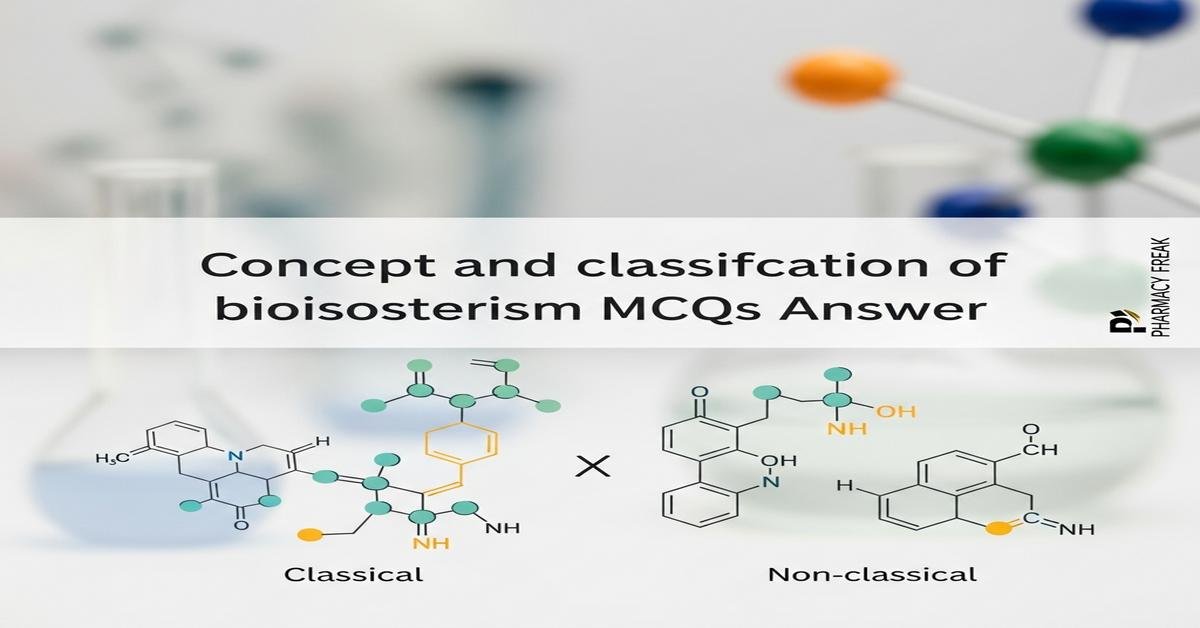
Concept and classification of bioisosterism MCQs With Answer

Concept and classification of bioisosterism MCQs With Answer

Introduction: Bioisosterism is a key concept in medicinal chemistry that involves replacing one atom or functional group with another to retain or improve biological activity. This concept and classification of bioisosterism help B. Pharm students understand how classical bioisosteres and non-classical bioisosteres are used in drug design, lead optimization, and scaffold hopping. Knowledge of common … Read more

PRO
Ad-Free Access
$3.99 / month
  • ✓ No Interruptions
  • ✓ Faster Page Loads
  • ✓ Support Content Creators