Trusted by 50K+ Pharmacy StudentsHigh Quality Notes, MCQs, Mock Tests & Study ResourcesGo Premium (Ads Free)
Pharmacy Freak

Pharmacophore mapping concept MCQs With Answer

Pharmacophore mapping concept MCQs With Answer

Pharmacophore mapping concept MCQs With Answer is a focused review designed for B.Pharm students to master the core ideas of pharmacophore modeling in rational drug design. This introduction covers essential keywords such as pharmacophore mapping, ligand‑based and structure‑based models, pharmacophore features (hydrogen bond donor/acceptor, hydrophobic, aromatic, ionizable), conformer generation, virtual screening, model validation, and 3D … Read more


Drug-likeness screening and filters MCQs With Answer

Drug-likeness screening and filters MCQs With Answer

Drug-likeness screening and filters MCQs With Answer Drug-likeness screening evaluates physicochemical and ADME-related properties to prioritize compounds during lead discovery. Key concepts include Lipinski’s Rule of Five, Veber and Ghose filters, Rule of Three for fragments, TPSA, logP, H-bond donors/acceptors, rotatable bonds, PAINS/REOS filters and in silico tools (SwissADME, pkCSM) for predicting bioavailability, permeability, metabolism … Read more

Virtual screening techniques overview MCQs With Answer

Virtual screening techniques overview MCQs With Answer

Virtual screening is a cornerstone of modern drug discovery, enabling B.Pharm students to explore how computational tools prioritize chemical libraries for experimental testing. This overview covers structure-based virtual screening (docking, binding site analysis), ligand-based virtual screening (similarity search, QSAR, pharmacophore modeling), and supportive methods like molecular dynamics, ADMET prediction, and hit-to-lead workflows. Practical aspects include … Read more

Molecular modeling in drug design MCQs With Answer

Molecular modeling in drug design MCQs With Answer

Molecular modeling in drug design introduces computational tools that predict how small molecules interact with biological targets, helping B. Pharm students understand rational lead discovery and optimization. Key concepts include docking, molecular dynamics (MD), quantitative structure–activity relationships (QSAR), pharmacophore modeling, virtual screening, force fields, solvation models, and ADMET prediction. Practical skills cover homology modeling, conformational … Read more

3D-QSAR approaches: COMSIA MCQs With Answer

3D-QSAR approaches: COMSIA MCQs With Answer

3D-QSAR approaches: COMSIA MCQs With Answer 3D-QSAR approaches, particularly CoMSIA (Comparative Molecular Similarity Indices Analysis), link three-dimensional molecular fields to biological activity using statistical models. For B. Pharm students, mastering CoMSIA involves understanding molecular alignment, probe-based field sampling (steric, electrostatic, hydrophobic, hydrogen-bond donor and acceptor), Gaussian-type similarity functions, and descriptor matrix generation. Key analysis steps … Read more

3D-QSAR approaches: COMFA MCQs With Answer

3D-QSAR approaches: COMFA MCQs With Answer

Introduction: 3D-QSAR approaches, especially CoMFA (Comparative Molecular Field Analysis), are powerful tools in rational drug design for B. Pharm students. CoMFA analyzes three-dimensional steric and electrostatic fields around aligned molecules to correlate molecular features with biological activity. Key concepts include molecular alignment, grid sampling, probe atom, partial charges, PLS (partial least squares) regression, contour maps, … Read more

Free Wilson analysis method MCQs With Answer

Free Wilson analysis method MCQs With Answer

Free-Wilson analysis is a practical QSAR method that decomposes biological activity into additive contributions of substituents on a common core. Ideal for B.Pharm students studying medicinal chemistry and drug design, the Free-Wilson method uses dummy (one-hot) variables and linear regression to estimate substituent effects, guiding lead optimization and SAR interpretation. Key concepts include the reference … Read more

Hansch analysis in QSAR MCQs With Answer

Hansch analysis in QSAR MCQs With Answer

Introduction: Hansch analysis is a cornerstone of QSAR (Quantitative Structure–Activity Relationship) studies used by B.Pharm students to relate chemical structure to biological activity. This method uses descriptors—hydrophobicity (π or LogP), electronic (Hammett σ), and steric (Taft Es)—within the Hansch equation to build multiple linear regression models that predict potency (e.g., pIC50). Key concepts include descriptor … Read more

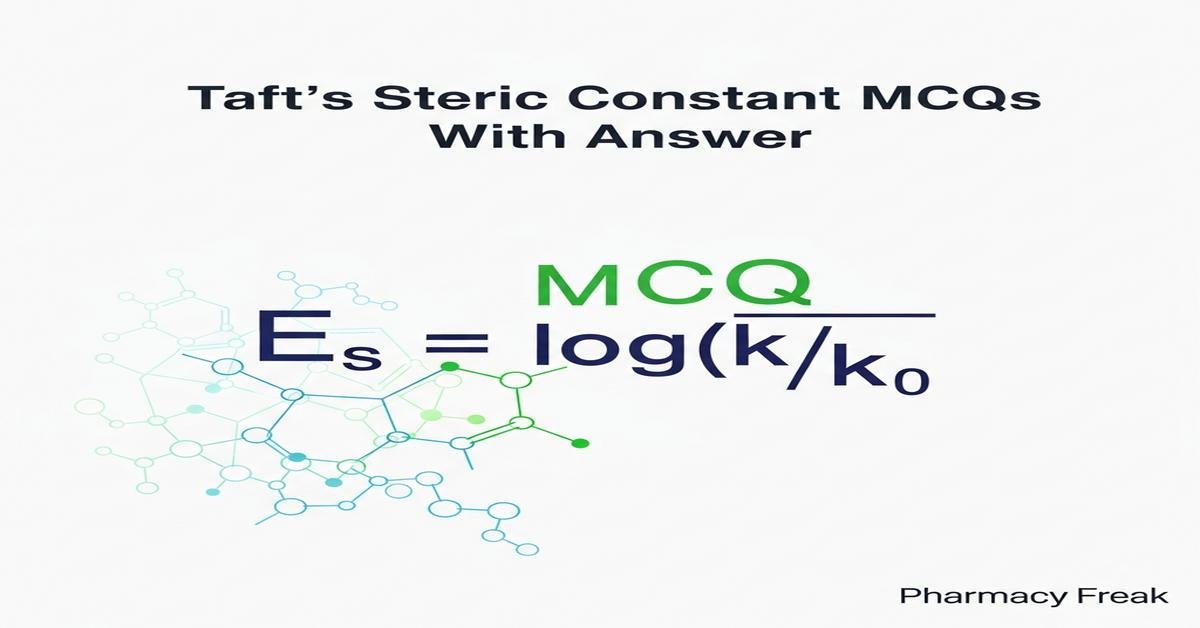
Taft’s steric constant MCQs With Answer

Taft’s steric constant MCQs With Answer

Taft’s steric constant (Es) is a core concept in physical organic and pharmaceutical chemistry, quantifying steric hindrance of aliphatic substituents and helping predict how bulky groups affect reaction rates and mechanisms. This resource for B.Pharm students covers how Es is measured from ester hydrolysis kinetics, its use alongside the polar constant (σ*) in the Taft … Read more

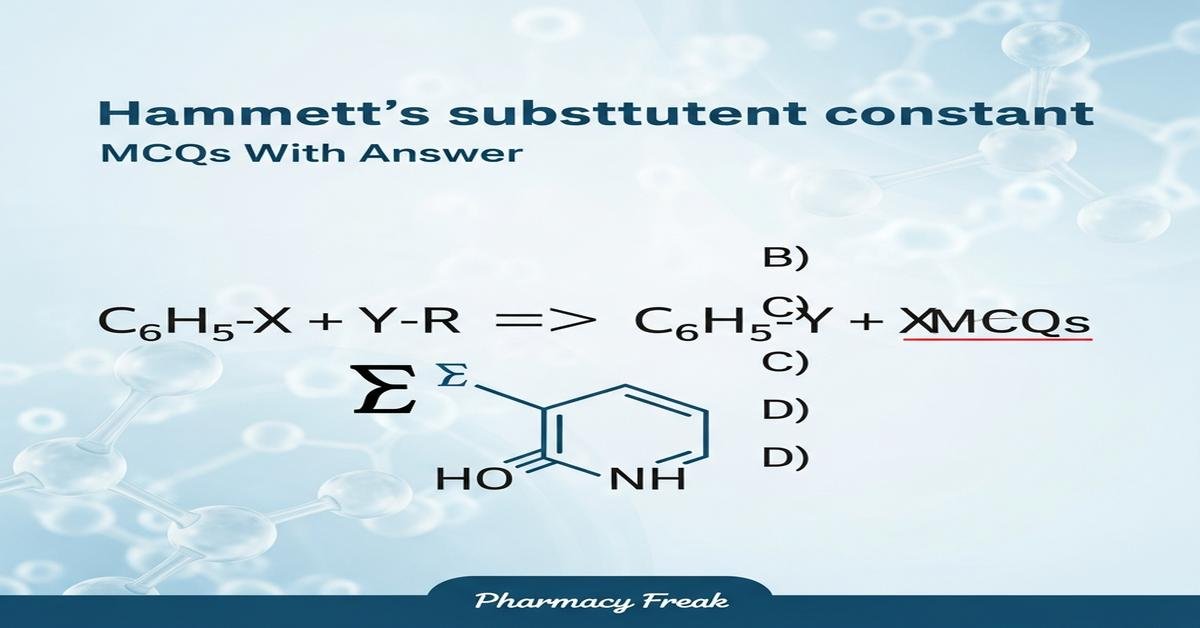
Hammett’s substituent constant MCQs With Answer

Hammett’s substituent constant MCQs With Answer

Hammett’s substituent constant MCQs With Answer Hammett’s substituent constant (σ) is a cornerstone concept for B. Pharm students studying how aromatic substituents influence reactivity and drug properties. This introduction covers sigma values, sigma+, sigma–, resonance and inductive effects, the reaction constant (ρ), Hammett plots, linear free energy relationships (LFER), and applications in QSAR, SAR and … Read more

PRO
Ad-Free Access
$3.99 / month
  • ✓ No Interruptions
  • ✓ Faster Page Loads
  • ✓ Support Content Creators