Trusted by 50K+ Pharmacy StudentsHigh Quality Notes, MCQs, Mock Tests & Study ResourcesGo Premium (Ads Free)
Pharmacy Freak

Hansch analysis – principles and application MCQs With Answer
Hansch analysis – principles and application MCQs With Answer

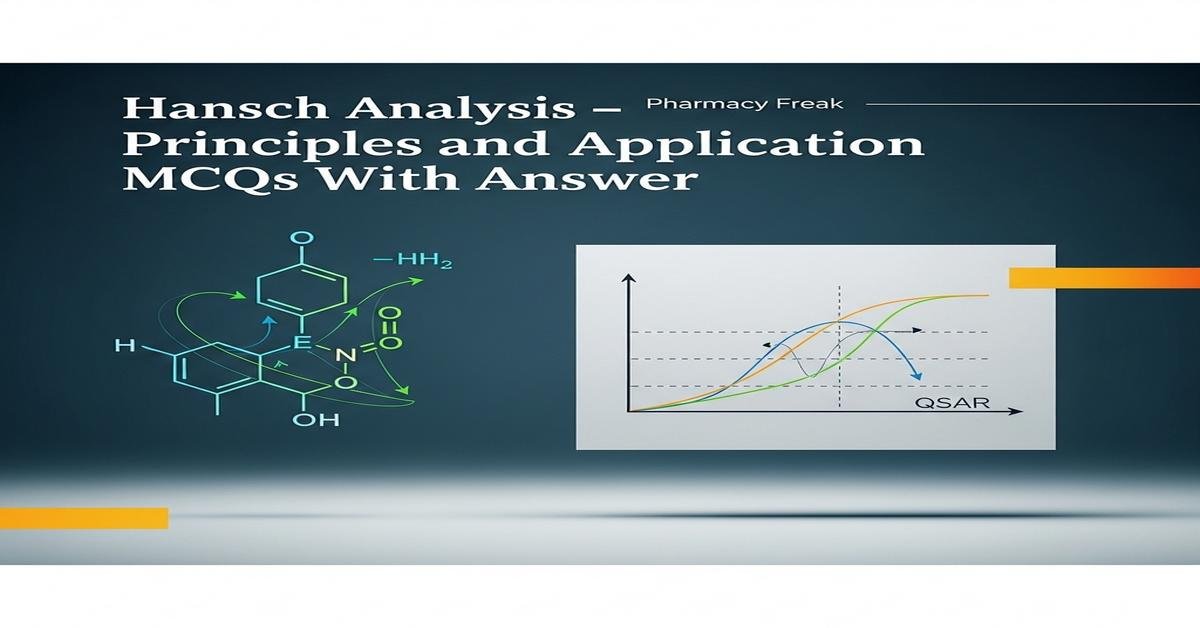
In Hansch analysis, a classical QSAR approach, relationships between chemical structure and biological activity are quantified using physicochemical descriptors like lipophilicity (log P, Hansch π), electronic (Hammett σ) and steric (Taft Es) parameters. B.Pharm students learn to construct Hansch equations using multiple regression, interpret coefficients (including parabolic π2 terms), assess model quality with r2, F-test … Read more


Physicochemical parameters in QSAR – partition coefficient, Hammett’s constant, Taft’s steric parameter MCQs With Answer

Physicochemical parameters in QSAR – partition coefficient, Hammett’s constant, Taft’s steric parameter MCQs With Answer

Introduction: QSAR (Quantitative Structure–Activity Relationship) uses physicochemical parameters to predict drug behavior. Key descriptors include the partition coefficient (log P) which measures lipophilicity and membrane permeability, Hammett’s constant (σ) that quantifies electronic (inductive and resonance) effects of aromatic substituents, and Taft’s steric parameter (Es) describing aliphatic steric hindrance. Understanding how log P, σ and Es … Read more

QSAR – concept and significance MCQs With Answer

QSAR – concept and significance MCQs With Answer

Quantitative Structure-Activity Relationship (QSAR) is a computational approach that correlates chemical structure with biological activity using molecular descriptors and statistical models. For B. Pharm students, QSAR is essential for rational drug design, lead optimization, and ADME/Tox prediction. Key topics include descriptor types (topological, electronic, hydrophobic, geometrical), model-building methods (MLR, PLS, SVM, random forest), validation strategies … Read more

Approaches used in rational drug design MCQs With Answer

Approaches used in rational drug design MCQs With Answer

Introduction: Rational drug design integrates biological target knowledge with computational and experimental tools to create effective therapeutics. Key approaches include structure-based drug design (SBDD), ligand-based drug design (LBDD), molecular docking, pharmacophore modeling, QSAR, virtual screening, fragment-based design, de novo design, homology modeling, and ADMET prediction. B. Pharm students should grasp concepts like lead identification, lead … Read more

Introduction to drug design MCQs With Answer

Introduction to drug design MCQs With Answer

Introduction to drug design MCQs With Answer Drug design is a core area of medicinal chemistry that covers target identification, lead discovery, structure–activity relationship (SAR), lead optimization, and ADME/pharmacokinetics considerations. This set of MCQs with answers for B. Pharm students focuses on key concepts such as molecular docking, QSAR, pharmacodynamics, prodrugs, combinatorial chemistry, bioisosterism, and … Read more

Sulfones – Dapsone – chemistry and mechanism MCQs With Answer

Sulfones – Dapsone – chemistry and mechanism MCQs With Answer

Sulfones – Dapsone – chemistry and mechanism MCQs With Answer Sulfones and dapsone are essential topics in medicinal chemistry and pharmacology for B.Pharm students. This introduction covers sulfone structure, synthesis approaches, spectral identification, pharmacokinetics, metabolic pathways (N‑acetylation and N‑hydroxylation), mechanism of action (competitive inhibition of dihydropteroate synthase and neutrophil oxidative pathways), clinical uses (leprosy, dermatitis … Read more

Folate reductase inhibitors – Trimethoprim, Cotrimoxazole MCQs With Answer

Folate reductase inhibitors – Trimethoprim, Cotrimoxazole MCQs With Answer

Folate reductase inhibitors – Trimethoprim, Cotrimoxazole MCQs With Answer Folate reductase inhibitors, especially trimethoprim and the combination cotrimoxazole (trimethoprim‑sulfamethoxazole), are vital for B.Pharm students learning antimicrobial pharmacology. This concise overview explains mechanisms — trimethoprim inhibits bacterial dihydrofolate reductase while sulfamethoxazole blocks dihydropteroate synthase — producing sequential folate synthesis blockade and synergy. Key topics covered include … Read more

Sulfamethizine, Sulfacetamide, Sulfamethoxazole, Sulphadiazine MCQs With Answer

Sulfamethizine, Sulfacetamide, Sulfamethoxazole, Sulphadiazine MCQs With Answer

These MCQs focus on Sulfamethizine, Sulfacetamide, Sulfamethoxazole and Sulphadiazine—important sulfonamide antibiotics studied in B. Pharm curricula. The introduction reviews structures, mechanisms of action, pharmacokinetics, therapeutic uses, resistance mechanisms, adverse effects, drug interactions and formulation considerations. Emphasis is on clinical applications, dosage calculations, topical and systemic preparations, and distinguishing spectrums of activity. Keywords such as sulfonamides, … Read more

Sulphamethizole, Sulfisoxazole, Sulphapyridine MCQs With Answer

Sulphamethizole, Sulfisoxazole, Sulphapyridine MCQs With Answer

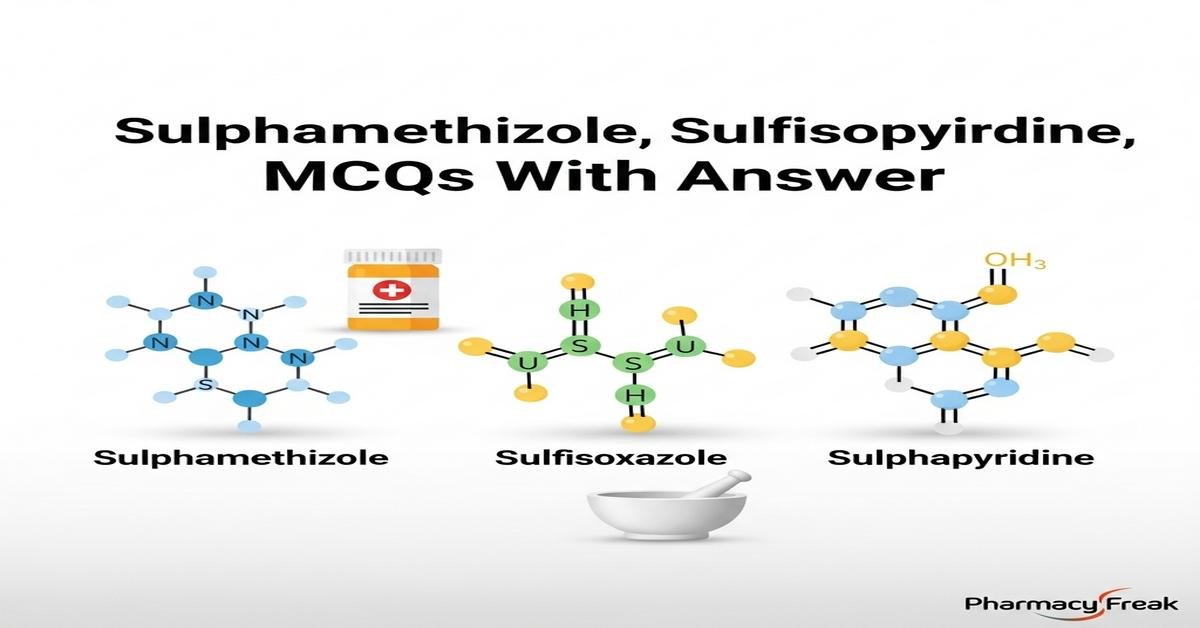
As B. Pharm students, mastering Sulphamethizole, Sulfisoxazole, and Sulphapyridine is essential for understanding sulfonamide pharmacology. These sulfonamides act as PABA analogues that competitively inhibit dihydropteroate synthase, producing bacteriostatic effects by disrupting folate synthesis. Key concepts include pharmacokinetics (absorption, hepatic acetylation, renal excretion), clinical uses (urinary tract infections, otitis media, and historical systemic roles), adverse effects … Read more

Mechanism of action of sulfonamides MCQs With Answer

Mechanism of action of sulfonamides MCQs With Answer

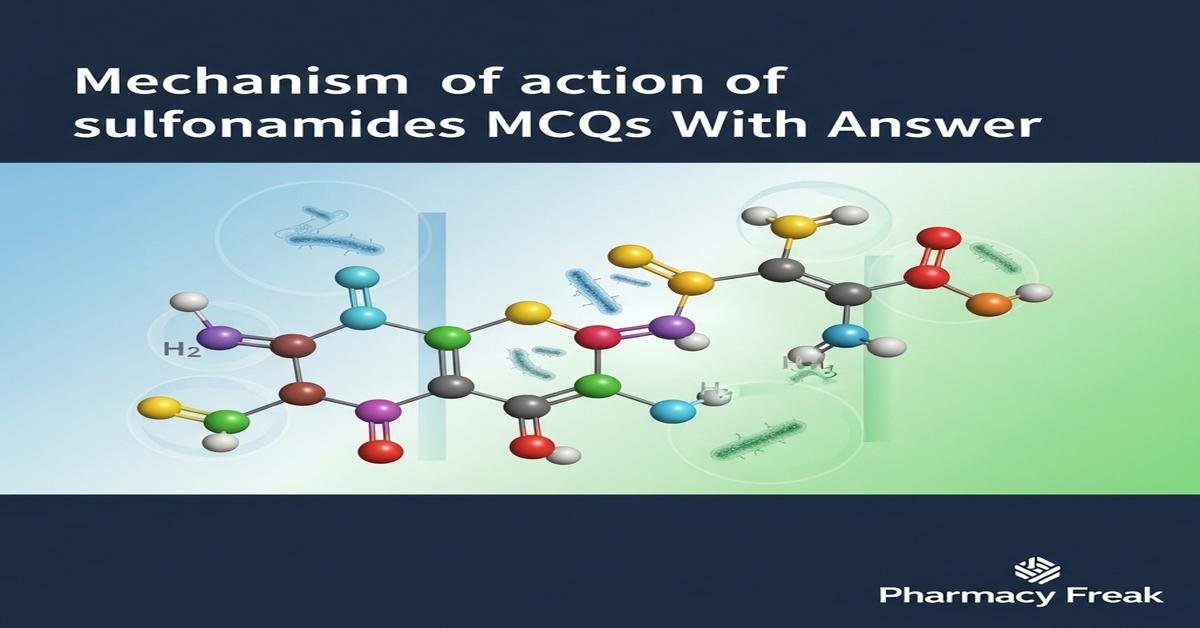
Introduction Understanding the mechanism of action of sulfonamides is essential for B.Pharm students studying antimicrobial pharmacology. Sulfonamides are structural analogs of para-aminobenzoic acid (PABA) that competitively inhibit dihydropteroate synthase, blocking folic acid synthesis required for thymidine and purine production. This bacteriostatic effect, important pharmacodynamic interactions (notably synergy with trimethoprim inhibiting dihydrofolate reductase), resistance mechanisms, adverse … Read more

PRO
Ad-Free Access
$3.99 / month
  • ✓ No Interruptions
  • ✓ Faster Page Loads
  • ✓ Support Content Creators