Trusted by 50K+ Pharmacy StudentsHigh Quality Notes, MCQs, Mock Tests & Study ResourcesGo Premium (Ads Free)
Pharmacy Freak

Glycogen metabolism – pathways MCQs With Answer
Glycogen metabolism – pathways MCQs With Answer

Glycogen metabolism is a central topic for B. Pharm students, covering the coordinated pathways of glycogenesis and glycogenolysis that maintain glucose homeostasis. This introduction reviews key enzymes—glycogen synthase, glycogen phosphorylase, branching and debranching enzymes—regulatory signals like insulin, glucagon and epinephrine, and cellular intermediates such as UDP‑glucose and glucose‑1‑phosphate. Understanding enzyme defects and glycogen storage diseases … Read more
G6PD deficiency MCQs With Answer

G6PD deficiency MCQs With Answer

Introduction G6PD deficiency MCQs With Answer is an essential revision resource for B. Pharm students studying pharmacology, hematology, and therapeutics. This concise, question-driven guide explores glucose-6-phosphate dehydrogenase deficiency pathophysiology, X-linked genetics, oxidative stress mechanisms, clinical features like hemolytic anemia and neonatal jaundice, diagnostic assays, and drug-induced hemolysis. Emphasis on drug interactions—primaquine, sulfonamides, dapsone—and safe medication … Read more

HMP shunt – significance MCQs With Answer

HMP shunt – significance MCQs With Answer

HMP shunt – significance MCQs With Answer The HMP shunt, also called the hexose monophosphate pathway (HMP) or pentose phosphate pathway (PPP), is a central metabolic route B.Pharm students must master. It produces NADPH for biosynthetic reactions and antioxidant defense, and ribose‑5‑phosphate for nucleotide synthesis. Located in the cytosol, the pathway links to glycolysis via … Read more

HMP shunt – pathway MCQs With Answer

HMP shunt – pathway MCQs With Answer

Hexose monophosphate (HMP) shunt, also known as the pentose phosphate pathway (PPP), is a vital cellular route that generates reducing power and biosynthetic precursors. For B. Pharm students, understanding HMP shunt fundamentals — NADPH production, ribose-5-phosphate synthesis, oxidative and non-oxidative phases, and regulation — is essential for pharmacology, drug metabolism, and biochemical pathway integration. This … Read more

Citric acid cycle – significance MCQs With Answer

Introduction: The citric acid cycle, also known as the Krebs cycle or TCA cycle, is a central metabolic pathway in cellular respiration critical for energy production and biosynthesis. For B. Pharm students, understanding the citric acid cycle significance is essential for pharmacology, drug metabolism, and clinical biochemistry. Key topics include enzyme regulation, ATP and reducing … Read more

Citric acid cycle – energetics MCQs With Answer

Citric acid cycle – energetics MCQs With Answer

Introduction: The Citric acid cycle (TCA or Krebs cycle) is central to mitochondrial metabolism and cellular energetics — a core topic for B. Pharm students studying drug action, metabolism, and bioenergetics. This concise guide emphasizes energetics: NADH and FADH2 generation, GTP formation, coupling to oxidative phosphorylation, and key regulatory points (PDH, isocitrate dehydrogenase, α‑ketoglutarate dehydrogenase). … Read more

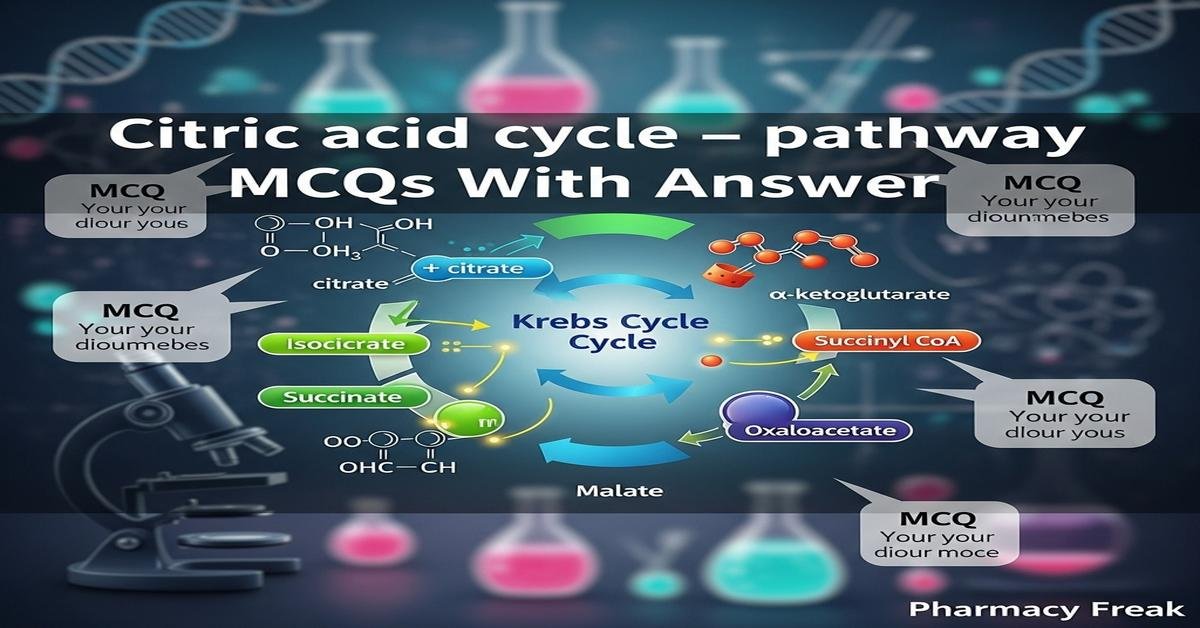
Citric acid cycle – pathway MCQs With Answer

Citric acid cycle – pathway MCQs With Answer

The citric acid cycle, also known as the Krebs cycle or TCA cycle, is a central aerobic metabolic pathway that oxidizes acetyl-CoA to CO2 while generating NADH, FADH2 and GTP/ATP. For B. Pharm students, understanding the cycle’s enzymes, intermediates, regulation, cofactor requirements (NAD+, FAD, CoA, lipoic acid, TPP), and links to electron transport and biosynthesis … Read more

Glycolysis – significance MCQs With Answer

Introduction: Glycolysis is a central pathway in glucose metabolism and an essential topic for B. Pharm students studying pharmacology, biochemistry, and clinical therapeutics. Understanding glycolysis—its enzymes, regulation, ATP and NADH yield, and links to lactate production and the TCA cycle—helps explain drug effects, energy metabolism in tissues, and disease states such as cancer and inherited … Read more

Glycolysis – energetics MCQs With Answer

Glycolysis – Energetics MCQs With Answer Glycolysis is a central metabolic pathway that converts glucose into pyruvate while yielding energy-rich molecules essential for cellular function. For B. Pharm students, mastering glycolytic energetics—ATP investment and payoff, NADH generation, substrate-level phosphorylation, and regulatory checkpoints—is crucial for understanding drug action, metabolic diseases, and biochemical pharmacology. This set emphasizes … Read more

Glycolysis – pathway MCQs With Answer

Glycolysis – pathway MCQs With Answer is a concise, student-friendly resource tailored for B. Pharm learners to master the central steps of glucose metabolism. This introduction covers key glycolytic enzymes, regulation points (hexokinase, PFK-1, pyruvate kinase), ATP and NADH yields, anaerobic vs aerobic fates, and clinically relevant inhibitors and disorders. Emphasis on mechanism, energetics, tissue-specific … Read more

PRO
Ad-Free Access
$3.99 / month
  • No Interruptions
  • Faster Page Loads
  • Support Content Creators