Trusted by 50K+ Pharmacy StudentsHigh Quality Notes, MCQs, Mock Tests & Study ResourcesGo Premium (Ads Free)
Pharmacy Freak

Coenzymes – biochemical functions MCQs With Answer
Coenzymes – biochemical functions MCQs With Answer

Coenzymes – biochemical functions MCQs With Answer Coenzymes are small organic molecules that work with enzymes to drive essential biochemical reactions in metabolism. This concise guide for B. Pharm students covers coenzyme types, mechanisms, vitamin-derived cofactors (NAD, NADP, FAD, CoA, PLP, TPP, biotin, THF, cobalamin), regeneration pathways, and clinical implications such as deficiency syndromes and … Read more
Coenzymes – structure MCQs With Answer

Coenzymes – structure MCQs With Answer

Coenzymes – structure MCQs With Answer Understanding coenzymes and their structures is essential for B.Pharm students studying biochemistry and pharmacology. This concise, keyword-rich introduction covers coenzyme classes, vitamin-derived cofactors, prosthetic groups, co-substrates, and structural motifs like adenine nucleotides, isoalloxazine, thiazolium and pyridoxal rings. You will learn how coenzymes such as NAD, FAD, FMN, CoA, PLP, … Read more

Isoenzymes – significance MCQs With Answer

Isoenzymes – significance MCQs With Answer

Izoenzymes (isoenzymes) are enzyme variants with similar catalytic functions but different amino acid sequences, tissue distribution, and kinetic properties. For B. Pharm students, understanding isoenzymes is essential for clinical diagnostics, pharmacology, and drug development — especially in interpreting enzyme assays, predicting drug metabolism, and recognizing genetic polymorphisms in CYP isoenzymes. Key topics include tissue-specific markers … Read more

Diagnostic applications of enzymes MCQs With Answer

Diagnostic applications of enzymes MCQs With Answer

Diagnostic applications of enzymes MCQs With Answer are essential for B. Pharm students preparing for clinical pharmacology and therapeutic monitoring. Understanding enzyme assays, isoenzymes, reference ranges, and pre-analytical variables helps pharmacists interpret lab reports for liver, cardiac, pancreatic and bone disorders. This set emphasizes practical concepts: enzyme kinetics, assay methods (colorimetric, kinetic, ELISA), diagnostic specificity … Read more

Therapeutic applications of enzymes MCQs With Answer

Therapeutic applications of enzymes MCQs With Answer

Therapeutic applications of enzymes MCQs With Answer are essential for B. Pharm students preparing for pharmacology and clinical pharmacy exams. This concise guide covers enzyme drugs, enzyme replacement therapies, thrombolytics, recombinant enzymes, and enzyme-targeting inhibitors with emphasis on indications, mechanisms, adverse effects, and monitoring. Keywords include enzyme therapy, thrombolytics, recombinant enzymes, enzyme inhibitors, asparaginase, pancrelipase, … Read more

Allosteric enzyme regulation MCQs With Answer

Allosteric enzyme regulation MCQs With Answer

Allosteric enzyme regulation MCQs With Answer Understanding allosteric enzyme regulation is essential for B. Pharm students preparing for pharmacology and biochemistry exams. This concise guide covers mechanisms, models, kinetics, and physiological examples of allosteric control, emphasizing concepts like cooperative binding, homotropic and heterotropic effectors, MWC and KNF models, and pharmacological modulation. Questions focus on real … Read more

Regulation of enzymes – repression MCQs With Answer

Regulation of enzymes – repression MCQs With Answer

Regulation of enzymes – repression MCQs With Answer The regulation of enzymes by repression is a key concept for B. Pharm students studying biochemical control, gene regulation, and pharmacology. This introduction covers transcriptional repression, operon models (e.g., trp and lac), corepressors, negative control, attenuation, catabolite repression, allosteric control, and post‑translational mechanisms that reduce enzyme levels … Read more

Regulation of enzymes – induction MCQs With Answer

Regulation of enzymes – induction MCQs With Answer

Regulation of enzymes – induction MCQs With Answer Understanding the regulation of enzymes, especially enzyme induction, is crucial for B. Pharm students studying pharmacology and drug metabolism. This introduction covers mechanisms like transcriptional activation, nuclear receptors (PXR, CAR, AhR), post‑translational modulation, and clinical implications such as drug‑drug interactions, altered pharmacokinetics, and therapeutic failure. Key topics … Read more

Enzyme inhibitors with examples MCQs With Answer

Enzyme inhibitors with examples MCQs With Answer

Enzyme inhibitors are central to pharmacology, affecting drug action, metabolism and therapeutic outcomes for B. Pharm students. This clear, exam-focused introduction covers major types — competitive, noncompetitive, uncompetitive, mixed, irreversible and mechanism-based (suicide) inhibitors — and links them to clinical and biochemical examples such as statins, methotrexate, aspirin, penicillin, allopurinol and organophosphates. You will learn … Read more

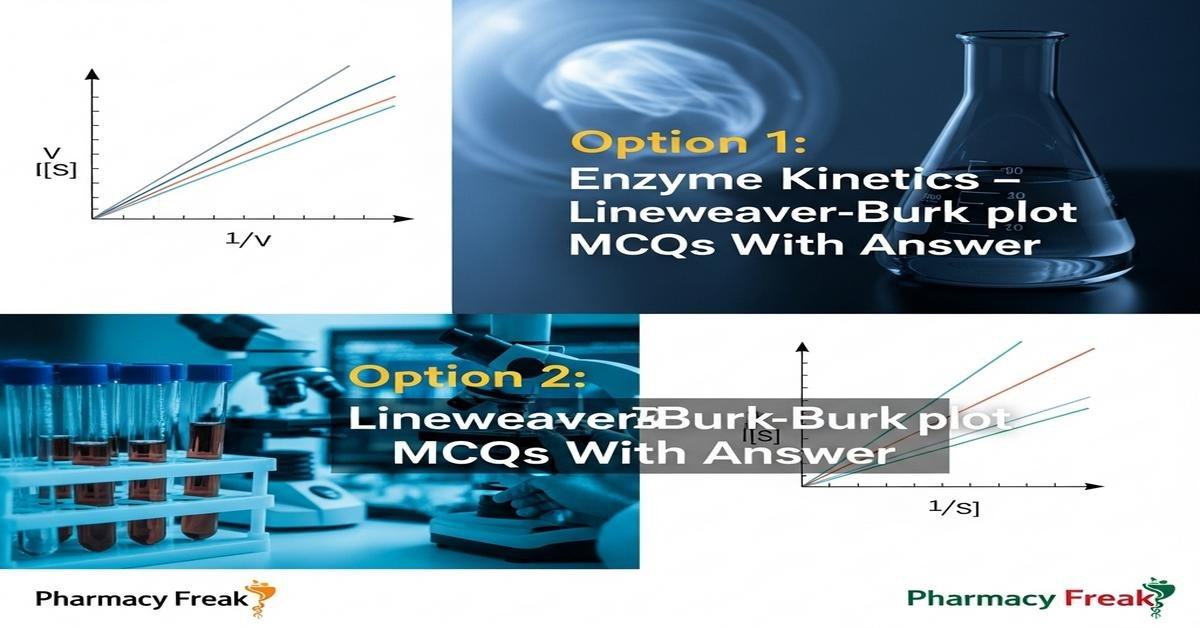
Enzyme kinetics – Lineweaver-Burk plot MCQs With Answer

Enzyme kinetics – Lineweaver-Burk plot MCQs With Answer

Enzyme kinetics – Lineweaver-Burk plot MCQs With Answer Understanding enzyme kinetics is essential for B. Pharm students studying drug action and metabolism. The Lineweaver-Burk plot, a double-reciprocal transformation of the Michaelis-Menten equation, helps estimate key parameters like Km and Vmax and distinguish types of enzyme inhibition. Mastery of concepts such as slope (Km/Vmax), x-intercept (−1/Km), … Read more

PRO
Ad-Free Access
$3.99 / month
  • No Interruptions
  • Faster Page Loads
  • Support Content Creators