Trusted by 50K+ Pharmacy StudentsHigh Quality Notes, MCQs, Mock Tests & Study ResourcesGo Premium (Ads Free)
Pharmacy Freak

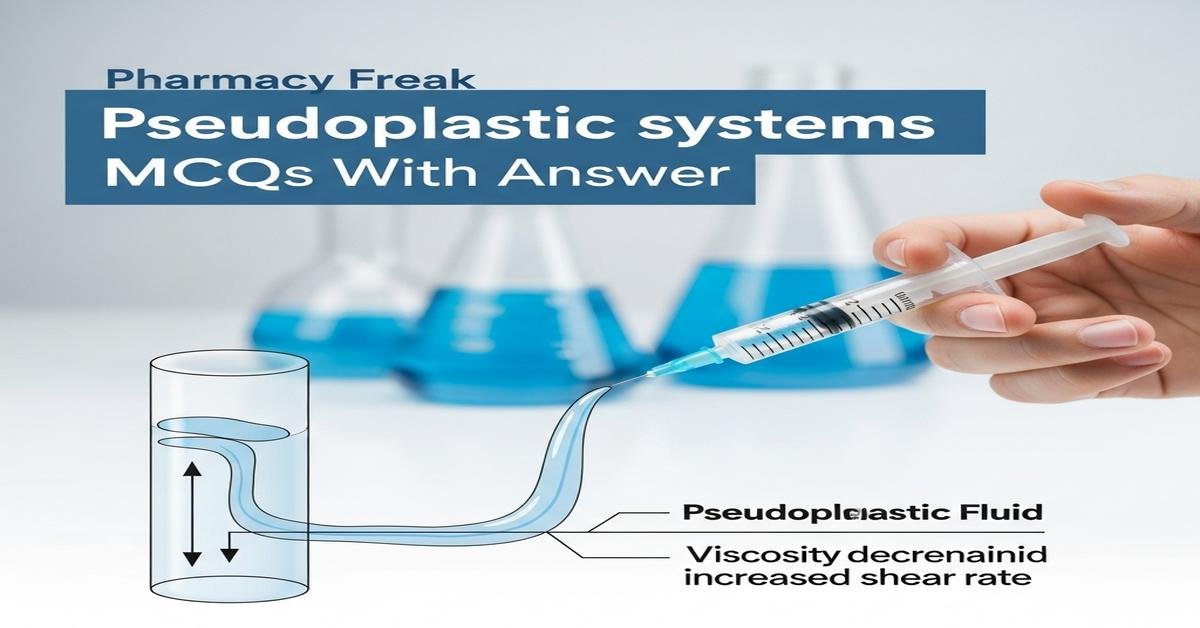
Pseudoplastic systems MCQs With Answer

Pseudoplastic systems MCQs With Answer

Pseudoplastic systems MCQs With Answer provide B. Pharm students a focused review of shear‑thinning rheology, formulation design, and practical measurement. This set covers pseudoplastic behavior, flow curves, power‑law models, viscosity–shear rate relationships, polymers and thickeners, thixotropy, instrument selection (Brookfield, capillary), and implications for suspension stability, drug release, and processing. Each question deepens conceptual understanding and … Read more

Non-Newtonian systems MCQs With Answer

Non-Newtonian systems MCQs With Answer

Non-Newtonian systems MCQs With Answer are essential for B. Pharm students to master rheology fundamentals that impact drug formulation, processing, and stability. This concise introduction covers shear-thinning and shear-thickening behavior, yield stress, thixotropy, viscoelasticity, and common rheological models (power-law, Bingham, Herschel-Bulkley). Understanding measurement methods (rotational viscometers, cone-plate rheometers) and the role of polymers (CMC, HPMC, … Read more

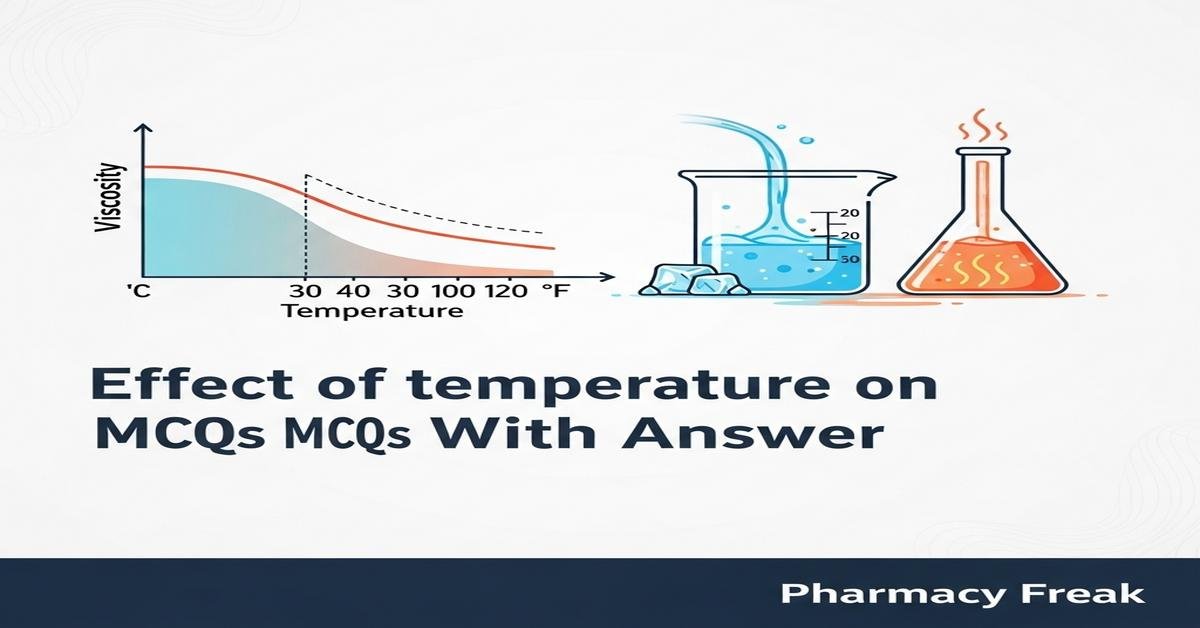
Effect of temperature on viscosity MCQs With Answer

Effect of temperature on viscosity MCQs With Answer

Effect of temperature on viscosity MCQs With Answer is a focused revision tool designed for B. Pharm students to master how temperature alters fluid flow and formulation behavior. This introduction covers key concepts—temperature dependence of liquid and gas viscosities, Arrhenius/Andrade relationships, activation energy of flow, Newtonian vs non‑Newtonian response, viscometry methods and practical formulation implications … Read more

Kinematic viscosity MCQs With Answer

Kinematic viscosity MCQs With Answer

Introduction: Kinematic viscosity MCQs With Answer are essential for B. Pharm students studying fluid flow, formulation science, and quality control. Kinematic viscosity—measured in stokes or centistokes—relates a fluid’s internal resistance to flow to its density and is distinct from dynamic viscosity. Understanding measurement techniques (capillary/Ostwald, Ubbelohde, Saybolt), temperature dependence, unit conversions, and practical implications in … Read more

Law of flow MCQs With Answer

Law of flow MCQs With Answer

Introduction: The Law of Flow MCQs With Answer is a focused study resource for B. Pharm students studying powder and granular flow in pharmaceutics. This introduction covers flow principles, measurement methods, practical equations and factors affecting powder flowability, such as particle size, shape, humidity, and excipients like glidants and lubricants. Key terms include angle of … Read more

Newtonian systems MCQs With Answer

Newtonian systems MCQs With Answer

Newtonian systems MCQs With Answer provide B. Pharm students a focused way to master core principles of classical mechanics relevant to pharmaceutical sciences, biomechanics, and laboratory instrumentation. This concise guide covers Newton’s laws, force balance, motion equations, friction, circular dynamics, momentum, energy conservation, simple harmonic motion and damping — all tailored for pharmacy undergraduates. Each … Read more

Protective action of colloids MCQs With Answer

Protective action of colloids MCQs With Answer

Protective action of colloids is a crucial topic for B.Pharm students exploring how colloidal stabilizers prevent aggregation, sedimentation, and loss of therapeutic activity in suspensions, emulsions, and nanoparticle drug carriers. This introduction covers mechanisms such as steric stabilization, electrostatic repulsion, hydration layers, and DLVO theory, plus practical implications for formulation design, excipient selection (e.g., PVP, … Read more

Peptization MCQs With Answer

Peptization MCQs With Answer

Peptization MCQs With Answer offers B. Pharm students a focused, exam-oriented review of peptization and colloidal stability in pharmaceutics. This concise introduction and question set covers core concepts such as peptization mechanism, peptizing agents, electrostatic and steric stabilization, DLVO theory, zeta potential, critical coagulation concentration, and practical implications for suspensions, emulsions, and parenteral formulations. Each … Read more

Coacervation MCQs With Answer

Coacervation MCQs With Answer

Coacervation MCQs With Answer: This focused introduction helps B.Pharm students master complex and simple coacervation, an essential microencapsulation technique in pharmaceutics. It covers principles of phase separation, polymer interactions (e.g., gelatin–gum arabic), pH and ionic strength effects, thermodynamics, crosslinking, and formulation strategies to improve encapsulation efficiency, particle size control and controlled drug release. Practical applications … Read more

Effect of electrolytes on colloids MCQs With Answer

Effect of electrolytes on colloids MCQs With Answer

Understanding the effect of electrolytes on colloids is essential for B. Pharm students focusing on drug formulations and suspension stability. This concise overview explains how electrolyte concentration, ion valency and specific ion adsorption alter colloidal stability through zeta potential modulation, ionic strength effects and DLVO interactions. Key topics include the Schulze–Hardy rule, critical coagulation concentration … Read more

PRO
Ad-Free Access
$3.99 / month
  • No Interruptions
  • Faster Page Loads
  • Support Content Creators