Trusted by 50K+ Pharmacy StudentsHigh Quality Notes, MCQs, Mock Tests & Study ResourcesGo Premium (Ads Free)
Pharmacy Freak

Application of preformulation in parenteral dosage forms MCQs With Answer
Application of preformulation in parenteral dosage forms MCQs With Answer

Introduction: Preformulation in parenteral dosage forms is a critical stage in B.Pharm training that evaluates physicochemical properties to ensure safe, effective injectable products. This preformulation assessment includes solubility, pKa, partition coefficient, stability (chemical and physical), compatibility with excipients and containers, sterility and endotoxin control, isotonicity, viscosity, and aggregation potential—especially for protein formulations. Understanding analytical tools … Read more

Application of preformulation in liquid oral dosage forms MCQs With Answer

Application of preformulation in liquid oral dosage forms MCQs With Answer

Introduction: Preformulation in liquid oral dosage forms is the foundational study of a drug’s physical and chemical properties to design safe, stable and effective syrups, suspensions and solutions. Key preformulation assessments include solubility, pKa, partition coefficient (logP/logD), stability (hydrolysis, oxidation, photodegradation), polymorphism, particle size, viscosity, rheology, preservative compatibility, buffer capacity, osmolarity and excipient interactions. Understanding … Read more

Application of preformulation in solid dosage forms MCQs With Answer

Application of preformulation in solid dosage forms MCQs With Answer

Preformulation studies are the foundation for developing robust solid dosage forms and essential for every B. Pharm student. This introduction covers the application of preformulation including evaluation of physicochemical properties, drug-excipient compatibility, solubility, particle size, polymorphism, stability, and dissolution behavior. Understanding analytical tools like DSC, FTIR, XRD and thermogravimetric analysis, as well as addressing hygroscopicity … Read more

Significance of BCS classification MCQs With Answer

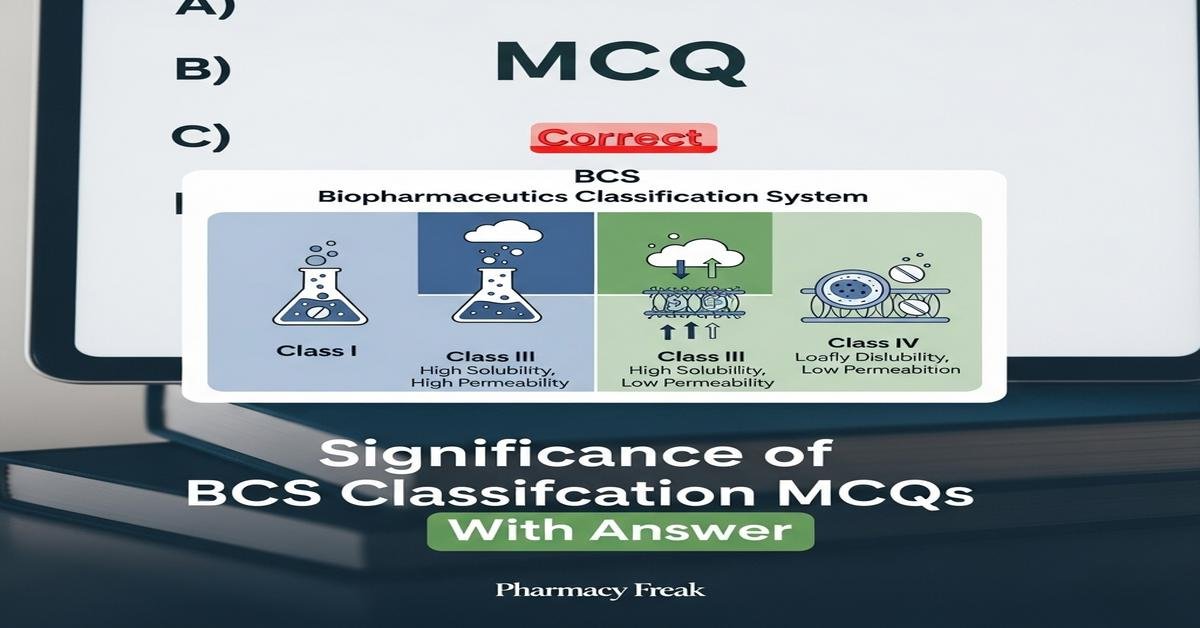
Significance of BCS classification MCQs With Answer

Introduction: The Biopharmaceutics Classification System (BCS) is a cornerstone concept for B. Pharm students, linking drug solubility, permeability, dissolution, and drug absorption to predict oral bioavailability and guide formulation strategies. Understanding BCS classification, dose number, solubility testing, permeability assays (e.g., Caco-2, PAMPA), and regulatory biowaiver criteria equips students to evaluate drug development, generic approval paths, … Read more

BCS classification of drugs MCQs With Answer

BCS classification of drugs MCQs With Answer

Biopharmaceutics Classification System (BCS) classification of drugs helps B.Pharm students understand how solubility and permeability determine oral drug absorption, dissolution behavior, formulation choices, and bioavailability. This concise guide emphasizes BCS classes I–IV, high solubility criteria (dose/250 mL), permeability assessment, dissolution testing standards, and BCS-based biowaivers. It links theory to practical formulation strategies—salt formation, particle size … Read more

Pharmacy Residency in the USA: Is a Residency Worth It? How It Can Double Your Starting Salary and Open Doors to Top Hospital Jobs.

Pharmacy Residency in the USA: Is a Residency Worth It? How It Can Double Your Starting Salary and Open Doors to Top Hospital Jobs.

Pharmacy residencies are intense, 1–2 year training programs that turn a new PharmD into a clinical pharmacist who can thrive in hospitals, ambulatory care clinics, and specialty services. The right residency can open doors to top-tier hospitals and niche roles like ICU, oncology, infectious diseases, or emergency medicine. The big question is whether it’s worth … Read more

Polymerization MCQs With Answer

Polymerization MCQs With Answer

Polymerization MCQs With Answer is a focused review designed for B.Pharm students to master polymer chemistry concepts applied in pharmaceuticals. Understanding polymerization is essential because polymers act as excipients, drug carriers, coatings and biomedical materials. This set covers chain-growth and step-growth mechanisms, free radical and ionic initiation, condensation and ring-opening polymerizations, controlled/living techniques, molecular weight … Read more

Racemization MCQs With Answer

Racemization MCQs With Answer

Introduction: Racemization refers to the conversion of an enantiomerically pure substance into a 1:1 mixture of enantiomers (racemic mixture), a key concept in stereochemistry and pharmaceutical chemistry. B. Pharm students must understand mechanisms (enolization, SN1, carbocations, pyramidal inversion), factors (pH, temperature, solvents, catalysts), analytical methods (polarimetry, chiral HPLC), and implications for drug stability, efficacy and … Read more

Reduction MCQs With Answer

Reduction MCQs With Answer

Reduction MCQs With Answer cover essential reduction reactions and concepts for B.Pharm students, linking organic chemistry to drug metabolism, formulation and medicinal chemistry. This focused set emphasizes hydride reagents (NaBH4, LiAlH4, NaBH3CN), catalytic hydrogenation (Pd/C, poisoned catalysts), stereoselective methods (CBS, Luche), transfer hydrogenation, and specialized reductions (MPV, Birch, Wolff‑Kishner, Clemmensen). It also addresses enzymatic and … Read more

Oxidation MCQs With Answer

Oxidation MCQs With Answer

Oxidation MCQs With Answer provide B.Pharm students with focused practice on oxidative processes relevant to pharmaceuticals, drug metabolism and formulation stability. This set covers key concepts such as redox reactions, oxidation states, cytochrome P450-mediated phase I metabolism, reactive oxygen species, free-radical chain mechanisms, antioxidant protection, metal-catalyzed degradation and analytical assays for peroxides. Emphasis is on … Read more

PRO
Ad-Free Access
$3.99 / month
  • ✓ No Interruptions
  • ✓ Faster Page Loads
  • ✓ Support Content Creators