Trusted by 50K+ Pharmacy StudentsHigh Quality Notes, MCQs, Mock Tests & Study ResourcesGo Premium (Ads Free)
Pharmacy Freak

Instrumentation of IR spectroscopy – sources, monochromators and detectors MCQs With Answer
Instrumentation of IR spectroscopy – sources, monochromators and detectors MCQs With Answer

Introduction Instrumentation of IR spectroscopy covers the essential components that determine spectral quality: IR sources, monochromators and detectors. B. Pharm students must understand common IR sources (Globar, Nernst glower, lasers), types of monochromators (dispersive prisms/gratings and the Michelson interferometer used in FT‑IR), beam splitters, and detector classes (thermal detectors like bolometers and pyroelectric, and photon … Read more
Factors affecting vibrational frequency and absorption MCQs With Answer

Factors affecting vibrational frequency and absorption MCQs With Answer

Introduction: Vibrational frequency and absorption are central concepts in infrared (IR) spectroscopy, crucial for B.Pharm students analyzing drug molecules and functional groups. Key factors affecting vibrational frequency include bond strength, reduced mass, bond order, hybridization (sp, sp2, sp3), and electronegativity. Spectral shifts arise from conjugation, hydrogen bonding, solvent effects, isotopic substitution, anharmonicity, and vibrational coupling, … Read more

Sample handling techniques for IR spectroscopy MCQs With Answer

Sample handling techniques for IR spectroscopy MCQs With Answer

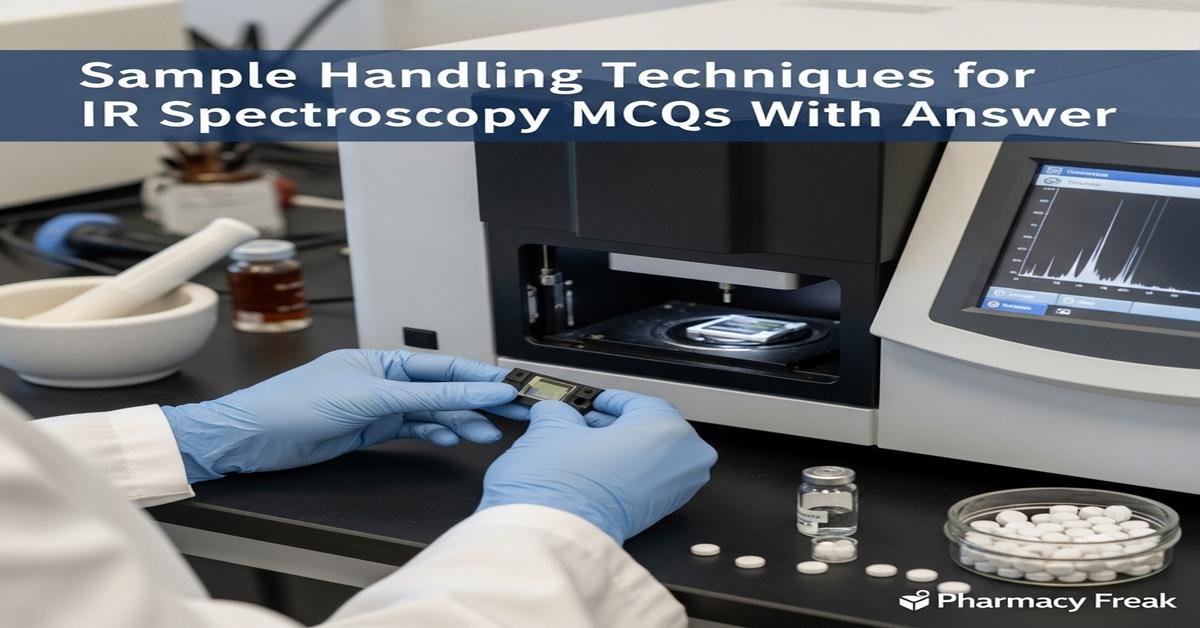
Sample handling techniques for IR spectroscopy are essential for accurate spectral interpretation in pharmaceutical analysis. This introduction reviews practical methods such as KBr pellet preparation, Nujol mulls, attenuated total reflectance (ATR), thin films, liquid cells, and diffuse reflectance, emphasizing steps to avoid contaminants, moisture, and scattering artifacts. Key considerations include choice of window materials (NaCl, … Read more

IR spectroscopy – principles and vibrational modes in molecules MCQs With Answer

IR spectroscopy – principles and vibrational modes in molecules MCQs With Answer

Infrared (IR) spectroscopy is a fundamental analytical technique for B.Pharm students that probes molecular vibrations to identify functional groups and confirm drug structures. Based on absorption of IR radiation at characteristic wavenumbers (cm−1), IR reveals stretching and bending vibrational modes, fingerprint regions, and effects of conjugation, hydrogen bonding, and isotopic substitution. Key concepts include selection … Read more

Instrumentation and pharmaceutical applications of fluorimetry MCQs With Answer

Instrumentation and pharmaceutical applications of fluorimetry MCQs With Answer

Introduction: Fluorimetry, or fluorescence spectroscopy, is a powerful analytical technique widely used in pharmaceutical analysis for sensitive and selective detection of drugs, impurities, and biomolecules. Understanding instrumentation — light sources, excitation-emission optics, monochromators, filters, detectors (PMT, CCD), and software — is essential for accurate assays. Key concepts include quantum yield, fluorescence lifetime, inner-filter effects, quenching … Read more

Internal and external conversion, fluorescence quenching and influencing factors MCQs With Answer

Internal and external conversion, fluorescence quenching and influencing factors MCQs With Answer

Introduction: Understanding internal conversion, external conversion and fluorescence quenching is essential for B. Pharm students studying photophysics and drug analysis. Internal conversion (non-radiative decay between electronic states) and external conversion (energy loss to solvent or collisions) control fluorescence intensity and quantum yield. Fluorescence quenching mechanisms — dynamic (collisional), static (ground-state complex formation), FRET (Förster resonance … Read more

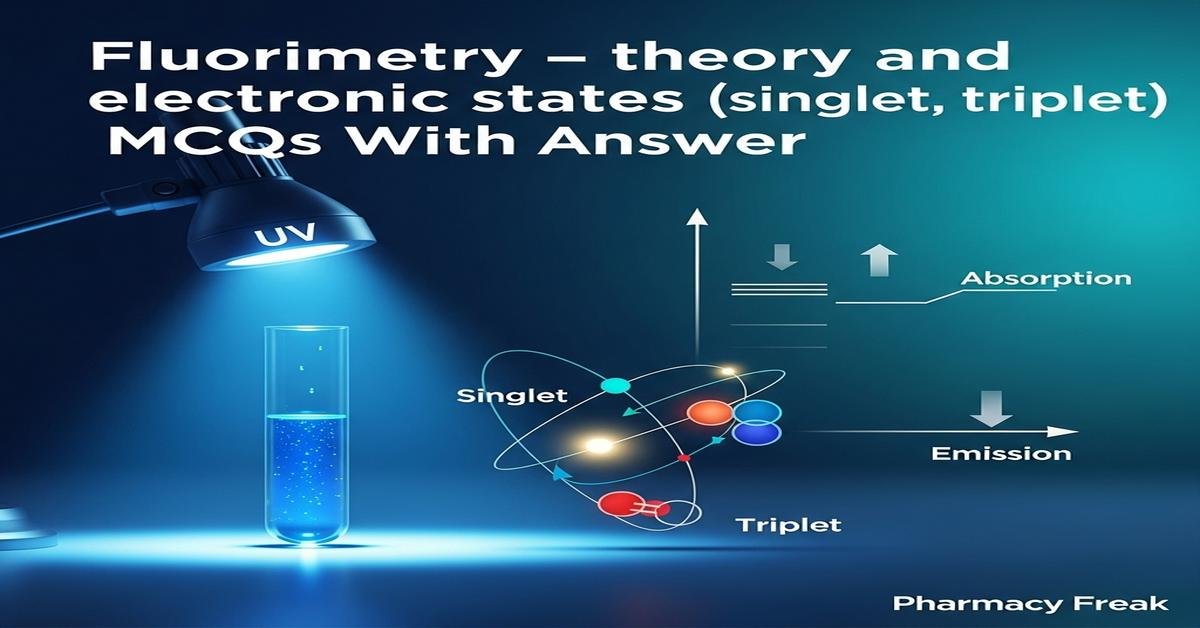
Fluorimetry – theory and electronic states (singlet, triplet) MCQs With Answer

Fluorimetry – theory and electronic states (singlet, triplet) MCQs With Answer

Fluorimetry is a sensitive analytical technique that measures fluorescence emitted by molecules after electronic excitation. Understanding the underlying theory—including the Jablonski diagram, singlet and triplet electronic states, Stokes shift, quantum yield and excited-state lifetimes—is essential for reliable drug analysis, impurity detection, and formulation studies in B.Pharm. Instrumental factors (monochromators, filters, detectors), solvent effects, inner-filter effects, … Read more

Spectrophotometric titrations and quantitative analysis MCQs With Answer

Spectrophotometric titrations and quantitative analysis MCQs With Answer

Spectrophotometric titrations and quantitative analysis are essential for B.Pharm students, merging titrimetric accuracy with spectroscopic detection to quantify drugs, impurities, and excipients. This introduction covers core keywords and concepts: spectrophotometric titrations, quantitative analysis, Beer–Lambert law, absorbance, molar absorptivity, path length, calibration curve, limits of detection (LOD/LOQ), linearity, instrument components (light source, monochromator, detector), sample preparation, … Read more

Applications of UV–Visible spectroscopy in single and multicomponent analysis MCQs With Answer

Applications of UV–Visible spectroscopy in single and multicomponent analysis MCQs With Answer

Introduction: UV–Visible spectroscopy (UV-Vis) is an essential tool in pharmaceutical analysis for qualitative and quantitative determination of drugs. This technique relies on the Beer-Lambert law, absorbance at characteristic λmax, and parameters like molar absorptivity and path length to perform accurate single-component assays and robust multicomponent analysis. In pharmaceuticals, methods such as the simultaneous equation method, … Read more

Sample cells and detector types – phototube, photomultiplier, photovoltaic cell, silicon photodiode MCQs With Answer

Sample cells and detector types – phototube, photomultiplier, photovoltaic cell, silicon photodiode MCQs With Answer

Introduction: Sample cells (cuvettes) and optical detectors are central to pharmaceutical analysis using UV-Vis spectrophotometry, HPLC detectors and assay instrumentation. B. Pharm students should understand cuvette materials (glass, quartz, plastic), path length, and solvent compatibility plus detector types: phototube, photomultiplier, photovoltaic cell and silicon photodiode. Key concepts include photoelectric effect, quantum efficiency, responsivity, gain, dark … Read more

PRO
Ad-Free Access
$3.99 / month
  • ✓ No Interruptions
  • ✓ Faster Page Loads
  • ✓ Support Content Creators