
Trusted by 50K+ Pharmacy StudentsHigh Quality Notes, MCQs, Mock Tests & Study ResourcesGo Premium (Ads Free)
Pharmacy Freak

Industry Fellowships (PharmD): The #1 Pathway to Big Pharma, A Guide to the Rutgers and MCPHS Programs for a Career in Medical Affairs

Industry Fellowships (PharmD): The #1 Pathway to Big Pharma, A Guide to the Rutgers and MCPHS Programs for a Career in Medical Affairs

Industry fellowships are the most direct bridge from a PharmD to a full-time role at a global pharmaceutical company. They give you structured training, real projects, and a network inside Big Pharma. If you want a career in Medical Affairs, the Rutgers and MCPHS programs are the two largest and most visible paths. This guide … Read more
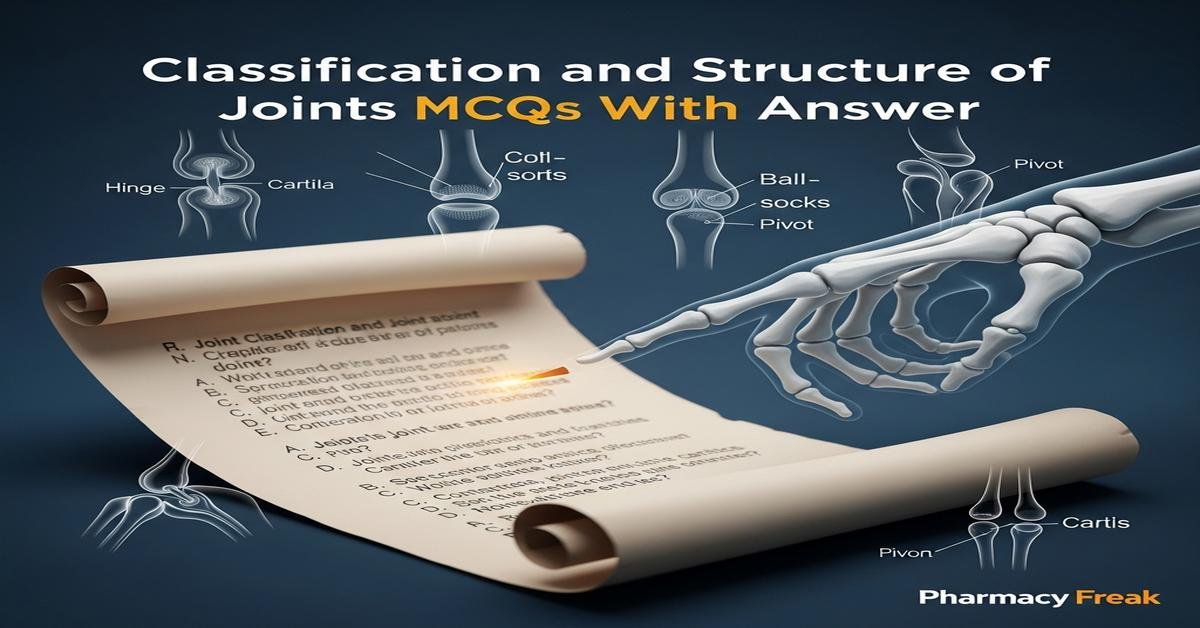
Classification and structure of joints MCQs With Answer

Classification and structure of joints MCQs With Answer

Classification and structure of joints MCQs With Answer is an essential topic for B. Pharm students, covering the anatomical types, functional categories, and microstructure of articulations relevant to pharmacology and clinical practice. This introduction reviews fibrous, cartilaginous and synovial joints, joint capsule components, synovial membrane and fluid, articular cartilage, ligaments and bursae, and common pathologies … Read more

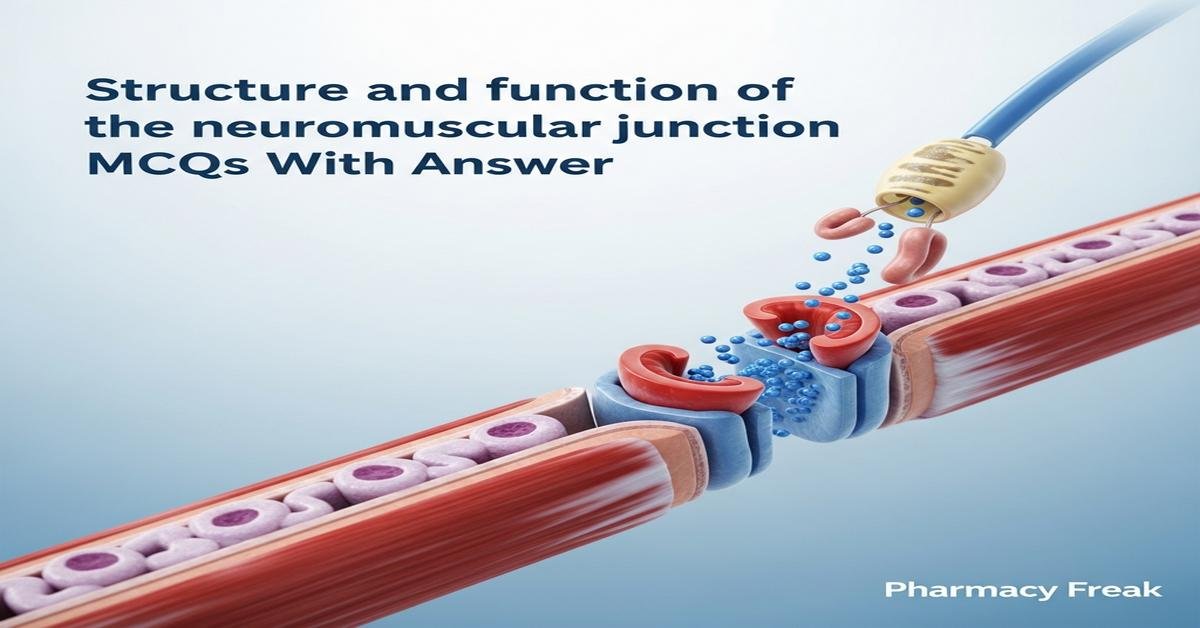
Structure and function of the neuromuscular junction MCQs With Answer

Structure and function of the neuromuscular junction MCQs With Answer

Introduction: The neuromuscular junction (NMJ) is the specialized synapse where motor neurons communicate with skeletal muscle fibers to produce contraction. Key elements include the motor end plate, synaptic cleft, synaptic vesicles containing acetylcholine (ACh), nicotinic acetylcholine receptors (nAChRs), and acetylcholinesterase (AChE). Understanding quantal release, end-plate potentials (EPPs), the safety factor for neuromuscular transmission, and presynaptic … Read more

Physiology of muscle contraction MCQs With Answer

Physiology of muscle contraction MCQs With Answer

Understanding the physiology of muscle contraction is essential for B.Pharm students. This focused review explains skeletal, cardiac, and smooth muscle mechanisms, emphasizing the sliding filament theory, excitation–contraction coupling, and cross-bridge cycling. Key molecular players—actin, myosin, troponin, tropomyosin, ATP, Ca2+, ryanodine and DHP receptors, and SERCA—are discussed with clinical and pharmacological relevance, including neuromuscular transmission, muscle … Read more

Lymphatic System Quiz | Human Anatomy & Physiology–I

Lymphatic System Quiz | Human Anatomy & Physiology–I Welcome to the Lymphatic System mock test, designed specifically for B.Pharma students studying Human Anatomy & Physiology-I. This quiz contains 30 multiple-choice questions covering key subtopics: lymphatic tissues and organs, lymph vessels, the mechanics of lymph circulation, and essential physiological functions. This assessment will help you evaluate … Read more

Organization of skeletal muscle MCQs With Answer

Organization of skeletal muscle MCQs With Answer

This compilation of Organization of Skeletal Muscle MCQs With Answer is designed for B. Pharm students to strengthen understanding of skeletal muscle structure and function. It covers muscle fiber organization, sarcomere anatomy, myofibrils, T-tubules and sarcoplasmic reticulum, excitation–contraction coupling, sliding filament mechanism, neuromuscular junction, muscle histology, fiber types, and clinical correlations. Each multiple-choice question targets … Read more

Body Fluids & Blood Quiz | Human Anatomy & Physiology–I

Body Fluids & Blood Quiz | Human Anatomy & Physiology–I Welcome to the mock test on Body Fluids and Blood, a core topic in Human Anatomy & Physiology–I for B.Pharma students. This comprehensive quiz is designed to test your understanding of key concepts, including the types and composition of body fluids, the intricate process of … Read more

Salient features and functions of appendicular skeleton bones MCQs With Answer

Salient features and functions of appendicular skeleton bones MCQs With Answer

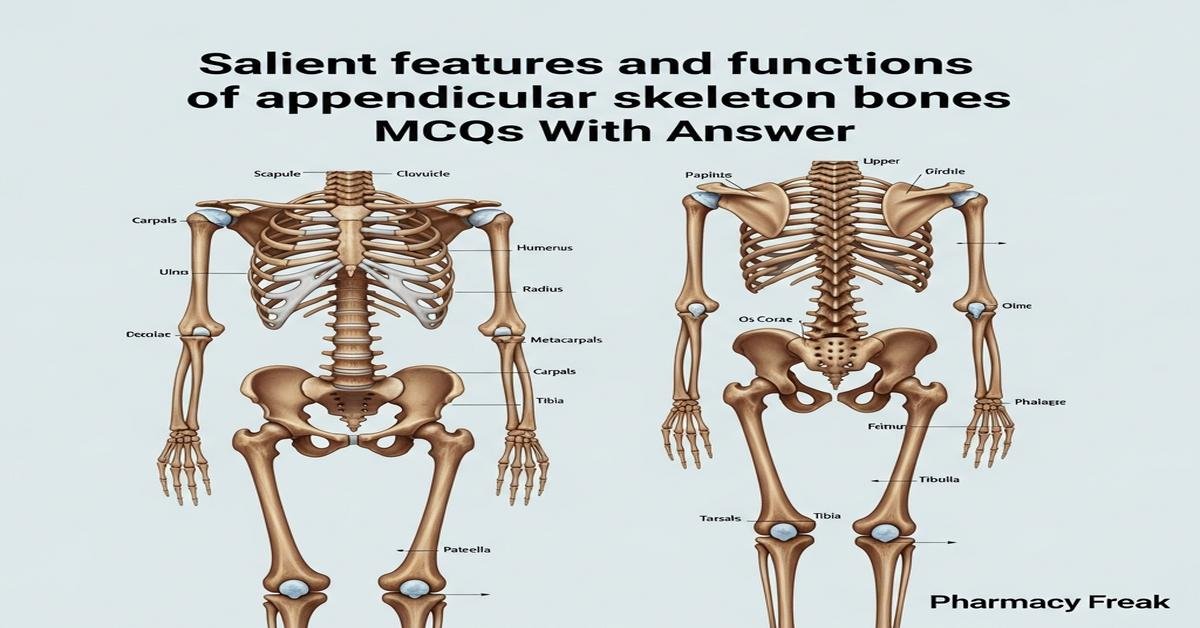
The appendicular skeleton covers the bones of the limbs and girdles and is vital for mobility, posture, and load transmission. This overview outlines salient features and functions of appendicular skeleton bones—clavicle, scapula, humerus, radius, ulna, carpals, metacarpals, phalanges, pelvis, femur, tibia, fibula, and tarsals—emphasizing structural landmarks, joint types, muscle attachments, neurovascular relations, ossification, and clinical … Read more

Salient features and functions of axial skeleton bones MCQs With Answer

Salient features and functions of axial skeleton bones MCQs With Answer

Introduction: The axial skeleton comprises the skull, vertebral column, ribs and sternum — structures fundamental to protection, support, movement and hematopoiesis. For B. Pharm students, understanding salient features and functions of axial bones is vital for linking anatomy with drug delivery, disease mechanisms and clinical implications. Key concepts include vertebral regional differences, foramina and cranial … Read more

Divisions and types of the skeletal system MCQs With Answer

Divisions and types of the skeletal system MCQs With Answer

Understanding the divisions and types of the skeletal system is essential for B. Pharm students who study anatomy, pharmacology, and bone-related therapeutics. This concise overview emphasizes osteology keywords: axial skeleton, appendicular skeleton, long bone, short bone, flat bone, irregular bone, sesamoid bone, compact bone, spongy bone, and ossification. It reviews bone functions, marrow types, and … Read more

PRO
Ad-Free Access
$3.99 / month
  • ✓ No Interruptions
  • ✓ Faster Page Loads
  • ✓ Support Content Creators