Table of Contents
Introduction
Kerendia is the brand name for finerenone, a non-steroidal selective mineralocorticoid receptor antagonist (MRA) used to reduce the risk of chronic kidney disease (CKD) progression and cardiovascular complications in adults with chronic kidney disease associated with type 2 diabetes mellitus.
Unlike older steroidal MRAs such as spironolactone and eplerenone, finerenone has a unique non-steroidal structure that provides high selectivity for mineralocorticoid receptors while minimizing off-target hormonal effects. Finerenone exerts both renoprotective and cardioprotective effects by blocking pathological mineralocorticoid receptor activation, thereby reducing inflammation and fibrosis in the kidneys and cardiovascular system.
Mechanism of Action (Step-wise)
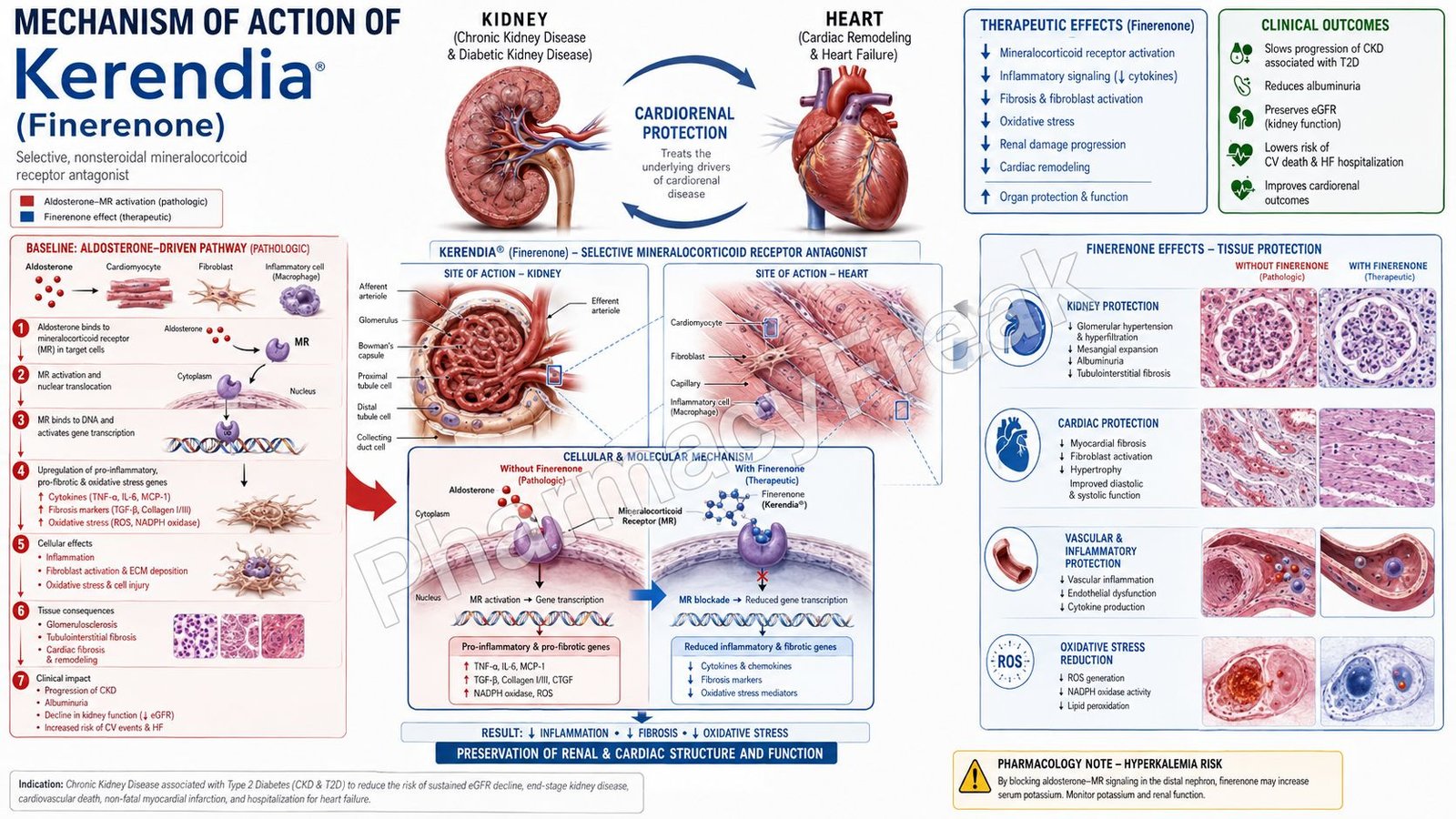
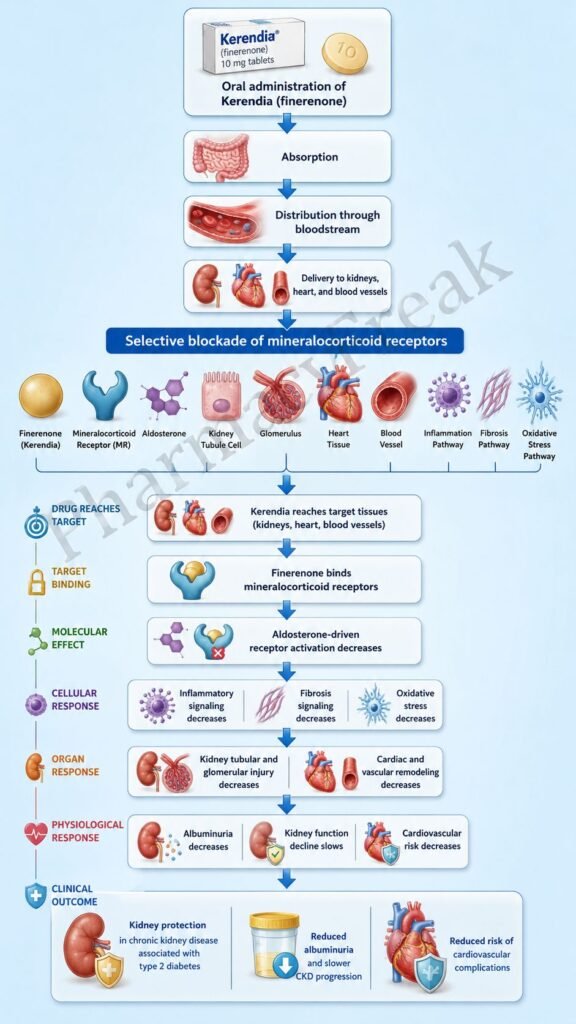
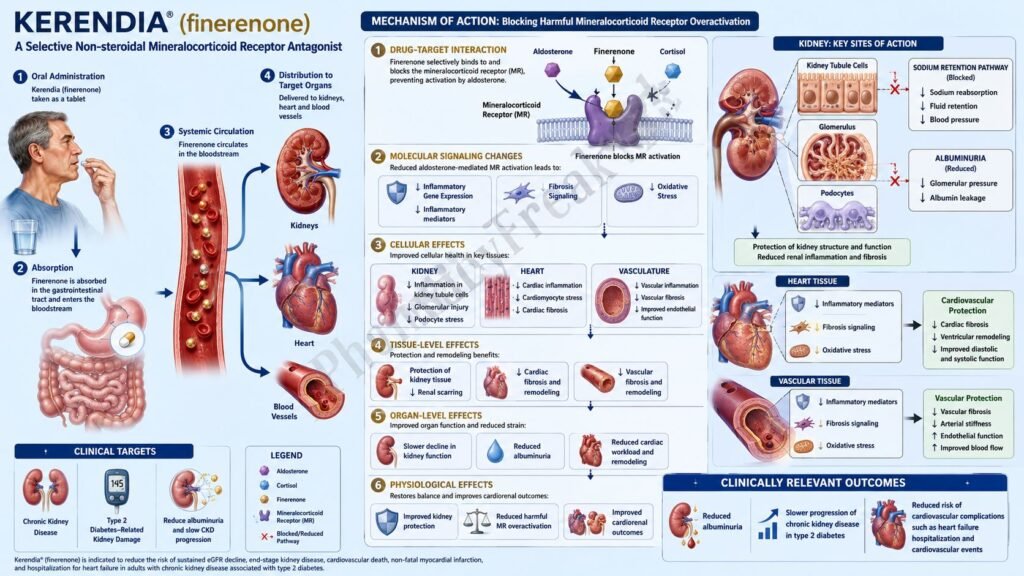
Finerenone acts by selectively blocking mineralocorticoid receptors and preventing harmful aldosterone-mediated signaling.
1. Mineralocorticoid Receptor Activation in Disease
Under normal physiological conditions, aldosterone binds to mineralocorticoid receptors (MRs) located in:
- Kidney cells
- Cardiomyocytes
- Vascular cells
- Inflammatory cells
Physiological activation helps regulate:
- Sodium balance
- Potassium balance
- Blood pressure
- Fluid homeostasis
In chronic kidney disease and diabetes, excessive mineralocorticoid receptor activation promotes tissue damage.
2. Excessive Aldosterone-Mediated Signaling
Persistent MR activation leads to:
- Increased inflammatory cytokine production
- Oxidative stress
- Fibrosis
- Endothelial dysfunction
- Structural remodeling of kidneys and heart
These processes contribute to progressive kidney injury and cardiovascular disease.
3. Selective Binding to Mineralocorticoid Receptors
Finerenone selectively binds to mineralocorticoid receptors with high affinity.
By occupying the receptor:
- Aldosterone cannot effectively activate MR signaling.
- Pathological transcriptional activity is reduced.
- Downstream inflammatory pathways are suppressed.
4. Inhibition of Pro-Inflammatory Gene Expression
Mineralocorticoid receptor activation normally promotes expression of genes involved in:
- Inflammation
- Oxidative stress
- Fibrotic tissue remodeling
Finerenone inhibits these gene transcription pathways, leading to:
- Reduced inflammatory cell recruitment
- Reduced cytokine production
- Lower oxidative injury
5. Reduction of Fibrosis
One of the most important effects of finerenone is suppression of fibrotic signaling.
This decreases:
- Renal fibrosis
- Glomerular injury
- Tubulointerstitial fibrosis
- Cardiac fibrosis
Reduced fibrosis helps preserve organ structure and function.
6. Protection of Kidney Function
By reducing inflammation and fibrosis, finerenone:
- Slows decline in glomerular filtration rate (GFR)
- Reduces albuminuria
- Slows progression of chronic kidney disease
- Preserves renal function
7. Cardiovascular Protection
In cardiovascular tissues, finerenone:
- Reduces myocardial fibrosis
- Improves vascular function
- Decreases adverse cardiac remodeling
- Lowers risk of cardiovascular events
8. Final Therapeutic Effect
The combined effects include:
- Reduced kidney damage
- Reduced albuminuria
- Slower CKD progression
- Reduced cardiovascular morbidity
- Improved long-term cardiorenal outcomes
Thus, finerenone acts as a selective non-steroidal mineralocorticoid receptor antagonist that suppresses inflammation and fibrosis in the kidneys and cardiovascular system.
Pharmacokinetics
Finerenone is administered orally and has favorable pharmacokinetic properties.
- Rapid oral absorption.
- Peak plasma concentrations occur within approximately 0.5–1.5 hours.
- High plasma protein binding.
- Primarily metabolized in the liver.
- CYP3A4 is the major metabolic enzyme.
- Metabolites are inactive.
- Excreted through both urine and feces.
- Elimination half-life is approximately 2–3 hours.
Strong CYP3A4 inhibitors can significantly increase finerenone exposure and should generally be avoided.
Clinical Uses
Chronic Kidney Disease Associated with Type 2 Diabetes
Finerenone is approved to reduce the risk of CKD progression in adults with type 2 diabetes.
Reduction of Albuminuria
Helps reduce urinary albumin excretion and kidney injury.
Cardiovascular Risk Reduction
Used to lower the risk of:
- Cardiovascular death
- Nonfatal myocardial infarction
- Hospitalization for heart failure
Cardiorenal Protection
Provides simultaneous kidney and cardiovascular protection in high-risk diabetic patients.
Adverse Effects
Common adverse effects include:
- Hyperkalemia
- Mild hypotension
- Dizziness
- Reduced blood pressure
Important adverse effects include:
- Significant hyperkalemia
- Elevated serum potassium
- Decline in renal function in susceptible patients
- Symptomatic hypotension
Regular monitoring of serum potassium and renal function is recommended during therapy.
Comparative Analysis
| Drug | Class | Mechanism | Major Clinical Use | Key Limitation |
|---|---|---|---|---|
| Finerenone (Kerendia) | Non-steroidal MRA | Mineralocorticoid receptor blockade | CKD with type 2 diabetes | Hyperkalemia |
| Spironolactone | Steroidal MRA | Mineralocorticoid receptor blockade | Heart failure, hyperaldosteronism | Gynecomastia, hormonal effects |
| Eplerenone | Steroidal selective MRA | Mineralocorticoid receptor blockade | Heart failure, hypertension | Hyperkalemia |
| Losartan | ARB | Angiotensin II receptor blockade | Hypertension, diabetic nephropathy | Hyperkalemia |
| Empagliflozin | SGLT2 inhibitor | Glucose and sodium reabsorption inhibition | Diabetes, CKD, heart failure | Genital infections |
Finerenone differs from spironolactone because it is non-steroidal and has minimal antiandrogenic or endocrine adverse effects. Compared with eplerenone, finerenone demonstrates strong anti-inflammatory and antifibrotic effects specifically studied in diabetic kidney disease.
MCQs
1. Kerendia contains which active ingredient?
a) Eplerenone
b) Finerenone
c) Spironolactone
d) Empagliflozin
Answer: b) Finerenone
2. Finerenone belongs to which drug class?
a) ACE inhibitor
b) ARB
c) Mineralocorticoid receptor antagonist
d) Beta-blocker
Answer: c) Mineralocorticoid receptor antagonist
3. Finerenone primarily blocks which receptor?
a) Angiotensin II receptor
b) Beta-1 receptor
c) Mineralocorticoid receptor
d) Alpha-1 receptor
Answer: c) Mineralocorticoid receptor
4. The natural ligand for the mineralocorticoid receptor is:
a) Cortisol only
b) Aldosterone
c) Epinephrine
d) Dopamine
Answer: b) Aldosterone
5. Finerenone reduces progression of:
a) Parkinson disease
b) Chronic kidney disease associated with type 2 diabetes
c) Tuberculosis
d) Asthma
Answer: b) Chronic kidney disease associated with type 2 diabetes
6. One major therapeutic effect of finerenone is:
a) Increased fibrosis
b) Reduced inflammation and fibrosis
c) Increased sodium retention
d) Enhanced platelet aggregation
Answer: b) Reduced inflammation and fibrosis
7. Which enzyme primarily metabolizes finerenone?
a) CYP2D6
b) CYP2C9
c) CYP1A2
d) CYP3A4
Answer: d) CYP3A4
8. The most important adverse effect of finerenone is:
a) Hypoglycemia
b) Hyperkalemia
c) Neutropenia
d) Ototoxicity
Answer: b) Hyperkalemia
9. Finerenone differs from spironolactone because it is:
a) An ACE inhibitor
b) A beta-blocker
c) Non-steroidal
d) A calcium channel blocker
Answer: c) Non-steroidal
10. Finerenone helps reduce:
a) Albuminuria
b) Hyperglycemia directly
c) Platelet count
d) Bone density
Answer: a) Albuminuria
11. Finerenone exerts protective effects mainly through:
a) Antibacterial activity
b) Anti-inflammatory and antifibrotic actions
c) Direct insulin secretion
d) Histamine blockade
Answer: b) Anti-inflammatory and antifibrotic actions
12. Monitoring during finerenone therapy should include:
a) Serum potassium levels
b) Visual acuity
c) Pulmonary function tests
d) Thyroid hormone levels
Answer: a) Serum potassium levels
FAQs
What is the mechanism of action of Kerendia?
Kerendia (finerenone) selectively blocks mineralocorticoid receptors, reducing aldosterone-mediated inflammation, fibrosis, and organ damage in the kidneys and cardiovascular system.
Is finerenone a steroid?
No. Finerenone is a non-steroidal mineralocorticoid receptor antagonist.
How does finerenone protect the kidneys?
It reduces inflammation and fibrosis within renal tissues, helping slow chronic kidney disease progression and reduce albuminuria.
What is Kerendia used for?
Kerendia is used to reduce the risk of chronic kidney disease progression and cardiovascular events in adults with CKD associated with type 2 diabetes.
What is the major adverse effect of finerenone?
Hyperkalemia is the most important adverse effect and requires regular potassium monitoring.
How is finerenone different from spironolactone?
Finerenone is more selective, non-steroidal, and has fewer hormonal adverse effects such as gynecomastia.
Does finerenone lower blood pressure?
Yes. It can produce modest blood pressure reduction through mineralocorticoid receptor blockade, although its primary benefit is cardiorenal protection.
References
Goodman & Gilman’s The Pharmacological Basis of Therapeutics
Katzung Basic & Clinical Pharmacology