
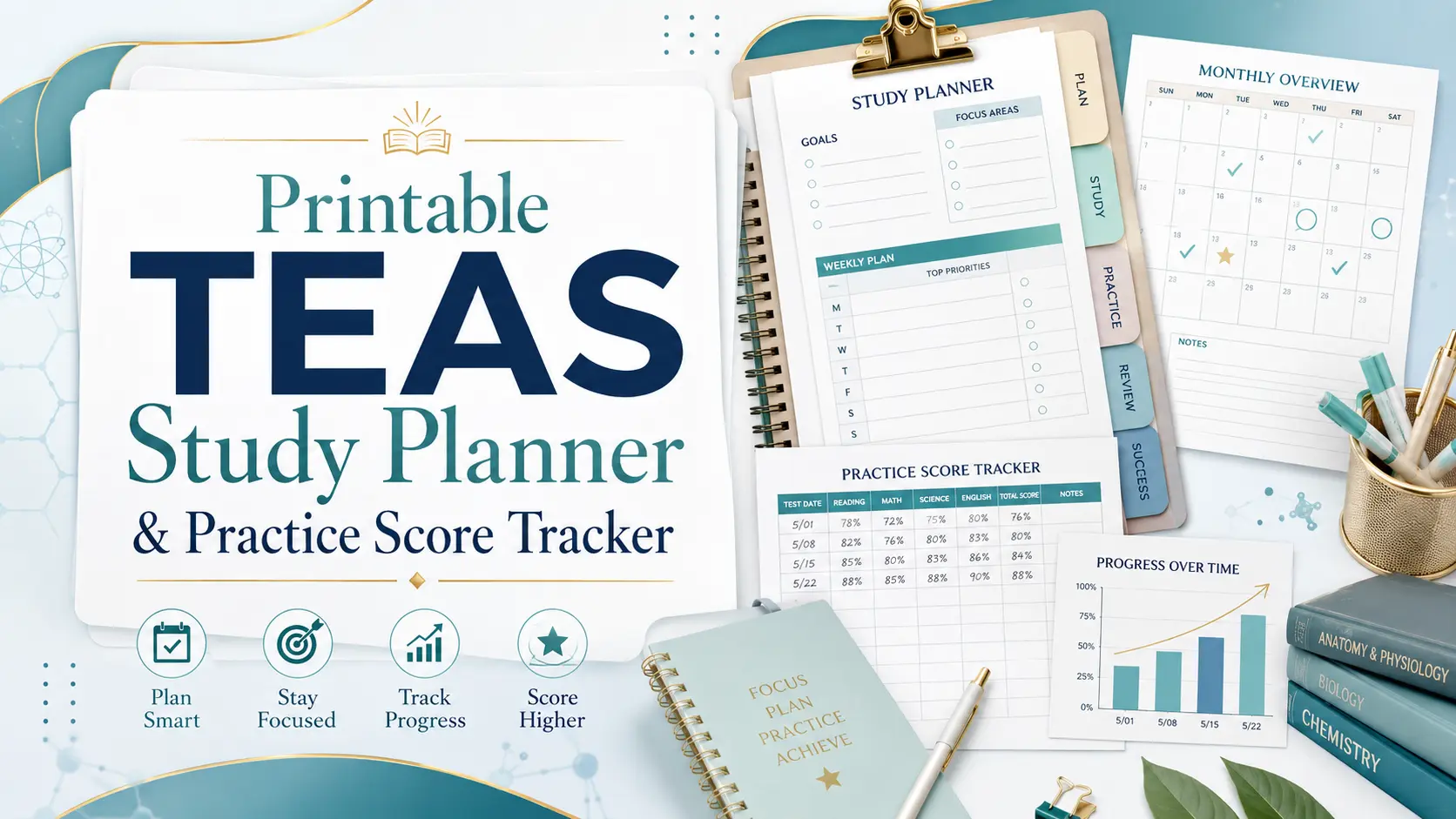
A TEAS study plan should tell you what to do next. A calendar filled with vague notes such as “study Science” or “review Math” won’t do that.
This planner helps you turn practice results into specific tasks. You can record section scores, track missed concepts, schedule subject tests, compare later attempts, and decide when you are ready for a mixed or full-length practice exam.
Use the tables directly on this page, copy them into a document, or print the page and complete them by hand.
Start with four dates
Before choosing what to study, write down the dates that control your preparation.
| Planning item | Your date |
|---|---|
| Official ATI TEAS test date | |
| Application deadline | |
| Score-submission deadline | |
| Planned final full-length practice test |
Leave several days between your final full-length test and the official exam. That gives you time to review mistakes without trying to learn large new topics at the last minute.
Students preparing for a retake should also record:
| Retake planning item | Your date or rule |
|---|---|
| Earliest permitted retake date | |
| School attempt limit | |
| School waiting-period rule | |
| Final date for submitting a new score |
Check these details with the school or testing provider rather than relying on a general rule from another student.
Choose a study period you can actually follow
The best plan is not always the longest one. It is the one that fits the time you have and leaves enough room for review.
Two-week plan
A two-week schedule is tight. Use it to repair the largest weaknesses rather than trying to relearn every topic.
A workable structure:
| Days | Main task |
|---|---|
| Day 1 | Take a mixed diagnostic test and record the result |
| Days 2–4 | Review the weakest subject |
| Day 5 | Take a timed subject test |
| Days 6–7 | Review explanations and repeat weak concepts |
| Days 8–9 | Review the second-weakest subject |
| Day 10 | Take another subject or mixed test |
| Day 11 | Correct mistakes and review timing problems |
| Day 12 | Take one full-length test if you have enough time and energy |
| Day 13 | Review the report and key notes |
| Day 14 | Light review, test-day preparation, and rest |
Do not fill every day with a new test. In a short plan, review time matters even more.
Four-week plan
Four weeks gives you enough time to diagnose, repair weaknesses, and retest.
| Week | Main focus |
|---|---|
| Week 1 | Baseline mixed test and subject review |
| Week 2 | Timed subject tests and error correction |
| Week 3 | Mixed practice and weak-area repair |
| Week 4 | Full-length practice, final review, and test-day preparation |
Use the first week to find problems. Do not guess.
A student who assumes Science is the weakest area may discover through testing that most lost points come from Math timing or English punctuation.
Six-week plan
Six weeks allows more space between tests.
| Week | Main focus |
|---|---|
| Week 1 | Learn the exam structure and take a baseline mixed test |
| Week 2 | Reading and Math review |
| Week 3 | Anatomy and Physiology review |
| Week 4 | Biology, Chemistry, Scientific Reasoning, and English |
| Week 5 | Subject tests and mixed practice |
| Week 6 | Full-length testing, targeted correction, and lighter final review |
This structure works well for students who need both content review and timed practice.
Eight-week plan
An eight-week plan gives you time to revisit weak topics after the first round of practice.
| Week | Main focus |
|---|---|
| Week 1 | Baseline and planning |
| Week 2 | Reading |
| Week 3 | Math |
| Week 4 | Anatomy and Physiology |
| Week 5 | Biology, Chemistry, and Scientific Reasoning |
| Week 6 | English and Language Usage |
| Week 7 | Mixed and subject retesting |
| Week 8 | Full-length checkpoints and final review |
An eight-week schedule should not become eight weeks of passive reading. Start practice early enough to expose mistakes.
Record your baseline
Begin with one mixed test that covers all four subjects.
Pharmacy Freak currently offers five free mixed sets:
- TEAS Practice Test 1
- TEAS Practice Test 2
- TEAS Practice Test 3
- TEAS Practice Test 4
- TEAS Practice Test 5
Each test includes 50 questions across Reading, Math, Science, and English and Language Usage, with a 61-minute timer, instant results, explanations, section-wise performance, PDF review, and no login requirement.
Use Test 1 as your baseline unless you have already completed it.
Baseline record
| Result area | Your result |
|---|---|
| Overall practice percentage | |
| Reading | |
| Math | |
| Science | |
| English and Language Usage | |
| Unanswered questions | |
| Questions marked or guessed | |
| Main timing problem | |
| Strongest subject | |
| Weakest subject |
Pharmacy Freak results are practice percentages. They are useful for comparing attempts and identifying weak areas, but they are not official ATI equated scores.
Build a weakness map
A section score tells you where a problem exists. It does not tell you why.
Use this table to separate knowledge gaps from test-taking mistakes.
| Subject | Weak topic | Error type | What happened | Next action |
|---|---|---|---|---|
| Reading | ||||
| Math | ||||
| Science | ||||
| English |
Useful error types include:
- Knowledge gap
- Misread question
- Calculation error
- Vocabulary problem
- Pacing
- Guessing
- Careless selection
- Changed a correct answer
- Left unanswered
Be specific.
“Science is weak” is too broad.
“Confused independent and dependent variables” gives you something to fix.
“Math timing” is still vague.
“Spent too long on multi-step percentage questions” is useful.
Subject study tracker
Use one tracker for each section.
Reading tracker
| Reading skill | Confidence before review | Review completed | Practice completed | Needs another review |
|---|---|---|---|---|
| Main idea | ||||
| Supporting details | ||||
| Inference | ||||
| Sequence and directions | ||||
| Author’s purpose | ||||
| Tone and point of view | ||||
| Vocabulary in context | ||||
| Comparing passages | ||||
| Evaluating evidence | ||||
| Charts and visual information |
Use the ATI TEAS 7 Reading Study Guide for review, then move to:
Each Reading test contains 30 timed questions and includes skill-wise results, explanations, and PDF review.
Math tracker
| Math topic | Confidence before review | Review completed | Practice completed | Needs another review |
|---|---|---|---|---|
| Fractions and decimals | ||||
| Percentages | ||||
| Ratios and proportions | ||||
| Rates | ||||
| Algebraic expressions | ||||
| Equations and inequalities | ||||
| Geometry | ||||
| Unit conversions | ||||
| Tables and graphs | ||||
| Mean, median, mode, and range |
After reviewing the ATI TEAS 7 Math Study Guide, use:
The Math tests contain 30 questions with a 45-minute timer, topic-level analysis, explanations, and PDF review.
Science tracker
| Science topic | Confidence before review | Review completed | Practice completed | Needs another review |
|---|---|---|---|---|
| Cardiovascular system | ||||
| Respiratory system | ||||
| Digestive system | ||||
| Nervous system | ||||
| Endocrine system | ||||
| Urinary system | ||||
| Reproductive systems | ||||
| Cells and organelles | ||||
| Genetics | ||||
| Chemistry | ||||
| Scientific method | ||||
| Variables and experimental design |
Use the ATI TEAS 7 Science Study Guide for detailed review.
Then take:
Each Science test contains 30 timed questions: 12 Anatomy and Physiology, 6 Biology, 6 Chemistry, and 6 Scientific Reasoning.
English and Language Usage tracker
| English skill | Confidence before review | Review completed | Practice completed | Needs another review |
|---|---|---|---|---|
| Sentence completeness | ||||
| Subject-verb agreement | ||||
| Pronouns | ||||
| Verb tense | ||||
| Commas | ||||
| Apostrophes | ||||
| Semicolons and colons | ||||
| Parallel structure | ||||
| Paragraph organization | ||||
| Context clues | ||||
| Prefixes, suffixes, and roots |
Review the TEAS Grammar Rules and Vocabulary Study Sheet and then complete:
Each English test contains 30 questions with a 30-minute timer, explanations, skill analysis, and PDF review.
Plan the five free mixed tests
Do not take the five mixed tests in random order.
Give each one a job.
| Mixed test | Recommended use |
|---|---|
| Test 1 | Baseline |
| Test 2 | Early progress check |
| Test 3 | Mid-plan review |
| Test 4 | Weak-area verification |
| Test 5 | Final mixed check |
After each attempt, review the explanations before moving to the next test.
A student who completes five tests but never studies the mistakes has mostly practised making the same errors.
Practice-test score tracker
Use this table for mixed, subject-wise, and full-length attempts.
| Test | Date | Type | Overall | Reading | Math | Science | English | Unanswered | Main action |
|---|---|---|---|---|---|---|---|---|---|
The “Main action” column matters most.
Examples:
- Review percentage decrease
- Repeat respiratory-system pathway
- Practise inference questions
- Stop changing answers without evidence
- Leave two minutes for unanswered questions
- Review apostrophes and pronoun agreement
Error log
Use one row for each repeated or important mistake.
| Question or concept | Subject | Error type | Why the error happened | Correct rule or reasoning | Retest date | Resolved? |
|---|---|---|---|---|---|---|
Do not copy the entire question unless you need it.
A short concept note is usually better:
- Pulmonary artery carries blood away from the heart
- Percent decrease uses the original value as the denominator
- Main idea must cover the whole passage
- Semicolon joins two independent clauses
When the same error appears twice, raise its priority.
Daily study checklist
A useful study session does not need to last several hours.
Use this structure:
- Review two or three previous errors.
- Study one focused topic.
- Complete a small set of questions.
- Read every explanation.
- Write down one rule or process from memory.
- Record the next task before stopping.
Short session: 30 minutes
| Time | Task |
|---|---|
| 5 minutes | Review old errors |
| 15 minutes | Study one concept |
| 8 minutes | Complete questions |
| 2 minutes | Record the next step |
Standard session: 60 minutes
| Time | Task |
|---|---|
| 10 minutes | Retrieval review |
| 25 minutes | Concept study |
| 15 minutes | Practice questions |
| 10 minutes | Explanation review and error log |
Longer session: 90 minutes
| Time | Task |
|---|---|
| 10 minutes | Review previous errors |
| 35 minutes | Study |
| 25 minutes | Timed practice |
| 15 minutes | Review explanations |
| 5 minutes | Update the planner |
Longer is not automatically better. Stop when attention drops enough that you are reading without processing.
Weekly reflection
Complete this section once a week.
What improved?
Which topic is still causing trouble?
Which error repeated?
Did timing improve?
Did I review every explanation?
What is next week’s first priority?
Should I change the plan?
Do not rewrite the whole schedule after one poor score. Look for a pattern across several attempts.
When to take a full-length practice test
A full-length test is useful when you need to measure more than subject knowledge.
It can show whether you:
- Maintain focus across 170 questions
- Manage separate section timers
- Slow down in later sections
- Leave questions unanswered
- Review effectively before submitting a section
- Use the optional break well
- Recover after a difficult section
Pharmacy Freak’s full-length ATI TEAS 7 practice-test package includes 10 complete practice exams for $9.
Each test includes:
- 170 delivered questions
- 150 scored questions
- 20 unidentified unscored questions
- Four separately timed sections
- Server-controlled timing
- Automatic saving
- Mark for Review
- A question navigator
- A four-function Math calculator
- An optional break after Math
- Locked submitted sections
- Overall and section-level results
- Email delivery
- A downloadable PDF report
- Saved account history
Do not take all 10 tests one after another.
Space them through the plan.
Suggested full-length schedule
| Practice test | Suggested role |
|---|---|
| Test 1 | Baseline, only when enough study time remains |
| Test 2 | End of first major review phase |
| Test 3 | Mid-plan checkpoint |
| Test 4 | Timing-focused attempt |
| Test 5 | Weak-section verification |
| Tests 6–8 | Spaced progress checks |
| Test 9 | Late-stage rehearsal |
| Test 10 | Final rehearsal, with enough time left to review |
You may not need all 10. The value comes from spacing, review, and correction.
Why Pharmacy Freak tests are more useful than score-only quizzes
Many available practice quizzes stop after showing a percentage.
Pharmacy Freak’s free mixed and subject-wise tests also provide the correct answer, the student’s answer, an explanation, section- or topic-level analysis, and a downloadable PDF review. No login is required.
That makes them more useful for planning because they help answer two questions:
- What went wrong?
- What should I study next?
The full-length tests add separate section timers, automatic saving, review tools, account history, and detailed reports. Those features matter when the goal is to practise the complete exam process rather than answer a short set of questions.
This does not make any practice score official. Pharmacy Freak practice percentages are study tools, not ATI scores or admission predictions.
Readiness checklist
Check each statement only when you can support it with practice results.
- I understand the four-section exam structure.
- I can complete Reading within the available time.
- I can use the Math calculator without losing time.
- I have reviewed the major Anatomy and Physiology systems.
- I can interpret Science experiments and graphs.
- I can identify common English sentence errors.
- I have taken at least one mixed test.
- I have reviewed every incorrect answer from recent tests.
- My scores are reasonably stable across more than one attempt.
- I can finish without leaving several questions unanswered.
- I have completed a full-length rehearsal when practical.
- I know my exam date, identification requirements, and testing method.
- I have a plan for the final week.
Do not use this checklist as a guarantee of a particular official score. It is a preparation check.
Final-week planner
Use the final week to reduce uncertainty, not create more of it.
Seven to five days before
- Review the error log.
- Revisit two or three weak topics.
- Complete one subject or mixed test if it serves a clear purpose.
- Confirm exam details.
Four to three days before
- Review formulas, diagrams, and grammar rules.
- Complete short practice sets.
- Avoid taking several full-length tests.
Two days before
- Review only the highest-priority notes.
- Confirm identification, location, time zone, or technical setup.
- Prepare what you need for test day.
One day before
- Keep study light.
- Stop early enough to rest.
- Do not judge readiness from one last-minute quiz.
How to use this planner with Pharmacy Freak
A simple study path looks like this:
- Start at the ATI TEAS practice-test hub.
- Take one free mixed test.
- Record the section results.
- Open the study guide for the weakest subject.
- Take the matching free subject test.
- Add repeated mistakes to the error log.
- Take a second mixed test after review.
- Use a full-length test for timing and endurance.
- Compare the new report with the baseline.
- Plan the final review from the differences.
The order matters. Test, review, repair, and retest.
Frequently asked questions
How long should a TEAS study plan be?
Choose a period that gives you enough time to review mistakes between tests. Two weeks can work for focused repair, while four to eight weeks allows more subject review and spaced practice.
How often should I take a practice test?
Take another test after you have reviewed the previous result and worked on the weak areas it revealed. Taking tests every day without review usually produces little improvement.
Should I record every wrong answer?
Record repeated mistakes, important concepts, and errors that reveal a flawed method. You do not need to copy every question word for word.
How should I use section scores?
Use them to decide where to spend study time. Then look inside the section to find the exact topic or error type responsible for the score.
When should I take a full-length TEAS practice test?
Take one after you have completed enough content review to make the result useful. Full-length tests are best for timing, endurance, section transitions, and final readiness checks.
Can I use the planner for a TEAS retake?
Yes. Begin with the previous score report, identify the weakest sections, confirm the retake rules, and schedule targeted practice before another full-length rehearsal.
Are Pharmacy Freak practice scores official ATI scores?
No. Pharmacy Freak results are practice percentages based on Pharmacy Freak questions. They are intended for study tracking.
Do I need to complete all five mixed tests?
No. Use as many as your schedule allows, but review each attempt. Three carefully reviewed tests are more useful than five rushed attempts.
Are the subject-wise Pharmacy Freak tests free?
Yes. The listed Reading, Math, Science, and English subject tests are free, require no login, and include explanations, performance analysis, and PDF review.
Is the full-length package required?
No. The free mixed and subject tests can support a large part of your preparation. The paid full-length package is most useful when you need repeated complete simulations with separate section timing and detailed reports.
Independence statement
Pharmacy Freak is an independent educational resource and is not affiliated with or endorsed by Assessment Technologies Institute. ATI and TEAS are trademarks of their respective owner.
