Trusted by 50K+ Pharmacy StudentsHigh Quality Notes, MCQs, Mock Tests & Study ResourcesGo Premium (Ads Free)
Pharmacy Freak

High-performance liquid chromatography (HPLC) in herbal product evaluation MCQs With Answer
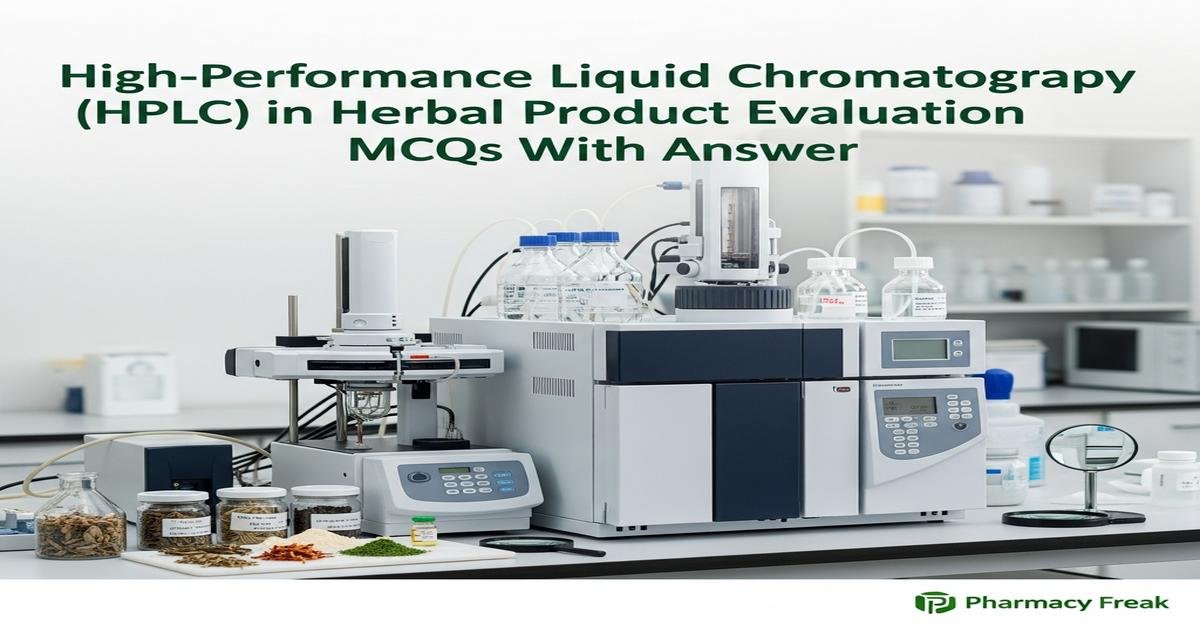
High-performance liquid chromatography (HPLC) in herbal product evaluation MCQs With Answer

Introduction: High-performance liquid chromatography (HPLC) is a cornerstone analytical technique in herbal product evaluation, enabling precise separation, identification, and quantification of complex phytochemicals. B. Pharm students must master HPLC principles — mobile phase and stationary phase selection, retention time, peak shape, and detector choice — to assess herbal quality, potency, and purity. Practical skills include … Read more

Gas chromatography (GC) applications in herbal analysis MCQs With Answer

Gas chromatography (GC) applications in herbal analysis MCQs With Answer

Gas chromatography (GC) applications in herbal analysis are essential for B. Pharm students studying phytochemical profiling, quality control, and standardization of botanicals. GC and GC‑MS enable sensitive qualitative and quantitative analysis of volatile and semi‑volatile compounds, providing retention time‑based fingerprinting, compound identification, and purity assessment. Key topics include sample preparation, extraction methods, derivatization, column selection, … Read more

High-performance thin-layer chromatography (HPTLC) for herbal standardization MCQs With Answer

High-performance thin-layer chromatography (HPTLC) for herbal standardization MCQs With Answer

High-performance thin-layer chromatography (HPTLC) is a powerful, cost-effective analytical technique widely used for herbal standardization and quality control of botanical medicines. For B. Pharm students, mastering HPTLC—sample preparation, mobile phase selection, chromatographic separation, visualization, densitometry, and method validation—is essential for reliable phytochemical fingerprinting, assay of marker compounds, and detection of adulterants. HPTLC combines speed, high … Read more

Chromatographic techniques in standardization of herbal products MCQs With Answer

Chromatographic techniques in standardization of herbal products MCQs With Answer

Chromatographic techniques are essential tools in the standardization and quality control of herbal products. For B.Pharm students, understanding separations such as thin-layer chromatography (TLC), high-performance liquid chromatography (HPLC), gas chromatography (GC) and hyphenated methods (LC-MS, GC-MS) is vital for phytochemical analysis, marker identification, purity testing and quantitative assay development. Method validation, resolution, retention time, mobile … Read more

Stability testing of herbal medicines MCQs With Answer

Stability testing of herbal medicines MCQs With Answer

Stability testing of herbal medicines is essential for B.Pharm students to understand how phytochemicals, extracts, and finished formulations retain quality, safety, and efficacy over time. This topic covers accelerated and long‑term stability studies, ICH and WHO guidelines, forced degradation, stability‑indicating assays (HPLC, TLC), packaging interactions, moisture and light effects, microbial control, and shelf‑life estimation using … Read more

Research guidelines for evaluating efficacy of herbal medicines MCQs With Answer

Research guidelines for evaluating efficacy of herbal medicines MCQs With Answer

Evaluating the efficacy of herbal medicines requires rigorous research guidelines tailored for B. Pharm students. This concise introduction summarizes key concepts: study design, botanical authentication, phytochemistry, standardization, quality control, preclinical models, clinical trial methodology, pharmacokinetics, safety assessment, adverse event monitoring, and regulatory frameworks. Emphasis is on evidence-based approaches — randomized controlled trials, validated analytical methods … Read more

Research guidelines for evaluating safety of herbal medicines MCQs With Answer

Research guidelines for evaluating safety of herbal medicines MCQs With Answer

Research guidelines for evaluating safety of herbal medicines equip B. Pharm students with practical knowledge in toxicology, pharmacovigilance, quality control, and regulatory frameworks. These guidelines cover preclinical studies (acute, subchronic, chronic, genotoxicity), analytical standardization (marker compounds, HPLC, DNA barcoding), contaminants (heavy metals, pesticides, pyrrolizidine alkaloids), and clinical trial requirements. Understanding concepts like NOAEL, LD50, ADME, … Read more

ICH guidelines for quality control of herbal medicines MCQs With Answer

ICH guidelines for quality control of herbal medicines MCQs With Answer

Introduction: The ICH guidelines for quality control of herbal medicines provide B.Pharm students with a regulatory framework to ensure safety, efficacy and consistent quality of botanical products. These guidance documents—linking pharmacognosy, quality assurance and analytical methods—cover specifications, validation of analytical procedures (ICH Q2), stability testing (ICH Q1), impurities, good manufacturing practices (GMP) and documentation. Understanding … Read more

EU guidelines for quality control of herbal drugs MCQs With Answer

EU guidelines for quality control of herbal drugs MCQs With Answer

EU guidelines for quality control of herbal drugs provide essential regulatory standards for B. Pharm students to ensure safety, efficacy and consistency, protecting public and patient safety in botanical medicines. These guidelines cover identification, authentication, standardization, analytical methods (HPTLC, HPLC, GC), limits for contaminants (heavy metals, pesticides, mycotoxins), stability testing, Good Manufacturing Practice (GMP), documentation, … Read more

Good Agricultural and Collection Practices (GACP) for medicinal plants (WHO guidelines) MCQs With Answer

Good Agricultural and Collection Practices (GACP) for medicinal plants (WHO guidelines) MCQs With Answer

Introduction: Good Agricultural and Collection Practices (GACP) for medicinal plants, as detailed in WHO guidelines, provide standards to ensure quality, safety, and traceability of herbal raw materials. B. Pharm students must understand site selection, certified planting material, sustainable wild collection, harvesting at optimal maturity, post-harvest drying, storage, pesticide and heavy metal control, documentation, and chain-of-custody. … Read more

PRO
Ad-Free Access
$3.99 / month
  • ✓ No Interruptions
  • ✓ Faster Page Loads
  • ✓ Support Content Creators