Trusted by 50K+ Pharmacy StudentsHigh Quality Notes, MCQs, Mock Tests & Study ResourcesGo Premium (Ads Free)
Pharmacy Freak

Classification and applications of cosmetic excipients MCQs With Answer
Classification and applications of cosmetic excipients MCQs With Answer

Introduction: Cosmetic excipients include a diverse group of ingredients—emollients, emulsifiers, surfactants, humectants, thickeners, preservatives, antioxidants, solubilizers and film formers—classified by function and chemical nature. Understanding classification, physico‑chemical properties, INCI names, excipient selection criteria, compatibility, stability issues and safety is essential for B.Pharm students designing topical formulations. Mastery of excipient applications—improving texture, stability, skin feel, penetration, … Read more
Cosmetic excipients – surfactants, rheology modifiers, humectants, emollients, preservatives MCQs With Answer

Cosmetic excipients – surfactants, rheology modifiers, humectants, emollients, preservatives MCQs With Answer

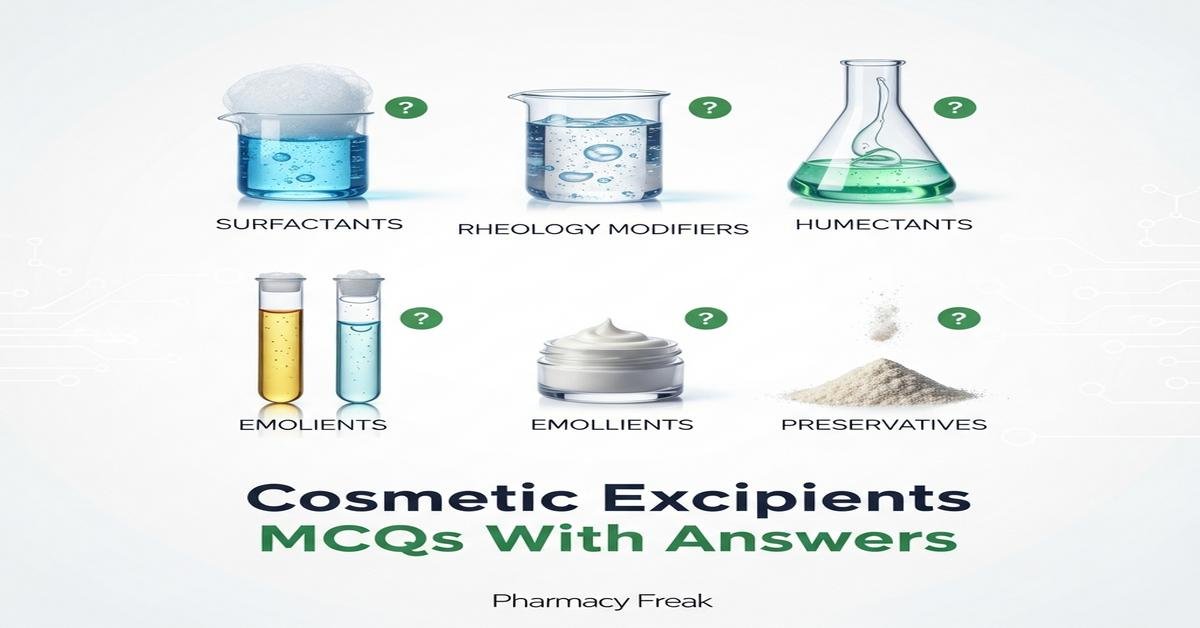
Cosmetic excipients—surfactants, rheology modifiers, humectants, emollients, and preservatives—are fundamental in topical formulation design. For B.Pharm students, mastering their functions, mechanisms and selection criteria is vital for developing safe, stable and effective products. Surfactants enable cleansing, emulsification and solubilization; rheology modifiers control viscosity, texture and spreadability; humectants attract and retain moisture; emollients restore barrier lipids and … Read more

Cosmetics as quasi and OTC drugs MCQs With Answer

Cosmetics as quasi and OTC drugs MCQs With Answer

Cosmetics as Quasi and OTC Drugs — Introduction Cosmetics, quasi‑drugs and OTC drugs occupy overlapping spaces in pharmaceutical practice, requiring B.Pharm students to understand regulatory definitions, active ingredients, labeling, quality control, stability, preservative efficacy and pharmacovigilance. This topic covers distinctions between cosmetic claims and therapeutic claims, examples like sunscreens and medicated shampoos, GMP and ISO … Read more

Evolution of cosmeceuticals from cosmetics MCQs With Answer

Evolution of cosmeceuticals from cosmetics MCQs With Answer

Introduction Cosmeceuticals represent the intersection of cosmetics and pharmaceuticals, evolving from simple beautifying products to evidence‑based topical agents with measurable biological effects. For B.Pharm students, understanding this evolution—covering active ingredients (retinoids, peptides, antioxidants), advanced delivery systems (liposomes, nanoparticles), formulation science, topical pharmacokinetics, safety, and regulatory frameworks—is essential. The field emphasizes proof of efficacy, stability testing, … Read more

Definition and classification of cosmetics as per Indian and EU regulations MCQs With Answer

Definition and classification of cosmetics as per Indian and EU regulations MCQs With Answer

Introduction: This concise guide covers the definition and classification of cosmetics under Indian regulations (Drugs & Cosmetics Act and Cosmetic Rules 2020) and the EU framework (Regulation (EC) No 1223/2009). It explains key concepts such as cosmetics definition, scope, product classification, forbidden and restricted substances (Annex II/III), permitted colorants and preservatives (Annexes IV/V), Responsible Person, … Read more

Protein kinases – role and functioning MCQs With Answer

Protein kinases – role and functioning MCQs With Answer

Protein kinases are enzymes that catalyze reversible protein phosphorylation, a key post‑translational modification controlling signal transduction, enzyme regulation, cell cycle, and apoptosis. For B. Pharm students, understanding kinase families (Ser/Thr, Tyr, dual‑specificity), structural motifs (ATP‑binding glycine loop, DFG and HRD motifs, activation loop), regulatory mechanisms (autophosphorylation, scaffolds, feedback), and pharmacology (ATP‑competitive, allosteric and covalent inhibitors, … Read more

Misregulation of signaling pathways and diseases MCQs With Answer

Misregulation of signaling pathways and diseases MCQs With Answer

Misregulation of signaling pathways underlies many human diseases, from cancer and metabolic disorders to neurodegeneration and chronic inflammation. For B. Pharm students, understanding cell signaling—receptor tyrosine kinases, GPCRs, JAK/STAT, PI3K/Akt/mTOR, Wnt, Notch and NF-κB—is essential for rational drug design, therapeutic targeting, and predicting adverse effects. Key concepts include oncogenic activation, loss of tumor suppressors (e.g., … Read more

Overview of signaling pathways MCQs With Answer

Overview of signaling pathways MCQs With Answer

Overview of signaling pathways MCQs With Answer Understanding cellular signaling pathways is essential for B. Pharm students studying pharmacology, drug action, and therapeutic targets. This set of MCQs covers core concepts such as receptor classes (GPCRs, RTKs, nuclear receptors), second messengers (cAMP, IP3/DAG, Ca2+), major cascades (MAPK, PI3K-Akt, JAK-STAT), feedback, cross-talk, receptor desensitization, endocytosis, and … Read more

Receptors for cell signals MCQs With Answer

Receptors for cell signals MCQs With Answer

Receptors for cell signals are central to pharmacology, mediating how drugs and endogenous ligands control cellular responses. This topic covers receptor families such as G-protein coupled receptors (GPCRs), receptor tyrosine kinases (RTKs), ion channel receptors, and intracellular/nuclear receptors, plus concepts like ligand binding, second messengers (cAMP, IP3/DAG, Ca2+), signal transduction, desensitization, internalization, and receptor kinetics … Read more

Cell signaling – introduction MCQs With Answer

Cell signaling – introduction MCQs With Answer

Cell signaling is the study of how cells communicate using receptors, ligands and intracellular messengers to regulate physiology and pharmacological responses. For B.Pharm students, mastering signal transduction pathways—GPCRs, receptor tyrosine kinases (RTKs), ion channels, and nuclear receptors—is essential to understand drug targets, mechanism of action, dose–response relationships, and adverse effects. Key second messengers such as … Read more

PRO
Ad-Free Access
$3.99 / month
  • ✓ No Interruptions
  • ✓ Faster Page Loads
  • ✓ Support Content Creators