Trusted by 50K+ Pharmacy StudentsHigh Quality Notes, MCQs, Mock Tests & Study ResourcesGo Premium (Ads Free)
Pharmacy Freak

Chemical incompatibilities with examples MCQs With Answer

Chemical incompatibilities with examples MCQs With Answer

Chemical incompatibilities with examples MCQs With Answer help B. Pharm students master real-world pharmaceutical science. Chemical incompatibility occurs when active ingredients or excipients react to form new products or lose potency (via oxidation, hydrolysis, precipitation, complexation, photolysis, acid–base reactions), unlike physical incompatibility (e.g., sorption, phase separation) or therapeutic incompatibility (pharmacodynamic). Key concepts include pH control, … Read more
Physical incompatibilities with examples MCQs With Answer

Physical incompatibilities with examples MCQs With Answer

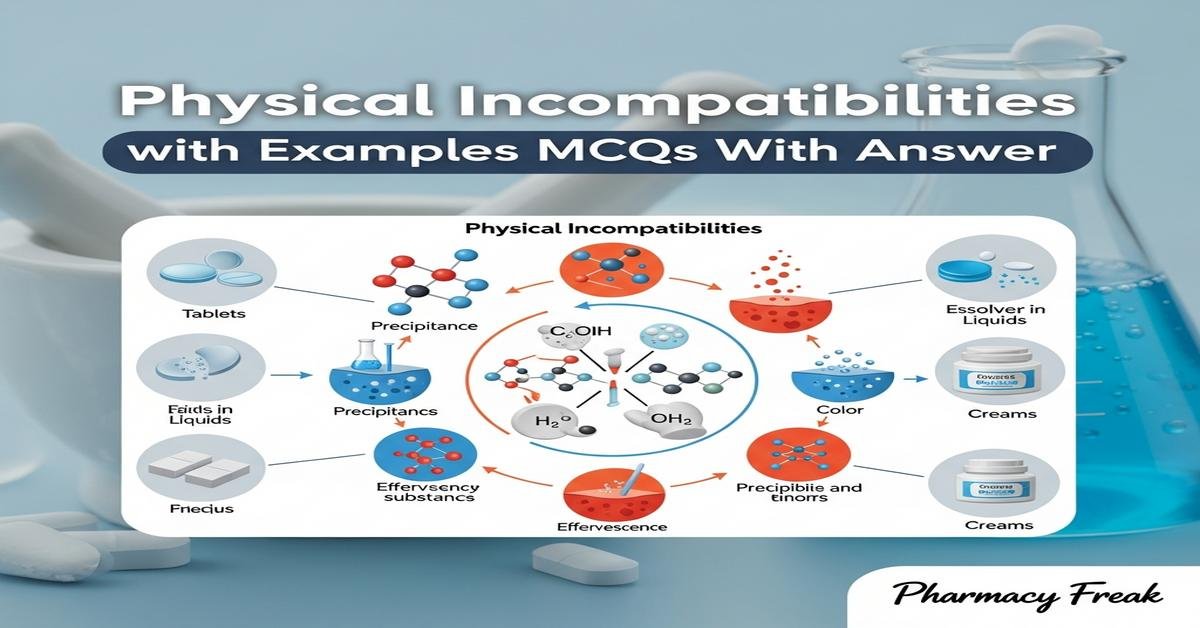
Introduction Physical incompatibilities in pharmaceutics occur when ingredients interact without chemical change but still compromise quality—through precipitation, immiscibility, caking, creaming, eutectic formation, sorption/adsorption, and phase separation. Understanding mechanisms like co-solvent dilution precipitation, pH-induced insolubility, salting out, Ostwald ripening, and deliquescence is essential for B. Pharm students involved in extemporaneous compounding, IV admixtures, and formulation stability. … Read more

Pharmaceutical incompatibilities – definition and classification MCQs With Answer

Pharmaceutical incompatibilities – definition and classification MCQs With Answer

Introduction Pharmaceutical incompatibilities are undesirable physical, chemical, or therapeutic interactions that occur when drugs and excipients are combined, leading to loss of stability, efficacy, or safety. Understanding the definition and classification of incompatibilities—physical (precipitation, liquefaction), chemical (hydrolysis, oxidation, complexation), and therapeutic (pharmacodynamic/pharmacokinetic)—is essential for B. Pharm students involved in dispensing, extemporaneous compounding, and IV admixtures. … Read more

Pharmaceutical incompatibilities – definition and classification MCQs With Answer

Pharmaceutical incompatibilities occur when drug and excipient components interact to cause undesirable changes in a formulation’s stability, safety, or efficacy. For B. Pharm students, understanding the definition, classification, mechanisms, and prevention of incompatibilities is vital in dispensing, compounding, and product development. Key types include physical incompatibilities (precipitation, liquefaction, sorption), chemical incompatibilities (hydrolysis, oxidation, complexation), and … Read more

Evaluation of suppositories MCQs With Answer

Evaluation of suppositories MCQs With Answer

Introduction: Evaluation of suppositories is a key B. Pharm competency that connects formulation science with therapeutic performance. This topic focuses on quality control tests such as appearance, weight variation, content uniformity, displacement value, softening/liquefaction time, disintegration and dissolution, in vitro drug release, mechanical strength (breaking/brittleness), and stability (rancidity, syneresis, polymorphism). You will relate base properties … Read more

Displacement value and calculations MCQs With Answer

Displacement value and calculations MCQs With Answer

Introduction Displacement value (DV) is a core concept in pharmaceutical calculations for B. Pharm students, especially in compounding suppositories and pessaries. Also known as the density factor, DV quantifies the weight of drug that displaces 1 g of base, enabling accurate estimation of base displaced and base required. Mastery of DV helps you calculate mold … Read more

Methods of preparation of suppositories MCQs With Answer

Methods of preparation of suppositories MCQs With Answer

Introduction Suppositories are solid dosage forms intended for rectal, vaginal, or urethral administration, prepared primarily by fusion (molding), compression, or hand-rolling. For B. Pharm students, mastering methods of preparation includes base selection (cocoa butter, polyethylene glycol, glycerinated gelatin), mold calibration, displacement factor calculations, tempering, lubrication, and techniques for incorporating soluble/insoluble, volatile, and thermolabile drugs. Key … Read more

Types of bases for suppositories MCQs With Answer

Types of bases for suppositories MCQs With Answer

Introduction Suppository bases are critical to formulation performance, stability, and patient comfort. B. Pharm students must understand types of suppository bases—oleaginous (fatty) bases like cocoa butter and hard fats, water-soluble/miscible bases such as polyethylene glycol (PEG) and glycerinated gelatin, and water-dispersible emulsifying bases. Key concepts include melting behavior vs dissolution, polymorphism (especially of cocoa butter), … Read more

Advantages and disadvantages of suppositories MCQs With Answer

Advantages and disadvantages of suppositories MCQs With Answer

Introduction: Advantages and Disadvantages of Suppositories MCQs With Answer Suppositories are solid dosage forms intended for rectal, vaginal, or urethral delivery, offering local and systemic effects. Key advantages include partial avoidance of first-pass metabolism, suitability for pediatric/geriatric patients, use during vomiting or dysphagia, and targeted therapy for hemorrhoids, proctitis, or vaginal infections. Disadvantages include variable … Read more

Suppositories – definition and types MCQs With Answer

Suppositories – definition and types MCQs With Answer

Introduction Suppositories are solid dosage forms inserted into the rectal, vaginal, or urethral cavity, where they melt, soften, or dissolve to provide local or systemic effects. For B. Pharm students, understanding the definition, classification by route, base types (fatty/oleaginous, water-soluble/miscible), and release mechanisms is essential. Key bases include cocoa butter (theobroma oil), glycerinated gelatin, polyethylene … Read more

PRO
Ad-Free Access
$3.99 / month
  • No Interruptions
  • Faster Page Loads
  • Support Content Creators