Trusted by 50K+ Pharmacy StudentsHigh Quality Notes, MCQs, Mock Tests & Study ResourcesGo Premium (Ads Free)
Pharmacy Freak

Applications of plant tissue culture in pharmacognosy MCQs With Answer
Applications of plant tissue culture in pharmacognosy MCQs With Answer

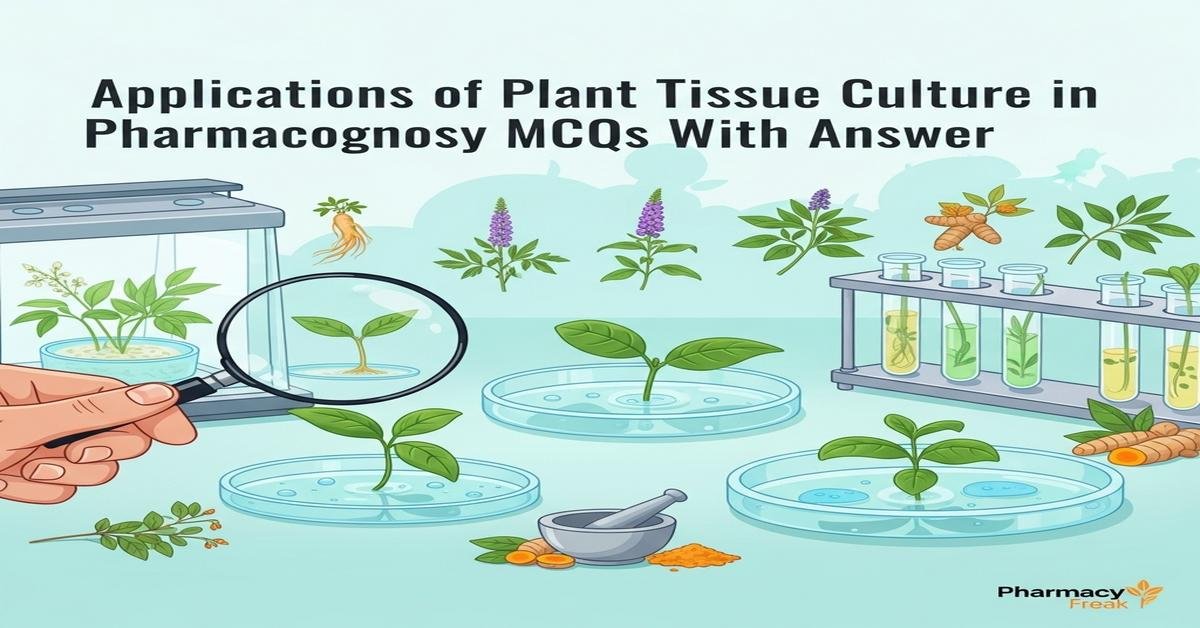
Plant tissue culture provides in vitro methods widely used in pharmacognosy to produce, modify, and standardize plant-derived drugs. Key applications include micropropagation, callus and cell suspension cultures, hairy root systems, and synthetic seeds for germplasm conservation and sustainable biosynthesis of secondary metabolites. These techniques support drug discovery, metabolite enhancement via elicitation, genetic improvement, and quality … Read more

Growth and maintenance of tissue cultures MCQs With Answer

Growth and maintenance of tissue cultures MCQs With Answer

Growth and maintenance of tissue cultures MCQs With Answer is a focused resource for B. Pharm students covering practical and theoretical aspects of in vitro cell culture. It introduces sterile technique, media composition, serum roles, primary versus continuous cell lines, passaging, and growth kinetics. Key lab skills such as aseptic handling, trypsinization, cryopreservation, CO2 incubation, … Read more

Nutritional requirements in plant tissue culture MCQs With Answer

Nutritional requirements in plant tissue culture MCQs With Answer

Nutritional requirements in plant tissue culture MCQs With Answer Understanding the nutritional requirements in plant tissue culture is essential for B. Pharm students studying plant biotechnology, pharmacognosy, and drug discovery. This introduction covers culture media composition, essential macronutrients (N, P, K, Ca, Mg, S), micronutrients (Fe, Mn, Zn, Cu, B, Mo), carbon sources, vitamins (thiamine, … Read more

Types of plant tissue cultures MCQs With Answer

Types of plant tissue cultures MCQs With Answer

Plant tissue culture is a vital biotechnology tool for B.Pharm students, linking in vitro techniques to drug discovery, micropropagation, and secondary metabolite production. This concise, keyword-rich overview on Types of plant tissue cultures MCQs With Answer covers callus culture, suspension culture, organogenesis, somatic embryogenesis, protoplast and anther culture, hairy root culture, meristem culture, synthetic seeds, … Read more

Historical development of plant tissue culture MCQs With Answer

Historical development of plant tissue culture MCQs With Answer

Historical development of plant tissue culture traces key discoveries that transformed in vitro plant science into a tool for pharmacy and biotechnology. From Haberlandt’s concept of cellular totipotency to the practical media innovations of Murashige and Skoog, milestones include callus culture, somatic embryogenesis, micropropagation, protoplast techniques and bioreactor scale‑up. Understanding pioneers, media composition, plant growth … Read more

Conservation of medicinal plants MCQs With Answer

Conservation of medicinal plants MCQs With Answer

Conservation of medicinal plants is a vital subject for B.Pharm students, linking pharmacology, biodiversity and sustainable healthcare. This topic covers in-situ and ex-situ conservation, sustainable harvesting, cultivation practices, seed banks, tissue culture, cryopreservation, and genetic resource management. Understanding ethnobotany, phytochemical variation, germplasm conservation, and legal frameworks such as CITES and the Nagoya Protocol helps pharmacists … Read more

Hybridization in medicinal plants MCQs With Answer

Hybridization in medicinal plants MCQs With Answer

Hybridization in medicinal plants combines classical breeding and modern biotechnology to develop hybrids with enhanced phytochemical content, disease resistance, and yield for pharmaceutical production. B. Pharm students should grasp controlled crosses, emasculation, cytoplasmic male sterility, heterosis (hybrid vigor), somatic hybridization (protoplast fusion), embryo rescue, and polyploidy, plus evaluation tools like marker-assisted selection, chemotyping, SSR/SNP markers, … Read more

Mutation in medicinal plants MCQs With Answer

Mutation in medicinal plants MCQs With Answer

Introduction: Mutation in medicinal plants explores induced genetic changes to improve yield, stability, and concentration of pharmacologically active secondary metabolites. For B.Pharm students, understanding mutagenesis—physical (radiation), chemical (EMS, MNNG), and molecular approaches (TILLING, CRISPR-assisted mutation)—is essential for pharmaceutical plant improvement, phytochemical enhancement, and quality control. Topics include mutation types (point, insertion, deletion, chromosomal), screening methods … Read more

Polyploidy in medicinal plants MCQs With Answer

Polyploidy in medicinal plants MCQs With Answer

Polyploidy in medicinal plants is the condition of having extra chromosome sets that influences genetics, morphology and biosynthesis of therapeutic compounds. For B.Pharm students, mastering polyploidy links cytogenetics, pharmacognosy and plant biotechnology: definitions (autopolyploidy, allopolyploidy), induction methods (colchicine, oryzalin, tissue culture), detection techniques (flow cytometry, karyotyping, stomatal and pollen analysis) and pharmaceutical impacts on alkaloid, … Read more

Plant hormones and their applications MCQs With Answer

Plant hormones and their applications MCQs With Answer

Introduction: Plant hormones (phytohormones) like auxin, gibberellin, cytokinin, ethylene, abscisic acid, jasmonic acid and salicylic acid regulate growth, development and secondary metabolite production. For B. Pharm students, understanding their biosynthesis, signaling mechanisms (e.g., TIR1, GID1, PYR/PYL), transport (polar auxin transport), synthetic analogs (2,4‑D, NAA, BAP) and inhibitors (NPA, paclobutrazol) is essential for pharmacognosy, tissue culture, … Read more

PRO
Ad-Free Access
$3.99 / month
  • ✓ No Interruptions
  • ✓ Faster Page Loads
  • ✓ Support Content Creators