Trusted by 50K+ Pharmacy StudentsHigh Quality Notes, MCQs, Mock Tests & Study ResourcesGo Premium (Ads Free)
Pharmacy Freak

Chemical properties of drugs MCQs With Answer

Chemical properties of drugs MCQs With Answer

Chemical properties of drugs determine how a molecule behaves in formulation, biological media, and during storage. For B.Pharm students, mastering concepts such as pKa, lipophilicity (logP/logD), solubility, ionization, chemical stability (hydrolysis, oxidation, photodegradation), tautomerism, stereochemistry, and salt formation is essential for rational drug design, pharmacokinetics, and formulation development. Understanding partitioning, buffer effects, polymorphism, and excipient … Read more
Polymorphism in drug substances MCQs With Answer

Polymorphism in drug substances MCQs With Answer

Polymorphism in drug substances MCQs With Answer Polymorphism in drug substances refers to the ability of a single pharmaceutical compound to exist in multiple crystalline forms, each with distinct physical properties. Understanding polymorphism is vital for B. Pharm students because different polymorphs can alter solubility, dissolution rate, stability, melting point, and bioavailability, affecting formulation and … Read more

Solubility profile – pKa, pH, partition coefficient MCQs With Answer

Solubility profile – pKa, pH, partition coefficient MCQs With Answer

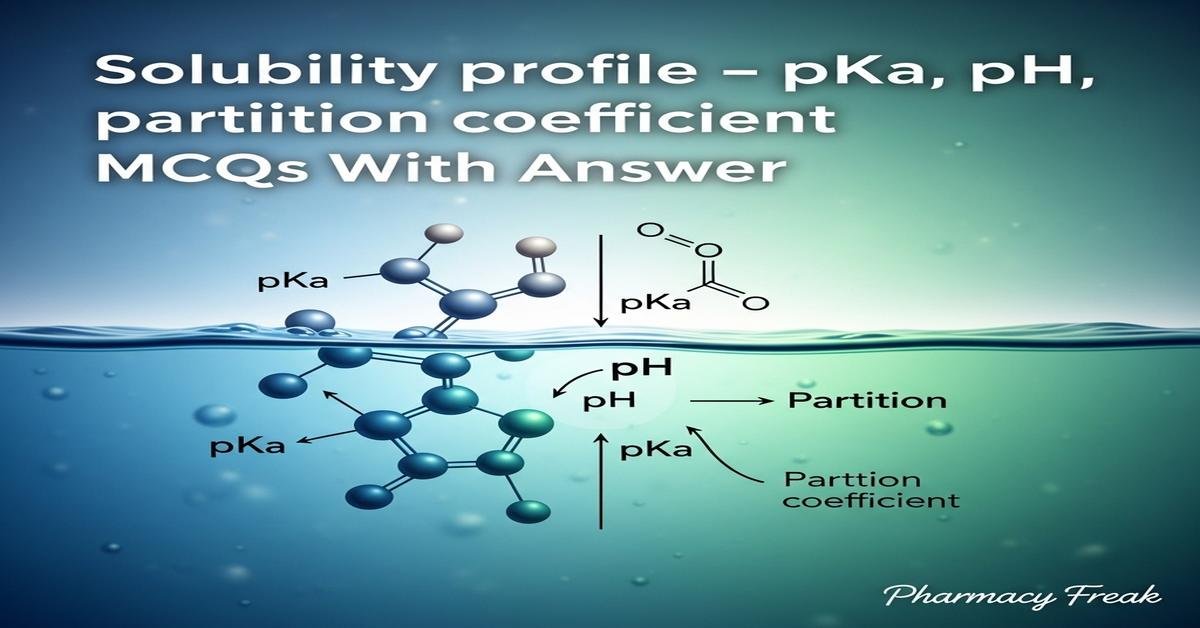
Understanding the solubility profile of drugs—how pKa, pH, and partition coefficient influence solubility and permeability—is essential for B. Pharm students. This introduction covers key concepts like ionization, Henderson-Hasselbalch relationships, log P and log D (lipophilicity), pH-dependent solubility curves, salt formation, and formulation strategies to enhance bioavailability. You will learn experimental methods (shake‑flask, potentiometric titration) and … Read more

Flow properties of powders MCQs With Answer

Flow properties of powders MCQs With Answer

Flow properties of powders are vital in pharmaceutical formulation and processing, influencing blending, granulation, tablet compression, capsule filling and inhalation delivery. B. Pharm students must understand how particle size, shape, surface texture, moisture, cohesion, density and size distribution govern powder flow. Key measurements include angle of repose, bulk and tapped density, Carr’s index, Hausner ratio, … Read more

Particle size and shape MCQs With Answer

Particle size and shape MCQs With Answer

Particle size and shape MCQs With Answer is an essential topic for B. Pharm students focused on how particle size, particle shape, and particle size distribution influence drug formulation, stability, dissolution rate, powder flow, and bioavailability. Understanding granulometry techniques (sieving, laser diffraction, microscopy), specific surface area (BET), aerodynamic diameter, and concepts like agglomeration, aggregation, and … Read more

Crystalline and amorphous forms MCQs With Answer

Crystalline and amorphous forms MCQs With Answer

Crystalline and amorphous forms profoundly influence drug solid-state behavior, stability, and bioavailability — essential concepts for B. Pharm students. Crystalline solids display long-range order, defined lattice energy, sharp melting points, and characteristic X-ray diffraction peaks, while amorphous forms possess disordered molecular arrangements, a glass transition, higher free energy, enhanced apparent solubility, and greater physical instability. … Read more

Physical properties of drugs MCQs With Answer

Physical properties of drugs MCQs With Answer

Understanding the physical properties of drugs is essential for B.Pharm students involved in drug formulation, stability assessment, and drug delivery design. This concise overview highlights key concepts including solubility, dissolution rate, partition coefficient (log P/log D), pKa and pH-dependent ionization, polymorphism, melting point, hygroscopicity, particle size, surface tension, and solid-state behavior. Mastery of these properties … Read more

Physicochemical characteristics of drug substances MCQs With Answer

Physicochemical characteristics of drug substances MCQs With Answer

Understanding the physicochemical characteristics of drug substances is essential for B. Pharm students involved in formulation, stability, and biopharmaceutics. This concise overview highlights key properties — solubility, pKa, partition coefficient (log P/log D), dissolution rate, polymorphism, crystal habit, melting point, hygroscopicity, and chemical stability — and explains their impact on absorption, bioavailability, drug–excipient compatibility, and … Read more

Goals and objectives of preformulation studies MCQs With Answer

Goals and objectives of preformulation studies MCQs With Answer

Preformulation studies establish the foundational data needed to design safe, effective pharmaceutical products. For B. Pharm students, understanding the goals and objectives of preformulation is essential: characterizing physicochemical properties, assessing stability, evaluating solubility and dissolution, determining pKa and partition coefficient, and studying drug-excipient compatibility. These studies guide salt selection, polymorph screening, particle size optimization, and … Read more

Introduction to preformulation MCQs With Answer

Introduction to preformulation MCQs With Answer

Introduction to preformulation MCQs With Answer This focused introduction to preformulation MCQs with answers guides B.Pharm students through essential preformulation concepts such as drug solubility, pKa, partition coefficient, polymorphism, stability, particle size, excipient compatibility and analytical techniques (DSC, XRD, FTIR). Emphasis is placed on physicochemical characterization, dissolution behavior, degradation pathways and formulation-relevant parameters like hygroscopicity, … Read more

PRO
Ad-Free Access
$3.99 / month
  • ✓ No Interruptions
  • ✓ Faster Page Loads
  • ✓ Support Content Creators