Trusted by 50K+ Pharmacy StudentsHigh Quality Notes, MCQs, Mock Tests & Study ResourcesGo Premium (Ads Free)
Pharmacy Freak

Ethambutol – mechanism of action MCQs With Answer

Ethambutol – mechanism of action MCQs With Answer

Ethambutol – mechanism of action MCQs With Answer Ethambutol is a first-line antitubercular agent important for B.Pharm students to understand, particularly its mechanism of action and clinical implications. It is a bacteriostatic inhibitor of mycobacterial cell wall biosynthesis that targets arabinosyl transferases (Emb proteins), blocking arabinogalactan polymerization and weakening the mycobacterial cell envelope. Key topics … Read more
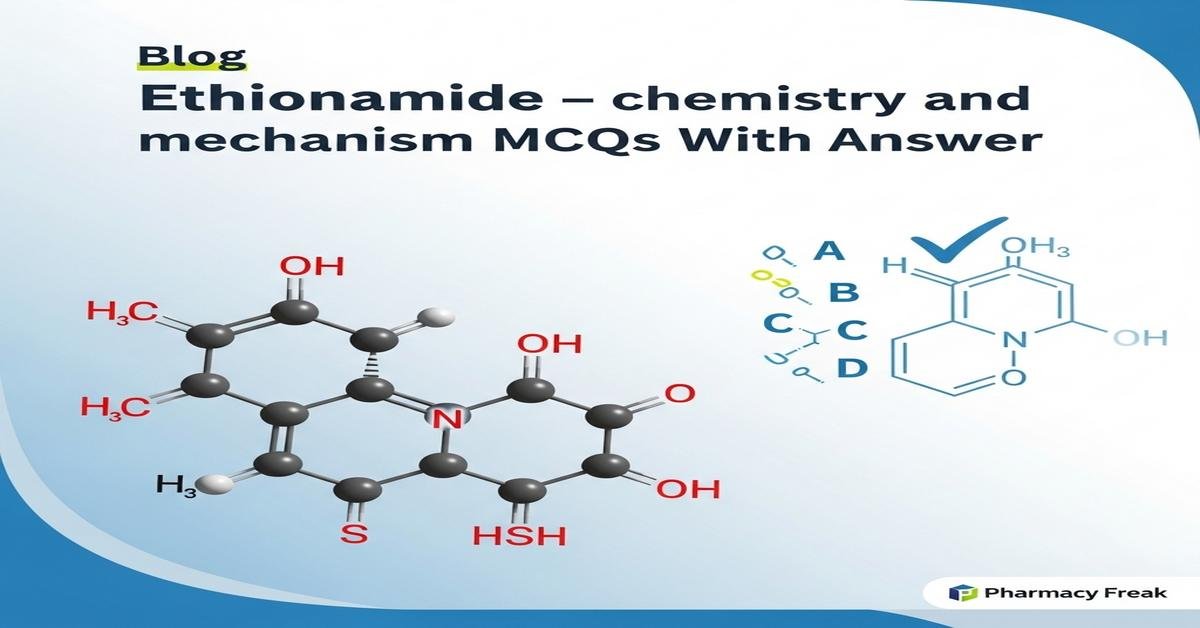
Ethionamide – chemistry and mechanism MCQs With Answer

Ethionamide – chemistry and mechanism MCQs With Answer

Ethionamide – Chemistry and Mechanism MCQs With Answer Ethionamide is a second-line anti-tubercular thioamide whose chemistry and mechanism are essential for B.Pharm students studying drug action and resistance. This introduction covers ethionamide’s chemical class, prodrug activation by EthA monooxygenase, and inhibition of mycolic acid synthesis via InhA (enoyl-ACP reductase) NAD-adduct formation. Key topics include structure–activity … Read more

Isoniazid – synthesis and mechanism MCQs With Answer

Isoniazid – synthesis and mechanism MCQs With Answer

Isoniazid (INH) is a cornerstone antitubercular prodrug used in first-line therapy for tuberculosis. This concise introduction covers INH’s chemical synthesis, activation by mycobacterial catalase-peroxidase (KatG), inhibition of mycolic acid biosynthesis via InhA, and clinically relevant pharmacokinetics and toxicity. Key concepts include acetylation by NAT2 (fast/slow acetylators), mechanisms of resistance, hepatotoxicity, peripheral neuropathy from pyridoxine depletion, … Read more

Synthetic antitubercular agents – classification and SAR MCQs With Answer

Synthetic antitubercular agents – classification and SAR MCQs With Answer

Understanding synthetic antitubercular agents is essential for B. Pharm students studying drug design, classification, and structure-activity relationships (SAR). This concise module covers major synthetic and semi-synthetic antitubercular classes — isoniazid, ethambutol, pyrazinamide, fluoroquinolones, cycloserine, para-aminosalicylic acid, bedaquiline, delamanid and others — linking chemical scaffolds to mechanisms of action, activation (prodrugs), resistance mechanisms, pharmacophore features, lipophilicity … Read more

Miscellaneous antimalarials – Pyrimethamine, Artesunate, Artemether, Atovoquone MCQs With Answer

Miscellaneous antimalarials – Pyrimethamine, Artesunate, Artemether, Atovoquone MCQs With Answer

Miscellaneous antimalarials such as Pyrimethamine, Artesunate, Artemether and Atovoquone (Atovaquone) are essential for B. Pharm students studying antimalarial pharmacotherapy. This concise introduction highlights mechanisms of action, pharmacokinetics, clinical indications, adverse effects, resistance mechanisms and key drug interactions for pyrimethamine–sulfonamide regimens, artemisinin derivatives and atovaquone-containing therapies. Emphasis is placed on dosing principles, combination strategies (to prevent … Read more

Biguanides and dihydrotriazines – Cycloguanil and Proguanil MCQs With Answer

Biguanides and dihydrotriazines – Cycloguanil and Proguanil MCQs With Answer

Biguanides and dihydrotriazines — Cycloguanil and Proguanil MCQs With Answer Biguanides and dihydrotriazines, exemplified by proguanil and its active metabolite cycloguanil, are key antimalarial agents covered in B. Pharm courses. This introduction summarizes chemical class, mechanism of action (DHFR inhibition), bioactivation of proguanil to cycloguanil via CYP2C19, pharmacokinetics, resistance due to plasmodial DHFR mutations, clinical … Read more

Quinacrine hydrochloride and Mefloquine MCQs With Answer

Quinacrine hydrochloride and Mefloquine MCQs With Answer

Quinacrine hydrochloride and Mefloquine MCQs With Answer — This concise introduction highlights essential pharmacology for B. Pharm students: quinacrine (mepacrine, Atabrine) and mefloquine are antimalarial agents with distinct mechanisms, pharmacokinetics, indications, adverse effects, and resistance profiles. Key topics include mechanisms (DNA intercalation and inhibition of hemozoin formation), long half-life and lipophilicity of mefloquine, neuropsychiatric and … Read more

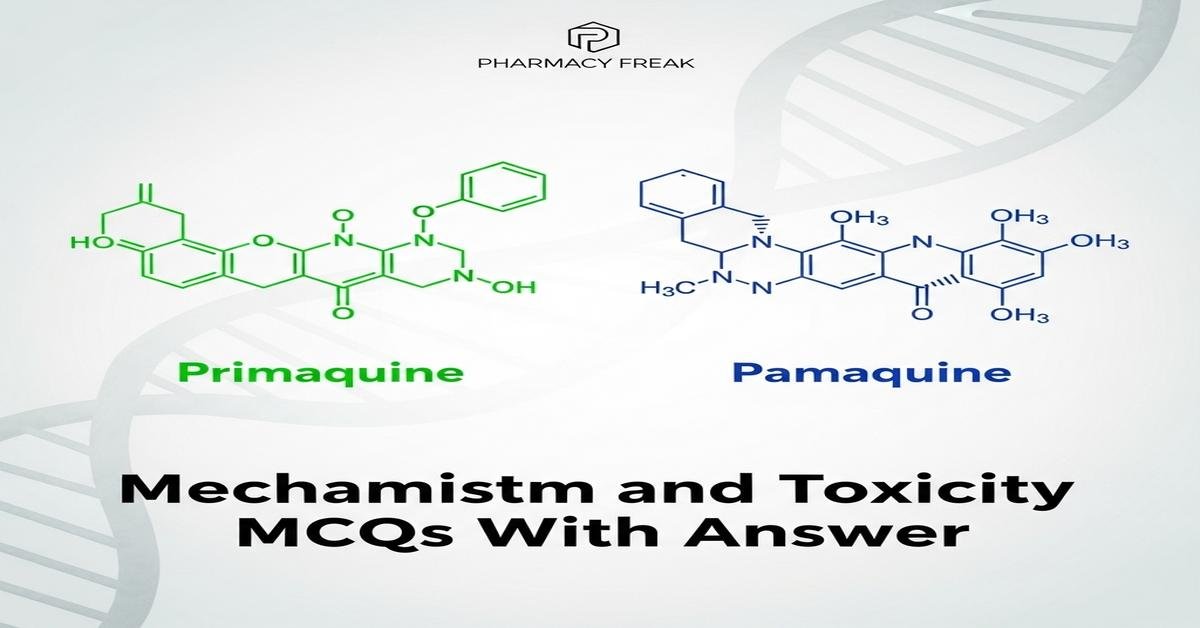
Primaquine and Pamaquine – mechanism and toxicity MCQs With Answer

Primaquine and Pamaquine – mechanism and toxicity MCQs With Answer

Introduction Primaquine and pamaquine are 8‑aminoquinoline antimalarials important in the pharmacology curriculum for B. Pharm students. This topic covers mechanism of action — hepatic bioactivation to oxidative metabolites that target hypnozoites and gametocytes — and key toxicity issues including hemolysis in G6PD deficiency, methemoglobinemia, gastrointestinal effects, and drug interactions (notably CYP2D6-related activation). Understanding pharmacokinetics, contraindications … Read more

Amodiaquine – chemistry and use MCQs With Answer

Amodiaquine – chemistry and use MCQs With Answer

Amodiaquine – chemistry and use MCQs With Answer Amodiaquine is a 4‑aminoquinoline antimalarial used mainly in combination therapy for uncomplicated Plasmodium falciparum malaria. This introduction covers amodiaquine’s chemical class, structural relation to chloroquine, biotransformation to the active metabolite desethylamodiaquine, CYP2C8‑mediated metabolism, mechanism of action (inhibition of hemozoin formation), pharmacokinetics, adverse effects such as hepatotoxicity and … Read more

Chloroquine – synthesis and resistance MCQs With Answer

Chloroquine – synthesis and resistance MCQs With Answer

Chloroquine – synthesis and resistance MCQs With Answer Chloroquine is a classic 4‑aminoquinoline antimalarial widely studied in medicinal chemistry and clinical pharmacy. This introduction covers chloroquine’s quinoline core synthesis (Skraup/Friedländer routes, introduction of 4‑chloro intermediate and nucleophilic side‑chain substitution), structure‑activity relationships (essential 4‑amino group, diethylamino side chain), pharmacokinetics, metabolism to desethylchloroquine, mechanism of action (inhibition … Read more

PRO
Ad-Free Access
$3.99 / month
  • ✓ No Interruptions
  • ✓ Faster Page Loads
  • ✓ Support Content Creators